
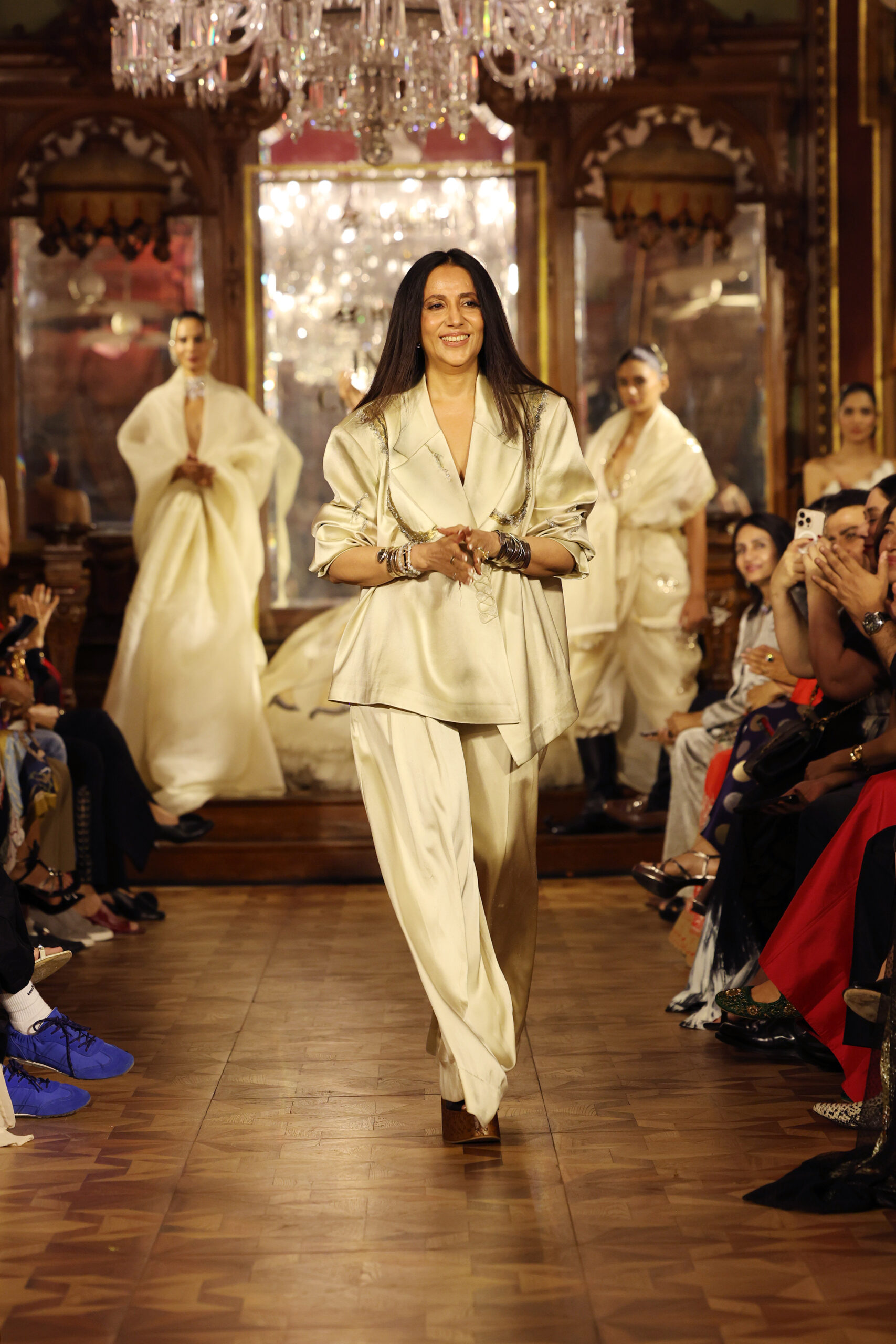
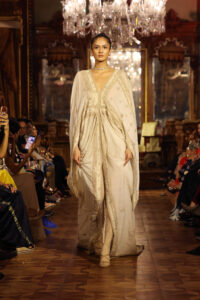
From Barmer textiles to Kalighat‘s Pat Chitra Katha, folk art, Anamika Khanna says craft can be minus its ethnicity, as couture offers patchwork, hand painting to gold foiling at the “pearl in the sky” Falaknuma Palace, Hyderabad.
By Asmita Aggarwal
It has turned into a favoured spot for designers—maybe it reeks of history going back in time, 1893, an ode to sheer luxe by Nawab Viqar-ul-Umra, Falaknuma Palace, Hyderabad translates to “Like the Sky” in Urdu. Anamika Khanna believed it was perfect, as Delhi and Mumbai as venues were done enough. She thought of Jaipur Palace, with Princess Diya Kumari Foundation, but finally narrowed down on Falaknuma-maybe it’s the walnut roof, shaped majestically like a scorpion, that serenaded her.
Hundred and eight craftswomen is a number that has been rotating in her head, artisans she wants to support, who indulge in intricacies of age-old techniques which have withstood the test of time. “I knew the importance of being financially independent being a woman, I observed a lot of craft is getting redundant. Artisans neither get money nor respect. I’m working with craft clusters dominated by women-mirror work to embroidery,” says Anamika.
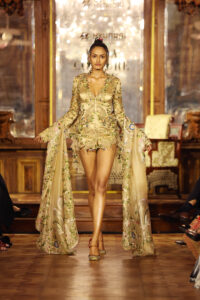
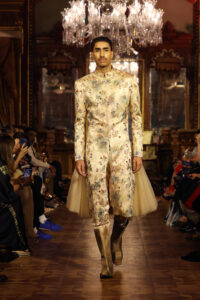
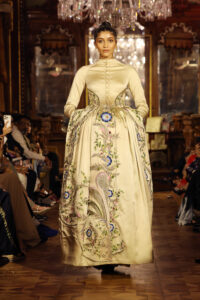
Couture is not about how you look in something but the feeling you get, richness of thought, “not perfect construction, hand craft,” she laughs, “if you ask me about my first show ever I will say I didn’t know anything, but one thing I can confirm is India is in my heart, and my experimentation is on for last 30 years. Craft is global, not Indian anymore. Fashion comes full circle for me as I take it out to a universal audience.”
Honestly, she says, the mistake she has often made is overdoing it, making it into a wedding show, “couture is about precision, refinement and intricacy. I want women to wear couture with their faded jeans, on a daily basis, not relegated to just weddings,” she confirms, adding, you notice carefully, stacked oxidised jewellery or even precious jewellery she has designed this year, it is more about styling, minus ethnicity.
“I love Tarun Tahiliani’s sensuous drapes, Abu-Sandeep’s embroideries that no one can do like them, or Gaurav Gupta no one can touch that space. When you show in Paris it takes the oxygen out of you, so hats off to them,” she giggles.

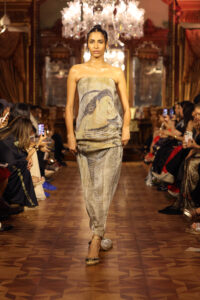
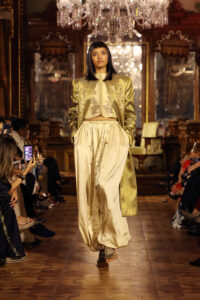
If you look around so many Anamika copies floating in the market, it saddens her, “I don’t see creativity in people pushing the bar, social media in some ways is to blame. For me couture can have trends, it is not classic, it is heading in the experimental direction, where there are no rules of materiality.”
On the other hand, is a young Vishesh, her son, returned from Central Saint Martins, two months ago, with an MA in fashion design; he is brimming with a new era for the label, admits, “it’s AK’s vision and aesthetics, I urge her to make couture minimal and digestible.”
Vishesh on a Sunday morning is rushing with his mom, to the factory it’s a herculean task to get the show on the road. He shares some beautiful pictures on whatsapp (which disappear as soon as you open them: so you can’t take screenshots). “I learnt from CSM menswear is about construction, finish and wearability, reducing embellishments,” he says. Outside India couture is simpler, but Jains and Marwaris when they come, they feel “it’s not enough, they need more, feel royal, get value for money”.
Fabio Piras, MA Fashion Course Director, Central Saint Martins, London, United Kingdom has trained Christopher Kane to Simone Rocha, “When I took pieces I designed to him, he told me it’s too old fashioned. He taught me a progressive way of thinking, and then AK’s way of doing things is a 360 degree turn—grandeur, embellishment,” he laughs, adding “AK is open to ideas”.
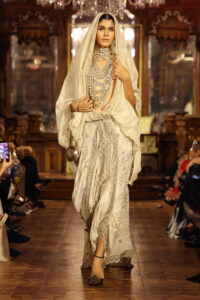
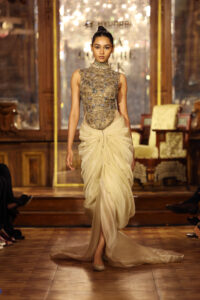
He finds Demna Gvasalia extremely interesting in what he did with Balenciaga, quite a departure from Peter Piccioli Balenciaga, it wasn’t about volume or larger-than-life. The shapes were to make women feel strong, not delicate like Karl Lagerfeld and his women in gloves. “They would tell us if you want to make money, sell 100 pound tee shirts, go to LCF,” he chuckles, adding studying with bootstrapped struggling students was insightful.
He learnt one idea in 6 different ways rather than 6 ideas in one collection, “let collection flow like music” he says. The world has changed since AK started, then her line was restricted to only 100 people watching now zillions judge her. “Mistakes are more pronounced. She has made Barmer textiles her own like the Kalighat temple paintings, in Patro chitra katha, from Kolkata,” he explains.
The Meghwal community in Rajasthan that AK worked with is known for various types of embroidery—Ari embroidery to Mukke ka kaam is a type of raised and padded embroidery, creating a three-dimensional effect.
AK is not going to go the Robert Wun way, big structures, it has to be her spirit in her line, just as “elegant, understated, that she is, that’s why the collection ‘Moonlight Kingdom’ is more vintage-y and old world,” he concludes.