
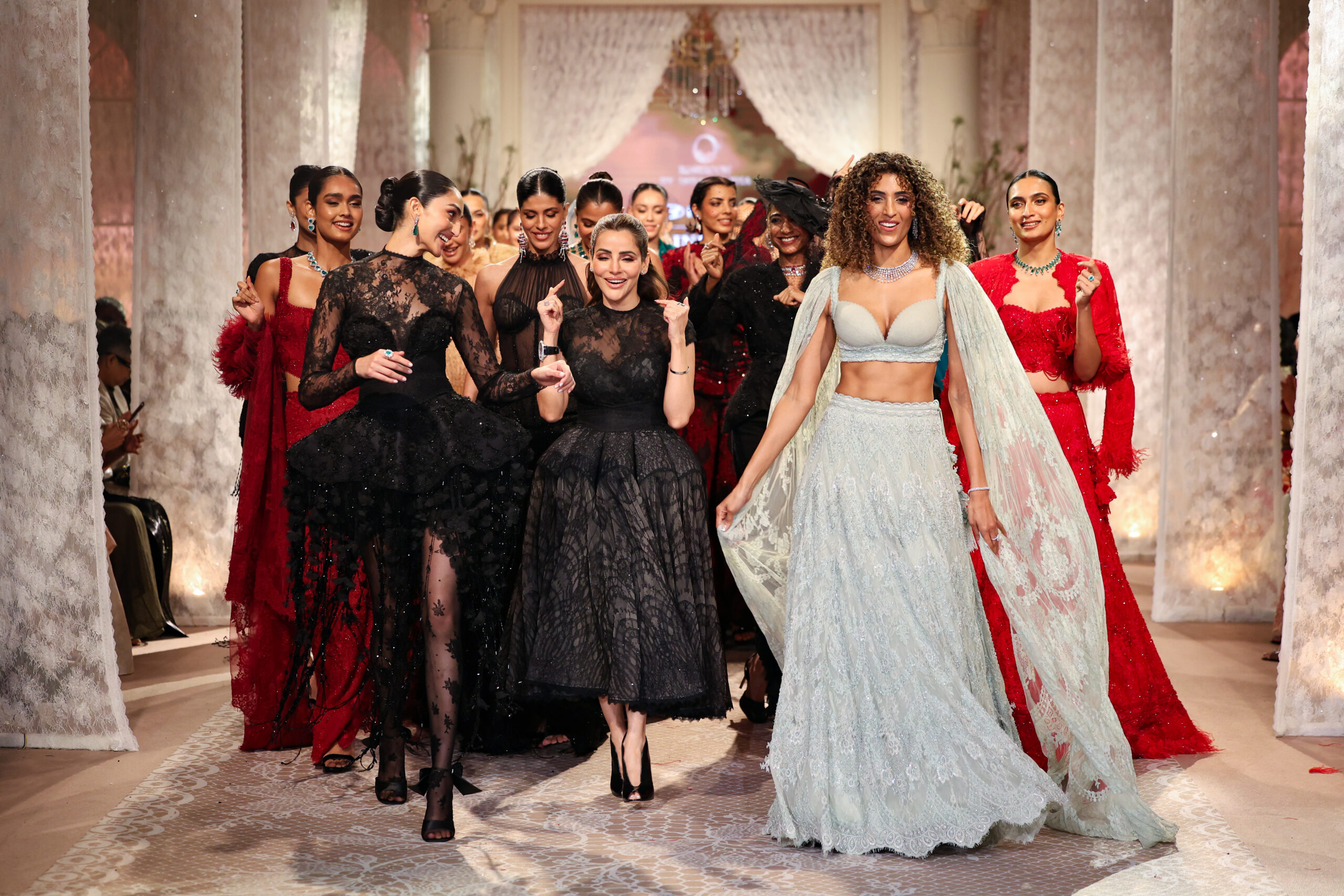
Women from marginalized jhuggis, craft lace pearl flowers for Isha Jajodia’s ICW line, as she offers clay embroidery, metal corsets and lace applique for a quieter, more self-assured bride.
By Asmita Aggarwal
She is known for delicate laces, her outfit for the Cannes red carpet was a hit, the 1100 hours of handwork showcased India’s prowess in gossamer embroideries. It was an invitation by Caroline Scheufele, co-President and Artistic Director of Chopard, which Isha Jajodia initially ignored, but later took it as a challenge to put our country’s artisans on the world map.
“I’m minimalistic, I wanted to keep lace as the hero, it was a technically heavy gown, styled with a pear-shaped diamond necklace by Chopard. From antique-inspired lacework, tulle, organza, applique, corsetry, and controlled volume it channelled my inner spirit,” she adds, admitting faux feathers added extra appeal.
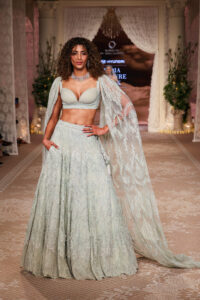
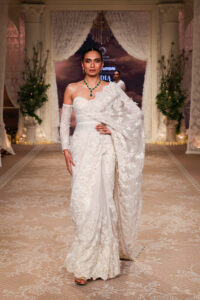
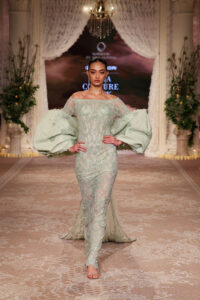
The idea was to depict softness and strength, opposing qualities a woman holds in her heart, as there are layers of responsibility she shoulders, showcasing the depth of her persona. We aren’t just talking about the affluent, but Isha really looked at those who are living on the fringes of society like Daya Bai from Moti Lal Nehru Jhuggi clusters.
Daya, 34, works with the NGO Spread the smile, and has made beautiful hand done lace flowers, 100 of them for Isha’s sculpted gowns, “It took me four hours to make one, Isha’s didi’s team came and taught us,” she says, she got both paid and adulation for her hand work.
Daya has two kids, daughter, 13, son, 9, she wants to educate them, girl doctor, as healthcare systems are not poor oriented, and the other a lawyer. “So many hardships I’ve faced, I don’t want my kids to suffer. I work in the NGO for two hours daily, I embroider, they are helping my kids. From education, school uniforms, books, shoes, they give us,” she explains. There are almost 100 women like her working in the basti, they make tissue boxes to thali covers.
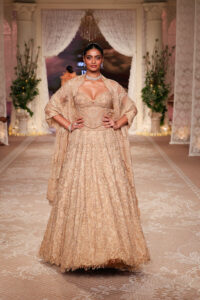
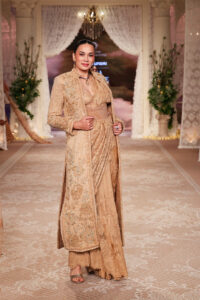
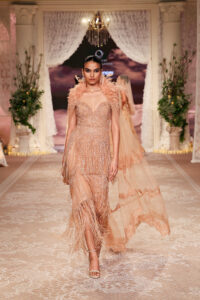
Along with her works Ratnesh, 38, who stays at the Shamshan Bhoomi jhuggi cluster, has two boys, aged 14 and 10, she doesn’t even have access to a toilet or clean water, she often has to stand in a line for basic necessities. “We come to the NGO, they give us work, we learn and make net flowers, cut, finish, embellish it with pearls. “I’ve been working here for the last 5 years, learning crochet, I’m from Uttar Pradesh, Etah where women do a long ghoonghat and are segregated from men,” she adds.
“I feel fashion must also look at those who are invisible, thus the idea of the NGO came about,” adds Isha who admits she is not what she was in 2014 when she began. “We did denim with strong embellishment, but I fell in love with lace, especially those with European appeal, as they say then there was no looking back,” she explains.
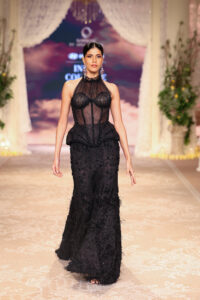
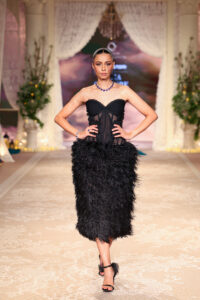
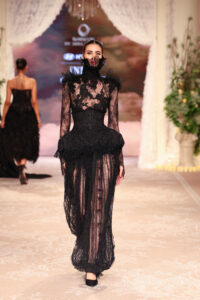
She was shocked to know that many brides, who handle heavy lehengas on their D-day, wear numbing cream so that they can’t feel the pain. Isha decided no can cans or anything big or unsettling for the bride. “Sheer, lace, fluid, soft embellishments became my language, multiple layers of lace. It’s a story told in tulle, minus any trends, ideal for a self-assured woman,” she adds. The palette is ivory, scarlet red, blush pinks and even though the belief is that sculpting isn’t for bigger women—Isha believes she gets 50 per cent women who are sumptuous. “It is tough to embroider lace as the hole is smaller. But this time, we have pushed ourselves—working with clay. It is paper light, we have crafted petals, florals in it as embellishment; surprise is also tweed with lace,” she adds. Metal corsets, with pearls, Chikankari in whispers of aqua, have been a challenge to source lace—Korea, China, Paris, Surat and Hong Kong, to this she adds Baroque influences, placing them as artworks.