
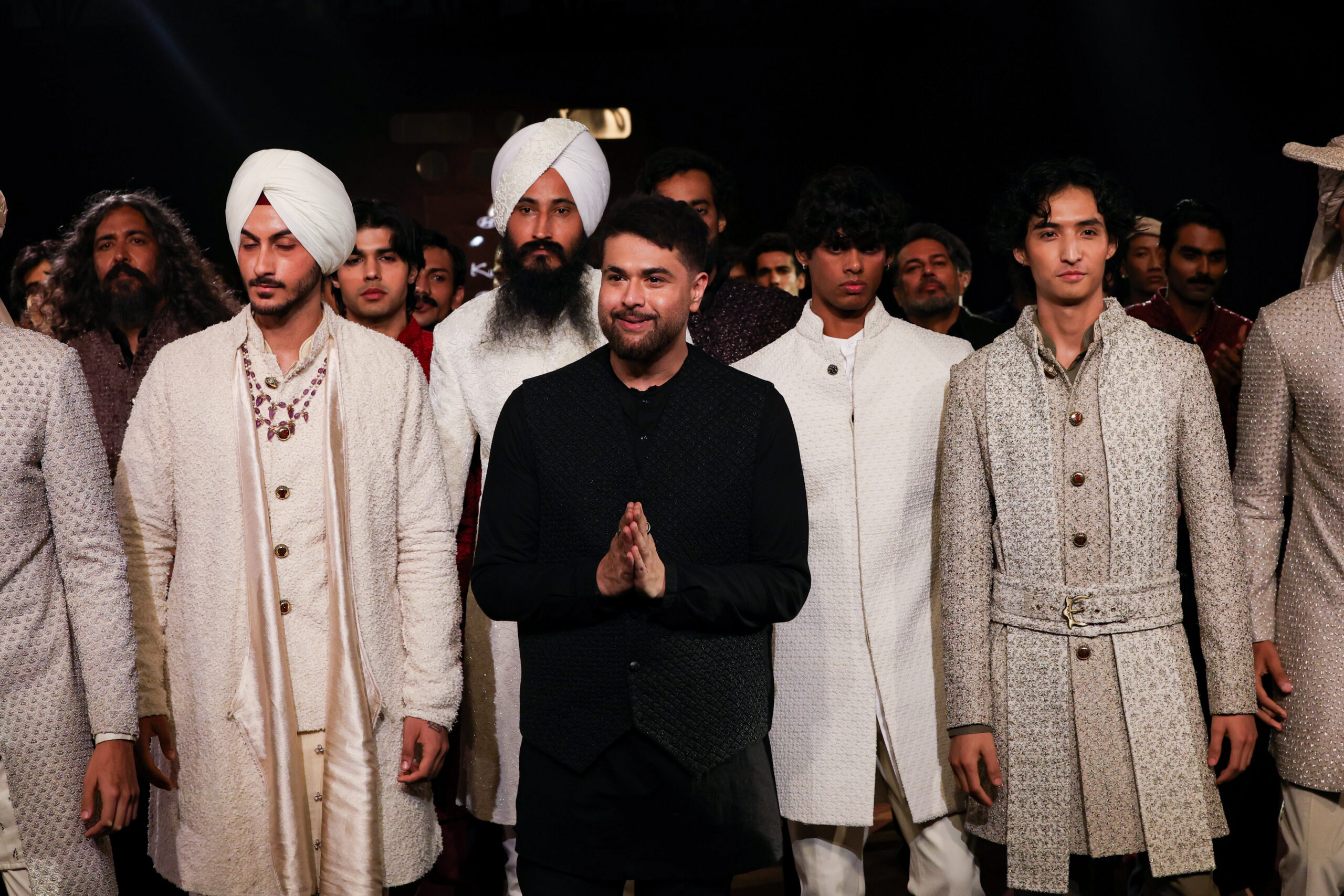
Working with Salman Khan, offbeat casting, designing music, body-cheat garment, magnet stole, sweat-absorbent linings and glow-in-the-dark details, Kunal Rawal believes interpreting Banarasi, Patola, Tangaliya or Chikankari for menswear is engaging.
By Asmita Aggarwal
He is known to have the most pulsating music on the runway, but few know that after fashion, films, music has always been Kunal Rawal’s biggest loves. His years as a costume designer also shaped the way he works, “I rarely see a garment in isolation. I imagine the room it enters, styling, light, mood and, very importantly, the sound.” He says as he gears up for the India Couture Week 2026.
When he began building the brand, he couldn’t find music that carried same energy as clothes: rooted in India, but distinctly contemporary. That became the ignition point for creating own sonic scape, drawing from folk and classical traditions, electronic music, rock-and-roll and unexpected cultural collisions. Vaari Vaarsi, for instance, played with the idea of Punjabi folk through a cowboy lens.
“As a menswear-first brand, music also allows us to extend the world of the brand beyond the people we dress. It becomes part of the celebration itself. Seeing tracks like Ishq Mitha become part of real baraats, bride- groom entries, sangeet performances and family celebrations has been incredibly humbling. The sound evolves every year, just as the clothes, and the men wearing them, do,” he adds.
He doesn’t think style can be divided neatly by geography anymore. You’ll find a tone-on-tone dresser in Delhi and Mumbai, just as you’ll find men in both cities, who appreciate zardozi, metalwork and intricate craft. The differences often come from the nature of celebration and overall vibe.
Delhi weddings tend to unfold across more occasions: musical evenings, carnivals, cocktails and larger celebrations, so the wardrobe naturally becomes broader. The city also has the advantage of winter, which opens up an entirely different conversation around layering, heavier textiles and sharper tailoring. “As a menswear designer living in Mumbai, that is something I genuinely enjoy about dressing Delhi,” he adds.
Inventor of the body-cheat garment, magnet stole, sweat-absorbent linings and glow-in-the-dark details, common thread remains comfort for him. A body-cheat garment uses proportion, layering and construction to make the wearer feel more assured without making the engineering visible. The magnet stole came from the same thinking: how do you keep a drape perfectly placed while allowing the groom to move freely through a long celebration? “Our sweat-absorbent linings are another practical response to dressing men in Indian weather. Innovation, for us, is never a gimmick. It has to improve how the garment functions,” he explains.
Craft has been an inspiring part of Kunal’s journey. He began as a contemporary menswear designer and fell in love with Indian handwork, but what fascinated him even more was the opportunity to reinterpret it for men. “Today, so many of our crafts are viewed through a womenswear lens. We’re interested in asking what Banarasi, Patola, Tangaliya or Chikankari can become when developed specifically for menswear and India today,” he confides.
That often means challenging familiar ideas, even weavers will sometimes ask, “Are you sure?” when we propose a charcoal Banarasi, an olive brocade or tone-on-tone zari instead of contrasting colours. Those conversations are the most exciting part of the process. “We aren’t trying to preserve craft exactly as it exists; we’re trying to give it another chapter, that’s what makes it fun and interesting. Sometimes that means layering Chikankari with raffia, French knots and chattai textures, or washing and reconstructing a weave until it feels entirely new, and sometimes even unrecognizable,” he says.
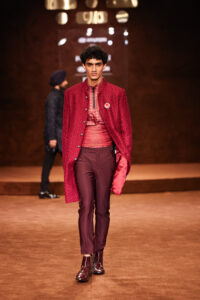
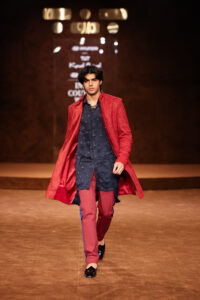
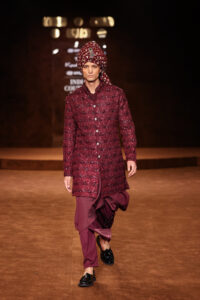
Kunal has always been fascinated by the diversity of Indian cultures and the way different regions dress for celebrations. he would see images of people from different parts of India in their traditional clothing and immediately wonder how those silhouettes could be made relevant to the way we dress now.
Sometimes a weave is washed, appliquéd or reconstructed until the craft reveals an entirely different character. The intention is not to disguise tradition, but to discover another way of seeing and experiencing it.
Does, he feel Bollywood overshadows fashion? Films and fashion are distinct industries, but their overlap is natural. In India, film, music, fashion and sport collectively shape popular culture. Actors are among the country’s strongest trend drivers, so the exchange between these worlds can be extremely rewarding, he adds.
“Our collaboration with Being Human began with Salman Khan’s paintings. Translating that artwork into a menswear line felt more like an art collaboration than a conventional fashion project. We developed stretchable hand embroidery for jersey T-shirts, which was technically challenging and remains a product I’m very proud of. Salman is deeply instinctive and extremely creative; the strength of the project came from working with something so personal to him,” he says.
Kunal often features older men and unconventional faces in his campaigns and shows he believes casting has always been about character rather than age or one prescribed idea of beauty. Some of the people are friends, while others are personalities he has discovered along the way.
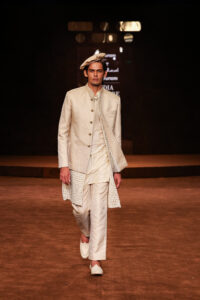
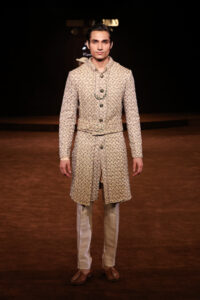
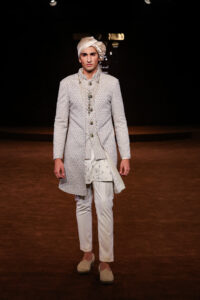
“My friend Vir has been associated with the brand for years because he represents it so naturally. Dhanraj, another close friend, has walked for us several times, and we’ve also had Anaita’s kids Zane and Zreh join our runway. The casting often becomes a family that grows with the brand. We dress men of different ages, builds and personalities, so it is important that the people wearing the clothes reflect that reality. Honestly, whenever I meet someone I find genuinely cool, I usually begin trying to convince them to walk for us. They bring their own life to the clothes,” he adds.
Kunal is releasing first brand music film, Rawalgarh Di Jugni, created with Akshay & IP. It brings together folk storytelling, performance, architecture and the energy of the couture. “I’m still an all-black person, so my wardrobe doesn’t change that often. Apart from my brand, I feel most comfortable in Rick Owens, and equally comfortable in H&M. In fact, that is almost exactly what I’m wearing today,” he smiles.
Interestingly, most challenging grooms are usually digital, long-distance ones. Couture is such a personal process: it depends on understanding how someone stands, moves, feels and wants to present himself. Nothing quite replaces that face-to-face interaction.
Today he’s dressing grooms across the world, and in the current environment, coordinating fittings and moving garments internationally adds another layer of complexity.
His new foray is homes— working with Boheim on a holiday home in Goa, along with another project in Mumbai. Interiors have become a very interesting extension of the way he thinks because the process is still rooted in mood, proportion, material and function.
Opulence is no longer one fixed visual in menswear. For some men, it may mean intricate zardozi; for others, it could be tone-on-tone threadwork, an exceptional textile or a sharply constructed garment. Menswear is in a far more democratic place today, and that has changed how luxury is understood and consumed. “Grooms are also considerably more involved in their choices. They appreciate embroidery when it represents their personality rather than simply signaling occasion wear. Comfort, repeatability and intelligent detailing matter just as much as surface craft. The new language of opulence is more personal and far less predictable,” he adds.
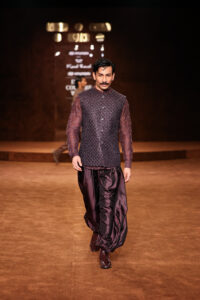
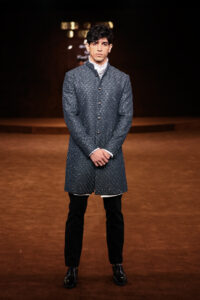
The groom is very much making his own choices. Hopefully, the days of him entering the process only for the final fitting are behind us. He now thinks about how he wants to feel, what the celebration should look like and how each outfit fits into that larger story. Brides and grooms both arrive with references, mood boards and strong points of view. They are creating the occasion together, and the groom understands that the wedding is as much his moment as it is hers.
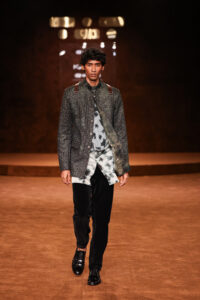
For India Couture Week 2026, he brings an all-menswear presentation of close to 150 looks, moving from modern occasion wear to deeply traditional groom wear. There is a new album, a performative dimension and a few immersive elements that bring music, couture and storytelling into the same world. “It is one of our most expansive presentations yet, but also a very focused expression of the codes we have been developing over the years,” he concludes.