
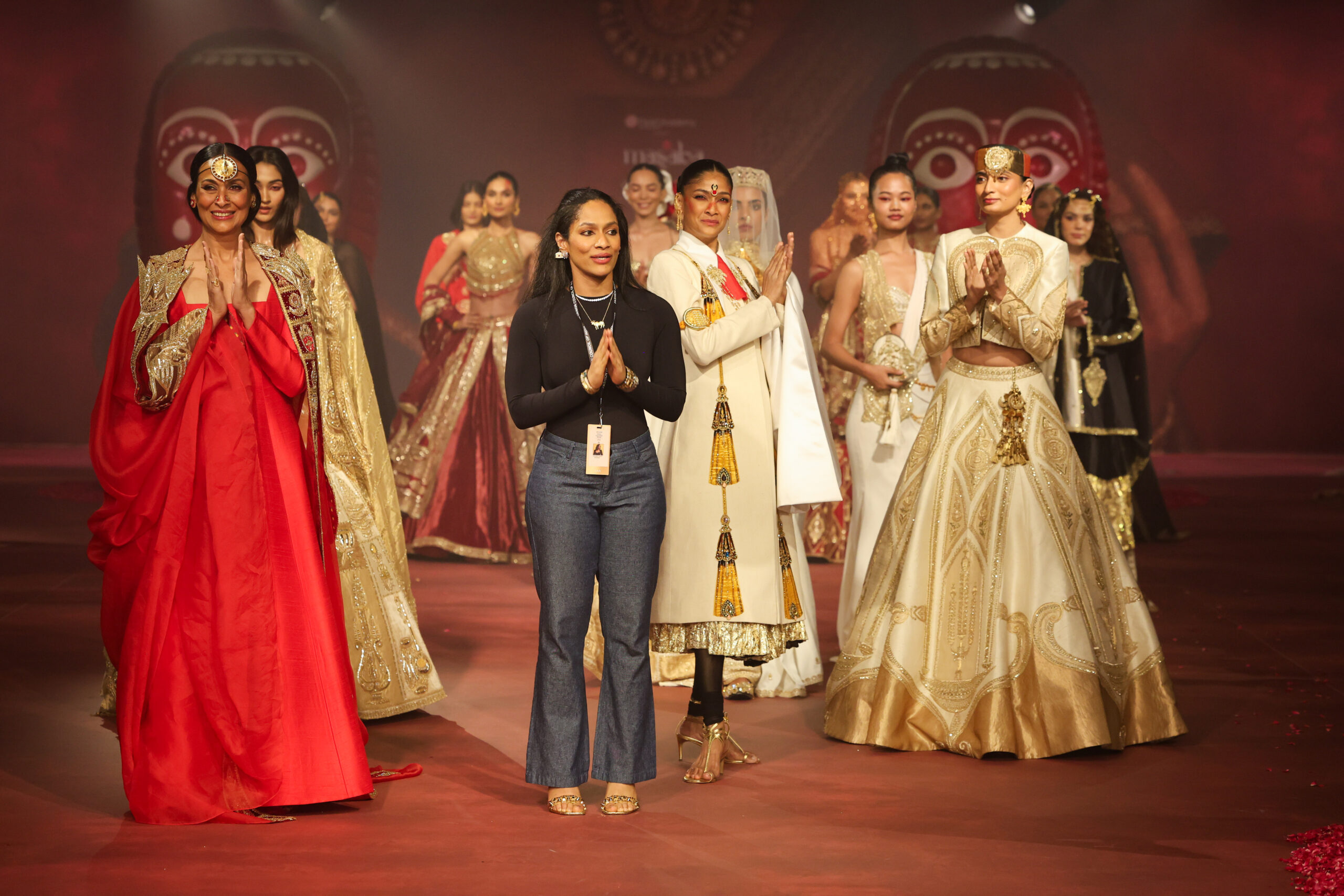
“Chadti Kala”, optimism in gloomy times, Masaba brings unabashed colour, bold Mughal zari motifs for a bride who has a sense of humour, can laugh at herself in a pineapple-shaped bustier.
By Asmita Aggarwal
She comes from an interesting mixed parentage- Punjabi mother Neena Gupta who grew up among the chaotic sounds and sights of old Delhi and West Indian (Caribbean) cricketer Vivian Richards. Thus, Masaba is unafraid to admit she loves to work with gold, as much as tourmalines— it exudes character, she believes.
Masaba is not new to the spotlight, in 2021, she starred in Sabyasachi Mukherjee’s bridal campaign, even though she debuted at Lakmé Fashion Week in 2009, at the age of 19. There is a certain irreverence in her prints—Nandi bull, celestial motifs, Hamsa hand, which she considers a symbol of protection, old cameras, Tamil script to pineapples, even toffees. Her most popular foray has been beauty “Lovechild Masaba”, paying homage to her mom’s intrepid choices. Interestingly, ‘i’ in Lovechild is the red bindi from Saans, a 90s show by Neena Gupta. It was a revolutionary script talking about women empowerment.
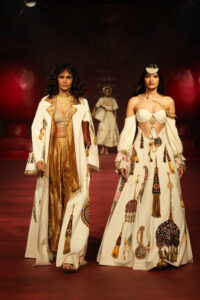
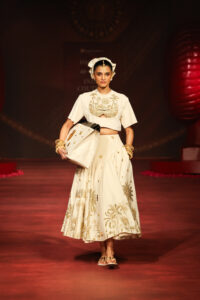
On the contrary there are also bold red dots that run through her entire offerings, or the Taj Mahal on bags, love is a recurring theme in her repertoire, but also looking at it rather playfully. She has had various experiments with fashion, whether it was handling Wendel Rodericks label or innovations with choli (Neena her mom also starred in the chart-topper “Choli ke peeche kya hai” with the inimitable Madhuri Dixit) or badla, peeta and nakshi.
If you look closely, she has a distinct sense of humour with slogan tees “Thak gayi”, or monikers he gives her jewellery-‘Palm Panna’, ‘Kala Tikka’, ‘Two-Faced’ or ‘Icy Kinara’, the palm motif inspired by her mother who is a consistent inspiration, even in her Netflix series “Masaba Masaba”. Her patchwork lehengas to kalidar lehengas, imagery is rooted in humble street metaphors, much like Manish Arora’s label Fish Fry.
This ICW finally we saw what the catwalk deserves-a model who paved the way for Indian fashion in the 90s- Madhu Sapre in unabashed flaming red. “The gloom in the world made me want to introduce happy colours for optimism,” says Masaba as she continues her love affair with crushed gotta mixed with military accents.
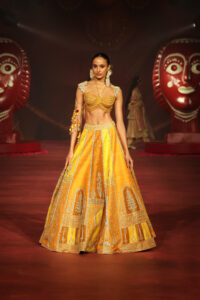
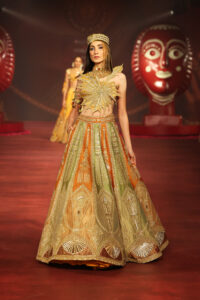
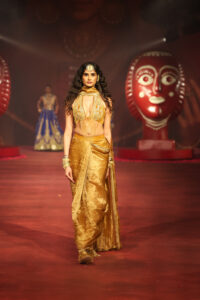
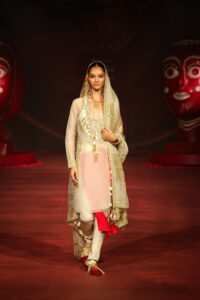
Drama ensued with long, sweeping coats, big bags with Hamsa, a palm-shaped amulet for protection, power, and blessings, Arabic word meaning “five”, representing fingers of the hand. Stacked gold jewellery, mom Neena Gupta in full support, anklets worn over churidars, gossamer organza kurtas and ubiquitous dhotis.
The ramp came with red rotating heads, with rose garlands, probably her most loved hue for brides, in some ways ceremonial, dressing in layered skirts, balloon pants with placement embroidery, lehengas with zardosi gilets. The irreverence stayed with pineapple and palm-shaped bustiers, harem pants showing up everywhere, mini bags fastened on waists, India’s jewelled map on black casual tees, beads hanging from sequinned tees, Mughal paintings as head bands paraded on Punjabi hit numbers Kala Shah Kala.
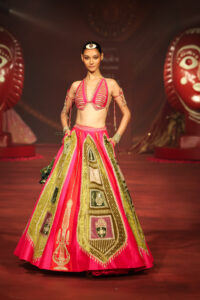
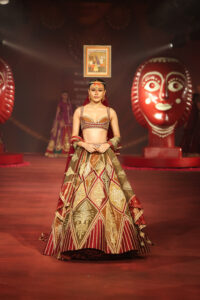
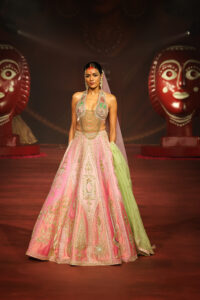
The Punjabi suits are seeing a homecoming, as sindoor comes smeared on foreheads, bejewelled blouses, Surrealist embroidery, kaleras and Himachali caps getting an embroidered avatar with aari work and Masaba’s ultra bold motifs.