
Farming in Hajipur village to LFW with wool indigo denim
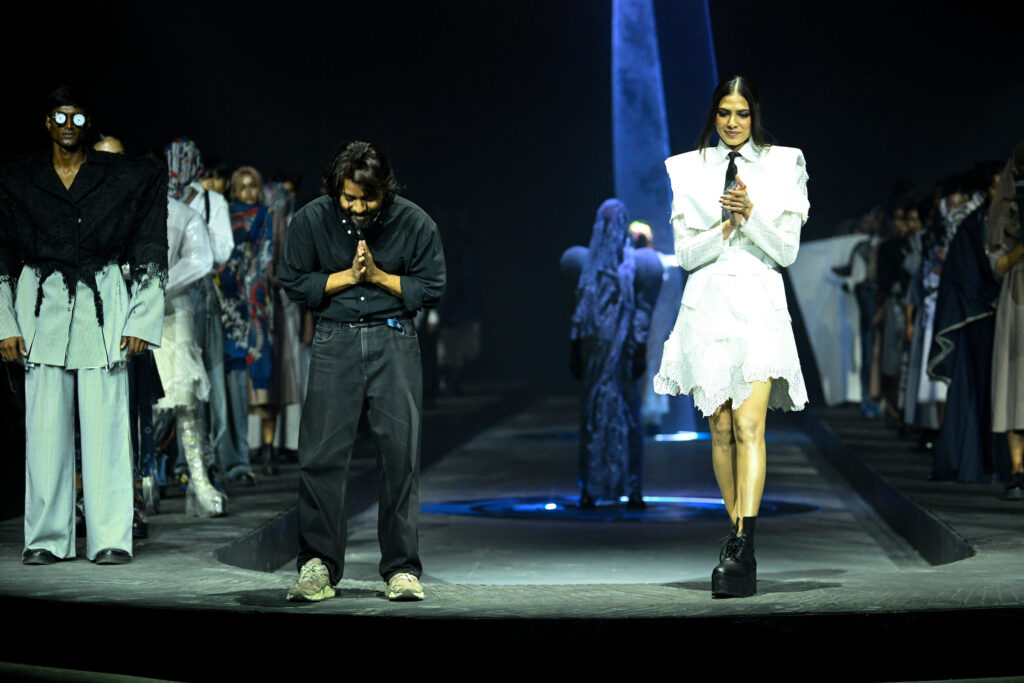
Farmer’s son Satender Jain and Dilip Singh meet Anurag Gupta to showcase their experiments with indigo dyed wool in IIT Delhi paving way for jeans you can wear in winter, keep warm! By Asmita Aggarwal He is from a non-descript village, Hajipur, tehsil Saipau, Dholpur, on the MP-UP border, in Rajasthan, born to a farmer, his dreams were beyond the fields everyday he grew up watching. Satender Jain’s school bag was hand sewn at home out of leftover Urea bags that came for crops nourishment, mom used to cut and stitch two handles on them, which went with his blue faded pants and rubber chappals. He decided to work on textiles, graduated from the Indian Institute of Handloom Technology, Jodhpur, and then from Bhilwara did his B Tech in textile chemistry. Cleared the entrance for IIT Delhi, to do his M Tech in textile engineering, little did he know his thesis would take him to LFW X FDCI runway. Can we make denim in wool for colder climates? You can’t wear denim in winter, is there an alternative for it? These were the questions that were swirling in his mind, when he began working with Prof B S Butola, Department of textile and fibre engineering, who told him to try indigo dyeing wool, it took two years to perfect this project! “The fabulous part about IIT is it gives you money for research, the challenge was to make denim in wool, machine washable at home,” he says. The product was handloom, wool Merino from Australia, so he decided to show the prototype to Levi’s. They loved it, and saw potential. Indigotex Private Limited, his company, is an IIT Delhi–originated startup, focused on R&D in innovative, sustainable textiles, protective textiles, and waterless technologies to reduce water consumption in textile industry. The company’s first product, IndiWool™️ Denim, is a wool-based, all-weather denim fabric that is machine washable. “Indigotex is developing ECOTEX wool and wool-blended machine-washable fabrics and indigenous lightweight breathable extreme-cold textile solutions (up to −30 °C) for the Indian Army which till now is wearing imported fabrics, in Siachen,” he says. They are funded by FITT-IIT Delhi, SIDBI and Ministry of Textiles. His trip to Bharat Tex he recalls a funny incident, with just his bag, after office, carrying samples, he knew nobody, “any foreigner going into a denim stall I followed and showed them my work, came back to IIT as I had no money.” Indian wool is underutilized as it’s too coarse, almost 70 per cent goes waste, farmers burn it, he says. In his village farming is only 4-5 months, rest of the time no work, in Dholpur, there’s no industry, unemployment, poverty, his idea was to start wool indigo industry there-with his company Indigotex. Designer Anurag Gupta decided to work with new materials like wool denim, for LFW, though his journey began from a village Biskohar, Ayodhya, in 2018, he knew it was going to be experimental. “Covid changed me. I decided I won’t work with craft but do something out-of-the-box,” he adds. In fashion they shy away from innovation, want to play safe as long as it is lucrative, he feels. He started working with knits, when most knitting units were shutting down, no work for them, exports affected due to high tariffs. “Knits are not considered a craft, but I decided to make knits in jacquards—overturned bird eye, ribbed, tuck, which no one wanted to do in small quantities, somehow I convinced them,” says Anurag. His signature though has been deconstruction, adding textures, subverting the template, cutting, slashing, which he says, “wasn’t accepted by clients, it was tough to survive for me. My themes too were unique-manual scavengers which no fashion journalist wanted to write about.” The wool experiment with Satender Jain, makes it softer and the roughness goes out, less water consumption, in more ways than one it is sustainable, also this wool after washing doesn’t shrink. “The surface is smooth and wearable and doesn’t feel itchy! Satender Jain and Dilip Singh’s collaboration was a eureka moment for me,” he adds. Inspired by 18th century Japanese painter Utagawa Kuniyoshi, Anurag liked his landscapes, women, Kabuki actors, cats, and mythical animals, especially Samurais, seaside islands to dragons. “Fashion magazines make me feel like an outsider, also I’m not a people pleaser, rich privileged kids get more easy coverage as they are in the party gang, we know jugaad, started from scratch,” he laughs. He signs of by saying he wanted to show a film he made on pollution, a video as a brand, how it is affecting human life.