
Fashion must be socially, politically conscious
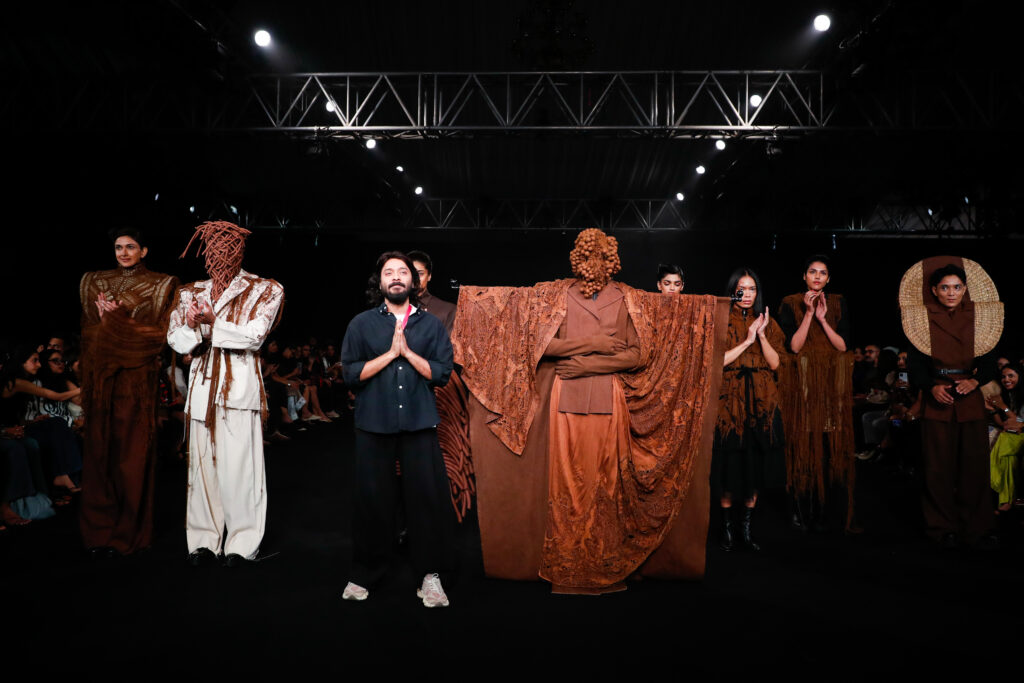
Water hyacinth gets converted into nifty baskets for gifting and packaging, as Anurag Gupta gives sex workers a dignified life training them in weaving water grass, Pacchu Tola, Biskohar. By Asmita Aggarwal It was a bright, sunny day, Anurag Gupta decided to visit Bharat Tex, his gaze fell on a stall from Bihar, and saw how beautifully the bags were crafted. “On a closer look it was water hyacinth, (Jalkumbhi) or water grass, mostly seen as a waste material,” he says. Locals have found a way to put it to good use by making mats, baskets, bags, as it is a much better and stronger alternative than jute. The NGO Anurag visited rescued sex workers more than 1300, trained them in this craft, “what I liked is that they ‘made’ artisans in Hajipur, on the border of Bihar-Jharkhand, didn’t work with existing ones. The idea was to offer them a dignified life which resonated with me,” he says. Anurag grew up in Biskohar, Uttar Pradesh, he realized there is raw material available there too, he wanted to highlight the marginalized, often not spoken or written about, especially women who work in red light districts. “My village is divided into two parts; Pacchu Tola, is a red light area, even though Biskohar survives on agricultural produce these patches face extreme poverty and helplessness. Women lack employment; I wanted to speak about their daily struggles, politicians come during elections, promise things, situations remain the same,” he says. Anurag will pay them to learn how to weave water hyacinth, start training 30 women, they can work from home, he has aptly titled it “Jal se Jivika”. “This can turn to custom packaging, boxes for corporate gifting, and the product is fully sustainable,” he remarks. For LFW x FDCI Anurag has worked with knitted textures, stepped out of his fantasy world, is making a “commercial” line, minus the avant-garde drama. Shapes remain experimental, knitwear is woven, combined with jacquards, and interesting textures. “We must talk about protests, as a community, it affects everyone. It is important for fashion to be politically conscious. Why should it be dominated by only Bollywood, stars, glamour?” he asks. His efforts have been to take the industry to the village, not other way round “we need to provide alternatives to people living on the fringes”. Social causes, putting a spotlight on what he internally and strongly believes in, Anurag felt he started with manual scavengers, but fashion media is partisan. “They look only at shiny people, privileged, don’t entertain me, maybe I’m not a people pleaser,” he confirms. Diet Sabya tried to police, and has fallen too in the trap of Elle, Vogue and Harper’s Bazaar, “big designers overshadow smaller ones who never get spoken about, just the top five are praised by magazines. How much will we talk about Sabyasachi. We know his contributions. We need to move on,” he concludes.
Boy from Biskohar
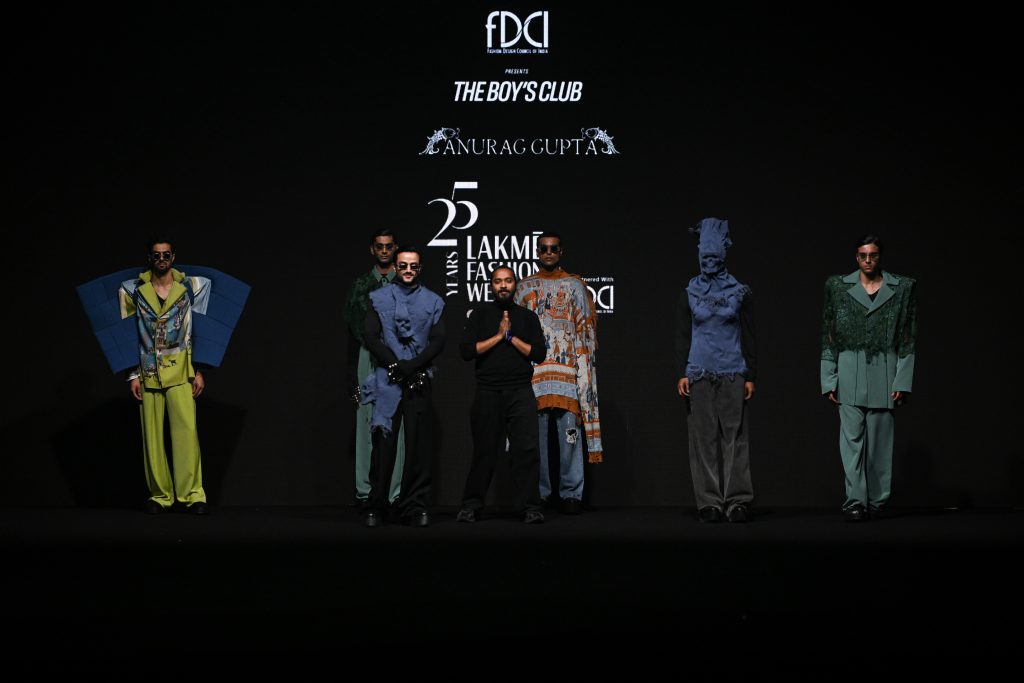
Anurag Gupta’s 3D, jacquard knits and intense screen prints tell us you can do a lot with menswear sans sequins. By Asmitaa Aggarwal Imagine growing up in a village, Biskohar, (Itwa) not so far from Ayodhya, the city of Lord Ram, in a home where forget conversations about fashion, there were not even “pucca” roads, what catapulted him was sheer grit. Anurag Gupta has a lot to be proud of, when he walks the ramp after the FDCI Boys Club menswear show this season at the Lakme Fashion Week 2025. NIIFT (Northern India Institute of Fashion Technology) kind of changed his life, along with a teacher who came to his nondescript school, (near the Nepal border) from Allahabad and taught him not just English but gave him the wings to fly away to the Metro city-Delhi. “I knew I had to leave, the place was too mind constricting, I had big dreams, but no exposure, I didn’t know one word of English so had to learn and unlearn everything as I wasn’t born in privilege,” he says. In 2018, he launched his label, in a glitzy world of fashion knowing that survival here is a challenge- but he did hone his skills- under Varun Bahl and Manish Arora for five years to grasp the business and marketing ethos maybe quirkiness too. “Biskohar had no internet, while I was growing up, but what did help me was that I was curious—even though the only channel was DD and scraps of newspapers from which I got information. My parents ran a medical store, so income was just barely enough,” says Anurag. Fashion for him was an escape, he admired Hrithik Roshan’s dance steps to his sunshine yellow tees, denim jackets in Kaho Na Pyaar Hai, so any hopes of his father to make him an IAS or engineer were incompatible. “I never had that kind of education,” he admits. Anurag admits unlike the swish set he is not inspired by Maldives or Seychelles, rather things he observes around him—sports shoes knitting process, which he converted into necklines, or his intricate screen prints which are laborious but the results are stupendous. “I have developed jacquard knits, deconstructed garments—used from door handles to medical equipment, tyres, tubes to make a line that is also paying homage to 3-D printing,” he admits. Fashion can be daunting-so in 2023, when he read Ambedkar’s book and was inspired to do a collection on “The Failed Promises” (1943) on the exploitation in manual scavenging, how it should be abolished, due to the ignominy, he says many were not interested to write about him. “I am the outsider, and will remain so,” he confesses. Maybe that’s why his line “Metamorphosis” is personal as it encapsulates his story, of how from his “cocoon” he emerged victorious-flew away. Though along the way he has included artists who have inspired him– MC Escher to movements like the Industrial Revolution. “The Dutch artist Maurits C. Escher (1898-1972) had a profound effect on me-specially his ‘mental imagery,’ which gave birth to puzzling architectural mazes and bizarre optical effects,” he concludes.
Engineered embroidery

From embroidery created out of scrap, to making even the motifs move along as you wear the ensemble Anurag Gupta woos the unusual. By Asmita Aggarwal