
Sari dress anyone?
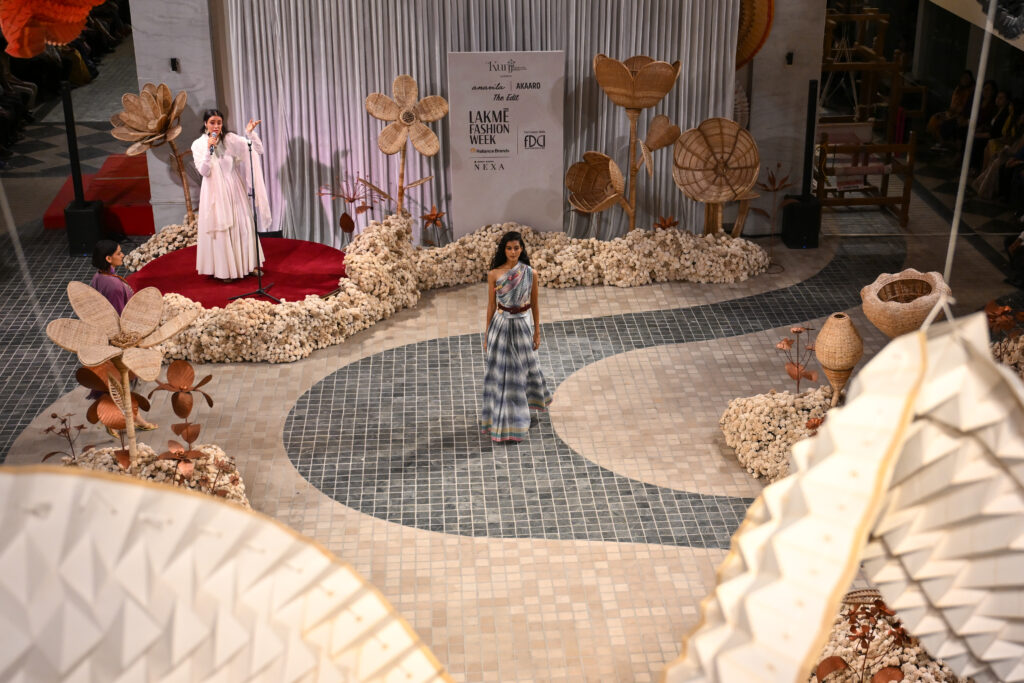
The opening show of the LFW X FDCI by Anavila Mishra and Gaurav Jai Gupta along with in house designers from The Kunj displayed the prowess of the sari, which is now not restricted by pleats and palla but has found a new disposition—jackets, Obi belts and knots. By Asmita Aggarwal Imagine being surrounded by art, culture and heritage, at the first glance at the roof of The Kunj, by the Ministry of Textiles, you are smitten by saris Ikkat, Pathani, Kota Dorias, Mekhla Chaddars, Narayan Peths, Sambalpuri to Maheshwaris, draped in Origami, by the inimitable Ankon Mitra, as you glance up. The waft of mogras on your wrist, and the cobbled ramp complete with wicker flowers, could there be a more befitting opening for the FDCI X LFW? After all, India is a nation known for its hand work, intricacy, and design thinking. The carved wooden pillars Chettinad style strike you, with their austerity on all three floors. Though everyone’s favourite undoubtedly was Suhail Bhan a Kashmiri Pandit, who has been perfecting the art of Bharatnatyam, setting the flow with his dexterous presentation. “I started learning dance when I was 12, learning from Justin, an American! I practise two hours daily, and teach also. Some are surprised to see men dancing, but they look so beautiful, it is an altogether different energy. Today there was more improvisation, as we danced for 20 minutes. Dance is about grace, control, and expressions, as well as how you involve the audience in your journey. I sing also, learnt for a year, it helps in dance,” says Suhail. Live music by classical singer Deveshi Sahgal began the opening show by Anavila Mishra, muslins and her unabashed love for whites. But what’s new is the sari is no longer being worn with palla and pleats, but jackets. “Sarmast”, references the Deccan, from the state of Wajd, thus the ode to handwoven linen, but it was a joy to see the Kerala Kasavu sari rubbed shoulders with pant suits on the notes of Aaoge Jab Tum by the inimitable Ustad Rashid Khan, an eternal fav. Saris came with Obi belts, trench coats, roomy Japanese jackets, telling us there are many ways to wear them. Blush pink looks fab in handloom cotton, as Kimono-style jackets revved up saris, lace bows in the hair completed the look. The show had “The Edit” by seven in-house designers of The Kunj curated by DC Handlooms Amrit Raj. “The look that we presented was entirely woven from waste like all our products, we showed styles on a male model, but all four garments are unisex. The kurta is a kurta dress, then a two-way top, jacket was reversible. The Kunj has been a great place for us to meet customers, and design for them accordingly, generating this level of work with artisans. We upcycle other people’s waste, this is my first experiment with B 2 C, it’ll help develop a deeper relationship with the customer,” says Bhavya Goenka of the label Iro Iro. Pedal looms we have used, natural dyes, extra weft technique to weave waste, Rohingya refugees have embroidered on linen. Interestingly, the belt has arrived and so has the long jacket, the broader the better, the Kutchi mirror work jackets, Ikkats in maroons, traditional saris draped almost sinuously around the body, pleats misplaced and palla disappearing, gave a peek into how innovatively the sari has metamorphosed.
Amit invokes spirit of Margiela
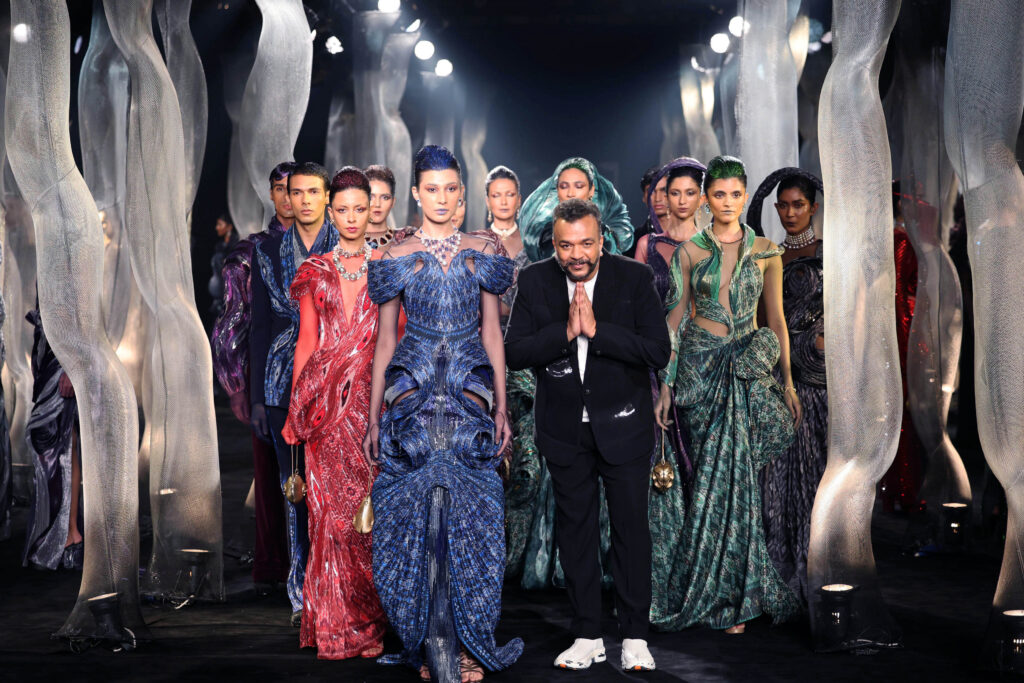
Fabric manipulation in its finest form, themes from the one directional arrow of “time” to now “DNA”, Amit Aggarwal tells us your old Banerasi and Ikkat can be your new cocktail gown, hand pleated and upcycled. By Asmitaa Aggaarwal There is always a lurking sense of inspiration, the industrial set, music that kind of makes you feel you are transported to a world into the future, slow but steady interpretation of textiles—and of course the Belgian 5, deconstructivist approach to design. Amit Aggarwal had his models’ faces covered just like the Martin Margiela, as he wanted everyone to focus on clothing, beautiful models often taking attention away from the artistry he felt—was imperative to observe. At ICW 2025, one noticed Amit pursuing unconventionality– fabric carved into waves, sheer used only as an accent, play of silver and charcoals, sensual touches of gooey chocolate as if it had melted on a gown-made its way all over as greys played peek-a-boo. By the way, a woman’s back is the most sensuous part of her body now, according to him, as silver mesh was worn inside velvety jackets, complemented with basket weave shoes. The beauty of it all was the gown moved mimicking the movement of the body, its curves, its nooks, and crannies. Amit kept colours at bay, only slight accents of reds and greens, his obsession with fabric manipulation, pleating and architectural shapes was evident. The line “Arcanum” denoting mysteries of the physical and spiritual worlds, also known as “elixir” was Japanese inspired probably what a Rei Kawakubo (Comme Des Garcons) would do, honouring our body’s imperfections, accepting it with the bulges, contortions, and misplaced cowls. The ode to ikkats and Banaras, in subtle purples to tangerine reds, told us our old sari can be your new cocktail dress, as men with minaudiere kept it androgynous, a contrast to the magnanimity of the line inspired by our DNA. You would wear this to a red carpet to make a statement. “We go beyond the last show where ‘Time’ was philosophised as a concept, some of the best stories of our life are written in this singular dimensional arrow. Time makes our stories denote that DNA is internal, we explore what it does to our life-takes us places we never thought we would explore,” says Amit. This year through the 25-minute show he narrated five different stories—Form, shape, grow to evolve to tie in every single tale that moved his soul. “Collections are never made in isolation. It started in my mind, a gradual process, actual pieces took four months, with styling and jewellery six months,” he explains. For Amit, style does not get boring if you keep evolving, pushing the same language forward, as a brand. It started as an inward journey, but soon he narrowed down on his favourites—Ikkat, hand woven upcycled, “creating a new narrative –a kind of benchmark for me,” he adds. The artistry could be seen in how he created water droplets through hand draping, as polymer, his constant companion along with Banarasi, were a runway spectacle. “I wanted the show to have a theatrical feeling, but you will see wearable versions of this in the store. For me sustainability denotes artisans trying to help them elevate craft frankly I’m bored of this question,” he says. For him his reused textiles embellished with hand twisted crystals was a way to show you need to be consistent, as he concludes, “Couture is feeling, an emotion, not just about jewellery and watches. Sustainability is the only way we should be living life.”
Layering Thoughts
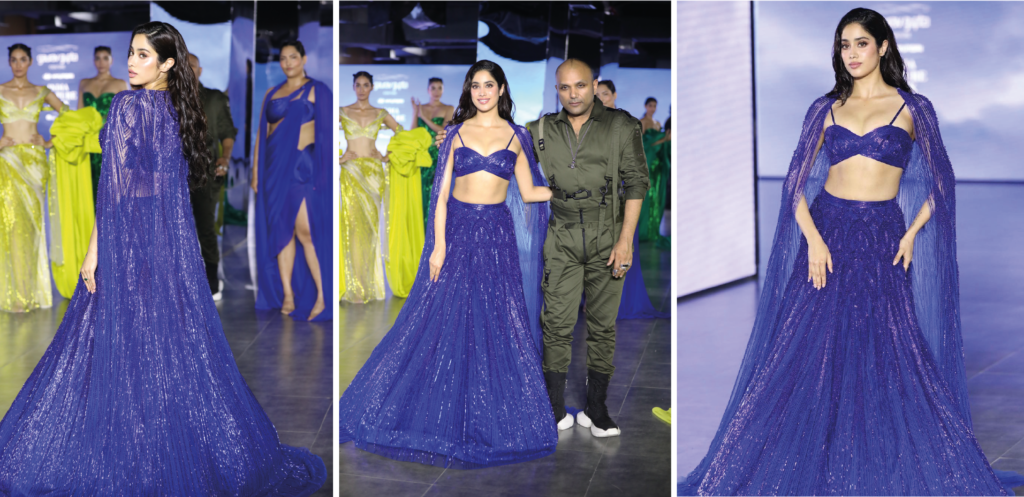
Vedas to swishing sculpted gowns, Gaurav Gupta can make the twain meet, just like his showstopper Jahanvi K., whos hybrid heritage makes a winning statement. By Asmita Aggarwal
Floriography
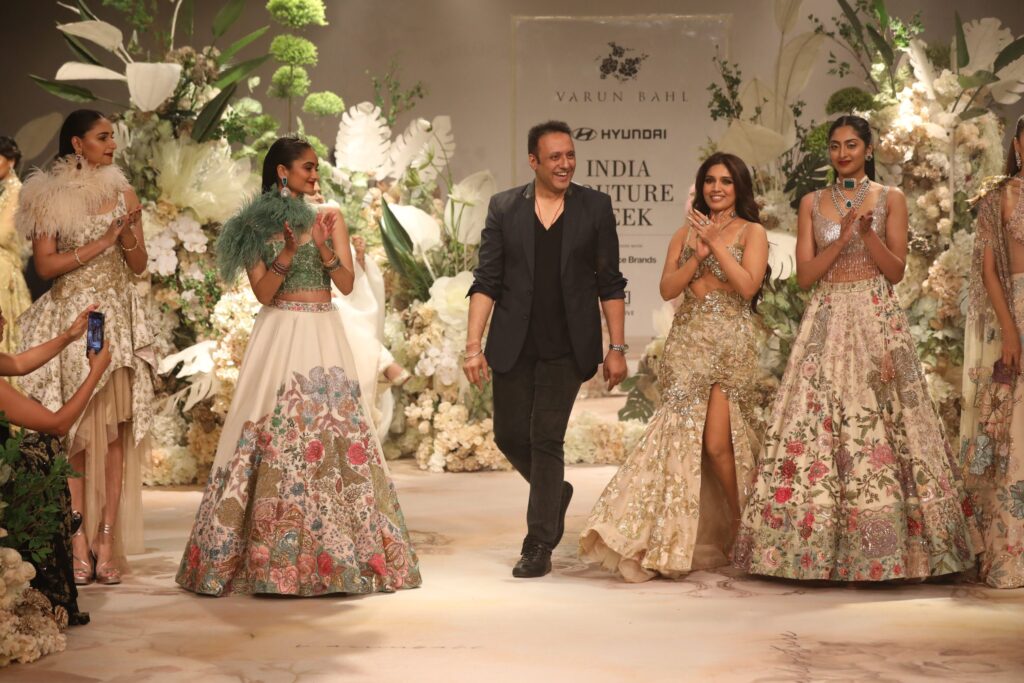
Varun Bahl believes couture must appeal to a woman who is aware, responsible, and wants to be original in thought and choice of occasion clothing. Though his love for flowers remains constant, just like his passion for monochromes. By Asmita Aggarwal
Au Naturel

Mogachea creates new textures in the print-obsessed fashion world, as Goa-based Tania Fadte keeps it simple By Asmita Aggarwal
Glamour Girls

A lawyer and a psychologist, both chose modelling to satiate their desire for glamour as Olivia and Ana get set for AIFW SS 17. By Asmita Aggarwal
Success Asana

Arya Bhat is more than just a pretty face as the boy from Kashmir hopes to be a yoga instructor. By Asmita Aggarwal
Brass Tacks

Accessory designer Vrinda Ashwani prefers silver over gold as she charts a new road to freedom with brass By Asmita Aggarwal
Leading by Example

Moutushi and Rituraj have been inspired by the Kerala Kasavu saree which has been given a modern interpretation. By Asmita Aggarwal
Saddling Up

Aditi Dhar of the accessories label Vitasta wants to offer minimal design with maximum impact with the use of hand crafted elements. By Asmita Aggarwal