
A different mirror

Fighting colourism world over, black models have emerged victorious a bit like this Brazilian beauty Marcella Jackie, a first timer at LMIFW19 By Asmita Aggarwal Even till today on the runways they exist in single digits and beauty companies only now have woken up and looked at launching products that work for their skin tones and kinky hair. Marcella Jackie is black, beautiful and articulate, despite English not being her first language, she expresses herself with candour. It was a brave move to come to a country where half the population still longs for fairness and dark-skin is considered a taboo. My parents were a little worried, but I took a risk. I am the only child so it took a lot of convincing and they are really supportive. They knew it was my dream to model internationally. To make sure they know I am safe, I speak to them everyday, this summer I am headed home, she confesses. From the picturesque Fortaleza, Brazil, Marcella began modelling with friends at the age of 18, and just last year signed on with an agency. I am a vegetarian, so unlike Brazil, India is heaven for me. There are so many choices for non-meat eaters here, she smiles. There are two things that motivated the young model to step into unknown territory—- yoga, which she is a devotee of, and spirituality which she believes is the only way to approach life and what curveballs it throws in your direction. My moms wish was that I hone my yoga skills and maybe go back and teach her too. But there is much more than that I discovered in India. Almost 20 different languages people speak here, which are region-specific and it is the second biggest country that speaks English, she laughs. Marcella, 21, was studying journalism in Brazil and worked for a fashion magazine before she came here last year in September. Covering fashion shows, she discovered what makes Brazil unique is there are all kinds of girls who walk—red heads, blondes, brunettes and even black, making it multi-racial. My father is black and my mom is Brazilian and I never thought I will get any work here, but I was in for a surprise, she says. Travelling has been a passion and being a journalist reading and writing have remained her soulmates which she hopes to pursue once she gives up the spotlight. Maybe one day I can start my own brand, cosmetics is my interest area as there arent enough for black girls as our skin and hair is different from white girls. I want to create a specific line so that backstage girls like me dont have to struggle to get the right foundation. Jewellery designing using alternative materials is another area I would like to explore, she admits. The Indian runways have recently seen an influx of Brazilian models, a far shot from Eastern European women who were the flavour of the season a few years ago. It is not easy being a black model, some of the girls who had earlier worked in India had warned me about prejudices, though I havent faced anything as yet. If you look at history, black girls have faced discrimination not just in modelling, but every profession, but they fought back. I admire Victorias Secret model Jasmine Tookes, though whether it was Naomi Campbell or Jourdan Dunn (the first black model to walk for Prada) they both made a place in fashion, she adds, adding, Dunn was a young mother and everyone told her she wont make it as there is no place for moms on the catwalk. She proved them wrong.
Princess of Tides
There is more to Brazil than soccer, carnivals, Gisele Bundchen, stunning coastlines and Christ the Redeemer…. meet Radylla, who gave up her white nursing coat for designer tunics and turned into an India lover and intrepid traveller By Asmita Aggarwal She has graced the covers of Swimsuit Illustrated, and is a Victorias secret angel, Brazilian bombshell Lais Ribeiro, is the perfect inspiration for Radylla. From the city of Natal, Rio Grande do Norte, situated in Brazil’s north-eastern tip, it is where Radylla discovered her love for the sun, sea and sand. The seed and fervent wish to travel made her abandon the safe environs and come to India last year. I always had my biggest motivators, my parents. They believed in my dreams and supported me in everything. I remember the day I spent the night in the street, with other girls who were also aspiring models, to participate in a modelling contest that took place in my city. It was heart breaking that I couldnt qualify, says the 23-year-old. This is her first trip as a model outside home and what made the nurse-turned-model give up the white robes was the archlights of the ramp. I was unhappy because my dream was to be a model and the first opportunity I got to change my life I grabbed it. I consider myself very strong— I came to a culturally different country, without knowing how to speak English and I learnt to live alone. I am very happy to be here, and I am not going back, India is my home, she laughs. After rejection, she did learn that to be a model, besides being beautiful, you must possess a positive attitude and believe in your potential. I come from a broken home, my parents separated when I was young, so I kept shuttling between the two different homes my parents stayed in. I have only one brother and he is the love of my life. We are very close and we have never stayed so far away; this is one of my biggest regret that I cant see him everyday, explains the first-time model at LMIFW’19. What remains synonymous with India and Brazil, is the simplicity of thought that people share, even though the food is too spicy for her getting around has become easier after a friend taught her a few key words of Hindi. I was spotted by an agent in Brazil and he asked me if I was willing to travel. Initially I was hesitant, but my fears soon faded when I was flooded with work here from catalogues to ramp requests, she admits. Coming from a city known for its vibrant nightlife, beaches that caress the Atlantic coast, clear blue waters, Radylla wants more people to know about what she calls home. I want to open a tourism company after I retire. I identify myself as someone who would like to show the world what the real Brazil is all about. Now that I have lived away from home, I value my city more, I want everyone to see how beautiful it is— a charming island, brimming with beautiful beaches, she concludes.
Silent Spring

Practising Ahimsa, or non-violence Eri silk became the leitmotif for a Telugu from Hyderabad, Jyoti Reddy, who travelled to the North-East and revived the lost art of caring By Asmita Aggarwal The chances of meeting a Reddy in Assam are more than bleak, but Jyoti not only climbed the hills, literally and metaphorically, but also elevated the living standards of the indigenous tribes there, employing almost 250 languishing artisans. Ereena by Jyoti is a five-year-old brand and works with only sustainable eri silk, which is made through a non-violent process. Here the silkworm is not killed, as the cocoons are open-ended. Almost 17 years ago Jyotis quest for an intelligent fabric took her to Assam, where she met a textile technologist, who told her that we dont need to create one, as Eri silk already exists. What lacks is the awareness. Few know that Eri possesses the softness of cotton, warmth of wool and the sheen of silk. It is also isothermal (warm in winter and cool in summer) and it is this versatility that Jyoti hoped to celebrate. A post-graduate in business studies from Cincinnati, US, she converted a cottage industry making Eri silk, 50 km off Guwahati, into a factory that today employs almost 250 artisans, primarily women, who earlier had looms at home and were not being able to make ends meet. The locals there consider Eri sacred, as it is pure, made with no chemicals thats why Buddhist monks in Nepal and Bhutan wore this, says Jyoti. The designer wanted innovation to be a part of the making of Eri, so where earlier only 5 metres of fabric was attained out of 1 kg of yarn, now 25 metres is produced, organically. Jyoti has worked on different concepts and surface textures —- tie and dye, printing, Bagru, block prints and natural dyes, Ikkat as well as Jamdani. The story behind the name Eri comes from the fact that the silkworm eats castor plant. In the local language Eri is called Eranda or Endi, so probably the name is a derivative from a Sanskrit word, she adds. The idea was not just to make silk, but create a lasting social impact, by training families in the North-East and building an industry. It was almost 30 years ago that I got interested in textiles, but marriage took me to the US, and I had two babies to look after, so it became impossible to work. My interest in art and textiles grew so I would visit trade shows, and there I met a technologist in Frankfurt, who told me the world today doesnt need any fabric, but a thinking one, so my quest began, she smiles. She did find what she was looking for and till today carries samples in her bag as she confesses that all what she learnt in three decades, is through back breaking field work. Dilip Baruah, my partner invited me to look at Eri and then as they proverbially say, there was no looking back 17 years ago, she admits. What Jyoti had done is added value to the yarn, by introducing 64 shades in natural dyes of Eri silk and combining various techniques (Ikkat and Jamdani). Sustainability doesnt need to be dowdy and boring as well as predictable, it can be glamorous and fashion-forward too, she says, adding, My aim is to get young people thinking about the idea of constant consumption and how it is damaging the environment. Having said this I dont think the world can be fully sustainable, but we can urge millennials to make socially responsible choices. The economics major, who grew up in Mumbai, Jyoti admits that her grandson is her inspiration for the latest natural dyes collection. Sustainable is anything that is recycled, reusable and you dont waste raw materials; the goal should be not to create anymore waste. Young people want to wear new things to be popular on social media, it is a race to the finish line. But I tell them be creative and learn how to effectively mix and match rather than buy endlessly, she explains. It is this need to be responsible that won her an invitation to show at the Salvatore Ferragamo museum in Florence, her natural dye Eri silk collection, will be a part of a curation from all over the world. The sad part is that internationally I have got more recognition, but my Eri ikat silk saris have made quite a splash domestically that I sell through the Crafts Council. And I dont get tired of explaining why my saris are expensive when buyers quiz me. I have understood that it is part of the job, she laughs.
The Artist is Absent

It was like a moonlit sonata, bright, with the colour of love red dominating Aneeth Aroras mindscape, as she let winter be warm, cozy, sweet and mindful. By Asmita Aggarwal
Grammar of Ornamentation

Fashion straddles both ideologies-form fitted and anti fit as marathon runner Namrata Joshipura brings back the body con, glowing gown and Siddhartha Tytler adds sequins to a mans boring, black trouser. By Asmita Aggarwal
Men not in Black

Fully loaded with muti-pocketed cargo pants, logos, checks and unapologetically oversized coats, men have embraced colour as graphics and stripes keep them hooked. By Asmita Aggarwal
Hook, line and Sinker

The eyes, they say are the windows to the soul; maybe thats why eyewear is now more than just an accessory, it can make a powerful statement as Indie Eye indulges us with a ride to the kingdom of cool! By Asmita Aggarwal
Das Kapital

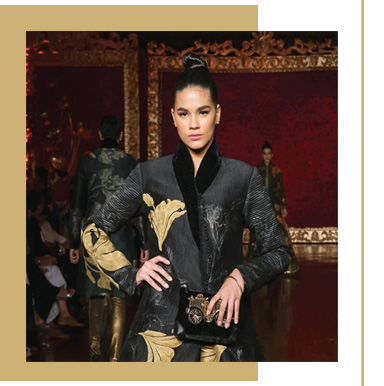
Almost 30 years in the business of dressing women, Sonams subtle strength is a testament to good design, as he mixes the old with the new—-brocades with eri silk to create a palette that reverberates with spirituality and displays his commitment to slow fashion. By Asmita Aggarwal
Twin Peaks

In a world that thrives on being connected Shikha Grover and Vinita Adhikari of Ilk a brand moving towards becoming sustainable are urging people to disconnect, one khadi garment at a time By Asmita Aggarwal
The Curated Closet

Celebrity stylist and designer Eshaa Amiin, believes that versatility and wearability is the key to a successful label and that women now dont need body con dresses, but comfort and functionality By Asmita Aggarwal