
Life comes a full ‘Crcle’ for Varshne
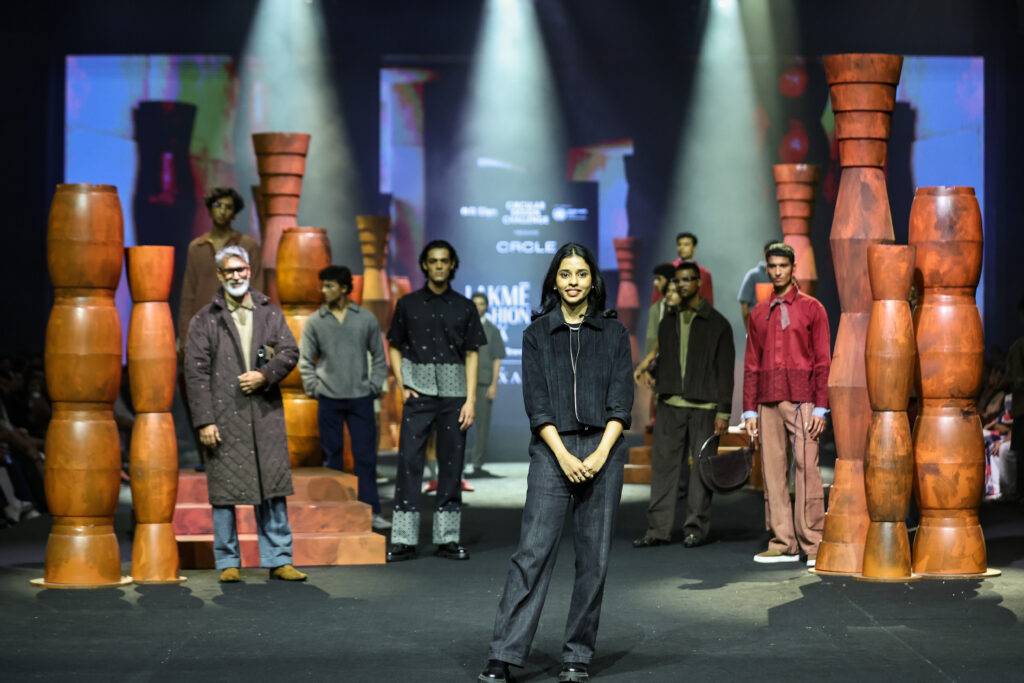
From upcycling leather to using stainless steel as handles for bags, Varshne, the CDC winner with her label Crcle, is telling us being modern is valuing our textiles. By Asmita Aggarwal Born and raised in Chennai, her graduation project in 2020 at NIFT (fashion design) mirrored the most potent fabric that has been adopted by the West like never before-Madras checks. Varshne wanted to depict it in a contemporary way, made a jacket not inside out or reversible but upside down, on the back was Chennai emblazoned and when you flip it you see Madras—it was an ambigram. “Lots of things inspired me, how the colour bleeds in Madras checks, as it is naturally dyed, gives a new look to the fabric every time, ideal for Chennai weather,” says Varshne, who showcased her eco-label Crcle, at the LFW X FDCI titled “Dialogue”. South where she grew up was all about Kanjeevaram saris, bright hues, but as a kid she was all about baggy jeans and oversized shirts, complete opposite-a study in contrasts. Varshne or “rain” in Sanskrit launched her label in 2024, wanted Crcle “to close the loop”. The arts she imbibed growing up -Bharatnatyam, to hip hop, free style dancing, as well as being an avid athlete, long jump to marathons, instilled discipline and an understanding of conviction. Thus “Dialogue” her collection was a conversation between—those wearing it, making it and the material. “It is about emotion transfer, how human beings connect with the garment, making them hold on to it forever,” says the Circular Design Challenge winner. Using crochet (hand done by a cluster in Pondicherry), hand embroidery, with various shades of madder to indigo, making textiles with vegan wool, using korai grass (cultivated along the Cauvery River in Tamil Nadu) which is traditionally used for mats in Chennai, she crafted bags with stainless steel handles. These can again be recycled and bonus: steel never loses its luster. “The beauty of crochet is you can completely unravel it, starting from the beginning, it becomes a fabric again. It offers endless possibilities,” she smiles. Another initiative she embarked upon was collecting waste leather from factories, who generally discard it, and are reluctant to hand it over. It was a challenge to convince them to give it to her, they couldn’t understand why she would even accept such small quantities. She segregated it colour wise, made bags out of it, giving them a new life. “My brand is menswear, but I look at it as unisex, anyone can wear it,” she admits, offering elevated essentials.
Meet Lambani tribe from Tanda
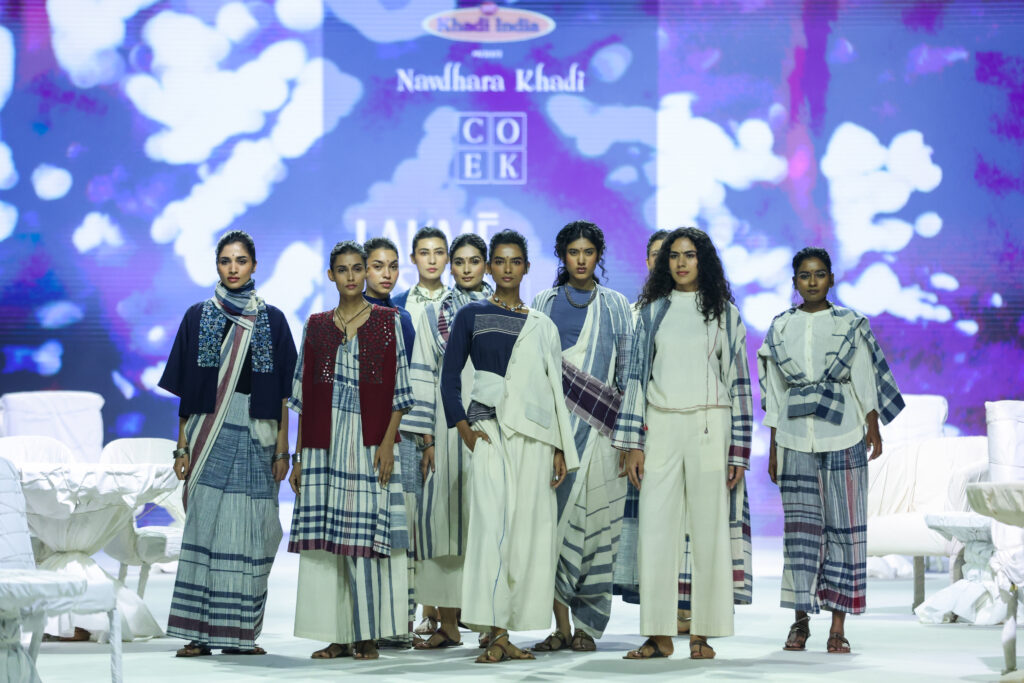
Emblazoned with seashells, mirrors, colorful threadwork khadi gets a cool makeover with tribal women from Sandur’s deft hand work at the FDCI Khadi showcasing. By Asmita Aggarwal The beauty of Khadi is in its enviable properties—summer cool and winter warmth, when you combine empowerment and women artisans in this mix, it becomes a movement of sorts. Sandur Kushala Kala Kendra (SKKK) has tied up with Co-Ek, (Centre of Excellence for Khadi), an initiative by the Ministry of MSME and KVIC, attempting to make Khadi young, cool and fresh. SKKK is working with tribal Lambani women from Tanda of Susheelanagar, a nomadic community, almost 500 artisans, hoping to make them self-reliant. Further the Khadi Commission equipped them with handlooms, Ambar charakas, so this year at LFW they will be showcasing their cotton khadi—hand spun spinning, weaving, and natural dyeing. Villages of Yeswantnagar, Krishnanagar, and Sandur, is using Ambar charkha, with 76 skilled women executing intricate Sandur Lambani embroidery. SKKK has worked to preserve the Lambani craft, won the UNESCO Seal of Excellence for Handicrafts in South Asia and has the Geographical Indication (GI) tag for “Sandur Lambani hand embroidery”. The inspiration has been nifty checks at Victoria and Albert Museum; here is the twist rather than uniformity they added surprises in the warp and weft. This was executed by the Devanga weaving community, artisans with 40-year experience who previously worked with the Karnataka Khadi Gramodyoga Samyukta Sangha, Hubballi, the only BIS-certified national flagmaker. “We have worked with Bijli embroidery, ‘lightning’ work, reflective, has a sparkling effect. It is space dyeing, with a chambray effect, looks complicated, but is simple,” says Nargis Zaidi, head, Apparels at the Centre of Excellence for Khadi. The Khadi unit currently employs around 98 weavers, but most clusters are set in their ways, hesitant to experiment, adds Nargis. The Lambanis use vivacious hues, red to indigos, but Co-Ek has toned them down, offering classic shapes, kedia tops, reversible jackets. “There is an increased awareness amongst youngsters about hand-made, hand embroidered, it is like a limited edition sneaker for them in some ways,” adds Nargis. Shruthi Muniyappa from Sandur Kushala Kala Kendra, says, “2023 a Guinness World Record was set at Hampi for the largest display of Lambani items. Artisans are skilled at block printing, and khadi production, our attempt is to make women breadwinners.” The patch work embroidery, mirrors and white metal jewellery along with seashells, intermingled with coloured threads makes each piece unique, as it carries 500 years of legacy, when they moved from Rajasthan to South India for trading, in Karnataka- 16th century!
Anamika to support 101 artisans
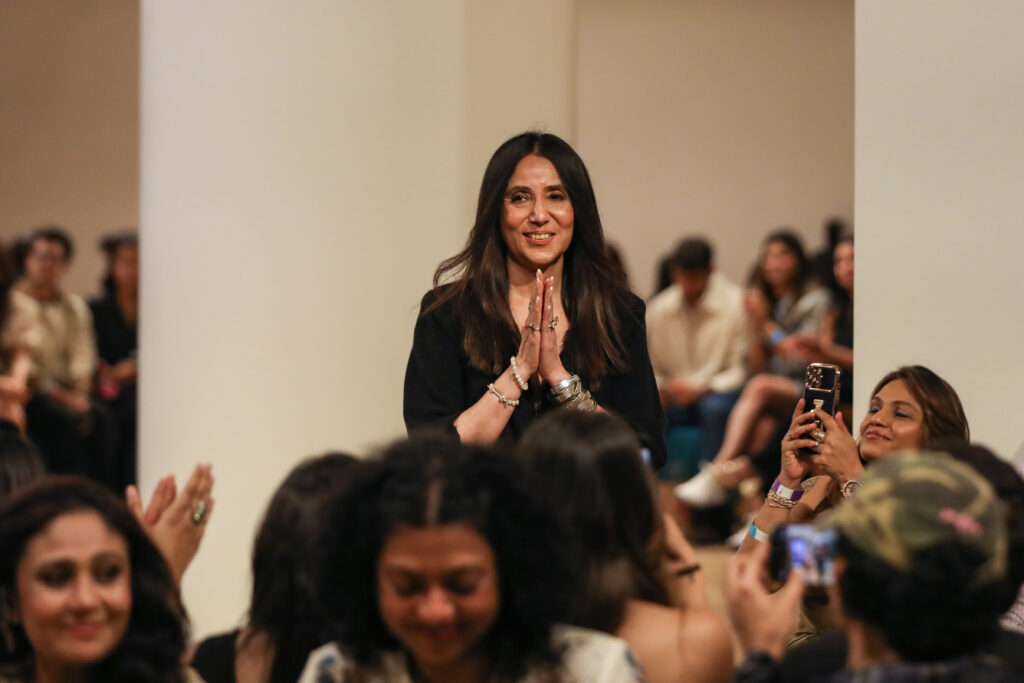
She is a tour de force in fashion, most sought after but she is wanting to give back generously, by making artisans from various clusters in Gond and Pichwai self-reliant, that’s her mission for the next three years. By Asmita Aggarwal Anamika Khanna has been a trooper of sorts ever since she won the Damania Award in 1995, her journey has been interesting in more ways than one. “I didn’t know then what was even one meter of cloth,” she laughs. Today she is Sonam and sister Rhea Kapoor’s go to! So, when she went as a newcomer to London Fashion Week, “putting yourself as a new label AK-OK was a challenge, we got an overwhelming response”, says the Kolkata-based guru of meaningful details. Though she was impressed by the working style, professionalism in London, it was simply “humbling”. At AK-OK, which she is showing at LFW X FDCI is for her “what we dream we do, hoping to offer global pret, this product has the wherewithal to become that”. Couture is hand crafted, we can’t compromise, completely hand done, nothing digital, even the jewellery perspective is Western with an Indian soul, wear it in New York or Dibrugarh. “We mix ancient temple motifs, with contemporary acrylic, 3-D printing, and two dynamic materials. I’m having a lot of fun with AK-OK (began when she was unwell, her twins would ask her AK- are you ok?), it is limitless, feel like a child in a candy store,” giggles Khanna. Though the designer now wants to give back, her new project is making women artisans 101 (she doesn’t know how she got that number in her mind) financially independent-craft clusters over the next three years. “Let’s say the Gond or Pichwai artisans, the idea is to spotlight them, as I use their craft in my bridal wear, hoping it brings awareness to the clusters and make women self-reliant. This will be a recurring initiative not a one-time passion but will continue,” says Anamika. Her fame has crossed borders, European Commission President Ursula Von der Leye wore her fitted bandhgala satin silk self-on-self, handmade embroidered on Jan 26, this year. “I knew she would like something like that, seeing her crisp no nonsense suits,” says Anamika. Her more recent love has been double ikkat Patola, sometimes she uses it as a traditional sari, other times as a base to enhance different experiments, mixing it with lace and Banarasi. Patola is sourced from Swadesh (Reliance Foundation to support master artisans like Kanubhai Salvi and Hema Patel, GI-certified handwoven in Patan, Gujarat, almost 750 years old). Though her one desire remains unfulfilled– to dress the iconic actress Rekha, her beauty frozen in time, “she would look ethereal in our organza sari, wouldn’t like to alter her look, or personality,” says Anamika. Dressing Rashmika Mandanna, from Coorg, in a rust-orange silk saree with a bold red border inspired by “Deccan Temple” embroidery in antique gold for her D day with Vijay Deverakonda. “We had to tone down the brief, or it would look like a costume, not too ethnic India,” she clarifies. It took two months to create, several months for R and D, as “research couldn’t be random”. She explains how concepts varied from shikar; they indulge in down South motifs for Vijay as well as South temple structures for the veil for Rashmika. Her two boys have made a place for themselves outside the shadow of their mom—Viraj the shy twin is an artist, Vishesh, has a master’s degree in design from Central Saint Martins. “He is in touch with Gen Z, I don’t know them, this is a big advantage, so I listen. He is the one who sent me sketches for menswear and I really respect his opinion. We three are good for each other,” she says. Her LFW line is an homage to flowers she loves, like Coco Chanel, her obsession with camellias, plus she is looking at an alternative to fur, vegan and sustainable. “We have explored knits, versatility is the key here, Japanese fabric was added for the first time, denim was cut and slashed last time, this year we have taken a detour. I work with my instinct to design for women, knowing what they want,” she signs off.
Kala Cotton adds character
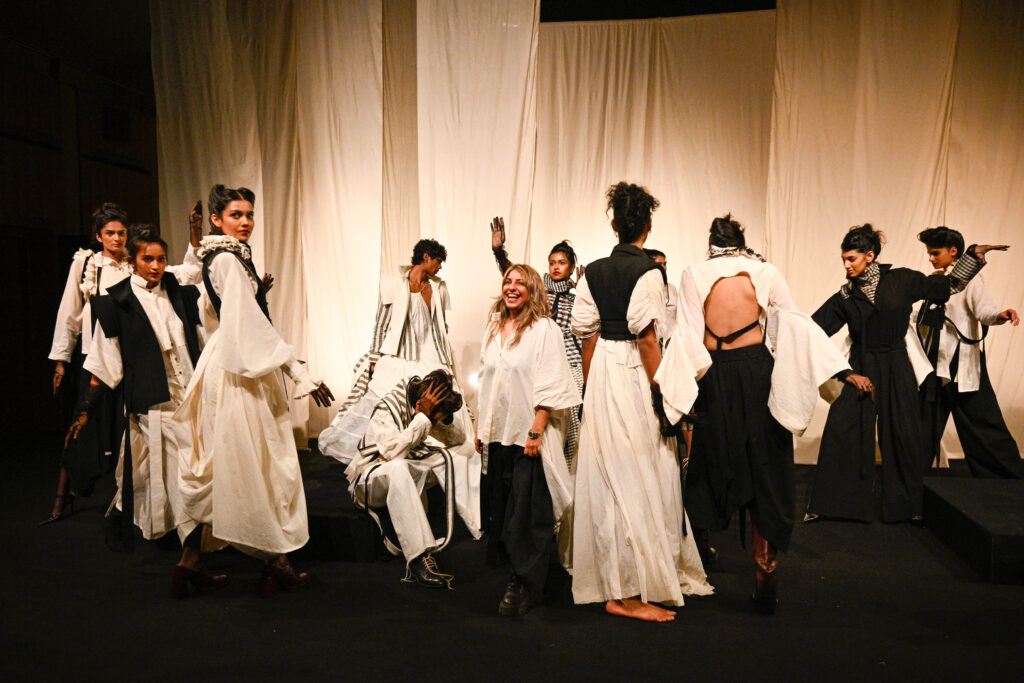
Sohaya Mishra is a 90s girl, she has seen the transformation from Doordarshan to AI, with Chola, she attempts to offer kala cotton with detachable Victorian collars. By Asmita Aggarwal Goa-based Sohaya Mishra is closely related to Nepalese actress Manisha Koirala, the doe eyed wonder who wowed us all in “Ek ladki ko dekha” by Vidhu Vinod Chopra in 1942-A love Story. Mishra is not new to this crazy world of fashion—she started a stylist in Channel V, after a master’s in psychology dressing VJs who were style icons. Yudhishthir VJ to Pia Rai Chowdhary, Ranveer Shorey. “The fun in all this was no internet, only using your wits and vision, trusting your judgment and instinct. It was generally my ideas, worked closely with tailors, remember this was the 90s no Pinterest or chat GPT,” she laughs. When she made VJ Anushka Manchanda wear a big, pink quilted jacket, paired with pants shouting with 100 buckles that moved up and down as she moved, she knew she had broken the template. “I’m petite, I would stand on a stool to dress Gaurav Kapoor, VJs really defined fashion, music and style are soulmates,” says Sohaya. She tried her hand at Bollywood styling but felt it was too chaotic, she attributes it to her being too young and inexperienced, and couldn’t grapple with Hindi movie world complexities. “The 90s was analogue now it’s Doordarshan to AI, completely digital, impersonal and somewhat scary, deep fakes are fearsome- what’s real and concocted, line is blurring,” she admits. Her label Chola, which goes by her pet name, in its 11th year, channels the ideology — edgy, not boring, not trendy but comfy, well made, breathable, oversized. “Initially things were simple, I have a 6-year-old son, I wanted the slow life and Goa offers that. I didn’t want him to be around an iPad, but beaches, sunshine and sports,” she laughs, adding “who knows next there may be interstellar travel?” Earlier, Sohaya was consumed by deconstruction, now it’s frilly and feminine, sharp and tailored sometimes, reflecting how she changed as a person. “This year at LFW X FDCI I wanted to pay homage to monochrome, not thinking of colour. I like waking up to fields, calmness of the ocean inspires me,” she adds. Quilting is her favourite along with fabric manipulation, along with kala cotton, Jamdanis to Chanderis offer character in clothing -backless shirts, Victorian removable collars, detachable drama, pedal pushers. “My clothes are unisex, why can’t men wear skirts?” she concludes, adding, “I make clothes I wear, no embroidery or embellishment, just pure fun.”
From Fatehpur to Europe: Radhesh
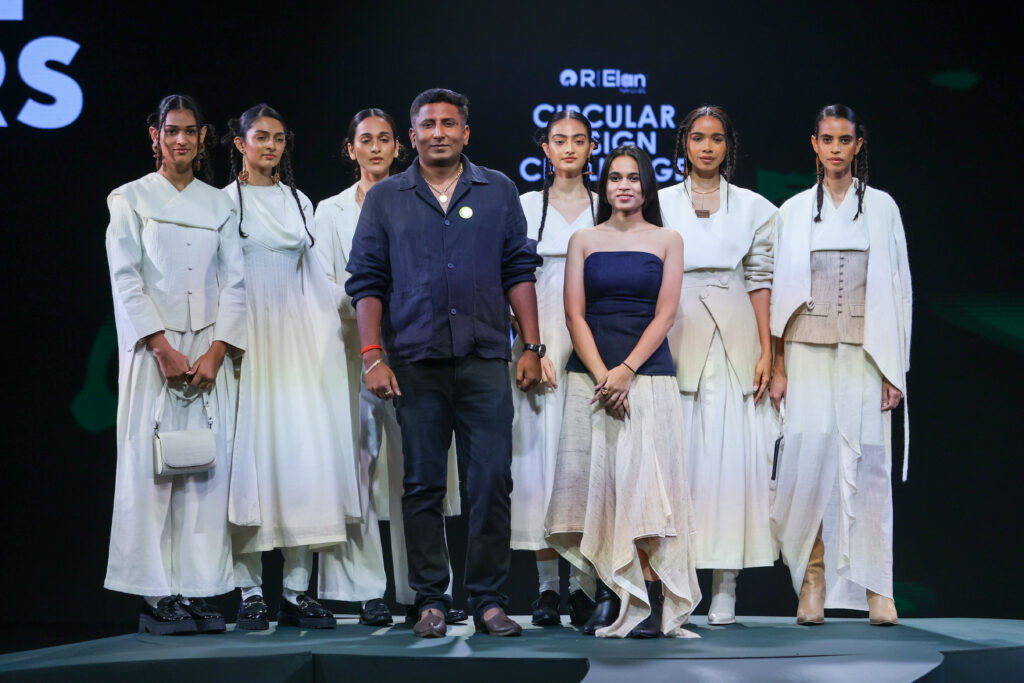
Imagine a shawl as soft as silk, but made from butchery waste, creating both livelihood for tribal women and circularity. From winning patents for his technology, to making wood free paper, Radhesh is a maverick hoping to create a new landscape of style, as a CDC finalist. By Asmita Aggarwal He has won a patent for his revolutionary technology where waste fowl feathers are sanitised and recycled into fibre, using natural ingredients. Radhesh Agrahari started Golden Feathers, his company with 20 women in 2019, today he has 1200 tribal women earning and running their homes. The chicken feathers are light, feels like silk. Growing up in Fatehpur, with zero exposure to fashion, dad was a government officer, he decided to go to NIFT Mohali, then won a gold medal at the Indian Institute of Craft and Design. “I realised there are many more professions than just doctors and engineers,” he laughs. “I come from a small town known for Bawani Nimli, 52 people were hanged by Britishers in 1858. On one side we have Ganga on the other Yamuna, nothing amazing. We lived a simple life, back then, like a tier 2/3 city,” says Radhesh. His work with Tribes India, as a purchase officer, for nine years exposed him to various craft villages, travelling to Baran, Asnawar, no roads, brick lanes where he discovered the most stunning hand work. “We had to buy artisanal products for 160 showrooms all over India, the exposure was enormous. I worked with the Bheel and Garasia tribe, who were traditionally tendu leaf pluckers, exploited by middlemen, earning Rs 80 per day. They started working with us and at home earned much more, creating a value chain system. The idea is not to make money but offer something sustainable to them,” he adds. Today Google and Morgan-Chase are his clients with 70 per cent exports and 30 per cent sales in India (Rs 6,000 for a stole), creating the best alternative to synthetic fibres. He has seen the power in looms, they can weave only 56 metres, but in handlooms women can go up to 60 metres. “I got my break on Shark Tank, we were offered Rs 700 crore for our patent, we never took it. We followed the Lajjat papad model, where raw material is given, and you can make things at home; at G 20 we won the top 8 startups award,” he says, adding machines must be semi-automatic, but tribal women must be involved. His tagline is “where style meets sustainability.” His next big project is wood free paper, and goal is to provide education, livelihood, and circularity to the marginalised. “Food waste like fowl feathers is the third most dangerous thing in the world, feathers create toxicity, and especially when it gets mixed in water. We process it in 27 steps laboriously and craft ultra fine stoles, shawls, mufflers, and can last up to minus 20 degrees. Only his company has a patent for fowl feathers. We have revived Indian crafts, wet spinning, and of course butchery waste which no one was using, lowering carbon emissions. We set up units in Pune, Rajasthan, and Jhalawar,” he adds. The feather-silk is crafted into fabric, keeps you warm in winters and cool in summers, and does not need to be dyed, as it is naturally off white in colour. “My target is not just India, it is the cold countries where winter is almost 8 months long, and they long for natural fibres. We are exporting to almost 11 countries in the world as well as Europe,” he admits. His journey started with showcasing in Dilli Haat and Dastakar, he made almost 386 products including hand made paper, but still faces several challenges like not allowing pickup of waste feathers, even though it emanates sulphur and methane gases which are extremely harmful for the environment and human beings, he concludes.
Meet next supermodels –Sky and Ava
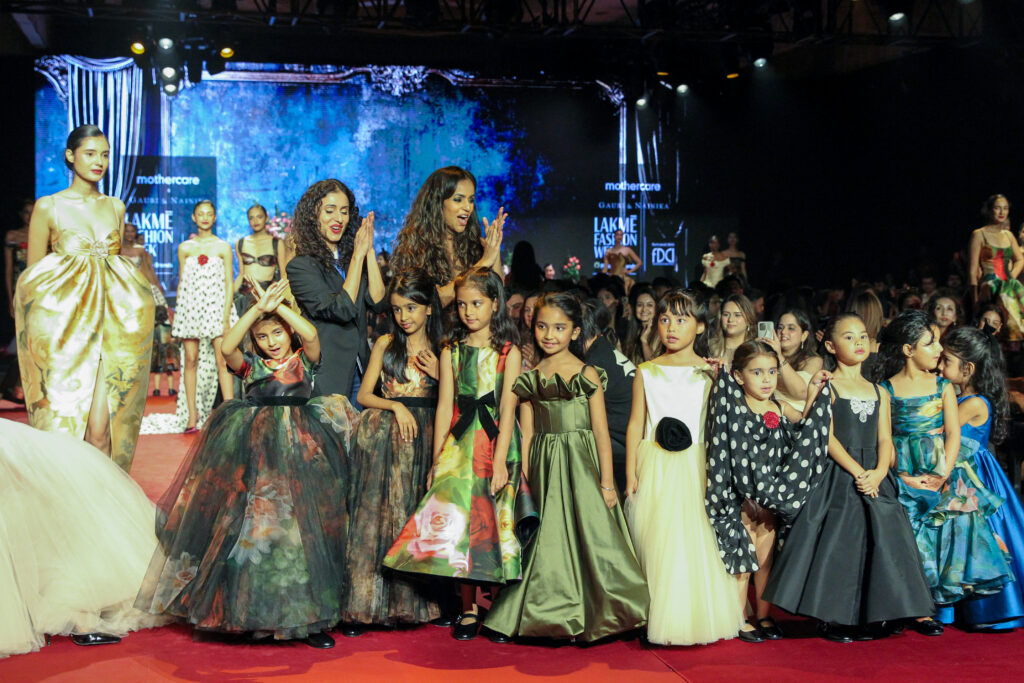
Nainika and Gauri’s daughters, give the catwalk some serious twirls, while Satya Paul announces Bollywood dreamboat Aditi Rao Hydari as their creative collaborator. By Asmita Aggarwal What happens when you have a live DJ, some moon, stars, and sun, mingling with the philosophy of “Papa don’t preach”. Well Shubhika knows young women, like quirky pink lehengas, she also believes dressing need not be about zardozi or kantha, but irreverent bags that come with pearl handles and sun shaped minaudieres. LFW X FDCI shows saw an influx of small dreamboats-including Nayanika’s daughter, as their tie up with Mothercare was surprising. Associated with red carpet, extravagant dressing, Priyanka Chopra in their backless neoprene number, it was a sea change from black gowns paraded with veils, and five-year-olds, in their floral full skirts beginning the show. Balloon and classic Balenciaga style envelope dresses, their signature big bows, polka dots, bunched up skirts channelled the spirit of the swinging 70s. Volume was their thing with tiered dresses in pleasing monochromes, European corsetry, a bit like what Scarlett O’hara wore in “Gone with the Wind”. Exaggerated and pixelated flowers on charcoal gowns, ruffled, and tiered, they decided to get Ava (Gauri) and Sky (Nainika) their daughters’ debut on runway. “We wanted to make clothes that sell—be glam, and introduce Princess dresses for girls (range for 3 to 6 years, some velvet suits for boys as well as bow ties). There is a book we used to read to our daughters–Kate and the Spanish Princess by James Mayhew, the whole show was inspired by this,” says Nainika. If you saw the Panniers or side hoops that they included it takes you back to the 17th and 18th centuries, a technique used to extend the width of the skirts. “Sky my daughter used to love the book, how the main character becomes part of a painting and gets to dress like a princess. We never made clothes for our daughters, though they saw us work all these 20 years. This was one opportunity to do so with Mothercare, it is a year-long collaboration, we have done 30 styles,” she adds. They used Mikado silk, tulle, printed luxe Duchess satin, using boning, bustle, and crinolines, very Marie Antionette styles. The empire cuts and tulip shapes were exaggerated, high lows used, in pure silk and chiffons, they abandoned polyester. “The prints were dark and moody, like an Albert Fernand-Renault painting or a Caravaggio, like an oil on canvas, with big roses,” she adds, admitting they didn’t name the collection, feeling it should be interpreted by the viewer in his own way. Satya Paul is undoubtedly a legacy brand, which understood that an Indian woman no matter how many gowns she wears, or aspires to buy will always wear saris. Almost 70 percent of our population thrives on it. Puneet Nanda and his father Satya Paul started this amazing journey in the 90s, with Genesis Luxury and till today their prints have been their showstoppers. David Abraham and Rakesh Thakore, creative directors of the brand, began with parrot green shoes, draped cowl saris, with bold flowers. And, of course hints of shimmer as their contrasts were engaging —deep blues worn with black and white stripes. From graphic to abstract prints saris worn as neck scarves, not pallas, one shoulder gowns in baby pinks, accompanied by long coats, sometimes knotted at the waist, they got circles, and dots printed as waists were cinched with leather belts. What is new is Bollywood beauty from Hyderabad, Aditi Rao Hydari, as their creative collaborator. “I am so excited, in fact thrilled to be a part of this. It is great to think creatively, play with fabrics, constantly come up with ideas, it is part of my DNA, part of who I am. Satya Paul is for women who own their femininity, it celebrates authenticity. It is a brand that is evolving like women do. I’m dreaming many, many dreams,” says Hydari.
Shibori, leheriya gets “imperfect”
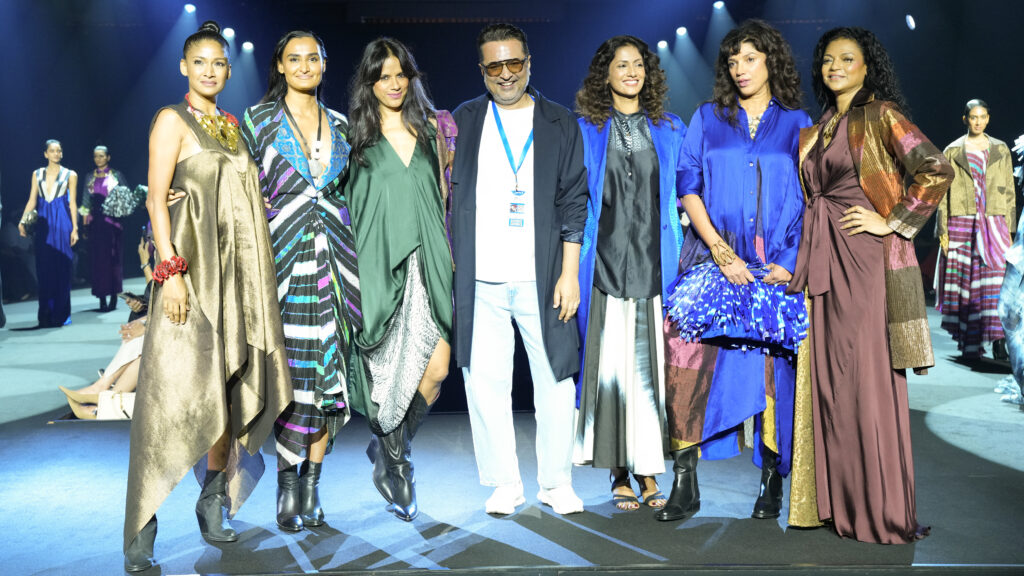
PR exercise is not always fruitful, as brands are not built on celeb dressing, but unique ideology, says Amit Hansraj of Inca. By Asmita Aggarwal “If Sonam Kapoor wears your label doesn’t mean you have arrived”, his point of view is refreshing, maybe because after 20 years in the business of fashion, he realized what really holds value. Amit Hansraj launched Inca, knowing the struggles of young brands, they get trapped in PR exercises, “make this celeb wear our outfit, send free clothes to this TV star” but this is not how brands are built according to him. In 2000 he started supplying to stores like Ogaan and Ensemble, though he had worked with Ritu Beri for six years, Amit Aggarwal too, decided he didn’t want to be an “Instagram genius”. “People who consume fashion are not scrolling Insta, influencers who ask you for clothes will never come and buy your outfits. You are basically not gaining anything by listening to PR demands. Rather relationship building works, a woman who is running a business will not be wasting time on social media. She will need clothes, and will come if you offer her quality,” he adds. Interestingly, he admits, Inca his brand is an exercise in “self-indulgence”, he does one size clothing, this time he added a bit of structure. “I love reversible things, like my jackets, traditional Leheriya got new colours, broke the lines, added vintage textiles, mixed it up. Then we added animal prints with hand blocks, which added depth. I do not like flat clothing,” he adds. His show had 90s supermodels—Carol, Indrani, Nyonika, Sheetal, all the beautiful women he wanted to dress when he began his career, today he got that opportunity. He is clear he does not want to put craft on a pedestal, but make it a day-to-day outfit, not something like your mom’s Banarasi sari lying buried in her cupboard. “Let me tell you something, craft clusters have been monopolized by big designers, they don’t entertain smaller designers. They want to work exclusively with them, all year round, there are many hidden challenges for young brands,” he confesses. Amit decided to do Kantha and Shibori his own way, with untrained women. “I love imperfection. I know many who digitally print Shibori, which I feel is reprehensible,” he adds. He does not want his clothes to look “crafty” this year, to accentuate his look, he began experiments with brass jewellery, made an exaggerated version with doris which he tie-dyed. “Used raffia, it is sturdy, as I didn’t want to use feathers, we revved up our jackets, it was the third element,” he adds. A big believer in “authenticity always works”, even though his Shibori is “made my own way, it looks real to me,” he explains. Dots, cutting in semi circles, is what fascinates him, especially what Carol Gracis wore. It is not size specific, cut on a bias, and takes the shape of the wearer’s body. “I am a textile addict, so Chanderi, linen and silk, organza is what works for me,” he says. After 40 years he admits, he knew his aesthetics even though it is an evolutionary process, “I followed what came naturally to me. Who knows maybe I will do bridal one day, like I dabbled in home and accessories,” he concludes.
Sari dress anyone?
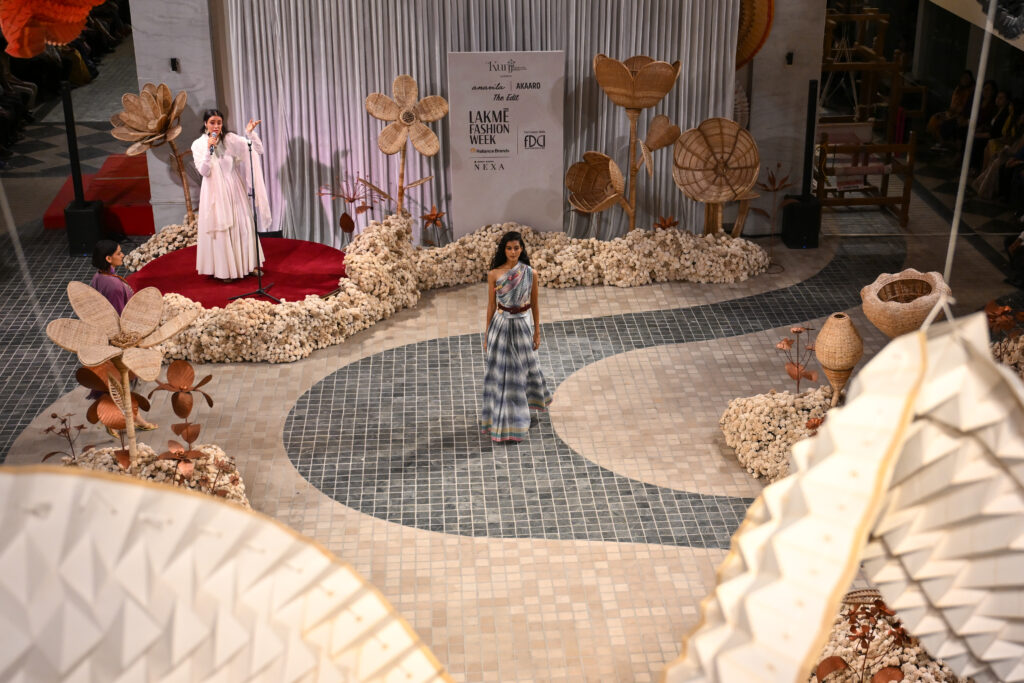
The opening show of the LFW X FDCI by Anavila Mishra and Gaurav Jai Gupta along with in house designers from The Kunj displayed the prowess of the sari, which is now not restricted by pleats and palla but has found a new disposition—jackets, Obi belts and knots. By Asmita Aggarwal Imagine being surrounded by art, culture and heritage, at the first glance at the roof of The Kunj, by the Ministry of Textiles, you are smitten by saris Ikkat, Pathani, Kota Dorias, Mekhla Chaddars, Narayan Peths, Sambalpuri to Maheshwaris, draped in Origami, by the inimitable Ankon Mitra, as you glance up. The waft of mogras on your wrist, and the cobbled ramp complete with wicker flowers, could there be a more befitting opening for the FDCI X LFW? After all, India is a nation known for its hand work, intricacy, and design thinking. The carved wooden pillars Chettinad style strike you, with their austerity on all three floors. Though everyone’s favourite undoubtedly was Suhail Bhan a Kashmiri Pandit, who has been perfecting the art of Bharatnatyam, setting the flow with his dexterous presentation. “I started learning dance when I was 12, learning from Justin, an American! I practise two hours daily, and teach also. Some are surprised to see men dancing, but they look so beautiful, it is an altogether different energy. Today there was more improvisation, as we danced for 20 minutes. Dance is about grace, control, and expressions, as well as how you involve the audience in your journey. I sing also, learnt for a year, it helps in dance,” says Suhail. Live music by classical singer Deveshi Sahgal began the opening show by Anavila Mishra, muslins and her unabashed love for whites. But what’s new is the sari is no longer being worn with palla and pleats, but jackets. “Sarmast”, references the Deccan, from the state of Wajd, thus the ode to handwoven linen, but it was a joy to see the Kerala Kasavu sari rubbed shoulders with pant suits on the notes of Aaoge Jab Tum by the inimitable Ustad Rashid Khan, an eternal fav. Saris came with Obi belts, trench coats, roomy Japanese jackets, telling us there are many ways to wear them. Blush pink looks fab in handloom cotton, as Kimono-style jackets revved up saris, lace bows in the hair completed the look. The show had “The Edit” by seven in-house designers of The Kunj curated by DC Handlooms Amrit Raj. “The look that we presented was entirely woven from waste like all our products, we showed styles on a male model, but all four garments are unisex. The kurta is a kurta dress, then a two-way top, jacket was reversible. The Kunj has been a great place for us to meet customers, and design for them accordingly, generating this level of work with artisans. We upcycle other people’s waste, this is my first experiment with B 2 C, it’ll help develop a deeper relationship with the customer,” says Bhavya Goenka of the label Iro Iro. Pedal looms we have used, natural dyes, extra weft technique to weave waste, Rohingya refugees have embroidered on linen. Interestingly, the belt has arrived and so has the long jacket, the broader the better, the Kutchi mirror work jackets, Ikkats in maroons, traditional saris draped almost sinuously around the body, pleats misplaced and palla disappearing, gave a peek into how innovatively the sari has metamorphosed.
I am greedy for crafts: Valaya
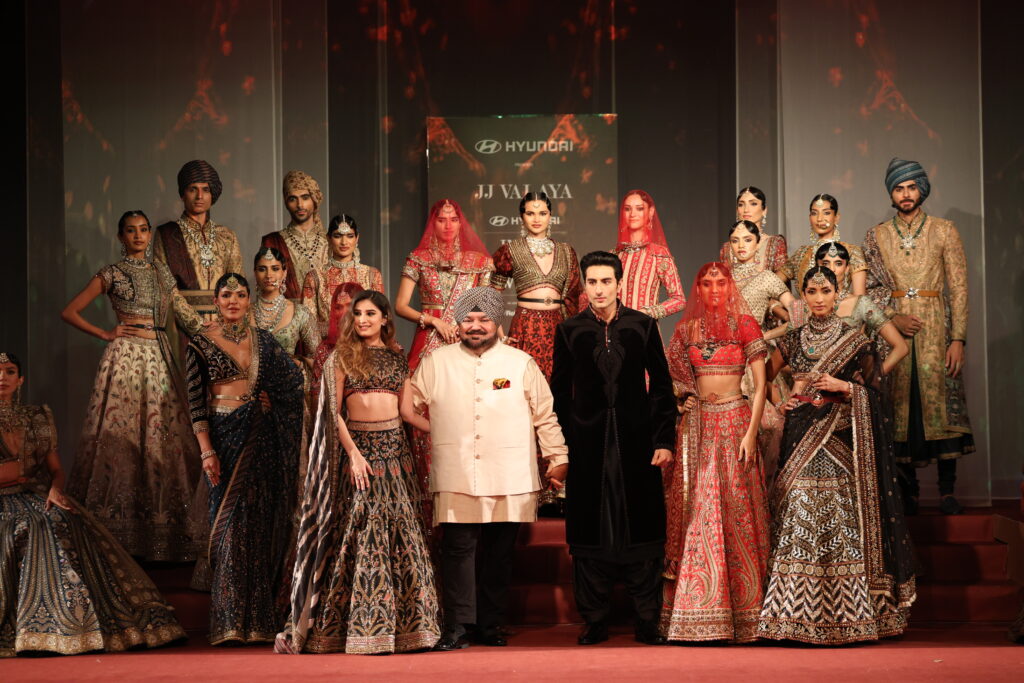
Army mom, Rajasthani crafts, travel and love for the East, forms the basis of Valaya’s ICW line replete with motifs of the Balkans to his ideology –a “royal nomad”. By Asmitaa Aggaarwal J J Valaya was born in Rajasthan, Jodhpur, a fauji kid who travelled all over the country Lucknow, Chandigarh, Pune, to Delhi and from here comes the spirit of travel, as well as exposure to multitude of cultures, living in different parts of country understanding artisanal forms that exists there. “My mom was an army wife, used to handle ladies’ welfare at the army cantonment where they teach embroideries-cross stitch, shadow work to smocking, which I imbibed along the way. All that seeps in, I believe in the power of creativity, it paves the way, defines the path of your life,” says Valaya. It has been 33 years, 35 if you count his education in NIFT, this is why he asserts, fashion is a fab career option, only if you have passion for it, as you are put on test every six months. “You must put blinkers on like a race horse, keep moving. Focus on what you are good at and focus on that, you can’t rest on your laurels. Be aware of what is going on in the world, don’t lose focus, don’t waste too much time on networking. Put in a lot of effort, work hard to hone your skill, make it the best,” he advises young designers. This is no hard and fast rule, he believes in “less is more” or “more is less”. Every designer can support both and believe in either ideology, maximalism vs minimalism both have advantages. India is a land of maximalism, foods are complex, we are a continent not a country, everything changes in our country from our festivals to our dresses. “No simplicity in Diwali or holi we are extravagant – architecture, carvings on rocks and stones, making masterpieces. Indians are not averse to embellishments, it is our greatest treasure—some use it to flourish with just a beautiful garment, some would create an entirely embellished masterpiece to go into a museum-highly subjective our love for shine, he believes. “It all depends on our design language. We love to celebrate—weddings are grand, we consume couture with fervour,” he adds. People should believe in their country more, focus on quality, Valaya doesn’t have gora hangover, feeding to the whims of the West, nor do we try to appease them. “Unless we get accepted in the West we don’t arrive, we feed on that ideology. We can’t be farther from the truth, India will be the prime market for everything in the next ten years,” he explains. His philosophy is to simply believe in my country, make indigenous fashion statements as brides are consuming couture, like they rush to buy bags and jewellery. Why not buy beautiful clothes? “Couture in India is linked to weddings, some women buy embroidered jackets, to feel happy,” he says. Any good brand in the world will be evolutionary in nature—is true benchmark of a brand which believes in its ethos and grows within that. It means you are aware of trends, you don’t blindly follow them, because luxury, to be called luxe, needs a high degree of timelessness. It is an investment, buying masterpieces, not clothes, you want them to last, pass them down to generations, that’s what couture is, he adds. The collection for ICW 2025 “East” and it’s his journey into this hemisphere….he is going back in time, 18th century when the West used to look at East with wonder. “It was a mysterious land full of stories —amazing cultures, artisans, crafts. So we wandered from the Balkans into the far East and finally settled in India,” says Valaya. When it comes to crafts, he is greedy, doesn’t cultivate favourites, he believes there is so much to explore in this country, it will take a lifetime. Any Indian designer must rediscover hidden crafts, and reinterpret for the current generation. Exactly what I am doing, innovate every year, push limits of excellence when it comes to workmanship, detailing and prints we sneak in. We don’t believe in extreme change every year. It has to be evolution. There is a distinct DNA of the brand that’s why customers come to us,” he adds. The bride is well travelled, the internet has brought everything close to us, she is intelligent, aware of what’s going on, all these factors make her better informed than brides of the past. “Being a classist, I want to create masterpieces she can truly enjoy, cherish, make her feel good, look good, give her pieces she knows can be worn again. I do not like gimmickry, I do not want to shock, I want to awe, but with a degree of craftsmanship, and artisanal quality in the garment. All the initial sketches are always done by Valaya himself; every sketch that’s made is fine-tuned by me. “Couture demands that attention, I really enjoy what I do. Gen Z and Gen Alpha are in another mind space, we are mere observers, from a distance see what’s happening and adapt to what’s going on. Tradition plays such a large part of Indian couture, there won’t be any radical changes happening, but mindset is changing-GenZ wants things to be experimental,” he adds. It is a very intelligent generation, they know exactly what they want. They realise, anything good has value and they are willing to pay for it, “so I think after 35 years I have learnt how to adapt to this generation,” he explains. Being a stylist, photographer, designer, a multifaceted person, “the royal nomad with a panache for art deco”, is an apt tagline. “It applies to me, as I love what I do, 33 years down the line I am still as excited about every show, every collection, every brand campaign that we do, photography is my alter ego at play, great leveler. We also do home interiors-carpets, love designing furniture, very fortunate to
I was a rebel, out to prove a point: Rimzim
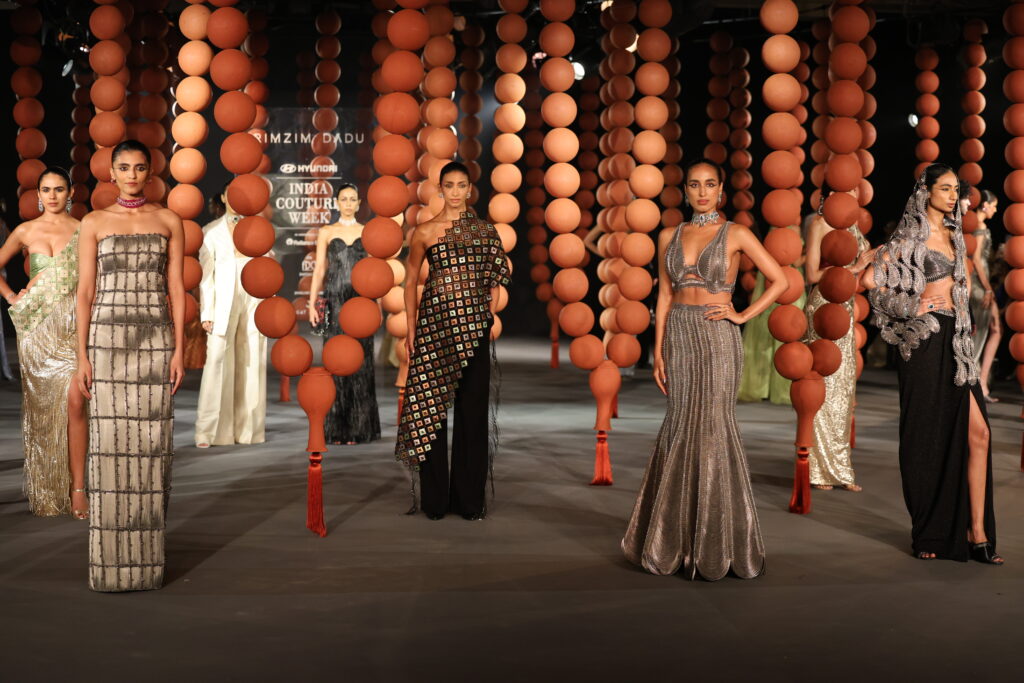
Age and time have taught Rimzim Dadu the importance of merging commerce with fantasy, this year her Banjara tribal jewellery inspired chainmail dress took one month to execute, just like her rejigged sari not swathed in metres of fabric-happily crisp. By Asmitaa Aggaarwal Once upon a time Rimzim Dadu’s steel saris were looked upon as an anomaly, but that was almost 18 years ago, when lehengas were red, zardozi weighed them down. As fashion and the audience has evolved, Dadu calls herself a “rebel, out to prove a point”. At 21, she didn’t care about commerce, though today she realises it takes a lot of maturity to finally run a business. “I think I have found a sweet spot to do what I want to, discovering my own voice, and an audience that accepts my aesthetic,” she adds. Instagram, she feels, has really evolved the public perception of style, though the intelligentsia may despise it, it isn’t frivolous. If anyone follows me they know exactly what’s new, what I am thinking, it is now a democratic process nondependent on traditional media,” she adds. Indian fashion is now looked upon with respect, also curiosity, we are no longer a manufacturing hub, crafts and artisans are the showstoppers, but there is room for many India stories. “There is India traditional, modern, and futuristic. Our traditional weave had been heavily dependent on motifs and embellishment, so what’s wrong with shine? I don’t find it repulsive. Even if you look at Jamdani it is white, but the motifs on it give it that unique character,” she admits. Dadu is experimental, develops new textiles, drawing boards, and karigars envision how to upcycle what is traditionally looked at as waste. “Sometimes it takes ten failed attempts to get things right,” she says, adding, “We start again if we feel it is not going how we planned.” The language of bridal couture has altered enormously; steel saris earlier brides would ask if they could check with their mom-in-law, before buying, now they are the decision makers. Cliché is out; everyone wants to look bolder. “Couture now has elevated craftsmanship, it is a vision, our metallic jewel tones, and a whole new section of gunmetal grey this season is a big risk I have taken. Even though I don’t like to work on set themes,” she says. Her inspiration this year has been Banjara tribes and their vivacious jewellery, Dadu has done Patola in the past, this year she has fallen in love with Bandhani, the knots, used as an embellishment rather than in whole. “For me fashion is art, so the skirt that we made with metal and steel interlinked inspired by tribal jewellery, a chainmail structure, took one month to make after several failures, just one piece,” she smiles. Though Dadu is a woman of finer tastes—she wants to do things other than clothing—maybe lights, textiles, sculpture. “Though what helps is switching off and living in my bubble,” she grins. That’s why her new “streamlined” lehenga (not using 20 but 2 metres of fabric) or playing with a new way of draping “palla”, after detailed R & D is what ICW 2025 saw. Cording, steel wires, in sherwanis, bandhgalas, bomber jackets, it has been a journey of following her passion, even as the new mother Dadu finds “solace” when she works relentlessly to create stand out pieces.