
After 25 years “waste is gold”
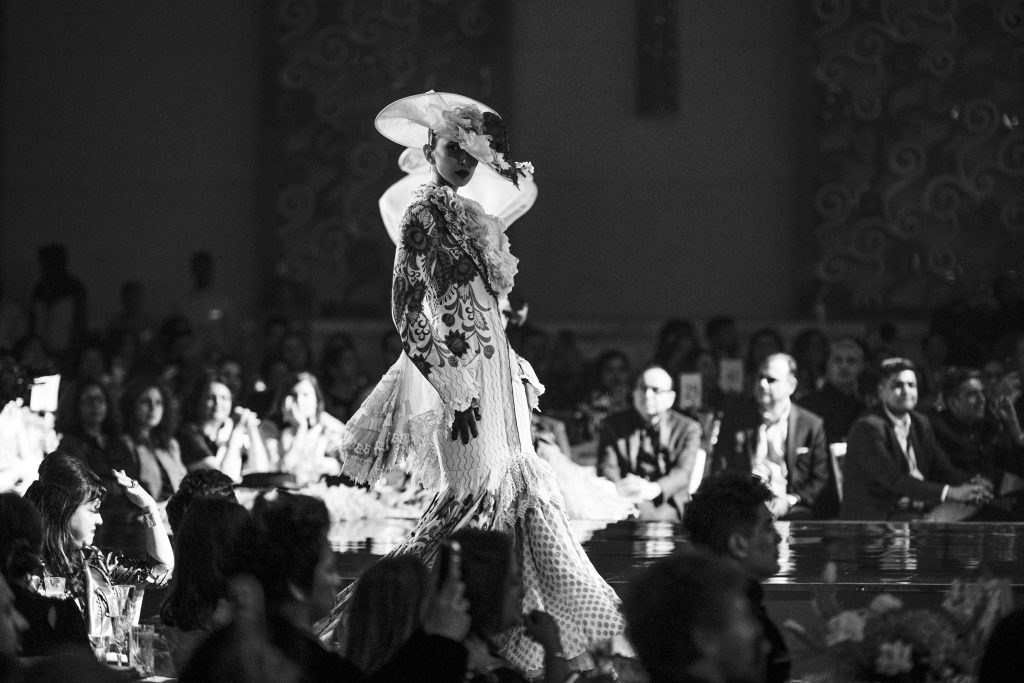
As fashion celebrates its silver jubilee, what is clear now is —sustainability is the only way to go forward, and designers have already taken the lead! By Asmitaa Aggarwal It was a reunion of sorts, designers came in droves, some who had not been seen for over 20 years—Anshu Arora of The Small Shop to Raghavendra Rathore, Ritu Beri, Monisha Jaising, Nikki Mahajan, once doyens of their field, today reticent. FDCI X LFW got them together—after all it was the time of celebrations—25 years of the fashion world! The Jio Convention Centre, Mumbai was where almost 300 people congregated—the most known faces, who have uplifted the barometer of design, innovation, and ingenuity—made a heady blueprint to go forward. Almost 33 designers recreated archival ensembles from 2000 onwards, with 60 models (Lisa Hayden to Lisa Ray), the biggest pool, with Indian-American actor Kal Penn as the host (Van Wilder, The Namesake, TV series House), who not only laughed at himself, but also asked an interesting question to Bollywood dreamboat Kareena Kapoor. “What do you think of fashion critics?” She candidly replied, “They are as important as film critics—they should keep designers on their toes.” Manish Malhotra when asked about his jewels glimmering on his sherwani admitted it was a “hard sell” and someone rightly said, “All this madness is therapeutic I would have it any other way.” Kareena confessed, “make and hair stylists the real stars as they make us look amazing. My darling brother Manish is here. Maybe I will come again on the catwalk not as size zero but owning my body completely”. For 25 seasons she walked as show stopper, once pregnant with her son Taimur, “most emotional moment for me, though my only hope is I don’t fall on the ramp, even if I do, I can get up with dignity. I also suck my tummy in a little,” she laughs. The show had Ritu Beri (2006), Tarun Tahiliani (2000), Monisha Jaising (2002), Rajesh Pratap Singh (2012), Raw Mango, Anshu Arora (2004), Anamika Khanna (2004), Manish Malhotra (2001) outfits recreated, among others. “As I reflect on the 25th year of Lakmé Fashion Week, I am reminded of the incredible journey fashion has taken in India. I had the privilege of opening the very first Lakmé Fashion Week in Delhi in 2000. Looking back, it’s nostalgic to see how far fashion has come—from a time when we could barely fill a room to today, where we are overflowing with a passionate audience. Creativity now permeates everything—the way people dress, the way they express themselves, and the way fashion is embraced in everyday life. It is a testament to how the industry has evolved, pushing boundaries and shaping a more vibrant, dynamic fashion landscape,” says Ritu Beri who started in 1990. She was the first one to do a show in Paris, headed a French fashion house Jean Louis Scherrer, and in 2010 won the Chevaliere des arts et des Lettres award. Though after 25 years one thing was clear—waste was gold now. Nagpur-based Shruti Sancheti, made hair bands, bags, scrunchies out of katrans, and has managed to get orders for it. There is undoubtedly a stream of attempts to be sustainable –the value of the ensembles made from it was Rs 30,000, says Urvashi Kaur. “We create textiles out of fabric, trying to be zero waste, but the beauty is that we are able to craft one-of-a-kind pieces, the key is to be able to shift consumer behaviour,” says Urvashi. On this it’s kantha, and her undying love for tussars, all hand-woven wonders she works with as the market is showing renewed interest, buyers want to know about their garment and how it is made. There seems to be a good churn happening, fashion weeks are a great platform for designers to express themselves visually. “We lost great design somewhere in the greed to keep selling, opulence and money wanting to show status. But the question is how do you contribute to a community. If your work does not hold meaning that money is not happy money. Young people are facing climate change, we have capitalist exploitative businesses, but we must find a way to keep our beautiful traditions alive,” she adds. Bangalore-based Mani Shankar, believes the customer has also changed, each city has its own nomenclature– “Delhi loves bling, so I make it, I must survive also. But the Rs 30000 fabric manipulation linen kurta sells well too, it is our USP,” he adds. “The last 25 years have been momentous in shaping what we now call the Indian fashion industry. Specifically, the last 10 have seen accelerated growth for many brands due to the various initiatives of the FDCI and the influx of corporatisation. I’m truly hoping the next decade is all about true growth, appreciative of all categories of fashion not limited only to bridal couture. I look forward to this next chapter,” says Ashish Soni. For 17 years he has been in the business of fashion, and Nachiket Barve, believes fashion is evolving with more awareness. He has launched a new line of enzyme washed denims for Rs16000, admits he has understood the market better. “I adapted. Design is a dialogue between the customer and you, you can’t be stuck in time or resist change. I look within. We are going to do more business and growth. India’s biggest strength is craftsmanship and willingness to change which will hold us in good stead,” he adds. Akshat Bansal of the experimental label Bloni, showed how he managed to do bio mimicry of a crocodile skin with Shibori, plus his additions of stainless-steel architectural materials on a tailored jacket. Some places you can also see ghungroos, as he sells the silk organza Japanese weave, with reflective properties for Rs 2,50000 lakhs. It comes with Savile Row tailoring, and a mix of various engaging techniques, custom designed. He is one of the bold, new designers who are taking fashion to the next level—see his silk felt raw fabric, it was waste that weavers
Khadi adopts new ‘vibe’
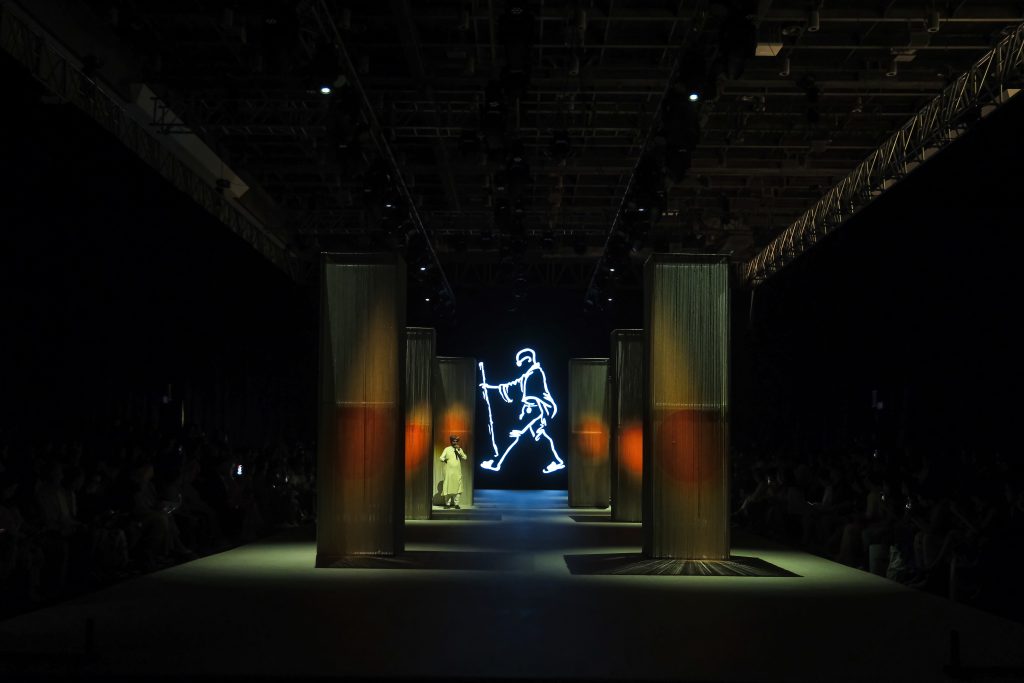
Hoping to wean away GenZ from fast fashion, Co-Ek has launched khadi resort wear-think wrap skirts and summer dresses. By Asmitaa Aggarwal It is always invigorating to observe seismic changes in the way Khadi has been perceived and elevated— leaving its traditional starchiness, adopting a modern nomenclature. This year Co-Ek (Centre for Excellence for Khadi), powered by Khadi and Village Industries Commission (KVIC), crafts dresses instead of saris. It was a concerted move, to serenade GenZ, maybe learning from Moscow Fashion Week, where Nargis Zaidi, head of apparel Co-Ek met khadi lovers, who told her “My grandmother was a Gandhian, I love its imperfections.” The shapes of khadi are now global, jackets skirts, pants, layered magic, inner wear, relaxed fits, also in the process Co-Ek recycles and upcycled katrans, channels circularity while creating statement pieces. “When we sort out fabrics, we do it colour wise, indigos stitched together for example, to offer a discerning palette,” says Nargis. Khadi is a versatile fabric, it may be Swadeshi, but it has international appeal, as she had gone ahead and crafted blazers with it. Since 2021 her efforts have been to start a new narrative, break mindsets and barriers, introduce new colourways (yellow and reds, or charcoals and reds). “We were trying to tell a story—paying homage to little things that often go unnoticed, but impact sustainability, that’s why you see tiny embroidered beetles on resort wear; our line of gamchas, we had the yardage increased while weaving to create wrap skirts,” she adds, hoping this will be an effective alternative to GenZ shopping at Zara and H & M. For the FDCI khadi show, at LFW 2025 she took her experience working with FabIndia and Avaram, forward, by weaving it in Bengal, Gujarat, Punjab to down South, each region bringing along its uniqueness. “We have students from fashion colleges coming to do final projects on khadi which is heartening. A Japanese fashion lover from Tokyo wrote to me on how she was doing her thesis on khadi. Unfortunately, in India, we take it for granted, globally they love the natural textures,” she adds. Hand spun, keeps you cool in summer and warm in winter, organic, a politically powerful fabric, no fabric has this much history!
No white collar, it’s silver for Anamika
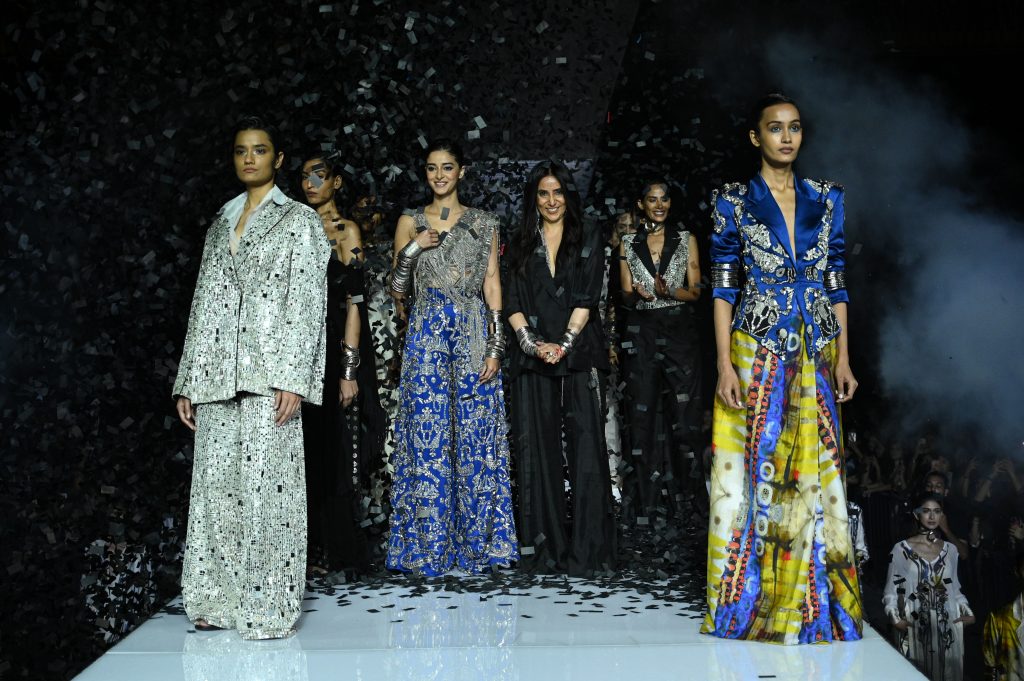
After almost 25 years, Anamika Khanna is hoping women in lucrative careers want something that is not just suits and blazers –maybe a silver tie, suspenders, daddy briefcase and some pearl encrusted denims from AK-OK! By Asmita Aggarwal India is all over the world, and it isn’t just “in India”, anymore maybe that’s why Anamika Khanna’s AK-OK for working women, is timed right, the market is ready for this, especially as professions are now unconventional. One could see nostalgia—daddy suitcases cleverly revived, splashes of colour, even though monochromes are her thing, denim is now slowly moving to her favourite list. Above all, no one can beat her in texturing—how she combines various techniques—patchwork, applique to mirror work at her show for LFW X FDCI. The ignition of the idea came from Rabari tribe who are movers never static—Gujarat, Rajasthan and have some Afghan influences too, she began researching, and found their silver stacking jewellery was phenomenal. She took those—and modernized it with suspenders, ties, chain loop belts, “you don’t need to wear silver only as a jhumka, if it can be a silver collar too”. She had that too—literally, workwear equals—”silver collar”, also the name of her line—like you have blue collar and white collar. “Let me tell you what I think is my biggest strength—I don’t think of the garment but the woman,” says Anamika, understanding the changing needs of modern women, their intimate relationship with clothing, and how it changes their mood. After 25 years in business, every time she does a line, she wants to incorporate something “forgotten or lost”, last season she also paid tribute to the Bonda tribe from Odisha. “Women bring not just power to the boardroom but also emotions and compassion onto work, I wanted each of the 50 pieces to reflect that,” she adds. If you look closely, the styling, it has a churidar, with a dhoti and collared skirt, each reference was out of India, but how to make it fashion Anamika knows. The show was about 9 to 5, and how workwear rules are being broken, in between this mix she revived her dhoti pants of the year 2000, churidars which she loves, as well as tattered holes and cut outs. “Designing as a profession is challenging, lot of people tell me take it easy, take a break, and while I am talking you, I’m sticking applique on a dress, this is my life, I live for fashion,” she smiles,
Clothes with feelings
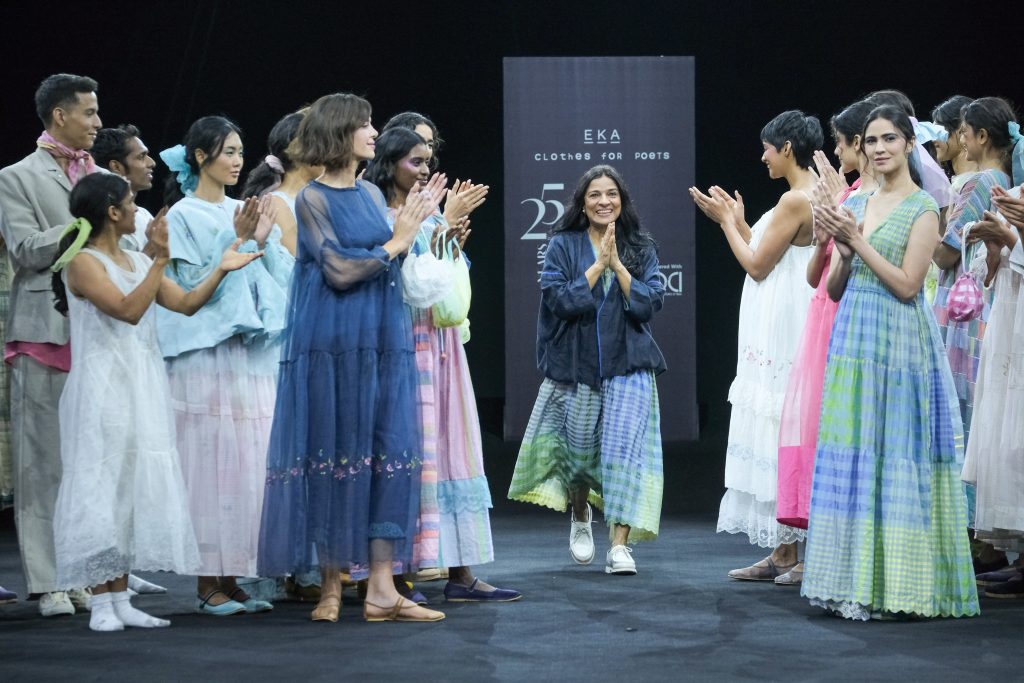
From serenading poets to artists, Rina Singh’s Eka is a case study of craft upliftment. By Asmita Aggarwal If clothes could have feelings Eka would be a right fit! Rina Singh, who built a brand, brick by brick, over 13 years believes it took years of developing product knowledge and working closely with clusters and weavers that helped her finally launch a brand. Unlike Gen Z who know marketing, but learn about product excellence along the way, their skills are so polished that business turns out to be good! “They do it right out of college, I took several years to have the courage and wherewithal to launch my label,” says Rina, adding, “the world of design has changed unequivocally.” Eka and Eka Core are two different ethos—but same mothership, the latter is ready-to-wear, younger, less moody, uses archival textiles and repurposes, so circular in ethos. Rina overdyes it, uses quilting, makes it trans-seasonal as most are leftover fabrics. Eka is known for its love for hand spun and slow, thus the making process is not instant and takes a year of planning. She took a concerted decision to be on the ramp, after a hiatus, to offer woven wonders from Bhagalpur, Banaras, Kota to Bengal, telling a story in Muslin, lace, inspired by Amer, Jaipur with its imposing mirror mosaics, for LFW this year, but she has interpreted it differently—appliqué to tiny embroidered motifs. The idea was to have movement in clothing, like choreography, how clothes adapt to the body and its wearer; as the DNA of the label remains the same every year, but the inspirations are rooted in craft upliftment. You may have boxy trousers, laces only show shifts in moods, things you can wear from Kutch to Tokyo, as it remains feminine, layered, and translucent—this time it’s silks, gossamer and diaphanous. “Sandeep my husband, is a pillar of support—he manages operations, so I am free to design, it takes a huge load off me, in the last decade, he has been a backbone. But I have learnt marketing needs to be loud, brands must have their own voice, and over the years I have learnt not to be rigid about my product,” she adds. Kurukshetra where she was born to agriculturalists, made a deep impact on her psyche growing up, she valued crafts and the “thinking before doing” process of clothing, where you deliberate rather than buy –it is laborious, time consuming, and expensive, but it is also timeless and hand spun, the beauty is unmatched. “I come from a Rajput family where traditionally women invest in weaves, pearls and Kashida, as well as vintage shawls, they understand aesthetics,” she says. Working with the European markets, especially Japan, Rina believes the real jewel in the crown in India is ready to wear, yet we are focussed on weddings, a money churner. “I know the Indian woman likes to be comfortable, yet classy, so why not give her craft-soaked offerings with hints of colour?” she concludes.