
Anamika to support 101 artisans
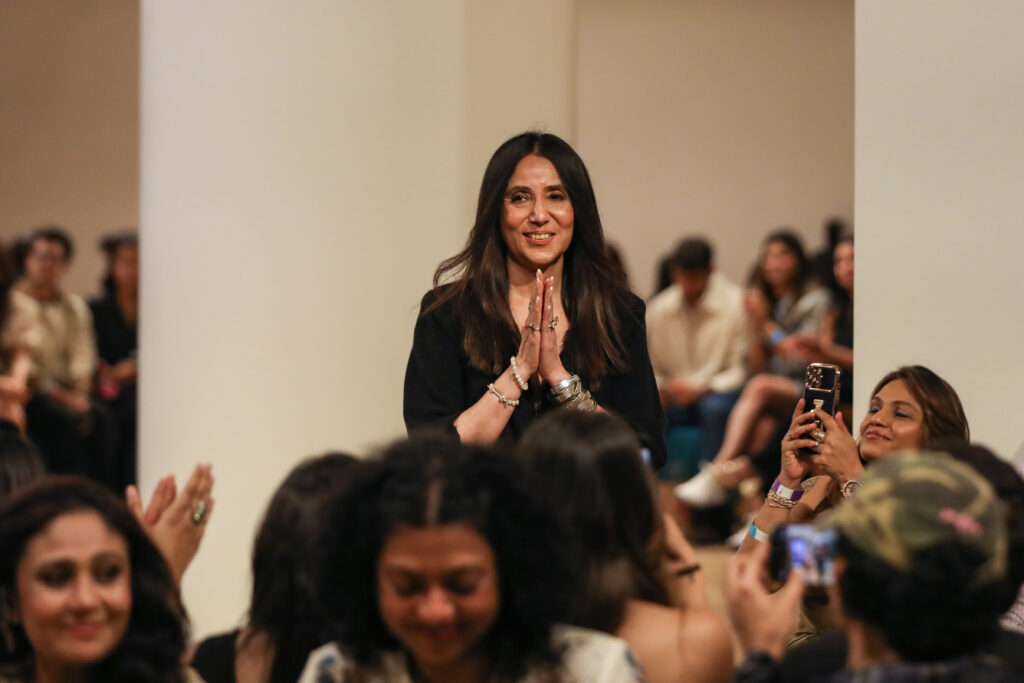
She is a tour de force in fashion, most sought after but she is wanting to give back generously, by making artisans from various clusters in Gond and Pichwai self-reliant, that’s her mission for the next three years. By Asmita Aggarwal Anamika Khanna has been a trooper of sorts ever since she won the Damania Award in 1995, her journey has been interesting in more ways than one. “I didn’t know then what was even one meter of cloth,” she laughs. Today she is Sonam and sister Rhea Kapoor’s go to! So, when she went as a newcomer to London Fashion Week, “putting yourself as a new label AK-OK was a challenge, we got an overwhelming response”, says the Kolkata-based guru of meaningful details. Though she was impressed by the working style, professionalism in London, it was simply “humbling”. At AK-OK, which she is showing at LFW X FDCI is for her “what we dream we do, hoping to offer global pret, this product has the wherewithal to become that”. Couture is hand crafted, we can’t compromise, completely hand done, nothing digital, even the jewellery perspective is Western with an Indian soul, wear it in New York or Dibrugarh. “We mix ancient temple motifs, with contemporary acrylic, 3-D printing, and two dynamic materials. I’m having a lot of fun with AK-OK (began when she was unwell, her twins would ask her AK- are you ok?), it is limitless, feel like a child in a candy store,” giggles Khanna. Though the designer now wants to give back, her new project is making women artisans 101 (she doesn’t know how she got that number in her mind) financially independent-craft clusters over the next three years. “Let’s say the Gond or Pichwai artisans, the idea is to spotlight them, as I use their craft in my bridal wear, hoping it brings awareness to the clusters and make women self-reliant. This will be a recurring initiative not a one-time passion but will continue,” says Anamika. Her fame has crossed borders, European Commission President Ursula Von der Leye wore her fitted bandhgala satin silk self-on-self, handmade embroidered on Jan 26, this year. “I knew she would like something like that, seeing her crisp no nonsense suits,” says Anamika. Her more recent love has been double ikkat Patola, sometimes she uses it as a traditional sari, other times as a base to enhance different experiments, mixing it with lace and Banarasi. Patola is sourced from Swadesh (Reliance Foundation to support master artisans like Kanubhai Salvi and Hema Patel, GI-certified handwoven in Patan, Gujarat, almost 750 years old). Though her one desire remains unfulfilled– to dress the iconic actress Rekha, her beauty frozen in time, “she would look ethereal in our organza sari, wouldn’t like to alter her look, or personality,” says Anamika. Dressing Rashmika Mandanna, from Coorg, in a rust-orange silk saree with a bold red border inspired by “Deccan Temple” embroidery in antique gold for her D day with Vijay Deverakonda. “We had to tone down the brief, or it would look like a costume, not too ethnic India,” she clarifies. It took two months to create, several months for R and D, as “research couldn’t be random”. She explains how concepts varied from shikar; they indulge in down South motifs for Vijay as well as South temple structures for the veil for Rashmika. Her two boys have made a place for themselves outside the shadow of their mom—Viraj the shy twin is an artist, Vishesh, has a master’s degree in design from Central Saint Martins. “He is in touch with Gen Z, I don’t know them, this is a big advantage, so I listen. He is the one who sent me sketches for menswear and I really respect his opinion. We three are good for each other,” she says. Her LFW line is an homage to flowers she loves, like Coco Chanel, her obsession with camellias, plus she is looking at an alternative to fur, vegan and sustainable. “We have explored knits, versatility is the key here, Japanese fabric was added for the first time, denim was cut and slashed last time, this year we have taken a detour. I work with my instinct to design for women, knowing what they want,” she signs off.
Veshti with a tuxedo-Anyone?
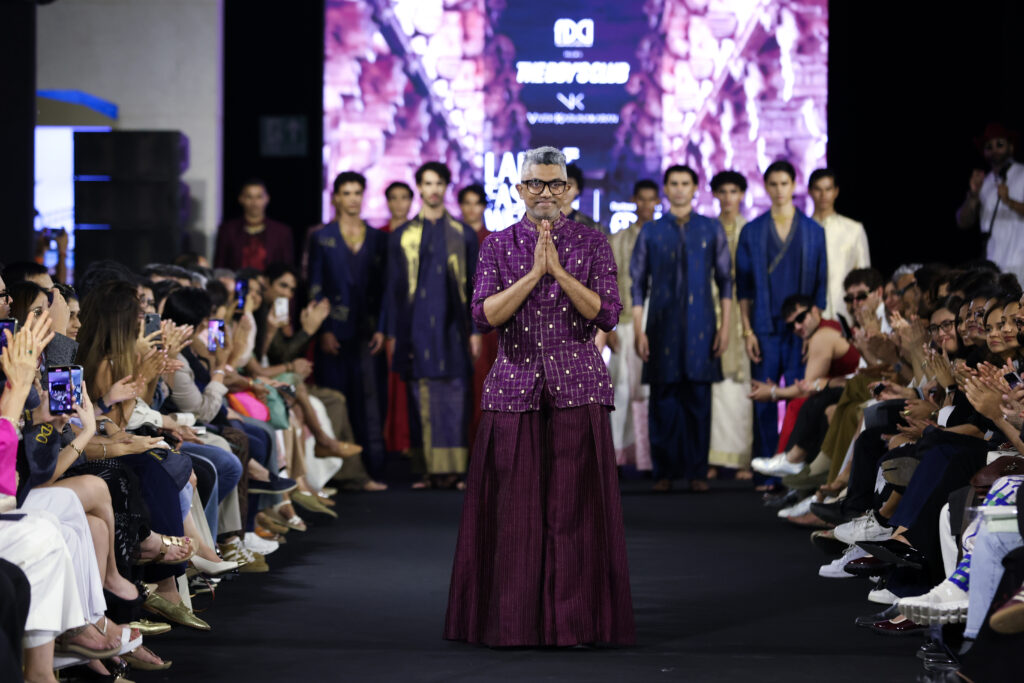
The veshti has found unadulterated love—now it can be worn with silk kurtas, bandhgala et al, Vivek Karunakaran shows us at FDCI Boys Club show at LFW! By Asmita Aggarwal Veshti is in and how! This culturally rooted piece of attire has found a new life with Gen Z adopting it, Vivek Karunakaran believes he has been a catalyst of sorts. “Whether it is lungi, dhoti or veshti, it has been reimagined, North Indian wear it uniquely, down South, or Sri Lanka has its own versions in sarongs. This rectangular piece of fabric is now a red-carpet staple too,” he adds. Vivek is a designer who celebrates his heritage and the Chendamangalam sari, hand woven cotton sari from Ernakulam, Kerala with its puliyilakara (tamarind leaf border), a thin black line that runs with sari’s selvedge, extra-weft chuttikara and stripes-checks of varying width. Vivek works with many such woven wonders in fact reveals that Ram Raj, a South Indian brand has been promoting Veshtis, extremely popular, in Bollywood, Kollywood and even Mollywood. Abhishek and Amitabh Bachchan wear lungis which has again brought the spotlight on it. In Chennai Veshtis are worn in silk, Kerala in fine muslin (Mund), border is in zari (kasavu). “In Chennai it is in Kanjeevaram, tissue, silk and thin pinstripes. We have checkered ones with zari inserts. In fact, in Kolkata we did a pop up, veshti we teamed up with a tuxedo, did very well,” he smiles. This drape evokes a sense of nostalgia, there is an emotion associated with it, veshti also comes with co-ords or a silk kurta, or shirt, a bandhgala and a kamarband, sounds crazy but it’s beautiful, he chuckles. “If you notice how Rashmika Mandana and Vijay Devakonda wore their heritage–veshti, gold and temple motifs, elegant yet luxe,” he adds. The 40-50 age group has it in their wardrobe, but Gen Z maybe needs to go for the stitched ones, like the pre-stitched sari. “Hyderabad is really the Delhi of the South, less is more doesn’t work here, they have a strong visual aesthetic: love zari plus texturing. Having said that South Indian bling comes with an in-built grace, Delhi’s a bit loud,” he laughs. His latest line for Lakme Fashion Week X FDCI “Thangam”, or “gold”, channels the feeling that he is the cultural ambassador of the South. “My grandma saved something in gold for my mom, it is vintage, she told my mom to pass it on to me. Gold is not jewellery, it represents permanence, reminds you of precious moments,” he says. His love for Tamil script has only grown over the years, it is one of the oldest in the world, starting with his line “Idam”, wearing it on your sleeve, literally and metaphorically. “When you see Tamil script on the back of a bomber or jacket, it makes you curious, conversation starter, everything has a deeper meaning,” he adds. Fascinated by “Thirukurral”, by 18th century Tamil poet Thiruvalluvar, his 1339 passages on how we should live our lives spoke to Vivek. His jackets come with words of wisdom “There is a space to grow with humility” or “Choose your work carefully as it’s going to be the biggest passion of your life”. Though his ingenious innovation on Madras checks is engaging, he created hand blocks and converted them to checks, printed them, even though many American brands have used it as “exotic India” trope; traditionally they are used on cotton lungis. “This draped fabric is frankly unisex, if you notice carefully, it has the jasmine placement embroidery on the elbow reminding you of the time when you go a temple and the flower seller outside measures the garland for the Gods inside, by elongating it till his elbow, and then cutting it. It is not a logo on the chest, it is a story we are narrating,” he explains. For women his veshtis came in silk with applique and translucent borders. “We dressed a bride in Sri Lanka with a red organza veshti and jasmine embroidery,” he concludes.
Clothes with feelings
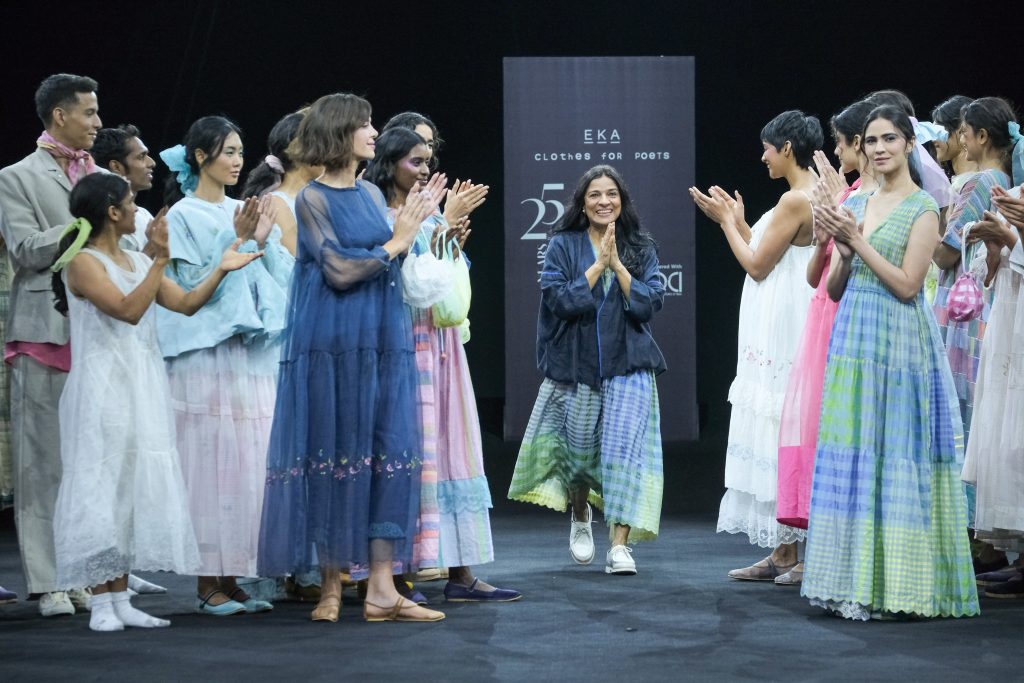
From serenading poets to artists, Rina Singh’s Eka is a case study of craft upliftment. By Asmita Aggarwal If clothes could have feelings Eka would be a right fit! Rina Singh, who built a brand, brick by brick, over 13 years believes it took years of developing product knowledge and working closely with clusters and weavers that helped her finally launch a brand. Unlike Gen Z who know marketing, but learn about product excellence along the way, their skills are so polished that business turns out to be good! “They do it right out of college, I took several years to have the courage and wherewithal to launch my label,” says Rina, adding, “the world of design has changed unequivocally.” Eka and Eka Core are two different ethos—but same mothership, the latter is ready-to-wear, younger, less moody, uses archival textiles and repurposes, so circular in ethos. Rina overdyes it, uses quilting, makes it trans-seasonal as most are leftover fabrics. Eka is known for its love for hand spun and slow, thus the making process is not instant and takes a year of planning. She took a concerted decision to be on the ramp, after a hiatus, to offer woven wonders from Bhagalpur, Banaras, Kota to Bengal, telling a story in Muslin, lace, inspired by Amer, Jaipur with its imposing mirror mosaics, for LFW this year, but she has interpreted it differently—appliqué to tiny embroidered motifs. The idea was to have movement in clothing, like choreography, how clothes adapt to the body and its wearer; as the DNA of the label remains the same every year, but the inspirations are rooted in craft upliftment. You may have boxy trousers, laces only show shifts in moods, things you can wear from Kutch to Tokyo, as it remains feminine, layered, and translucent—this time it’s silks, gossamer and diaphanous. “Sandeep my husband, is a pillar of support—he manages operations, so I am free to design, it takes a huge load off me, in the last decade, he has been a backbone. But I have learnt marketing needs to be loud, brands must have their own voice, and over the years I have learnt not to be rigid about my product,” she adds. Kurukshetra where she was born to agriculturalists, made a deep impact on her psyche growing up, she valued crafts and the “thinking before doing” process of clothing, where you deliberate rather than buy –it is laborious, time consuming, and expensive, but it is also timeless and hand spun, the beauty is unmatched. “I come from a Rajput family where traditionally women invest in weaves, pearls and Kashida, as well as vintage shawls, they understand aesthetics,” she says. Working with the European markets, especially Japan, Rina believes the real jewel in the crown in India is ready to wear, yet we are focussed on weddings, a money churner. “I know the Indian woman likes to be comfortable, yet classy, so why not give her craft-soaked offerings with hints of colour?” she concludes.