
Farming in Hajipur village to LFW with wool indigo denim
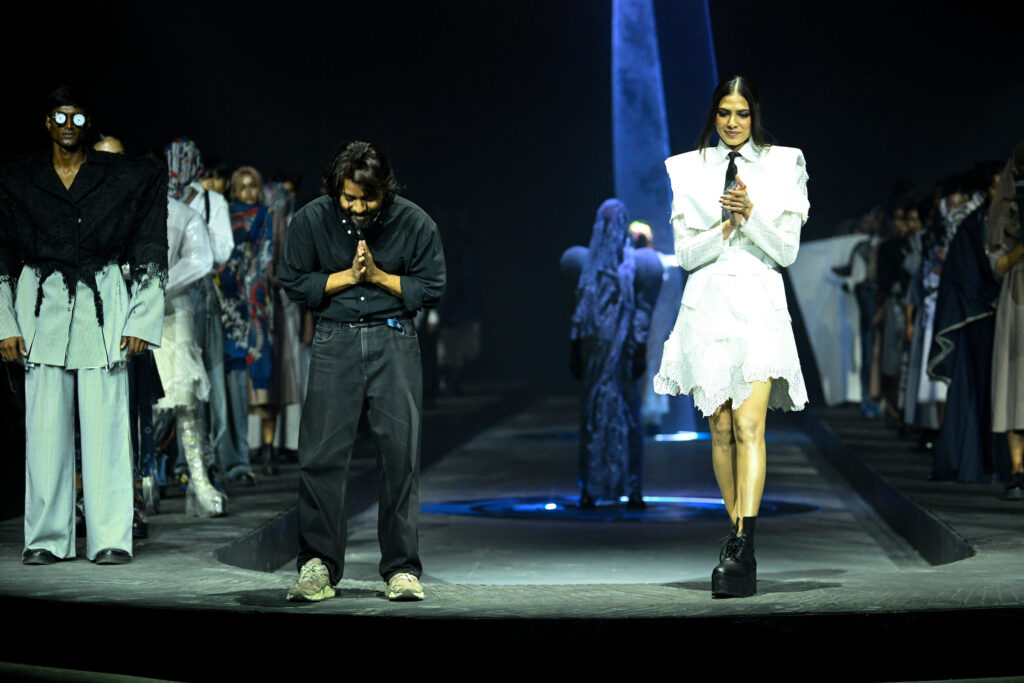
Farmer’s son Satendra Singh and Dilip Singh meet Anurag Gupta to showcase their experiments with indigo dyed wool in IIT Delhi paving way for jeans you can wear in winter, keep warm! By Asmita Aggarwal He is from a non-descript village, Hajipur, tehsil Saipau, Dholpur, on the MP-UP border, in Rajasthan, born to a farmer, his dreams were beyond the fields everyday he grew up watching. Satendra Singh’s school bag was hand sewn at home out of leftover Urea bags that came for crops nourishment, mom used to cut and stitch two handles on them, which went with his blue faded pants and rubber chappals. He decided to work on textiles, graduated from the Indian Institute of Handloom Technology, Jodhpur, and then from Bhilwara did his B Tech in textile chemistry. Cleared the entrance for IIT Delhi, to do his M Tech in textile engineering, little did he know his thesis would take him to LFW X FDCI runway. Can we make denim in wool for colder climates? You can’t wear denim in winter, is there an alternative for it? These were the questions that were swirling in his mind, when he began working with Prof B S Butola, Department of Textile and Fibre engineering, who told him to try indigo dyeing wool, it took two years to perfect this project! “The fabulous part about IIT is it gives you money for research, the challenge was to make denim in wool, machine washable at home,” he says. The product was handloom, wool Merino from Australia, so he decided to show the prototype to Levi’s. They loved it, and saw potential. Indigotex Private Limited, his company, is an IIT Delhi–originated startup, focused on R&D in innovative, sustainable textiles, protective textiles, and waterless technologies to reduce water consumption in textile industry. The company’s first product, IndiWool™️ Denim, is a wool-based, all-weather denim fabric that is machine washable. “Indigotex is developing ECOTEX wool and wool-blended machine-washable fabrics and indigenous lightweight breathable extreme-cold textile solutions (up to −30 °C) for the Indian Army which till now is wearing imported fabrics, in Siachen,” he says. They are funded by FITT-IIT Delhi, SIDBI and Ministry of Textiles. His trip to Bharat Tex he recalls a funny incident, with just his bag, after office, carrying samples, he knew nobody, “any foreigner going into a denim stall I followed and showed them my work, came back to IIT as I had no money.” Indian wool is underutilized as it’s too coarse, almost 70 per cent goes waste, farmers burn it, he says. In his village farming is only 4-5 months, rest of the time no work, in Dholpur, there’s no industry, unemployment, poverty, his idea was to start wool indigo industry there-with his company Indigotex. Designer Anurag Gupta decided to work with new materials like wool denim, for LFW, though his journey began from a village Biskohar, Ayodhya, in 2018, he knew it was going to be experimental. “Covid changed me. I decided I won’t work with craft but do something out-of-the-box,” he adds. In fashion they shy away from innovation, want to play safe as long as it is lucrative, he feels. He started working with knits, when most knitting units were shutting down, no work for them, exports affected due to high tariffs. “Knits are not considered a craft, but I decided to make knits in jacquards—overturned bird eye, ribbed, tuck, which no one wanted to do in small quantities, somehow I convinced them,” says Anurag. His signature though has been deconstruction, adding textures, subverting the template, cutting, slashing, which he says, “wasn’t accepted by clients, it was tough to survive for me. My themes too were unique-manual scavengers which no fashion journalist wanted to write about.” The wool experiment with Satender Singh, makes it softer and the roughness goes out, less water consumption, in more ways than one it is sustainable, also this wool after washing doesn’t shrink. “The surface is smooth and wearable and doesn’t feel itchy! Satendra Singh and Dilip Singh’s collaboration was a eureka moment for me,” he adds. Inspired by 18th century Japanese painter Utagawa Kuniyoshi, Anurag liked his landscapes, women, Kabuki actors, cats, and mythical animals, especially Samurais, seaside islands to dragons. “Fashion magazines make me feel like an outsider, also I’m not a people pleaser, rich privileged kids get more easy coverage as they are in the party gang, we know jugaad, started from scratch,” he laughs. He signs of by saying he wanted to show a film he made on pollution, a video as a brand, how it is affecting human life.
After 25 years “waste is gold”
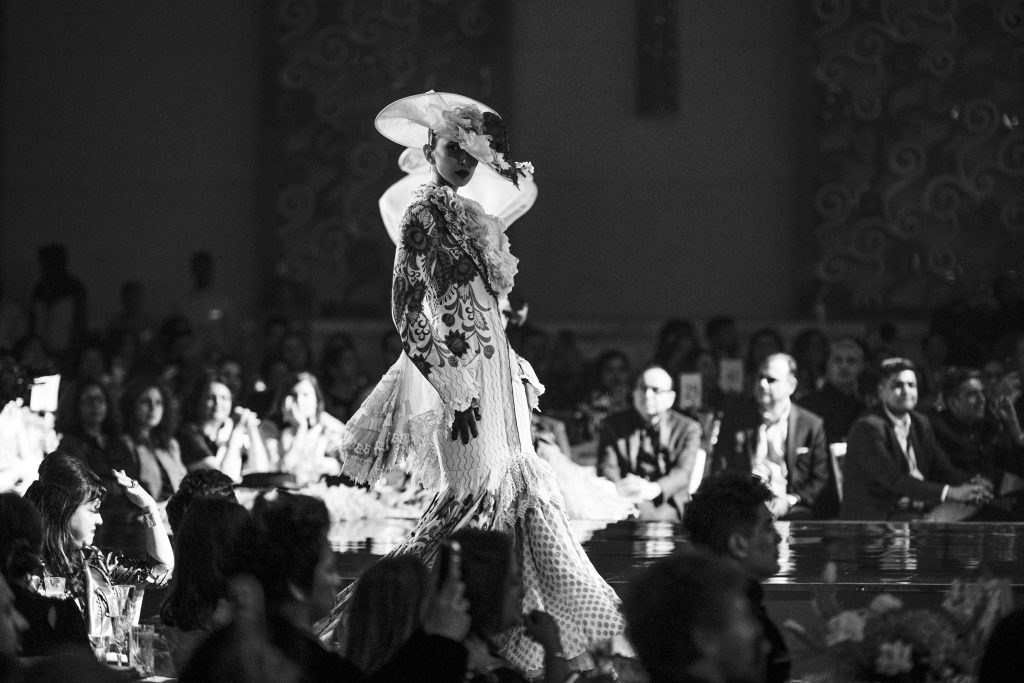
As fashion celebrates its silver jubilee, what is clear now is —sustainability is the only way to go forward, and designers have already taken the lead! By Asmitaa Aggarwal It was a reunion of sorts, designers came in droves, some who had not been seen for over 20 years—Anshu Arora of The Small Shop to Raghavendra Rathore, Ritu Beri, Monisha Jaising, Nikki Mahajan, once doyens of their field, today reticent. FDCI X LFW got them together—after all it was the time of celebrations—25 years of the fashion world! The Jio Convention Centre, Mumbai was where almost 300 people congregated—the most known faces, who have uplifted the barometer of design, innovation, and ingenuity—made a heady blueprint to go forward. Almost 33 designers recreated archival ensembles from 2000 onwards, with 60 models (Lisa Hayden to Lisa Ray), the biggest pool, with Indian-American actor Kal Penn as the host (Van Wilder, The Namesake, TV series House), who not only laughed at himself, but also asked an interesting question to Bollywood dreamboat Kareena Kapoor. “What do you think of fashion critics?” She candidly replied, “They are as important as film critics—they should keep designers on their toes.” Manish Malhotra when asked about his jewels glimmering on his sherwani admitted it was a “hard sell” and someone rightly said, “All this madness is therapeutic I would have it any other way.” Kareena confessed, “make and hair stylists the real stars as they make us look amazing. My darling brother Manish is here. Maybe I will come again on the catwalk not as size zero but owning my body completely”. For 25 seasons she walked as show stopper, once pregnant with her son Taimur, “most emotional moment for me, though my only hope is I don’t fall on the ramp, even if I do, I can get up with dignity. I also suck my tummy in a little,” she laughs. The show had Ritu Beri (2006), Tarun Tahiliani (2000), Monisha Jaising (2002), Rajesh Pratap Singh (2012), Raw Mango, Anshu Arora (2004), Anamika Khanna (2004), Manish Malhotra (2001) outfits recreated, among others. “As I reflect on the 25th year of Lakmé Fashion Week, I am reminded of the incredible journey fashion has taken in India. I had the privilege of opening the very first Lakmé Fashion Week in Delhi in 2000. Looking back, it’s nostalgic to see how far fashion has come—from a time when we could barely fill a room to today, where we are overflowing with a passionate audience. Creativity now permeates everything—the way people dress, the way they express themselves, and the way fashion is embraced in everyday life. It is a testament to how the industry has evolved, pushing boundaries and shaping a more vibrant, dynamic fashion landscape,” says Ritu Beri who started in 1990. She was the first one to do a show in Paris, headed a French fashion house Jean Louis Scherrer, and in 2010 won the Chevaliere des arts et des Lettres award. Though after 25 years one thing was clear—waste was gold now. Nagpur-based Shruti Sancheti, made hair bands, bags, scrunchies out of katrans, and has managed to get orders for it. There is undoubtedly a stream of attempts to be sustainable –the value of the ensembles made from it was Rs 30,000, says Urvashi Kaur. “We create textiles out of fabric, trying to be zero waste, but the beauty is that we are able to craft one-of-a-kind pieces, the key is to be able to shift consumer behaviour,” says Urvashi. On this it’s kantha, and her undying love for tussars, all hand-woven wonders she works with as the market is showing renewed interest, buyers want to know about their garment and how it is made. There seems to be a good churn happening, fashion weeks are a great platform for designers to express themselves visually. “We lost great design somewhere in the greed to keep selling, opulence and money wanting to show status. But the question is how do you contribute to a community. If your work does not hold meaning that money is not happy money. Young people are facing climate change, we have capitalist exploitative businesses, but we must find a way to keep our beautiful traditions alive,” she adds. Bangalore-based Mani Shankar, believes the customer has also changed, each city has its own nomenclature– “Delhi loves bling, so I make it, I must survive also. But the Rs 30000 fabric manipulation linen kurta sells well too, it is our USP,” he adds. “The last 25 years have been momentous in shaping what we now call the Indian fashion industry. Specifically, the last 10 have seen accelerated growth for many brands due to the various initiatives of the FDCI and the influx of corporatisation. I’m truly hoping the next decade is all about true growth, appreciative of all categories of fashion not limited only to bridal couture. I look forward to this next chapter,” says Ashish Soni. For 17 years he has been in the business of fashion, and Nachiket Barve, believes fashion is evolving with more awareness. He has launched a new line of enzyme washed denims for Rs16000, admits he has understood the market better. “I adapted. Design is a dialogue between the customer and you, you can’t be stuck in time or resist change. I look within. We are going to do more business and growth. India’s biggest strength is craftsmanship and willingness to change which will hold us in good stead,” he adds. Akshat Bansal of the experimental label Bloni, showed how he managed to do bio mimicry of a crocodile skin with Shibori, plus his additions of stainless-steel architectural materials on a tailored jacket. Some places you can also see ghungroos, as he sells the silk organza Japanese weave, with reflective properties for Rs 2,50000 lakhs. It comes with Savile Row tailoring, and a mix of various engaging techniques, custom designed. He is one of the bold, new designers who are taking fashion to the next level—see his silk felt raw fabric, it was waste that weavers
No white collar, it’s silver for Anamika
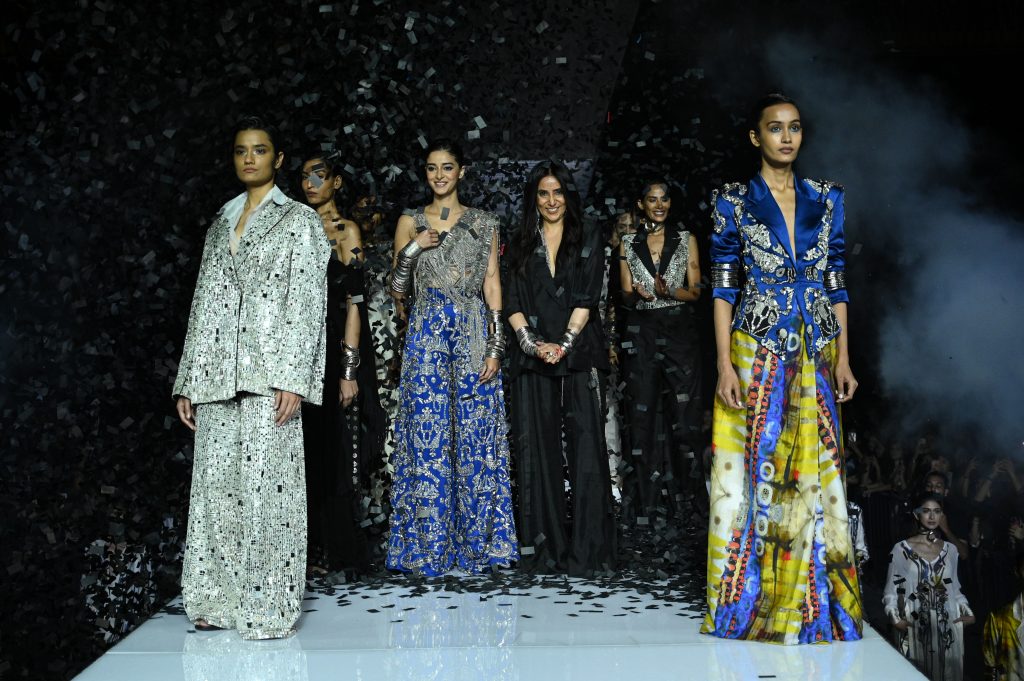
After almost 25 years, Anamika Khanna is hoping women in lucrative careers want something that is not just suits and blazers –maybe a silver tie, suspenders, daddy briefcase and some pearl encrusted denims from AK-OK! By Asmita Aggarwal India is all over the world, and it isn’t just “in India”, anymore maybe that’s why Anamika Khanna’s AK-OK for working women, is timed right, the market is ready for this, especially as professions are now unconventional. One could see nostalgia—daddy suitcases cleverly revived, splashes of colour, even though monochromes are her thing, denim is now slowly moving to her favourite list. Above all, no one can beat her in texturing—how she combines various techniques—patchwork, applique to mirror work at her show for LFW X FDCI. The ignition of the idea came from Rabari tribe who are movers never static—Gujarat, Rajasthan and have some Afghan influences too, she began researching, and found their silver stacking jewellery was phenomenal. She took those—and modernized it with suspenders, ties, chain loop belts, “you don’t need to wear silver only as a jhumka, if it can be a silver collar too”. She had that too—literally, workwear equals—”silver collar”, also the name of her line—like you have blue collar and white collar. “Let me tell you what I think is my biggest strength—I don’t think of the garment but the woman,” says Anamika, understanding the changing needs of modern women, their intimate relationship with clothing, and how it changes their mood. After 25 years in business, every time she does a line, she wants to incorporate something “forgotten or lost”, last season she also paid tribute to the Bonda tribe from Odisha. “Women bring not just power to the boardroom but also emotions and compassion onto work, I wanted each of the 50 pieces to reflect that,” she adds. If you look closely, the styling, it has a churidar, with a dhoti and collared skirt, each reference was out of India, but how to make it fashion Anamika knows. The show was about 9 to 5, and how workwear rules are being broken, in between this mix she revived her dhoti pants of the year 2000, churidars which she loves, as well as tattered holes and cut outs. “Designing as a profession is challenging, lot of people tell me take it easy, take a break, and while I am talking you, I’m sticking applique on a dress, this is my life, I live for fashion,” she smiles,