
After 25 years “waste is gold”
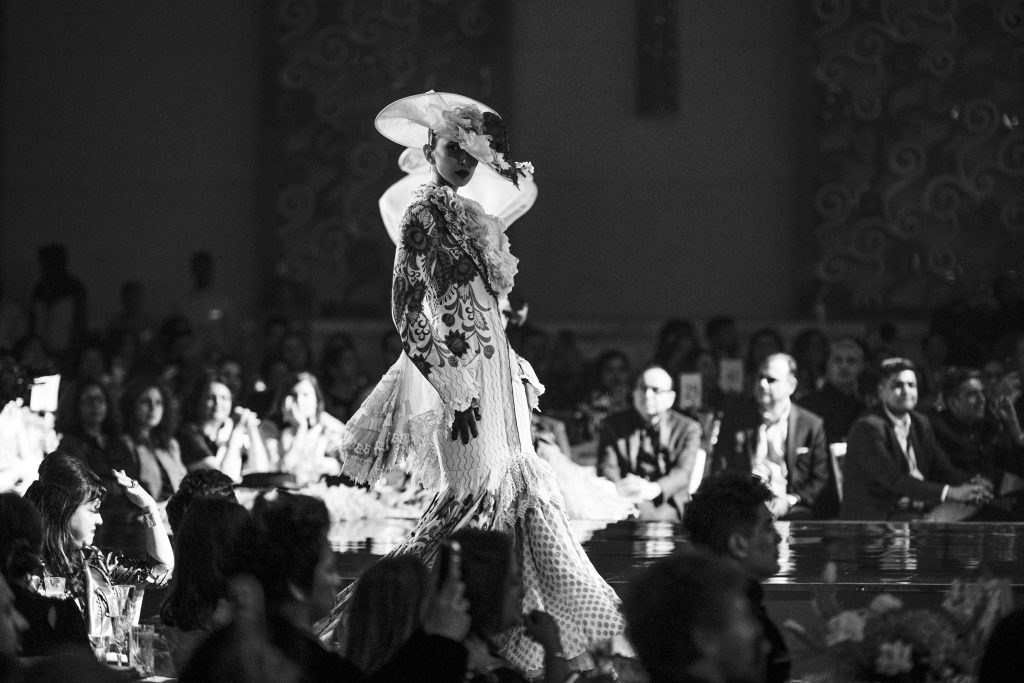
As fashion celebrates its silver jubilee, what is clear now is —sustainability is the only way to go forward, and designers have already taken the lead! By Asmitaa Aggarwal It was a reunion of sorts, designers came in droves, some who had not been seen for over 20 years—Anshu Arora of The Small Shop to Raghavendra Rathore, Ritu Beri, Monisha Jaising, Nikki Mahajan, once doyens of their field, today reticent. FDCI X LFW got them together—after all it was the time of celebrations—25 years of the fashion world! The Jio Convention Centre, Mumbai was where almost 300 people congregated—the most known faces, who have uplifted the barometer of design, innovation, and ingenuity—made a heady blueprint to go forward. Almost 33 designers recreated archival ensembles from 2000 onwards, with 60 models (Lisa Hayden to Lisa Ray), the biggest pool, with Indian-American actor Kal Penn as the host (Van Wilder, The Namesake, TV series House), who not only laughed at himself, but also asked an interesting question to Bollywood dreamboat Kareena Kapoor. “What do you think of fashion critics?” She candidly replied, “They are as important as film critics—they should keep designers on their toes.” Manish Malhotra when asked about his jewels glimmering on his sherwani admitted it was a “hard sell” and someone rightly said, “All this madness is therapeutic I would have it any other way.” Kareena confessed, “make and hair stylists the real stars as they make us look amazing. My darling brother Manish is here. Maybe I will come again on the catwalk not as size zero but owning my body completely”. For 25 seasons she walked as show stopper, once pregnant with her son Taimur, “most emotional moment for me, though my only hope is I don’t fall on the ramp, even if I do, I can get up with dignity. I also suck my tummy in a little,” she laughs. The show had Ritu Beri (2006), Tarun Tahiliani (2000), Monisha Jaising (2002), Rajesh Pratap Singh (2012), Raw Mango, Anshu Arora (2004), Anamika Khanna (2004), Manish Malhotra (2001) outfits recreated, among others. “As I reflect on the 25th year of Lakmé Fashion Week, I am reminded of the incredible journey fashion has taken in India. I had the privilege of opening the very first Lakmé Fashion Week in Delhi in 2000. Looking back, it’s nostalgic to see how far fashion has come—from a time when we could barely fill a room to today, where we are overflowing with a passionate audience. Creativity now permeates everything—the way people dress, the way they express themselves, and the way fashion is embraced in everyday life. It is a testament to how the industry has evolved, pushing boundaries and shaping a more vibrant, dynamic fashion landscape,” says Ritu Beri who started in 1990. She was the first one to do a show in Paris, headed a French fashion house Jean Louis Scherrer, and in 2010 won the Chevaliere des arts et des Lettres award. Though after 25 years one thing was clear—waste was gold now. Nagpur-based Shruti Sancheti, made hair bands, bags, scrunchies out of katrans, and has managed to get orders for it. There is undoubtedly a stream of attempts to be sustainable –the value of the ensembles made from it was Rs 30,000, says Urvashi Kaur. “We create textiles out of fabric, trying to be zero waste, but the beauty is that we are able to craft one-of-a-kind pieces, the key is to be able to shift consumer behaviour,” says Urvashi. On this it’s kantha, and her undying love for tussars, all hand-woven wonders she works with as the market is showing renewed interest, buyers want to know about their garment and how it is made. There seems to be a good churn happening, fashion weeks are a great platform for designers to express themselves visually. “We lost great design somewhere in the greed to keep selling, opulence and money wanting to show status. But the question is how do you contribute to a community. If your work does not hold meaning that money is not happy money. Young people are facing climate change, we have capitalist exploitative businesses, but we must find a way to keep our beautiful traditions alive,” she adds. Bangalore-based Mani Shankar, believes the customer has also changed, each city has its own nomenclature– “Delhi loves bling, so I make it, I must survive also. But the Rs 30000 fabric manipulation linen kurta sells well too, it is our USP,” he adds. “The last 25 years have been momentous in shaping what we now call the Indian fashion industry. Specifically, the last 10 have seen accelerated growth for many brands due to the various initiatives of the FDCI and the influx of corporatisation. I’m truly hoping the next decade is all about true growth, appreciative of all categories of fashion not limited only to bridal couture. I look forward to this next chapter,” says Ashish Soni. For 17 years he has been in the business of fashion, and Nachiket Barve, believes fashion is evolving with more awareness. He has launched a new line of enzyme washed denims for Rs16000, admits he has understood the market better. “I adapted. Design is a dialogue between the customer and you, you can’t be stuck in time or resist change. I look within. We are going to do more business and growth. India’s biggest strength is craftsmanship and willingness to change which will hold us in good stead,” he adds. Akshat Bansal of the experimental label Bloni, showed how he managed to do bio mimicry of a crocodile skin with Shibori, plus his additions of stainless-steel architectural materials on a tailored jacket. Some places you can also see ghungroos, as he sells the silk organza Japanese weave, with reflective properties for Rs 2,50000 lakhs. It comes with Savile Row tailoring, and a mix of various engaging techniques, custom designed. He is one of the bold, new designers who are taking fashion to the next level—see his silk felt raw fabric, it was waste that weavers
Clothes with feelings
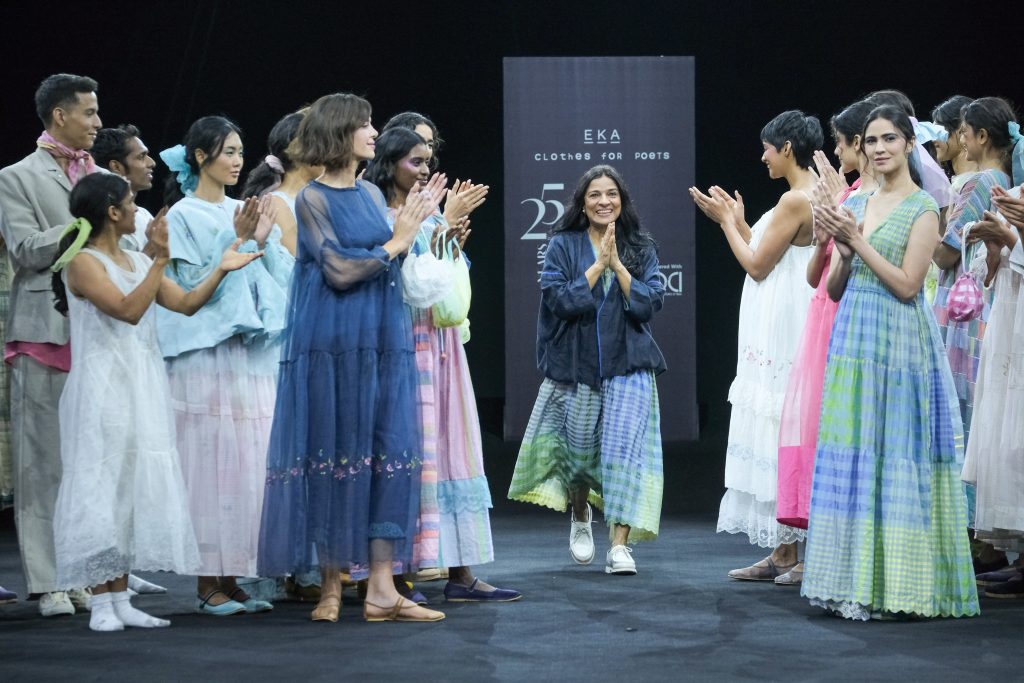
From serenading poets to artists, Rina Singh’s Eka is a case study of craft upliftment. By Asmita Aggarwal If clothes could have feelings Eka would be a right fit! Rina Singh, who built a brand, brick by brick, over 13 years believes it took years of developing product knowledge and working closely with clusters and weavers that helped her finally launch a brand. Unlike Gen Z who know marketing, but learn about product excellence along the way, their skills are so polished that business turns out to be good! “They do it right out of college, I took several years to have the courage and wherewithal to launch my label,” says Rina, adding, “the world of design has changed unequivocally.” Eka and Eka Core are two different ethos—but same mothership, the latter is ready-to-wear, younger, less moody, uses archival textiles and repurposes, so circular in ethos. Rina overdyes it, uses quilting, makes it trans-seasonal as most are leftover fabrics. Eka is known for its love for hand spun and slow, thus the making process is not instant and takes a year of planning. She took a concerted decision to be on the ramp, after a hiatus, to offer woven wonders from Bhagalpur, Banaras, Kota to Bengal, telling a story in Muslin, lace, inspired by Amer, Jaipur with its imposing mirror mosaics, for LFW this year, but she has interpreted it differently—appliqué to tiny embroidered motifs. The idea was to have movement in clothing, like choreography, how clothes adapt to the body and its wearer; as the DNA of the label remains the same every year, but the inspirations are rooted in craft upliftment. You may have boxy trousers, laces only show shifts in moods, things you can wear from Kutch to Tokyo, as it remains feminine, layered, and translucent—this time it’s silks, gossamer and diaphanous. “Sandeep my husband, is a pillar of support—he manages operations, so I am free to design, it takes a huge load off me, in the last decade, he has been a backbone. But I have learnt marketing needs to be loud, brands must have their own voice, and over the years I have learnt not to be rigid about my product,” she adds. Kurukshetra where she was born to agriculturalists, made a deep impact on her psyche growing up, she valued crafts and the “thinking before doing” process of clothing, where you deliberate rather than buy –it is laborious, time consuming, and expensive, but it is also timeless and hand spun, the beauty is unmatched. “I come from a Rajput family where traditionally women invest in weaves, pearls and Kashida, as well as vintage shawls, they understand aesthetics,” she says. Working with the European markets, especially Japan, Rina believes the real jewel in the crown in India is ready to wear, yet we are focussed on weddings, a money churner. “I know the Indian woman likes to be comfortable, yet classy, so why not give her craft-soaked offerings with hints of colour?” she concludes.
Bill Clinton told us to be at MOMA: Gautam Malik
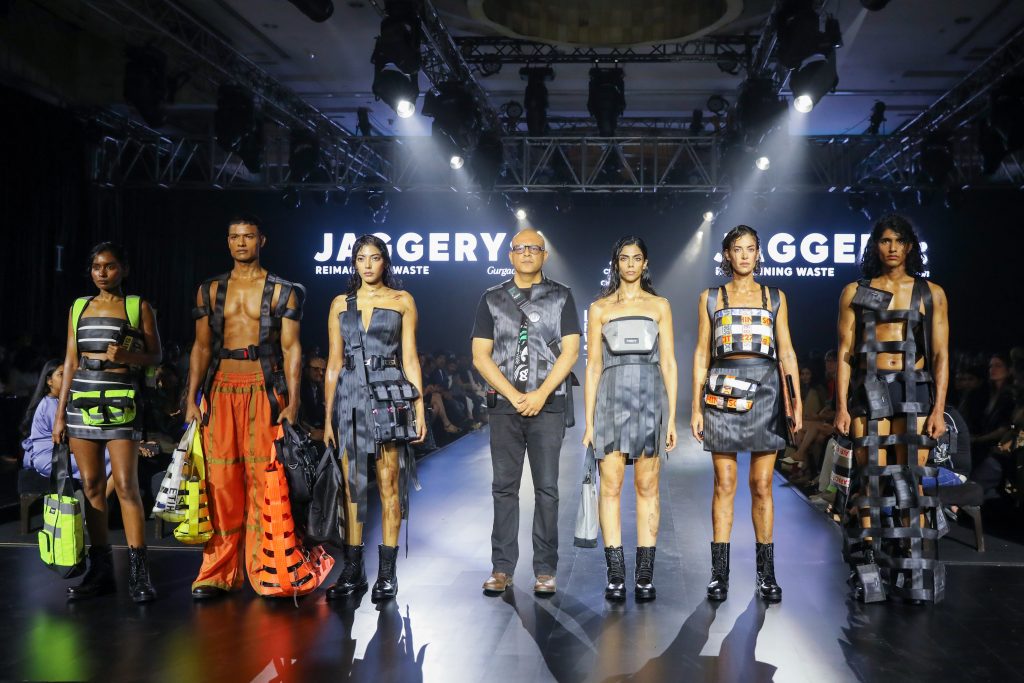
Making bags out of discarded seat belts, the JNU kid, who grew up with a father who taught quantum physics is today building a sustainable community one gilet at a time with his brand Jaggery. If Apple can sell electronics, why can’t jaggery sell bags? By Asmita Aggarwal Former US President Bill Clinton met him at the New York Fashion Week, recently concluded, and told Gautam Malik of the label sustainable Jaggery, that one day he hopes to see his products at Museum of Art (MOMA), New York, the store invites purpose-driven makers. So, the passionate entrepreneur went unannounced to MOMA and pitched his sustainable bags and ensembles, even though onboarding is online. Meet the social innovator, Gautam Malik part of the Circular Design Challenge in partnership with United Nations. You would never imagine a Jawaharlal Nehru University kid delving into fashion—it is not impossible but it is unprecedented. Malik’s parents are both professors—his dad taught quantum physics in JNU and mom super conductivity in Delhi University. It was surprising he chose to study fine arts and media studies from University at Buffalo University, and then Memphis University where he studied communication design. He says, whatever he learnt, he is applying to what he is doing today—whether it is documentary filmmaking, storytelling to making bags out of waste at Jaggery–Reimagining Waste, a women-led social enterprise. They upcycle discarded car seat belts, decommissioned cargo belts and ex-army canvas into sustainable products. “Since 2018, we have been able to divert 2400+ tons of waste from the landfills of Delhi, impacting the lives of 25,000 people,” he adds. His childhood sweetheart Bhawana Dandona, (University of Pennsylvania M.Sc in historic preservation) who worked in conservation of old buildings, found a meeting point in ideas. “We discussed structuralism, cultural heritage, and I loved jamming with her. When I returned from the US in 2010, I worked in the corporate sector in UA/UX design in India after ten years of living in America,” says Gautam. His experience is vast—Time Turner to Jabong, e-commerce designer, the creative head also launched a fashion magazine, but he calls himself a “social innovator”, someone who wants to impact society. In the year 2000, he got a chance to intern at Auroville, Pondicherry, where people from different nationalities have renounced their citizenship, are living as a community, he then decided he wanted to build one too, thus Jaggery. They work in Haryana to Jharkhand mostly with “aspirational districts”, most importantly with Nuh, known for its political tensions. “How do you decide who to work with?” he asks. “Jaggery” or “repurpose” the toss-up was there for the name of the brand, the former fitted in—-as while making jaggery nothing goes to waste; it is produced in small batches, the process is thus humanised, it leaves behind a witty flavour. If Apple can sell electronics why can’t jaggery sell bags?” he laughs. Growing up simply he went to Modern School, found a huge inequality in terms of social status, he would get Rs 25 weekly allowance, he learnt to live in that, JNU is in his DNA. “I had to come back from the US, as I saw India was the hot bed of startups, also living in the US you never feel part of it,” he admits. For LFWXFDCI he is donning a fashion designer’s hat creating bags and garments from repurposed car and airplane seat belts (cars which are 15 years old must be scrapped, according to government policy). This creates enormous waste—they use the rubber, roof lining, seat belts, residue, and have come up with a system wherein many NGOs (also Mayapuri car scrappers) are helping them source it. “We tie up with RWAS like we did in Gurgaon where we are based to start donation drives—you can give your old denims and corduroys and we will spin them into a new designer ensemble,” he admits. He believes in co-creating and partnerships, with Volvo Jaggery does corporate gifting, Tata any car scrapped they can utilise, they ask them to replace cardboard box boxes for Diwali sweets with recyclable bags, their new work is with EVs. “Earlier vendors would fleece us asking for money for things that are waste, they would just throw. They thought we are using it for profit, now they understand many years later what we are doing,” he adds. He faced many challenges, even how workers they would hire, when he would inform they are working with discarded materials, “why can’t we work with new ones? They would say. The bags he makes are sold at Embassy fairs like the US and Austrian as well as Dastkar though he knows the sword is always dangling for this bootstrapped company. “We never know when we will fold, we want to partner people who understand what work we do, it is a dual impact model. Waste is recycled, it is circular, creates jobs, we create a value chain. It’s an ethos-based brand,” he adds. You can get a wallet for Rs 750, and a duffel bag for Rs 7,000. “Also on offer are bespoke products, cargo belts come in different colours, we customise you can choose British, Qatar or Singapore Airlines, play around with the sequence. I started with just one employee Shahid bhai, now we are nine in total,” he says. FDCIXLFW line of garments are risqué-jackets, gilets, reinterpreting the Nehru jacket, corsets, and asymmetrical skirts. The philosophy is gender agnostic pieces, like the caged maxi dress it’s avant-garde but with an industrial vibe. “Society cages us, this is breaking free for me,” he concludes.
Sari Stories
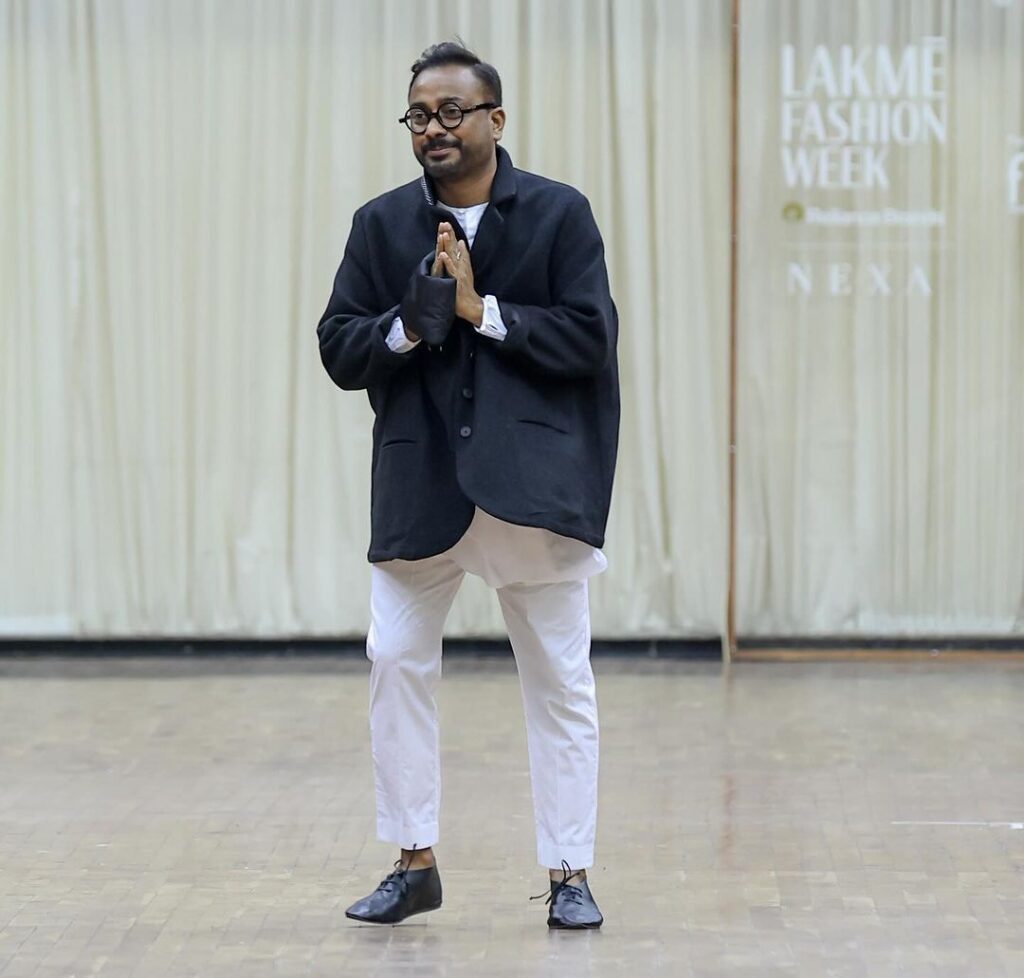
The tuxedo blouse, wide lapels, geometric shapes, hints of metallic glitter, ode to charcoals, the boy from Mubarikpur Sanjay Garg of Raw Mango, told us the sari is as cool as a floor sweeping, Paris-returned gown. By Asmita Aggarwal