
Ikkat, Brocade, Ladakh is more than Boks
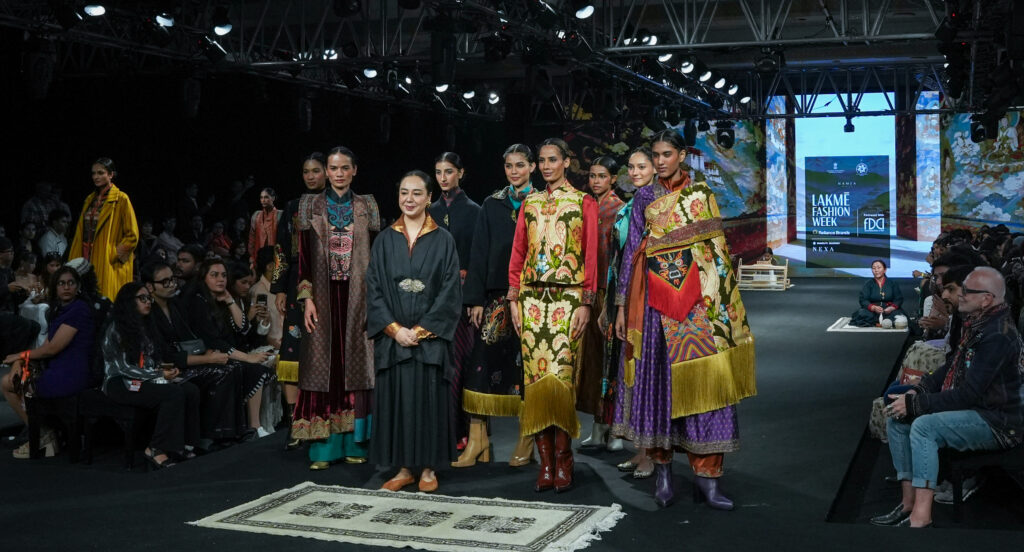
Padma Yanchan’s label Namza revives traditional motifs of ancient monasteries, Kimkhab, and Gyaser, to Ikkat that came from China via Silk Route at LFW. By Asmita Aggarwal Ladakh is not just about the beautiful landscapes but also the finest pashmina which most people think is from Kashmir. The historic treaty Treaty of Tingmosgang, signed in 1684, had pashmina from Tibet through Ladakh to Kashmir, after the Tibet–Ladakh–Mughal War. What is most fascinating is the Padma Yangchan label Namza, which translates to clothing in Ladakhi, even though Padma studied psychology in LSR. After a fashion designing course from JD institute of design, she went to London School of trends in 2013. “Growing up in Ladakh heritage and crafts were part of our everyday life subconsciously, wool, pashmina, nomadic life, monasteries shaped me,” she says. Her father was in the Army and mom worked with PWD, she applied to JNU, didn’t qualify, wanted to become a teacher, gave up NIFT Chennai, to conduct thorough research on Ladakhi textiles. She discovered Ladakh was part of the Silk Route, so it carries in its belly richness and culture, how even though they never made silk, it is omnipresent in monasteries as it came from Tibet. “When trade stopped, Marwaris in Banaras started weaving silks with sacred motifs Kimkhab, and Gyaser. Now it is a hub, and is exported all over the world. If you see it has Chinese motifs-dragons, phoenix, mythical creatures. Animals have rankings in Ladakh-dragons are a fav of royal families. We have Takchuri (tak is mountains and chu water, ri is cloud),” inspired by the landscape,” she adds. Interestingly, she always saw only two colours in Ladakh-maroon and black, and wanted to change that perception. Working with a nomadic community that weaves pashmina, even the dyeing was done traditionally fully chemical free from herbs collected from mountains. “We use nettle, rhubarb, madder, onion peels, walnut husks to marigolds,” she explains. First time showcasing at the FDCI LFW, they also use indigo which is not from Ladakh, but the beauty is whatever they eat is later used for dyeing, channeling a green philosophy. “We launch a collection only once a year, and won the national award for weaving Pashmina too, reviving various textiles of Ladakh. I wanted to also document the food, as it wasn’t ever done, so I travelled to remote villages to see how they live, eat, survive,” she adds. What remains concerning is the green cover in Ladakh that is fast diminishing, as she is a part of the Ladakh Pashmina Board, believing it will hamper the production. Narendra Modi, today approved the project on Green Energy Corridor (GEC) Phase-II – Inter-State Transmission System (ISTS) for 13 GW Renewable Energy Project in Ladakh. The project is targeted to be set up by FY 2029-30 at a cost of Rs.20,773.70 cr. The project requires roughly 48,000 acres of vital seasonal grazing land used by the Changpa community. Nomadic herders will destroy pastures for thousands of Pashmina-producing goats. Four per cent of the total pashmina production of the world is from Ladakh, but nomads have no hospitals or schools for their children, they are quickly migrating to Leh where they are getting facilities. “In winters the entire region gets blocked due to snow, these nomads have to use horses to navigate the place. With migration, there will be no rearing, herding and they have no facilities for survival,” she adds. A month ago the government gave 8 crore subsidies to Ladakh to preserve the green cover, Changthang Plateau and the border village of Thang, is where you get the best pashmina due to the high altitude, the ones from Kargil are not as fine. “We have sheep, yak and camel wool, with medicinal properties. The insulation is so good that it can tolerate the harshest climate, yak wool is good for joints, you can convert it into a tent, and pashmina gives warmth. Kashmiris never focused on the medicinal aspect of the wool,” she affirms. The beauty of the weaving is it is done on Pashmina mattresses at home, as a community exercise, they don’t know the value of the wool, as they are tribals,” she says. The blanket or chaati, is what they wear at home, using Sukdan (carpet) made of it,” she adds. She has her own set of weavers in Banaras who are making fine silk, replicating ancient sacred textiles with similar motifs almost 100 years old. “I visit many monasteries to scour old textiles, colours and inspirations. My brand partner Jigmet Disket, is from the royal family and I saw how her grandfather’s robe was made out of golden threads woven. There is even historical evidence of ikkat coming to Ladakh as I saw in the robe from the Chinese Xinjiang Uyghur Autonomous Region (XUAR),” she explains. The ikkat is from Kashgar, “Ikat” is from Indonesian word mengikat, meaning “to tie.” While Kashgar is famous for its striking, vibrant Atlas Ikat, so people wear these dresses in Ladakh, Xuar ikkat has bigger motifs. “My clothes tell the story of Ladakh. It is more than Bok (clothing), Mogos (women) or Phogos (men attire). When Sonam Kapoor wore it for Ambani’s wedding with a brocade shawl, it put the spotlight on our traditions,” she concludes.