
Nikki’s Khadi Resort wear
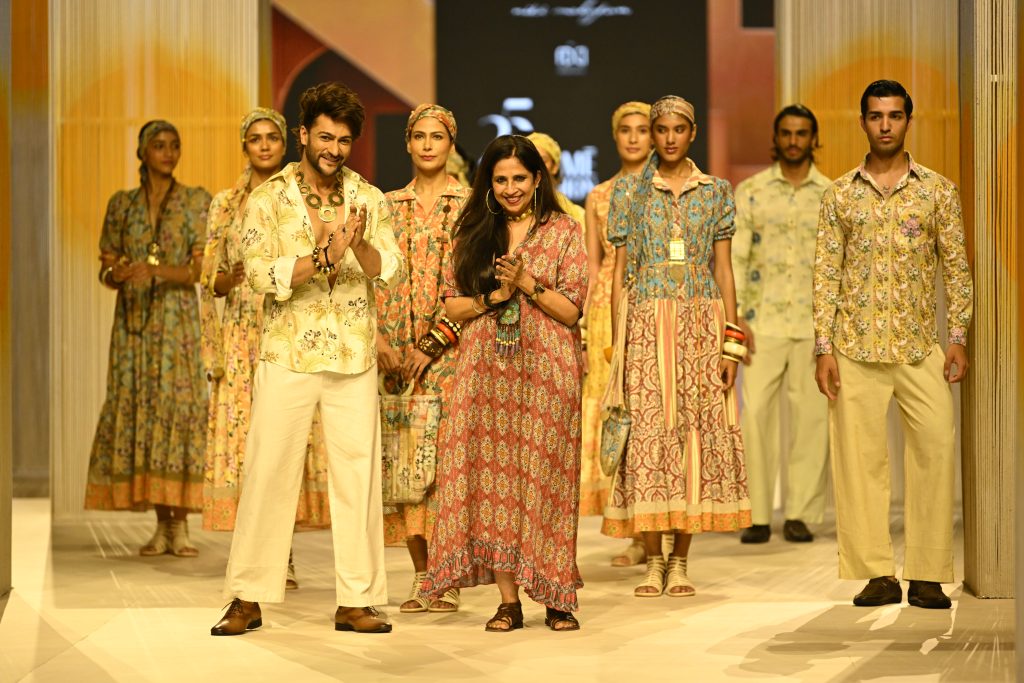
After 42 years in fashion, perfecting block printing, Nikki Mahajan pays tribute to khadi not through predictable kurtas, but dresses with baroque elements and French prints. By Asmitaa Aggarwal She began almost 42 years ago, in the 80s when she was newly married, at 20, studying in Lady Shri Ram college of Commerce, English literature, had no clue even about the word fashion, she would call herself a “tailor”. But Nikki Mahajan knew when she was taught needle work and smocking in Loreto Convent school, Delhi, she started making clothes and embroidered it herself for her friends’ moms — this would be her calling! Ten years ago, the business dynamic altered, she moved to working with Japan, Middle East and US markets, special collections, about after 42 years in the business. Self-taught, the 62-year-old knows the challenges of running a brand, “In the late 80s, there wasn’t any fashion school, only polytechnics, which were not considered great, but I found my way around,” she says. She used to take her two kids to play tennis in DLTA, Delhi where she saw the exodus of Kashmiri women, in the early 90s, sitting opposite, looking for work, she decided to help, hired them as embroiderers utilizing their skill and providing employment. “Bindiya Judge’s store Signature in Hauz Khas Village, was the first one that sold luxury designer wear, but unlike today’s generation, we had to find our own niche,” she explains. For the FDCI khadi show at the LFW, Nikki has done what she does best-block printing, which even her Japanese clients love (she made a 3000-piece line for Anthropologie too). She found a way to make the uneven blocks as they are hand done into some form of evenness by digitizing it for her buyers abroad who wanted “sameness”. “I digitize the fragments I get while visiting various museums all over the word-Egypt to Uzbekistan, Amsterdam to France, and this line is an amalgamation of all those shared experiences,” she confirms. She takes pics and then makes a collage and starts work on the storyboard. To this she added Baroque elements and French prints, dexterously executed on Khadi, even though she works with mostly cotton and silk, she loved the textiles and unevenness khadi offered. “When you wear linen it crushes easily, khadi doesn’t and that’s its beauty–I discovered and admire its slubbiness,” says Nikki. Fashion is now easier. It has Pinterest, Instagram, the new breed of designers are intrepid, they aren’t insecure, it’s the same masala box, but they are cooking up a storm with it. She is back on the runway after 10 years, but decided not to make the usual kurta with khadi rather went opposite-resort wear, carefree and fluid!
Clothes with feelings
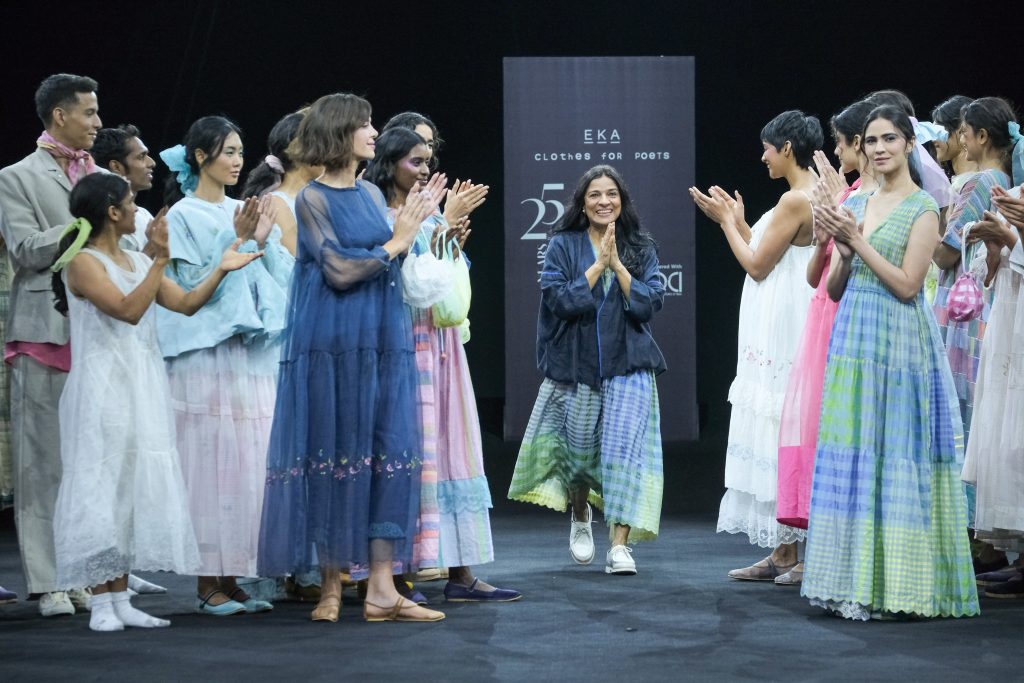
From serenading poets to artists, Rina Singh’s Eka is a case study of craft upliftment. By Asmita Aggarwal If clothes could have feelings Eka would be a right fit! Rina Singh, who built a brand, brick by brick, over 13 years believes it took years of developing product knowledge and working closely with clusters and weavers that helped her finally launch a brand. Unlike Gen Z who know marketing, but learn about product excellence along the way, their skills are so polished that business turns out to be good! “They do it right out of college, I took several years to have the courage and wherewithal to launch my label,” says Rina, adding, “the world of design has changed unequivocally.” Eka and Eka Core are two different ethos—but same mothership, the latter is ready-to-wear, younger, less moody, uses archival textiles and repurposes, so circular in ethos. Rina overdyes it, uses quilting, makes it trans-seasonal as most are leftover fabrics. Eka is known for its love for hand spun and slow, thus the making process is not instant and takes a year of planning. She took a concerted decision to be on the ramp, after a hiatus, to offer woven wonders from Bhagalpur, Banaras, Kota to Bengal, telling a story in Muslin, lace, inspired by Amer, Jaipur with its imposing mirror mosaics, for LFW this year, but she has interpreted it differently—appliqué to tiny embroidered motifs. The idea was to have movement in clothing, like choreography, how clothes adapt to the body and its wearer; as the DNA of the label remains the same every year, but the inspirations are rooted in craft upliftment. You may have boxy trousers, laces only show shifts in moods, things you can wear from Kutch to Tokyo, as it remains feminine, layered, and translucent—this time it’s silks, gossamer and diaphanous. “Sandeep my husband, is a pillar of support—he manages operations, so I am free to design, it takes a huge load off me, in the last decade, he has been a backbone. But I have learnt marketing needs to be loud, brands must have their own voice, and over the years I have learnt not to be rigid about my product,” she adds. Kurukshetra where she was born to agriculturalists, made a deep impact on her psyche growing up, she valued crafts and the “thinking before doing” process of clothing, where you deliberate rather than buy –it is laborious, time consuming, and expensive, but it is also timeless and hand spun, the beauty is unmatched. “I come from a Rajput family where traditionally women invest in weaves, pearls and Kashida, as well as vintage shawls, they understand aesthetics,” she says. Working with the European markets, especially Japan, Rina believes the real jewel in the crown in India is ready to wear, yet we are focussed on weddings, a money churner. “I know the Indian woman likes to be comfortable, yet classy, so why not give her craft-soaked offerings with hints of colour?” she concludes.
Tribute to Shakti
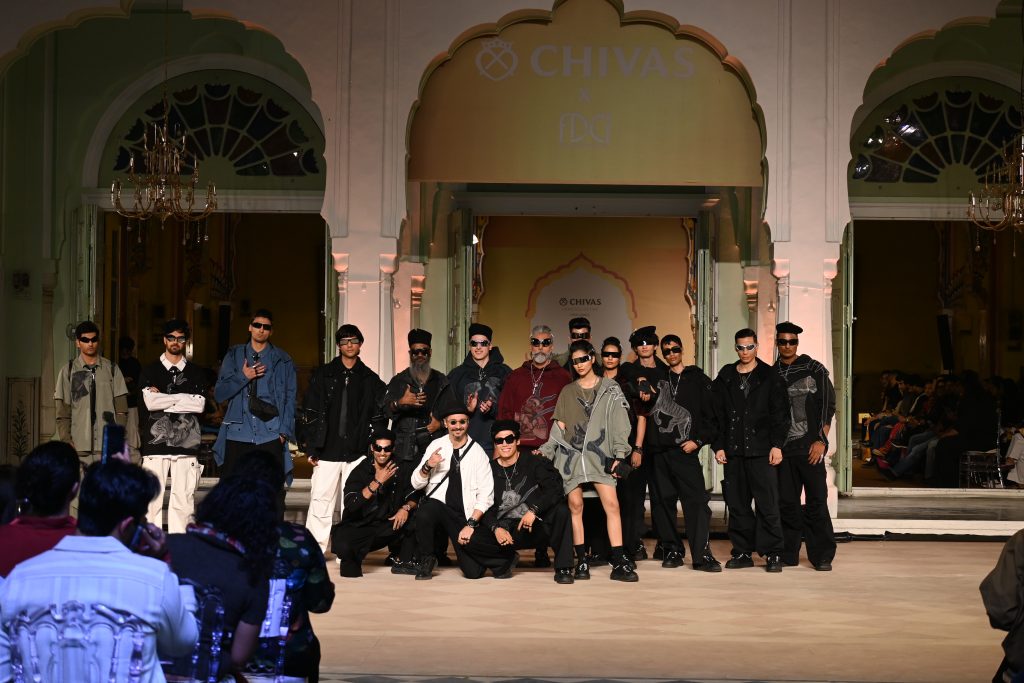
Hindu texts are replete with engaging tales of the goddess and demons, for Nitin Bal Chauhan, the 17th C Devi Kothi became a metaphor, for his streetwear line inspired by Chamunda, and the demons to be slayed — both external and internal in his menswear line titled ‘A Tale of Chamba’. By Asmita Aggarwal You will often see him in black, like the rest of us lovers of this hue, that blends in rather than stands out, I wonder if it has anything to do with how we think or how we want others to think about us? Nitin Bal Chauhan, is in charcoal just like me, when I meet him on a sun-drenched afternoon, bougainvillea blooming in Jaipur, we decided to sit on wrought iron heavy chairs made in the 1850, at Diggi Palace, accompanying heavy duty marble table tops. He had just shown his line at the Chivas Luxe Collective Perfumes presents FDCI India Men’s Weekend 2025 in Jaipur, a line inspired by the temple of Devi Kothi in Chamba. Built by Raja Umed Singh in 1754, dedicated to Goddess Chamunda, it is the northwestern frontier of the kingdom. Chamunda, another form of Durga, is from the text ‘Devi Mahatmya’, warrior goddess, who slayed demons Chanda and Munda. Vijay Sharma, a Padma Shree awardee artist and former curator of the Chamba Museum, and renowned art historian and scholar Dr Vishwa Chander Ohri revived the Chamba miniature painting tradition, Pahari school of art. “Devi Kothi temple’s architecture has an embellished wooden ceiling, and pillars which caught my eye,” says Chauhan, who was raised in Himachal, adding it is remotely placed, and the paintings are almost 300 years old in Tissa, 4-hour drive from Chamba. Bal decided to pay homage to the Chamunda, with hand painting, brush, and Air Ink, (ink made from collecting vehicular carbon emissions in Delhi and NCR. Founded by Anirudh Sharma, a graduate of Massachusetts Institute of Technology in Boston (USA), Graviky produces it) channelling sustainability. “How I’ve dressed myself in the last 20 years is very liberating yet simple,” he smiles. Using cotton twill, detailing like armored core used, a bit like Medieval armour in street wear. To match the Chamunda spirit, he had tracks from the American band GodSmack (had three of their hits– “Woo doo” and “Serenity”) to elevate the pagan elements associated with Chamba, the band connected to that vibe. Bal courted riveting, external elements inspired by armour, he added godets to enhance the shape of armour, straps have a defining factor of street wear, along with broad fringes. “The fighting spirit in clothing comes from Japan, but has entered India only now,” says Chauhan. He adds Hiroshi Fujiwara, is the father of street wear, way back in 1992, and Chauhan added his unique spin on it. Born in Shimla, specifically Mandi, studying at NIFT changed his life, he would come back home, climb walls, get into orchards, jump around, and live carefree. He decided not to get a job, started an NGO titled Sewa Himalayas, revived almost ten crafts – Chamba rumal (detailed patterns), metal carvings, carpet and blanket weaving, Pattu weaving (woollen fabric woven in the Kullu Valley) to woodworking, setting up 73 clusters. “Looked at marketing solutions. Himachal festivals Kullu Dussehra are big draw for tourists and Devis are honoured by carrying them on ornate palki, almost 200 carriages are taken out, it is like the Hornbill of the Himachal, (Shivaratri is huge here),” he says talking about the rich cultural tapestry. “I see a boom in street wear culture, sneakers have boosted it, Gen Z has purchasing power. They know they buy it for Rs 6,000 but can sell it for Rs 12,000. The fastest moving product now is hoodie, the market is in a good place,” he signs off.
Residual Memories
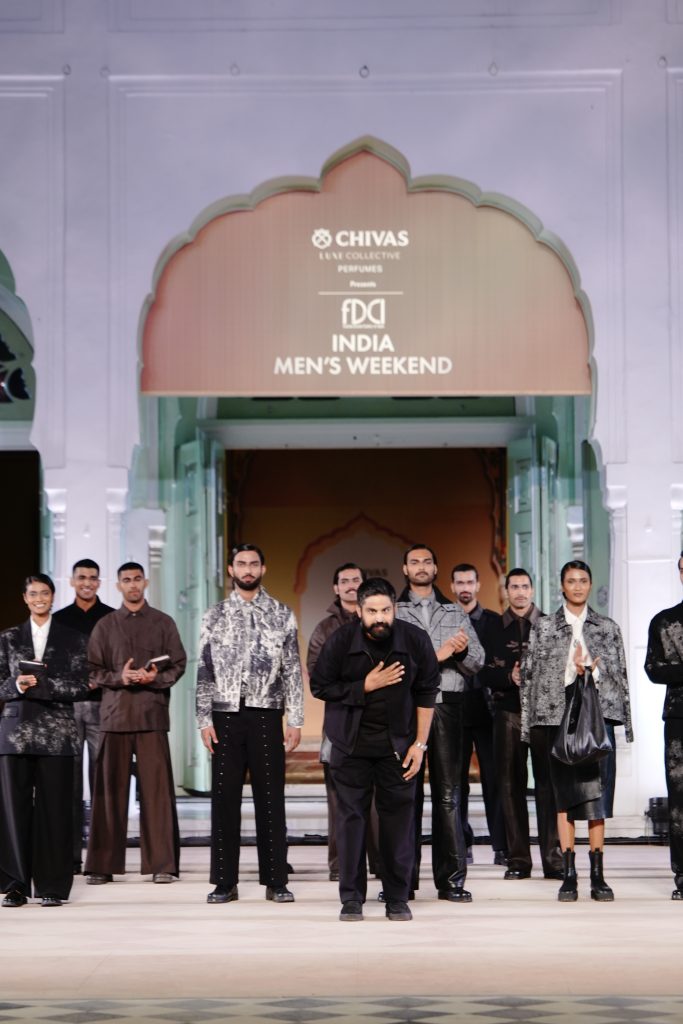
Sushant Abrol, inspired by the ideology of “what is left behind” pays homage to his late brother Samir, through molten metallics, abstract kantha and silver coated denim. Asmita Aggarwal Five years ago, when Sushant Abrol’s brother Squadron Leader Samir Abrol’s brother, died in a crash, he went to the crash site, and noticed boundaries were put in place. It was an emotional time, with his mother, who had lost a young son, the tarmac had ripped, he saw shiny metal pieces strewn across, and one such was right next to his shoes. He quietly picked it up, put it in his pocket, it had a screw left in it, a molten piece of burnt aircraft. He thought to himself this is what gets left behind of a once mighty plane, thus the name of his men’s wear line for Chivas X FDCI “Residual”. “When I looked closely, I saw how deformed metal has become, almost charred,” says Sushant of the label Countrymade. Only three hues – black, silver and grey form the basis of his line, the patterns come from them — cotton, leather coated, metallics, along with hand tucking to add a third dimension mirroring the look of how metal burns and kind of turns inwards or folds. He has added many effects— burnt, tears and charred look, as well as denim and frays, as well as hand done applique. Such is the attention to detail, if you look closely the buttons resemble broken plane parts. Out of fabric scraps, he has created a camouflage pattern, like residual pieces, to make a ‘whole’. The speciality of the collection is a unique coating on denim — silver, then enzyme wash treatment to erode it – giving a washed out look. Images of metal textures, fuselage look of an aircraft is done with rivets. “We have coated cotton, wet-looking, almost slippery, like leather, even though kantha is our USP we incorporate it every year, we have ‘residual stitches’ which have a different interpretation. No motifs were used, allowed kantha to flow, abstract shapes, in any direction it wanted—unpredictable,” says Sushant. Molten lines which have been moved or disturbed, sunset images reflecting faded memories, embroidered denims give us a sneak peek into how he wanted to recreate a scene that has been stuck in the recesses of his memory. The consumer must know what he is wearing, where is it coming from, what’s the story behind it? Not too loud, or restrained but commercially viable clothing, after all, he runs a business. “I do seasonal lines, and just returned from a Paris trade show, where I discovered they like cuts to be away from the body, but in India we still like a fitter appeal-diametrically opposite,” he concludes.
From the earth for the Universe
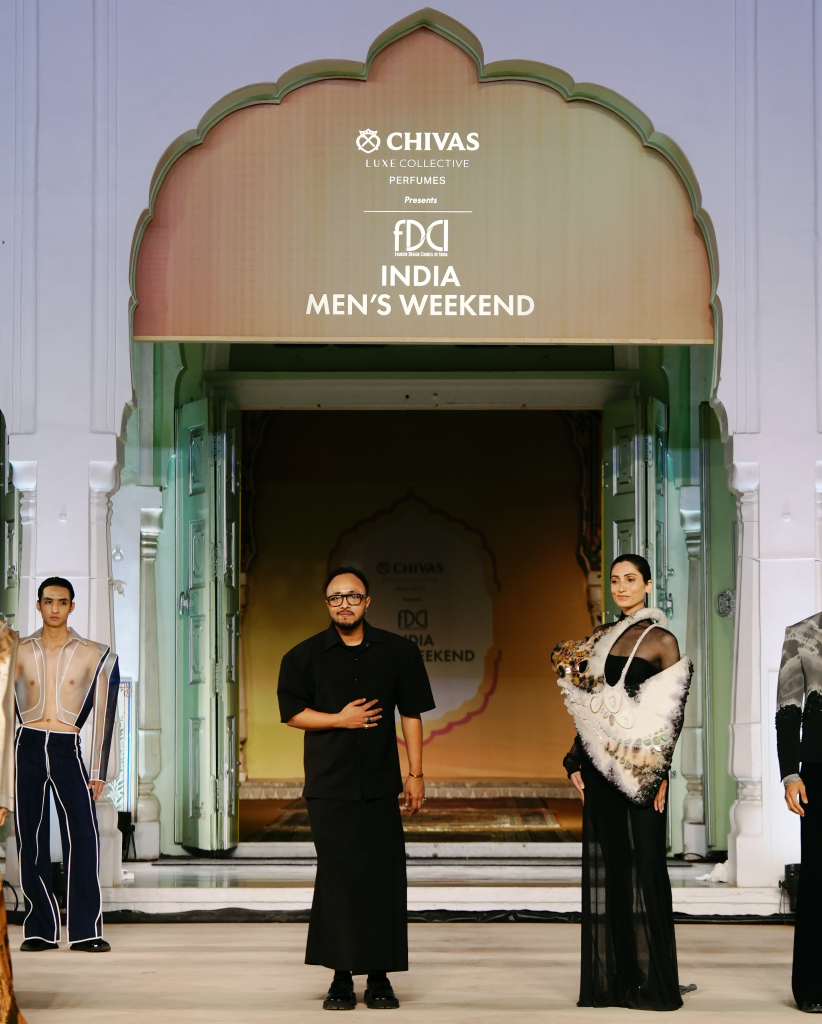
From healing crystals, to dressing body types and not genders, raw wool to unconventional shapes, Akshat Bansal is thinking out-of-the-box! By Asmita Aggarwal Small town boys have this innate desire to succeed, quite different from Metro cities, maybe it has to do with fewer opportunities, and exposure back home. Akshat Bansal of the label Bloni is interesting, from Hisar, went to Central Saint Martins, decided not to do bridal lehengas, but took the rather tough path of understanding science in fashion. Think reflective materials, colour sensitive fabrics, hemp, econyl regenerated, nylon flooring, industrial waste, and fabric scraps to craft ensembles. In 2022, he made his Paris Fashion Week debut, engagingly mixing rubber with tie and dye to crochet, hues which change along with body heat. In his line, the jacket can sometimes become a leotard, then a jumpsuit too, but here the dichotomy is lines like ‘Seher’ beautifully shot capturing small-town aesthetics and its austere life. He attempts to build a bridge between the past and future, and his experiments with felt are ingenious, so is his usage of 100 percent wool, raw in its form (heavily non-processed). ‘Passages’ his line for the Chivas X FDCI is where different dimensions align, fully couture, in its appeal. He uses gemstones, crystals, deconstruction of what earth holds, digging for that era gone by. “From the earth for the universe”, where you have no mechanisms, natural dyes used, mostly tie and dye, vegan rubber, futuristic in its look. “Crystals when they are not polished, but left as they were found, is what we use, it’s a different perception of beauty that many may find ‘dirty’. Just like hemp, it has in-built anti-bacterial properties, found in abundance,” says Akshat. This co-exists with manmade stainless steel, he believes it is impossible to go zero plastic, as there will always be silicon, plus Woolmark does merge Merino wool with polyester for elasticity. His denims are hand woven, by artisans, “I’m wearing CK jeans but I’m missing the comfort of my own creations,” he smiles. His fervent desire to take the road less travelled got him an invitation from Nature Morte gallery, where Peter Nagy termed his creations more “art than fashion”—you can buy it, wear it, or simply display it. A bit like what Natasha Poonawalla wore—a teardrop, it can be a lamp or just a pot too. 3D modelling, traditional hand hammering was employed from Moradabad artisans, to add to this chrome electroplating finish! Another such is a piece Sudha Murthy wore ‘Breathing Cocoon’ biomorphic wearable piece made of metal, wool, agate, and gemstones, which Akshat thinks could also be an artefact placed in a drawing room, breaking rules of what is traditionally considered art. “Why do we always talk of preserving art, but it is living, you can evolve it, isn’t it?” he asks. Crystals, he believes have healing powers, calming effects, remembering amethyst trees back home, protection from negative energy! “I did a Ted talk where I spoke about innovation over decoration, why did we wear jewellery? In history if you see silver releases electromagnetic waves, it isn’t about beauty but energy,” he explains. Cotton is the same wavelength as humans, linen more spiritual he believes, there is a hidden meaning to everything, he calls himself future friendly, not futuristic, but the quest is to find true purpose. His Paris experience was interesting, as looking at his offerings he was often asked, “where did you grow up”? Instead it should be where were you born? His lines are always fluid, and gender for him is nothing but ‘body’. “So many clients who do not fit into womenswear prefer the pieces I make for men. I think it is a body type not a gender we dress. I wonder who set those boundaries? Named these pieces? Why this segregation?” The search is to make a classic, which is named by him-as he asks why can’t pants have a train channelising a non-conformist approach to what is conventionally considered silhouettes, as he completes seven years in business, turned a wise 34 years!
Mani is not a SNOB
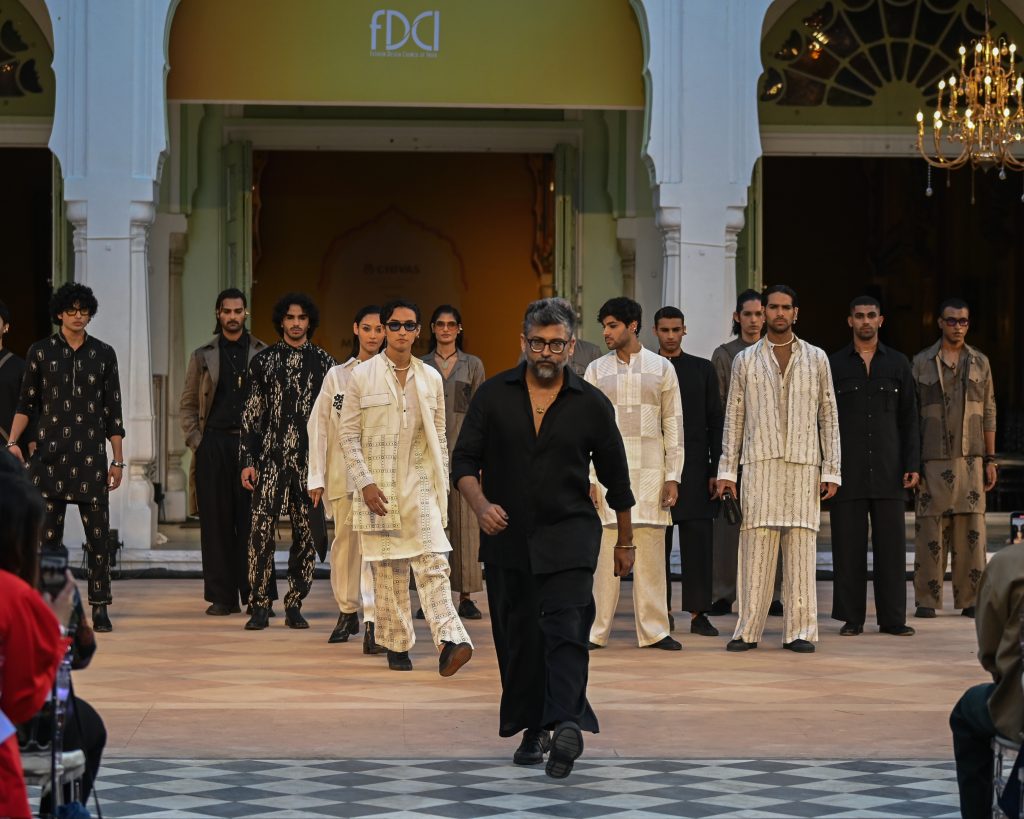
His label serenades linens, he gives them a hip feel, with zips, tassels and hints of embroidery, for a new age man, who wants to experiment, but not go overboard. By Asmita Aggarwal He comes from a well-read Bihari family, father is a professor of English and mom botany, at Patna University; his sister is a doctor in the US. He studied at Doon School, worked in the corporate sector for 14 years (creative director Myntra and then Madhura Garments), saved up to launch his own label SNOB (Son of a Noble). Thus, his approach to fashion is unique — it must be commercial, he has not lost his way, as clothes are not art, they need to be simple and functional, he believes. Men’s fashion has become a lot younger, seamless, to this engaging mix there are streetwear elements and grunge. Mani Shankar Singh believes, dressing is more hybrid, like a mash up of everything, and even though he is known for his linens, within that space, he offers an undeniable, interesting variety. “It is easy, breathable, perfect for our country’s weather,” says Mani Shankar Singh at the Chivas Luxe Collective Perfumes presents FDCI India Men’s Weekend 2025 at Diggi Palace, Jaipur with Chivas. Though he has taken linen out of its stiffness and formality, added fun elements to it—sports vibe, grunge, fabric manipulations avoiding hectic embroidery, making it less old school, hipper and newer. “I wanted a 20-year-old to wear it, not just using it for boring kurtas, in a way our approach is futuristic. This collection we have added a little touch of embroidery,” he adds, confirming that most adhere to the minimal aesthetic. “We make ensembles for father (structured) and the son (easy, sometimes wicked),” says the Patna boy, now settled in Bangalore, after studying in NIFT where he did FDIT (fashion design and infotech) in 2003. Gaining international exposure from ‘Who’s Next?’ Paris and Ounass Middle-East, he believes austerity is the name of the game — black, white, and green remain his palette, playing sometimes with blushing neutrals. SNOB offers from kurtas, to shackets, trench, an ideology where you can wear a kurta, but a Cowboy version, with zips and tassels. “Kurta is essentially a long shirt, I have given it a global approach,” he smiles, adding his life partner Ritu Jain has launched a womenswear label. For men’s fashion week he has done bundis, a staple now in every man’s wardrobe, but with a twist—metal buttons to rivets. Denim added as well as kantha, sometimes they come with inverted box pleats. “Minimal detailing, but lots of textures, and since 2015 I have stuck to what and enjoy and do best—which is dressing men, asking them to cross the Rubicon and try a shot of edgy classics,” he concludes.
VK finds his ‘Idam’
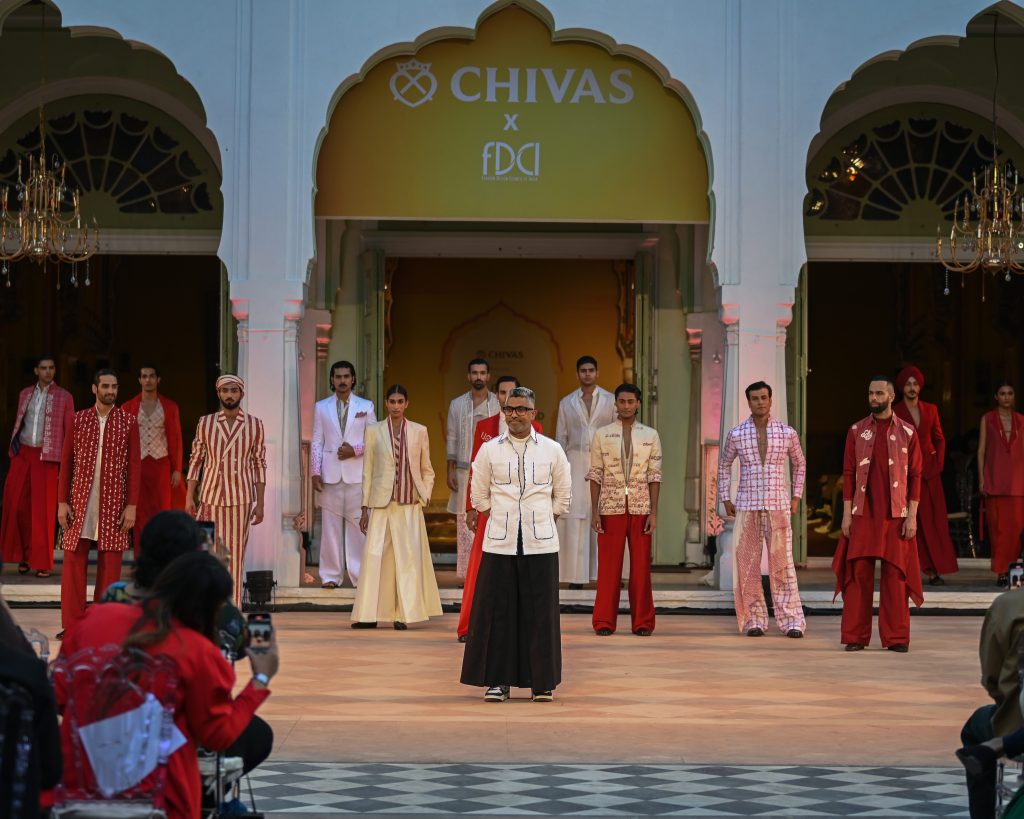
From recreating the Madras checks, to paying homage to his Tamil roots through spiritual texts “Thirukkural”, Vivek Karunakaran has come full circle at the FDCI India Men’s Weekend at Diggi Palace, Jaipur. By Asmita Aggarwal His earliest memory of fashion is an eight-year-old sitting on his mom’s feet, pleating her South silk saris, he would hand iron to smoothen the crease. He credits his innate sense of creativity to her. What changed the course of his life was Aishwarya Rai (Ms World) and Sushmita Sen (Ms Universe) winning coveted crowns in the dawn of fashion-year 1994. His father was an engineer in the Indian Space Research Organization (ISRO), he remembers, his parents waking up at 6 am, getting ready to leave for work, making his food for the entire day, how much they worked hard! His journey began in 1999, when from Thiruvananthapuram, he decided to move to Chennai, to study fashion design from NIFT. His label Vivek Karunakaran is now almost 18 years old. It was a challenge coming from a middle-class family, his parents wanted him to be an engineer, but he calls his life’s trek, “extremely humbling”. As providence would have it, when he was set to leave for his masters in Milan, he got selected for India Fashion Week, two weeks before for the GenNext showcasing in 2007. Coming from a bootstrapped business, having no business acumen, taking wrong turns all the time but learning crucial lessons from them, has been the “biggest gift” for Vivek who changed his brand name from Viaa to VK. He counts the seven-and-a-half years he spent at an export house Cammacaria, which worked with European labels like Armani to Diesel and Kenzo, as that’s where he learnt “deep experimentation. How design is not a piece of art, but retail,” he adds, learning the intricacies of menswear despite his line for NIFT being innately womenswear. Post-Covid he shifted gears and decided to focus on dressing men, “operationally better” he confirms. His USP would be fit, detailing and finish–what can look demure on a rack, can come alive when you know how to wear/style it. “I today feel rooted to where I belong, whether it is fabrics or heritage,” he adds. Having worked with Kancheepuram silks to Balrampur cotton, this year he has used Tamil script in various ingenious ways in garments. His inspiration is Tirukkural (Tamil language text on morality consisting of 1,330 short couplets, or kurals, of seven words each. It is divided into three books with spiritual teachings on virtue, wealth, love, humility). He converted it into a running script for his collection showcased at Diggi Palace, Jaipur at the FDCIXChivas India Men’s Weekend. From checks, shackets, embroidery on elbow sleeves of bombers, the whole approach is to break free from the cookie cutter method. Layering to pleated palazzos, wrap pants, chanderi kurtas with bombers give his line “Edum” or “space from where you belong”, a third dimension, also in some ways it is a tribute to Chennai. This teamed up with jasmine flowers, heritage elements, silk taffeta to Egyptian cotton, textures used innovatively, is what he believes is a change from what men wear. Tucking, block prints, Madras checks are not bought and used literally (buy and sew) but created using textures, by weaving, silk tussars, also window pane checks. Vivek has had many firsts, his project “Flawsome”, that channelled the ideology of one product at one time, unisex, anyone could wear it, simple shirt in Egyptian cotton and jersey sleeves did extremely well. “Bundi is passe, a shacket (you can wear with anything—slim pants to capris and even palazzos) is cool, especially our play of prints is interesting,” he affirms. Chennai, he says shaped the person he is today, it is the “silent force” that helped him reach this far, the unknown faces, people, who came into his life, and his wife Shreya’s gave him the impetus he required. “Shreya and I always believe we came from nowhere but found home here-in Chennai,” he concludes.
To Mom with Love
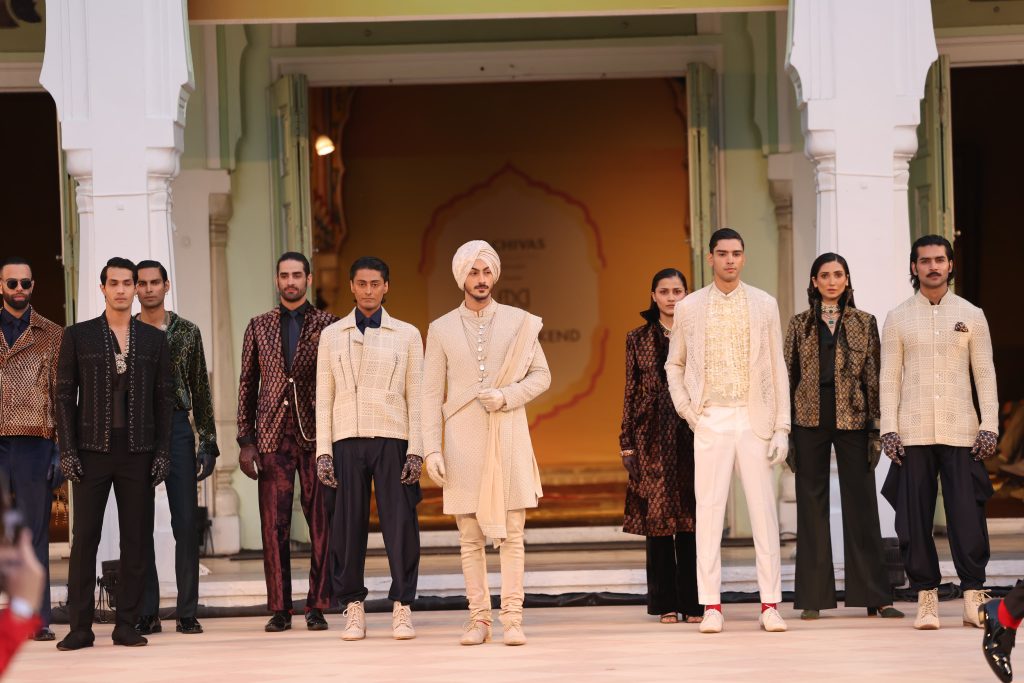
Arjan Dugal’s line ‘Vintage 2030’ combines modern design engineering with traditional Japanese motifs, as zardosi and florals become the hero at Chivas Luxe Collective Perfumes presents FDCI India Men’s Weekend 2025 at Diggi Palace, Jaipur. By Asmita Aggarwal He kind of worked both sides of the fashion spectrum — his father’s export house, his mother’s love for textiles and indigenous crafts. Maybe that’s what makes Arjan Dugal so confident about his menswear line he launched ten years ago. Son of the country’s leading supermodel of the 90s Simar Dugal, who died battling cancer, Arjan was just 28. After studying economics and finance in Dallas, US, and a remote fashion course from Parson’s School of Fashion, he decided to foray into this unpredictable world. His father’s work made him adept at stitching, pattern cutting with the best ateliers in Spain and Italy. He designed for Tommy Hilfiger, Ted Baker, Pepe Jeans, Pedro to Claudia Strater. The imposing frescos painted sunshine yellow, the chandeliers almost 200 years old once maybe lit with candles in 1860 when it was built. The stained glass windows, Persian carpets, bevy of boys, with golden hair clips and bulging biceps (not beer biceps thankfully), came in skirts, as the maharaja of yesteryear’s black and white portrait hung above watching the show unfold. Arjan’s love music and pops of red playing peek a boo from ankle length pants, were cool. So were the brocade breeches! He was trying to tell us through his charming reds — you can wear all white and yet add fun, and make it light. For a reality check, he worked as a store keeper for his mom, checking colour fastness to sizing in her Indian wear line. October 2014, he took a giant leap of faith, went solo, this year he completed 10 years in the business. The beauty of the Arjan Dugal label is his ability to combine design engineering with subtle crafts. His mom’s love for Jamavar, Baghs, Kalamkaris to Phulkaris, as she was a collector, he places along with sequins, and his beloved dori embroidery. Add to this mix a smattering of Persian influences, including zardozi. His father who earlier headed Apollo Leather, before he began the export house, taught him how to work with horse tail hair, silicon tapes, dextrously employ embroidery on leather, as well as foiling, and with this he always makes textiles the showstoppers. Being an avid golfer, Argan, felt dressing well became his idiom, thus his first line was from Ajrakhpur, combined with Mashru, a capsule collection. Kind of a bridge between luxe designer wear and FabIndia — that was his ideology. His experiments with Chintz, linen, Chanderi and silks on menswear helped him understand that new-age men like experimentation, but in pieces, not as a whole. “I felt as I am a millennial no one in my generation really appreciates the beauty of textiles, I wanted to give them an interesting mix—ajrakh with leather in a tailored look. Not the usual red pocket square, bandhgala and breeches,” he smiles. As women are more aware, spoilt for choice, they want their husbands to follow suit, as they can’t be ‘mismatched’. India is a country of festivals and celebrations — from Durga pooja to Chhaat and Karwa Chauth, shopping is always festive. “I follow the 80 X 20 principle, while crafting an ensemble – first will be an austere self-on-self and the rest a striking contrast,” he says. Printed lining is his USP, plus built in pocket squares, which you can see in his couture line for men at the Chivas Luxe Collective Perfumes presents FDCI India Men’s Weekend 2025 at Diggi Palace, Jaipur. “Kora work on organza, brocade underlay, hand stitched seams, insides and piping give each ensemble a unique look. We work a lot with organza, emblazoned with Dori embroidery,” he adds, saying his mother’s memory is of him being more of a sibling less of a child. As she was just 23 when she had him, he would accompany her to various fashion shows. Of course, this equation changed, when they diagnosed her with the illness, in her last three years, he became the caretaker. “I realised I must cope with the pair of cards that life deals you, can’t choose or plus and minus. I found my soulmate in a lawyer, who stood by me in my toughest days,” he admits. ‘Vintage 2030’ is his line, where zardozi and florals play with Japanese motifs on organza. “I have taken elements from the past, given them an entirely new treatment. Our logo is the gramophone, as it resonated with me. I have a sleek designed one at home, where I play my vinyl records, plug it in and you get the same vivacity of sound as the 50s one,” he confirms. Curiosity made him seek crafts from other cultures whether it was Shibori or Uzbeki ikat which was fascinating as it is woven from silk velvet threads. “My mom said to me ‘Arjan you are my legacy’, those words still ring in my heart,” he concludes.
Fervent Tribute to Bal

FDCI and Blenders Pride pay a befitting homage to Gudda, with 100 showstoppers, friends, family and in this beautiful story, an emotional Sonam Kapoor. By Asmita Aggarwal What happens when you have more than 100 showstoppers paying tribute to the man, and the myth, who left behind an unparalleled legacy? Rohit Bal when he was alive and when he passed on to the next world, always had a full house! Blenders Pride with the Fashion Design Council of India, presented an homage, a show curated by Chairman Sunil Sethi, with people whose life Gudda irrevocably touched, not just with his sense of style, but warmth and candour. Known for his abundant-skirts, crinkled, extravagant pieces resembling the vibrant life he lived, Bal’s friends, and family turned up in droves, to relive his magic in fashion, through his blooming roses on voluminous monochromes. Designer Ashish Soni dressed in a pleated, butter-coloured Bal, reminding us of classic whirling dervishes’ aesthetics, smiled, “I knew him since he was 15, it’s a huge void he has left in fashion.” The ramp was decorated with chinar leaves, a memory that Bal often recounted growing up in Kashmir, his motherland, till he was 17, moving to the capital to find his way in a world that was still nascent; as the first NIFT has just opened, serendipitously timed with his foray. He studied at the prestigious St Stephen’s College, through his velvet boleros with Kashmiri embroidery, crinkled kurtas, he courted an India, which was ready to consume fashion-post liberalisation. It was the Circa 1992, foreign brands still could not enter our country, FDI in retail hadn’t been approved, which in a way was great, as it nurtured homegrown labels. At Le Meridien hotel, with over 600 guests, the night was a sea of black, with of course a robust bloom…the eponymous poppy, pleasing chrysanthemums roses, lotus (on the painted stage), they kept making fleeting appearances on his delightful tunics. Designer Raghavendra Rathore, remembers how Gudda was his “extended family”. When he came to Delhi he was guided by where to buy German shoulder pads, the Palika Bazar in the early 90s, how they all cut patterns for common fashion friends on the floor. “Gudda was exceptionally unique, most focused, and gave me direction. My earliest memory of him was helping me during my first show in Jodhpur, 1994—he negotiated fittings and models. It was all new for me, Gudda took it on himself to be there, more importantly help—twirls he asked the girls to do were phenomenal. He had a generous way to offload wisdom, he was most unique. I just stood afar and watched the whole thing,” adds Raghavendra. Bal was forward thinking, and understood, it doesn’t matter which royal family you belong to, as long as you have talent—fashion then was the purest community, everyone wanted to help each other—in the 90s. His iconic show in 1994, was historic, he used muslin (cheese cloth, which had then no relevance to the luxury segment) inspired by the Taj Mahal, held at Hauz Khas. It was the dawn of Indian fashion, where he created kurtas for men; he had the power to push unique thoughts. Femina, First City magazines of that era lusciously picked it up and made it an anthem. Soon one saw Katra market churning out his flower motifs, he was the original leader of the pack! His references from the Calico Museum, you can see in his heritage silhouettes, how much he picked up on old patterns, elevated and recognised them. Khadi too—seriously, he was brought back into the “It world” way back in 2000. Signs of being ahead of the game were always omnipresent—he knew recognising the future was daunting, and required a big change. At the Saturday showcasing in Delhi, Kashmiri live songs, complete with traditional musical instruments set the rhythm. Rezon’s Kalyani Chawla opened in a crinkled tangerine dress, closely followed by model-turned lenswoman Sheetal Malhar. The roses were bold and bright in the starry night, and models wore desi gulab, another one of Bal’s favourites, that hung from their nimble wrists, as embroidered parrots danced on sleek branches, revving up sherwanis. From choreographer Prasad Bidapa, in a necklace, lithe shawl to Vidyun Singh and Asha Kochhar, as graceful as ever in white sari, to Varun Bahl in an embroidered floral tunic, it was all heart. Some decided to just dance, as filmmaker Madhur Bhandarkar known to have modelled many characters from the style world in his blockbuster “Fashion” couldn’t keep away. Bal’s proteges, Pankaj-Nidhi, who trained under him and got married, to Jenjum Gadi and Sahil Kochhar, Dhruv Vaish, Anjali Kalia, to Countrymade’s Sushant Abrol, made sure they paid their respects. The “Page 3” world came in full throttle –Priya Sachdev in pink and gotta, filmmaker Mozes Singh certainly knows how to preen, to Laxmi Rana and Sonalika who made sure Bal’s love for volume was celebrated. The coup was getting 80s supermodel Shymolie Varma, she had walked for Pierre Cardin, moved to Paris, to work with Yves Saint Laurent, Chanel, Karl Lagerfeld, Max Mara, the half-Bengali, Punjabi and English model danced. Interestingly, Bal’s driver, his clothes man Rajinder, and best sales person Akriti at his boutique were included in the homage on the runway. Former model Inder Bajwa to actor Muzzamil Ibraham and boxer Vijendra Singh wowed in Singh is King glittering dress, complete with an eagle motif. The entire Bal family was well represented along with the former Chief Minister of Meghalaya Mukul Sagma, and leading Indian cardiologist and Chairman of Interventional Cardiology at Medanta Medicity, Dr Pravin Chandra. Model and actor Rahul Dev and his partner Mugdha Godse have many engaging stories about the legend. Rahul first met him at the most happening nightclub in Delhi, Ghungroo at Maurya Sheraton. Bal was accompanied by the frontrunner of style, Rohit Khosla. “I met him with my late wife Rina—his long, flowing golden locks caught my attention,” says Rahul. Vimal ads were huge in the 80s and 90s—(big
In Fine Print
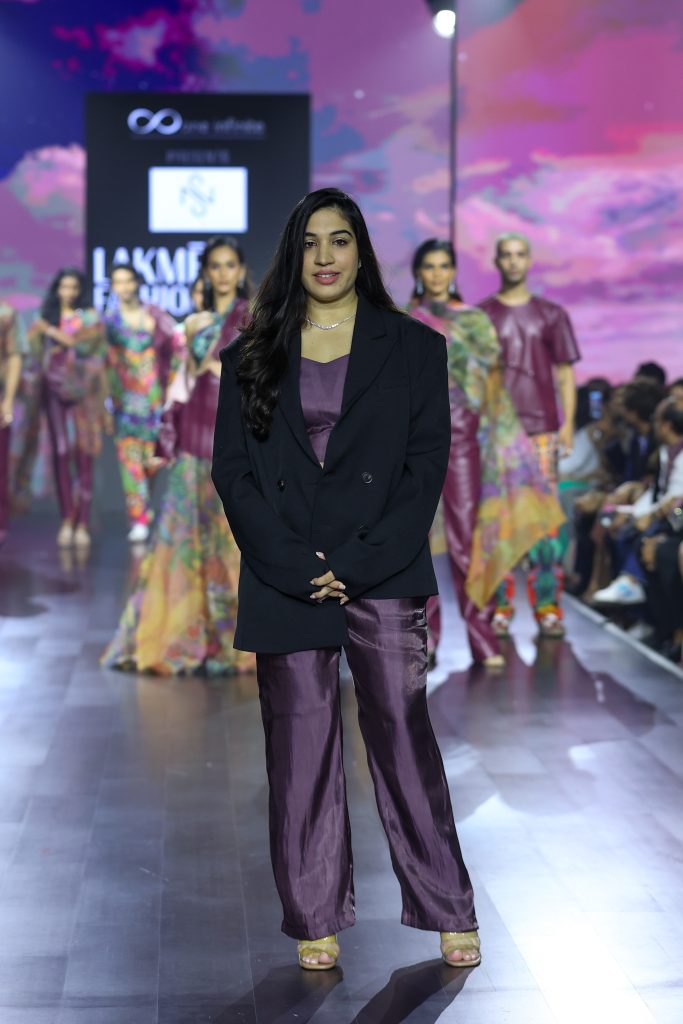
From Picasso, to Banksy and Mr Brainwash, Salita Nanda reinterprets art pieces through her unique rendering of hand illustrated prints in satiny draped dresses. By Asmita Aggarwal Born and raised in London, Salita Nanda studied at the London College of Fashion, University of the Arts, and then further honed her skills at Domus Academy in pattern making. The Indian community in the UK was vibrant, she decided to launch her brand in 2014, later moved to Mumbai after she met her investment banker husband. Known for 3 D printing, and selective laser centering a technique which accentuates conceptual prints, Nanda combined this with hand painting and illustrating original artworks, in the ready-to-wear line. “Growing up, I observed my mother loving all types of fabrics. She understood how to convert them into stylish clothing herself. We would go to different suppliers with her, that’s when I knew clothes would be something that I would do in the future, of course, in my own interesting way,” she smiles. Even though Nanda belongs to a family which is into construction from Pune, her father took the road less travelled and started the food exports industry in the UK. There was a void in the UK, in custom-made occasion wear, she teamed up with her mother, winning a clientele from Mumbai to Dubai and UK. “Prints are our signature, colorful and fun, most of the time they are inspired by artists,” she says. Some years ago, it was Picasso and his painting Les Demoiselles d’Avignon (The Young Ladies of Avignon, originally titled The Brothel of Avignon) from 1907 by the Spanish artist now part of the Museum of Modern Art, New York. “The angular, unusual body shapes, some Egyptian, African, and Asian styles were converted into paintings. Each of the five women were represented with symbols we handmade and broke down the colour ways, adding gradations,” she says. Art has been a recurring leitmotif in her collections as she was fascinated by graffiti street artist Bansky known for his political statements and also his protégé Mr Brainwash or Thierry Guetta, a French-born Los Angeles–based street artist. He reworks popular imagery as well as some from Jeff Koon’s steel balloon animals and Banksy’s ‘Throwing Man’, in a playful manner. “Mr Brainwash has designed album covers for Madonna’s Celebration, and Red-Hot Chili Peppers I’m With You, among others,” she adds. She is searching for an Indian artist she can immortalise with her artworks reinterpreting them uniquely. Satins, organza, crepes, on flowy silhouettes, and drapes gives each piece unmatched fluidity. “There is a song that has been playing in my head. It is about the sky. It is a 60s song, vintage but represented through the hues of what we see when we look above,” she says. It is not your typical blue—but yellows, pinks, and flaming orange, to depict changing seasons and ties of the day. “This year we have spray painted and also used watercolours mixing it with hand illustrations,” she explains.