
Who needs a showstopper? asks Ankur
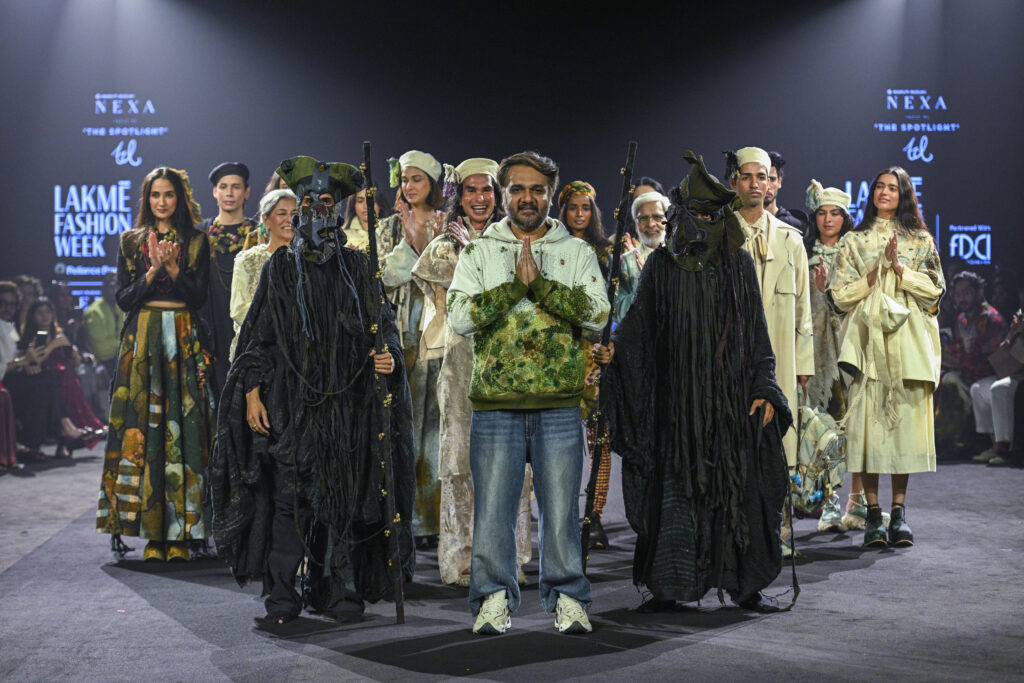
Converting waste into textural garments with a strong sense of identity, Ankur Verma of Til tells us, 3 months to craft one cape, several artisans create magic with just the power of discarded fabrics. By Asmita Aggarwal If experience counts for anything in life, Ankur Verma of Til would be the flagbearer. From Bottega Veneta to Armani, Sabyasachi Mukherjee to Varun Bahl, Ankur Verma has been there! Sometimes a “pause” in life helps you rethink, and re-access, thus his line “Breathe”, though he is gearing up for the Fashion Trust Arabia, representing India in Doha. “Til” the moniker for his label, or body textures— wrinkles, freckles has been his muse, though vibrancy is in his DNA, this time he channeled a softer palette—ivory, blacks, beige, combined this with patchwork, upcycling and created something new from something old. If you look closely, there are artistic traits in him that he employs to make things other than fashion—like the Doll house, completely made from waste—including cushions to sofas, furniture. It started as an idea for his six-year-old daughter, ignited the desire to take it forward by making dolls, charms, jewellery, even brooches. Intermingling organza and sheer, an easy line, with textural layering, experimental and innovative. This is despite the fact he admits “capital backing is not strong for young designers, this kind of work needs a lot of investment. It is entirely done by hand, one installation took three months to craft as it is laborious. “We used zardosi technique and the most expensive item I have in my collection is almost Rs 125000, a fully worked on jacket. Believe me when we started it was tough to sell something completely done by hand for Rs 22,000! Now there is a sea change in customer understanding,” he admits. From the pintuck kurta he wore, to creating garments entirely out of waste, it is free size, like the cape shawl. You can throw it on anything—jackets, sari, and even roomy pants. Nexa is celebrating its tenth anniversary, and they have selected three past winners Naushad Ali, Ankur Verma and SWGT. “Fashion is not just about lehenga-cholis, this doesn’t represent our culture. Look at how streetwear is burgeoning, hoodies to track suits, who would have thought this would ever happen?” he asks. People in India go after tags, “Made in Italy”, “Made in France”, what about Made in India? Isn’t there pride in this? he questions. “I’m old school, I do not browse through shows sitting on my couch. I believe in personal touch, you cannot see detailing online, even if you zoom in. I do not want to spend on photoshoots to serenade my buyers,” he says. Men, he believes are experimental, most of his women’s wear is being adopted by men, a corporate honcho inquired if Ankur could add collars on a woman’s jacket so that he could wear it! “My Afghani hoodie kurta is unisex, much loved,” he adds. One of the few who believes celeb showstoppers add nothing to the show, that’s why he convinced his 72-year-old father to walk the ramp again, both age inclusive and breaking boundaries of the “ideal face”.
Then and now with Ashish Soni
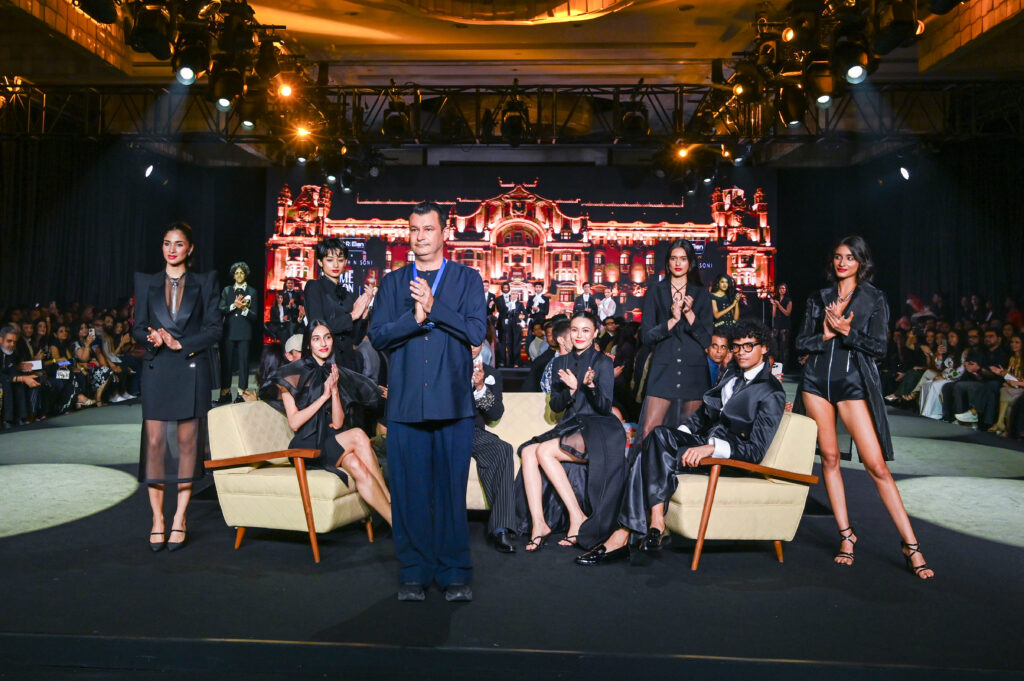
From trying to market the crisp, white tailored shirt in the 90s, to working with revered stylists like Deep Kailey, to now an entire collection with just black, Ashish is going back to his roots. By Asmita Aggarwal It was the year 2000, when India Fashion Week began at the Taj Palace hotel, IMG used to manage it, Ashish Soni was one of the few who was part of that exclusive community. This was 25 years ago, today tastes have been sharply refined, understanding is better. He may not remember his first collection’s name but he does recall he used denims, felt, and was told to follow the international calendar which works a season ahead. “There were only a handful of us, we had done trade shows, that’s all. Our exposure to fashion was going to Khan Market and buying American Vogue, as there was no real time coverage or social media chaos,” he adds, saying he could never make Indian clothes. The struggle was teaching the Indian audience that a crisp white shirt for Rs 5,000 can also be luxury, you do not need to wait eight days for an embroidered sari. “Newspapers and fashion weeks were instrumental in fueling growth,” he admits. Pushing the shirt, he added button hole details, cutting armholes innovatively unlike ready-made shirts, it was more of educating customers back in early 2000. His most memorable show was “Sounds of Silence” in 2004, he credits FDCI for the success, it put him on the path to fame, got invited to London and New York fashion week post that. “It changed my life, using Indian fabrics I crafted a global language. Borrowed from Kutch, Gujarat, a tribal blouse, he developed a woman’s jacket,” he remembers, and it sold almost 1,500 pieces becoming a bestseller. Learning from the most distinguished stylists Deep Kailey, who in 2008 was directing covers for Harper’s Bazaar and Vogue was an eye opener. His sales agent was Florence Duchamp who launched Comme Des Garcon and introduced Rei Kawakubo, “she told me the Indian wooden hand made button is too polished, stitch it on the wrong side; such detailing really opened my metaphoric third eye,” he admits. Just when he was planning to settle in the US the markets crashed, but he did live in London for two years managing a South African brand Vanessa G. He then decided the focus had to be India, and till today Ashish has archived all his key pieces effectively. He has a women’s vest framed, his first foray working with fake crystals (Swarovski hadn’t come in) and mesh that sold enormously well. This year with RRelan, he showed his finest—sculpted tailoring, pattern cutting, using sustainable man-made fabrics, wool blends, polyester viscose to poly linens that do not crush. The cool-tex he has worked with is super light, loosely woven crepes, super fine shirting, textured knits creating women’s jackets and pants. “We have done Indian embroidery using belt hooks recycled that came in the wrong size, vendor refused to take it back, so we embroidered them. A sculpted bandhgala and a sheer skirt, sheer kurta with a sculpted sherwani that’s what I feel works well,” he explains, this along with his quintessential tuxedos for women a la YSL style. “The spirit is very Diane Keaton, I know as a designer I must make myself relevant, so I went back to my roots. In the 90s when everything was maximalist I decided to stick to minimalism. Less for me is always more,” he says, adding, “This year the show was entirely black but 30 variations of it, adding both texture and character.”
Life comes a ‘Crcle’
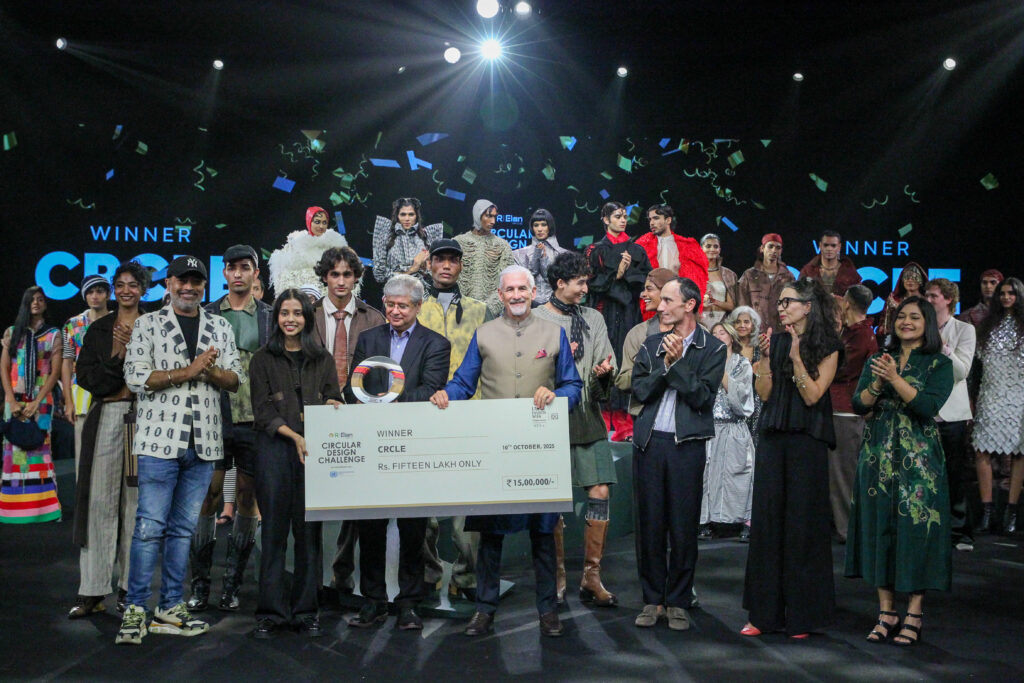
From Veganwool to banana leather, CDC finalist Varshne B is crafting a unique trek to not “save the planet” but give cool alternatives and watch out for her stainless steel bags. By Asmita Aggarwal Varshne B founded Crcle in 2024, born and raised in Chennai, after studying fashion design from NIFT, Chennai, she works with . She admits she loved two things—drawing and dressing up. Though growing up with no internet, only newspapers and few fashion magazines, she knew one day, she will close the proverbial “loop”, thus the moniker Crcle. “In college, I was alarmed at the waste fashion produces, I knew I wanted to do something in this field. Paulo Coelho quote rang in my ears— ‘Planet doesn’t need saving, we do’. It resonated with me and I decided to study design. For me ‘save the planet’ is a sign of human arrogance, we need to look within,” she explains. She began with weganool, 100 p c sustainable, zero-waste woven satin fabric, plant-based and a chemical-free, cruelty-free wool alternative from the Calotropis plant. She also works with banana leather. “Both are innovative and environmentally friendly materials, the latter is extracted from the banana plant, made from the stems and pseudo stems of the banana,” she adds. Way better than traditional animal and synthetic leather, though she also works with indigenous crafts like khadi, hand woven denims, and kala cotton. “We collect discarded materials from factories,” she adds. Like Balenciaga, she also has her version of the stainless-steel bag, refashioned from scraps and leather offcuts, sourced from metal units and leather factories in Chennai. She combines this with crochet, natural dyeing, and embroidery, “I like working with material innovations, converting leather belts into coasters, making a new version of lifestyle products,” she explains, adding, “we create unisex products, using natural dyes.” Mats are hand woven in Tamil Nadu, crochet from women’s groups, plus recycling waste through India Waste Group, where they collect studio waste, discarded pieces, and make something new with it. “Circular Design Challenge has given me this opportunity and I hope I can spread the message that we need to consume consciously,” she concludes.
Meet next supermodels –Sky and Ava
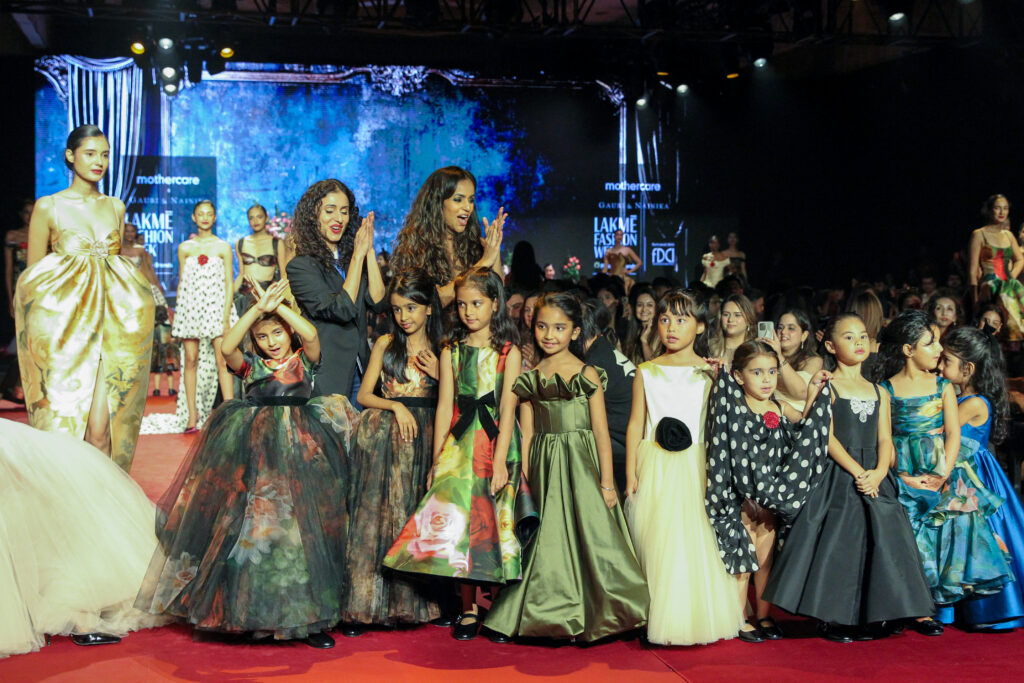
Nainika and Gauri’s daughters, give the catwalk some serious twirls, while Satya Paul announces Bollywood dreamboat Aditi Rao Hydari as their creative collaborator. By Asmita Aggarwal What happens when you have a live DJ, some moon, stars, and sun, mingling with the philosophy of “Papa don’t preach”. Well Shubhika knows young women, like quirky pink lehengas, she also believes dressing need not be about zardozi or kantha, but irreverent bags that come with pearl handles and sun shaped minaudieres. LFW X FDCI shows saw an influx of small dreamboats-including Nayanika’s daughter, as their tie up with Mothercare was surprising. Associated with red carpet, extravagant dressing, Priyanka Chopra in their backless neoprene number, it was a sea change from black gowns paraded with veils, and five-year-olds, in their floral full skirts beginning the show. Balloon and classic Balenciaga style envelope dresses, their signature big bows, polka dots, bunched up skirts channelled the spirit of the swinging 70s. Volume was their thing with tiered dresses in pleasing monochromes, European corsetry, a bit like what Scarlett O’hara wore in “Gone with the Wind”. Exaggerated and pixelated flowers on charcoal gowns, ruffled, and tiered, they decided to get Ava (Gauri) and Sky (Nainika) their daughters’ debut on runway. “We wanted to make clothes that sell—be glam, and introduce Princess dresses for girls (range for 3 to 6 years, some velvet suits for boys as well as bow ties). There is a book we used to read to our daughters–Kate and the Spanish Princess by James Mayhew, the whole show was inspired by this,” says Nainika. If you saw the Panniers or side hoops that they included it takes you back to the 17th and 18th centuries, a technique used to extend the width of the skirts. “Sky my daughter used to love the book, how the main character becomes part of a painting and gets to dress like a princess. We never made clothes for our daughters, though they saw us work all these 20 years. This was one opportunity to do so with Mothercare, it is a year-long collaboration, we have done 30 styles,” she adds. They used Mikado silk, tulle, printed luxe Duchess satin, using boning, bustle, and crinolines, very Marie Antionette styles. The empire cuts and tulip shapes were exaggerated, high lows used, in pure silk and chiffons, they abandoned polyester. “The prints were dark and moody, like an Albert Fernand-Renault painting or a Caravaggio, like an oil on canvas, with big roses,” she adds, admitting they didn’t name the collection, feeling it should be interpreted by the viewer in his own way. Satya Paul is undoubtedly a legacy brand, which understood that an Indian woman no matter how many gowns she wears, or aspires to buy will always wear saris. Almost 70 percent of our population thrives on it. Puneet Nanda and his father Satya Paul started this amazing journey in the 90s, with Genesis Luxury and till today their prints have been their showstoppers. David Abraham and Rakesh Thakore, creative directors of the brand, began with parrot green shoes, draped cowl saris, with bold flowers. And, of course hints of shimmer as their contrasts were engaging —deep blues worn with black and white stripes. From graphic to abstract prints saris worn as neck scarves, not pallas, one shoulder gowns in baby pinks, accompanied by long coats, sometimes knotted at the waist, they got circles, and dots printed as waists were cinched with leather belts. What is new is Bollywood beauty from Hyderabad, Aditi Rao Hydari, as their creative collaborator. “I am so excited, in fact thrilled to be a part of this. It is great to think creatively, play with fabrics, constantly come up with ideas, it is part of my DNA, part of who I am. Satya Paul is for women who own their femininity, it celebrates authenticity. It is a brand that is evolving like women do. I’m dreaming many, many dreams,” says Hydari.
Luck by Design
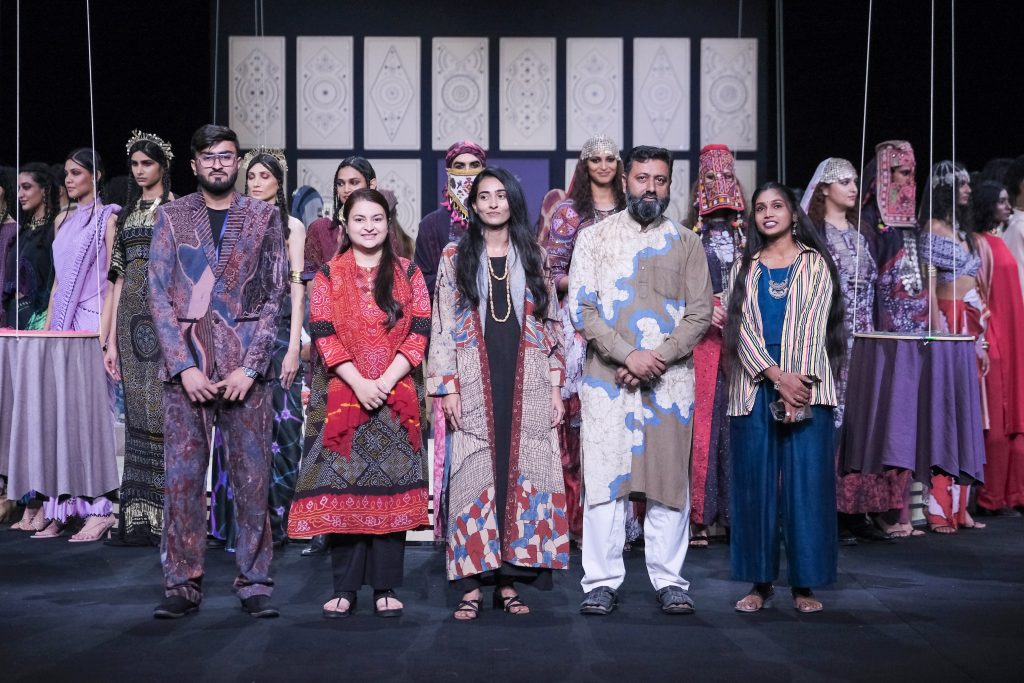
Somaiya Kala Vidya, is creating a space for artisans from Gujarat working with Bandhani, Ajrakh, block printing to applique, equipping them with skills that combine—marketability with design prowess-craft is just not art. By Asmita Aggarwal You would never expect a chemical engineer from the acclaimed NIT, Trichy to be working in the development sector, but there is a lot more to Nishit Sangomla than just his degree. He won the SBI Youth for India fellowship which took him to the Barefoot College, Rajasthan, established by visionary Bunker Roy in 1972, hoping to empower rural communities. In “Solar Mama”, how to fabricate solar panels, lights and photovoltaic circuits is taught 110 km from Jaipur, Tilonia village. Nishit began working with them, and it changed his life forever. He had found his true calling many years ago. Though he did notice it was dominated by women, as the men had gone to bigger cities to work in mines, never sent money home, forcing them to fend for themselves. Agriculture was not an option—but the region was loaded with crafts—they worked with leather, made durries, everything was laboriously hand-crafted—a gem waiting to be showcased to the world. “They are skilled, but did not know the technical aspects—marketing to supply chain management. After all, erstwhile kings wore crafts that are now museum pieces, all they needed was design direction,” says Nishit. This gave birth to the design lab they set up, to dig deeper into concepts, educate artisans, the seed of the idea came when Nishit met the legendary Judy Frater, an anthropologist from US, who came to Kutch, Gujarat in the 70s, the rest is history.. Judy, lived 30 years here, with artisans, particularly women embroiderers, studied their traditional crafts, Kala Raksha Trust she set up in 1993, to empower artisans. After the 2001 earthquake, she founded the Kala Raksha Vidhyalaya School in Meghpar, Anjar, Gujarat, the first design school for traditional skilled artisans. Bonus: they are setting up a natural dyeing research lab, which anyone can use. When he met Judy in 2016, she mentored Nishit, in 2019 she wanted to go back home, Nishit took over as the vision was clear. Bandhini, Shibori, Batik, weaving, block printing, patchwork to applique—artisans are taught how to modernise and sell. There were many hurdles he faced —in the one-year program, women artisans’ families were not comfortable to send them to a residency (12 women, 12 men trained every year, number varies). Interestingly, the age is dropping for students, earlier it was above 30, now younger artisans are joining, who had given up this generational skill. There are six modules— they can learn from street markets, retail stores, and exhibitions—colour development to trend forecast, experimenting with motifs, each skilled artisan is taught various verticals to enable him to be market ready. “When we take interesting calls like increasing dips in indigo the results are spectacular—innovation is the game,” he smiles, adding they also added violet to Ajrakh giving it a new spin. At LFW X FDCI Somaiya Kala Vidya showcased Ajrakh by Ziad Khatri, Alaicha (Mashru) by Amruta Vankar, ‘Anatomy’ by Mubbasirah Khatri, ‘Mystery’ by Muskan Khatri, ‘Tradition to modern’ by Shakil Ahmed, the school has now been taken over by Somaiya Trust, which is a prestigious educational institution based out of Maharashtra since 1942. Amrita Somaiya, who owns the school, has a Bachelor’s degree in Economics from Simmons College, Boston, and her husband did Chemical Engineering from Cornell University, a Master’s degree in Public Administration from Harvard University. Their family originally belongs to Kutch, Karamshi Jethabhai Somaiya, was an Indian educationist, who founded educational institutes in Maharashtra, was awarded the Padma Bhushan, Samir his son is carrying forward his legacy. “My father-in-law worked relentlessly after the earthquake to build Kutch, then my husband met Judy, as she was looking for opportunities to continue the craft work,” says Amrita. Amrita’s father is an architect, mother an interior designer, she inherited the love for aesthetics from them, crafts has been her mainstay, thus subsidised education for artisans at Somaiya Kala Vidya. “Real craft is handmade, each artisan who showcased had a personal story in the collection, like Shakeel bhai and the beautiful Batiks, it was contemporary, but soaked in craft,” she adds. An avid lover of textiles, from Ajrakh to Bandhini, hand woven is her go to, she spends time in clusters, and from grassroots understands how to bring awareness to the processes. Juhi Lakhwani, business development officer at Somaiya Kala Vidya, joined this year, but her experience is vast—she won the Naropa Fellowship, which took her to Ladakh. She worked with traditional artisans in carpet weaving, realised handicrafts are losing their identity, and wanted to teach them social entrepreneurship. “The products worked well, but Covid hit, we had to pause. The key was teaching them e-commerce, digital merchandising, it worked in their favour,” Juhi says. At Somaiya she helps them market their products, with design intervention—Soof, Rabari embroideries are much loved along with Batik. Somaiya Kal Vidya has opened another school in Karnataka, Bagalkot; they have a store in Prag Mahal in Bhuj. “The reason why Gen Z does not buy craft is the lack of awareness, they have been brainwashed by Westernisation. Artisans have saris and stoles, and silhouettes need to be taught to serenade a younger clientele,” Juhi adds. When you see artisans like Mubbasirah combine traditional Ajrakh blocks with hand painting, or Amruta’s new developments for Mashru, you know they are set to succeed. Alaicha translates to Mashru in Kutchi, it is associated with the Ahir community, each pattern reflects legacy —they have a new palette, in some ways redefined it. Mubassirah is the first female artisan to step into the male dominated Khatri Ajrakh artisans rejigging it with freehand painting! Craft is business now, not just art. “I began learning from my father six years ago after he returned from SKV, I’m the only woman in three generations from Ajrakhpur to take this up,” says Mubbasirah. Ajrakh means “leave it for a while” in Kutchi, it takes
Nikki’s Khadi Resort wear
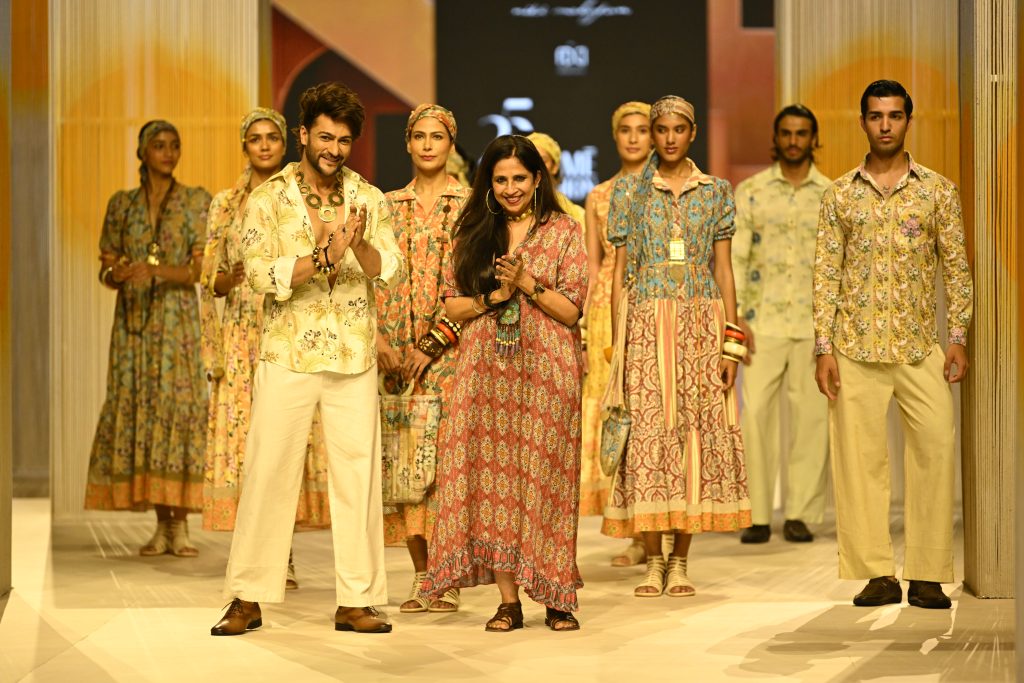
After 42 years in fashion, perfecting block printing, Nikki Mahajan pays tribute to khadi not through predictable kurtas, but dresses with baroque elements and French prints. By Asmitaa Aggarwal She began almost 42 years ago, in the 80s when she was newly married, at 20, studying in Lady Shri Ram college of Commerce, English literature, had no clue even about the word fashion, she would call herself a “tailor”. But Nikki Mahajan knew when she was taught needle work and smocking in Loreto Convent school, Delhi, she started making clothes and embroidered it herself for her friends’ moms — this would be her calling! Ten years ago, the business dynamic altered, she moved to working with Japan, Middle East and US markets, special collections, about after 42 years in the business. Self-taught, the 62-year-old knows the challenges of running a brand, “In the late 80s, there wasn’t any fashion school, only polytechnics, which were not considered great, but I found my way around,” she says. She used to take her two kids to play tennis in DLTA, Delhi where she saw the exodus of Kashmiri women, in the early 90s, sitting opposite, looking for work, she decided to help, hired them as embroiderers utilizing their skill and providing employment. “Bindiya Judge’s store Signature in Hauz Khas Village, was the first one that sold luxury designer wear, but unlike today’s generation, we had to find our own niche,” she explains. For the FDCI khadi show at the LFW, Nikki has done what she does best-block printing, which even her Japanese clients love (she made a 3000-piece line for Anthropologie too). She found a way to make the uneven blocks as they are hand done into some form of evenness by digitizing it for her buyers abroad who wanted “sameness”. “I digitize the fragments I get while visiting various museums all over the word-Egypt to Uzbekistan, Amsterdam to France, and this line is an amalgamation of all those shared experiences,” she confirms. She takes pics and then makes a collage and starts work on the storyboard. To this she added Baroque elements and French prints, dexterously executed on Khadi, even though she works with mostly cotton and silk, she loved the textiles and unevenness khadi offered. “When you wear linen it crushes easily, khadi doesn’t and that’s its beauty–I discovered and admire its slubbiness,” says Nikki. Fashion is now easier. It has Pinterest, Instagram, the new breed of designers are intrepid, they aren’t insecure, it’s the same masala box, but they are cooking up a storm with it. She is back on the runway after 10 years, but decided not to make the usual kurta with khadi rather went opposite-resort wear, carefree and fluid!
No white collar, it’s silver for Anamika
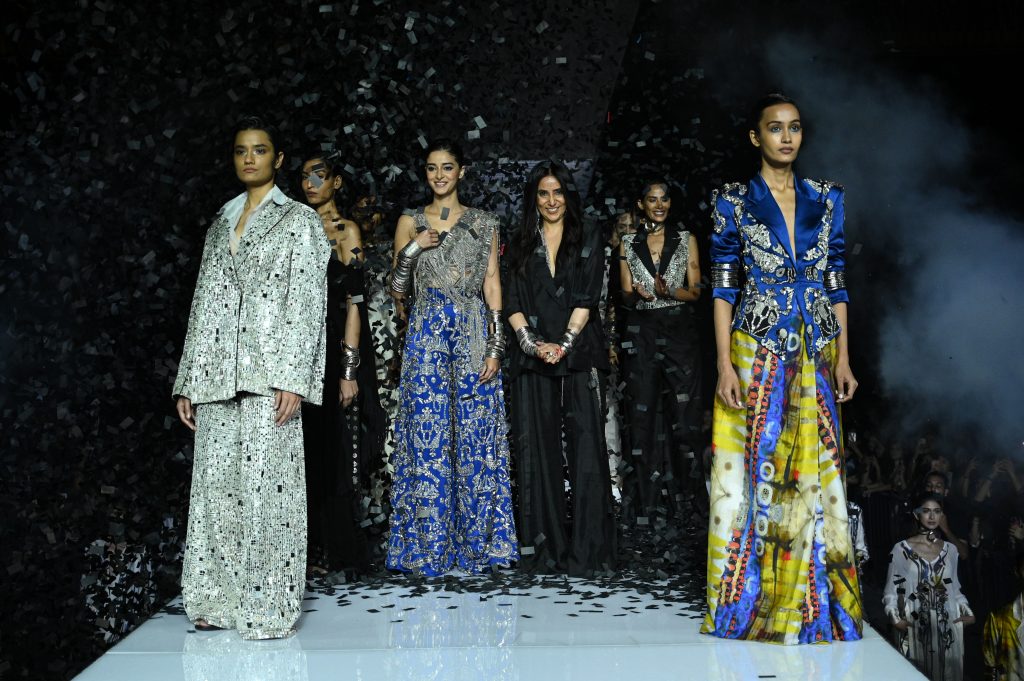
After almost 25 years, Anamika Khanna is hoping women in lucrative careers want something that is not just suits and blazers –maybe a silver tie, suspenders, daddy briefcase and some pearl encrusted denims from AK-OK! By Asmita Aggarwal India is all over the world, and it isn’t just “in India”, anymore maybe that’s why Anamika Khanna’s AK-OK for working women, is timed right, the market is ready for this, especially as professions are now unconventional. One could see nostalgia—daddy suitcases cleverly revived, splashes of colour, even though monochromes are her thing, denim is now slowly moving to her favourite list. Above all, no one can beat her in texturing—how she combines various techniques—patchwork, applique to mirror work at her show for LFW X FDCI. The ignition of the idea came from Rabari tribe who are movers never static—Gujarat, Rajasthan and have some Afghan influences too, she began researching, and found their silver stacking jewellery was phenomenal. She took those—and modernized it with suspenders, ties, chain loop belts, “you don’t need to wear silver only as a jhumka, if it can be a silver collar too”. She had that too—literally, workwear equals—”silver collar”, also the name of her line—like you have blue collar and white collar. “Let me tell you what I think is my biggest strength—I don’t think of the garment but the woman,” says Anamika, understanding the changing needs of modern women, their intimate relationship with clothing, and how it changes their mood. After 25 years in business, every time she does a line, she wants to incorporate something “forgotten or lost”, last season she also paid tribute to the Bonda tribe from Odisha. “Women bring not just power to the boardroom but also emotions and compassion onto work, I wanted each of the 50 pieces to reflect that,” she adds. If you look closely, the styling, it has a churidar, with a dhoti and collared skirt, each reference was out of India, but how to make it fashion Anamika knows. The show was about 9 to 5, and how workwear rules are being broken, in between this mix she revived her dhoti pants of the year 2000, churidars which she loves, as well as tattered holes and cut outs. “Designing as a profession is challenging, lot of people tell me take it easy, take a break, and while I am talking you, I’m sticking applique on a dress, this is my life, I live for fashion,” she smiles,
In Fine Print
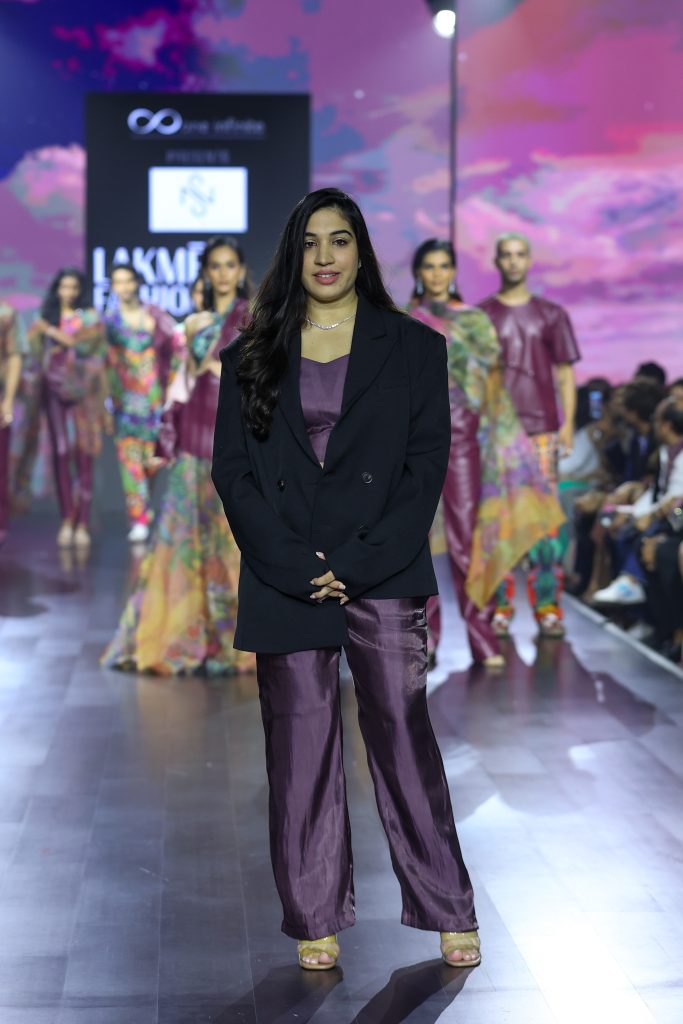
From Picasso, to Banksy and Mr Brainwash, Salita Nanda reinterprets art pieces through her unique rendering of hand illustrated prints in satiny draped dresses. By Asmita Aggarwal Born and raised in London, Salita Nanda studied at the London College of Fashion, University of the Arts, and then further honed her skills at Domus Academy in pattern making. The Indian community in the UK was vibrant, she decided to launch her brand in 2014, later moved to Mumbai after she met her investment banker husband. Known for 3 D printing, and selective laser centering a technique which accentuates conceptual prints, Nanda combined this with hand painting and illustrating original artworks, in the ready-to-wear line. “Growing up, I observed my mother loving all types of fabrics. She understood how to convert them into stylish clothing herself. We would go to different suppliers with her, that’s when I knew clothes would be something that I would do in the future, of course, in my own interesting way,” she smiles. Even though Nanda belongs to a family which is into construction from Pune, her father took the road less travelled and started the food exports industry in the UK. There was a void in the UK, in custom-made occasion wear, she teamed up with her mother, winning a clientele from Mumbai to Dubai and UK. “Prints are our signature, colorful and fun, most of the time they are inspired by artists,” she says. Some years ago, it was Picasso and his painting Les Demoiselles d’Avignon (The Young Ladies of Avignon, originally titled The Brothel of Avignon) from 1907 by the Spanish artist now part of the Museum of Modern Art, New York. “The angular, unusual body shapes, some Egyptian, African, and Asian styles were converted into paintings. Each of the five women were represented with symbols we handmade and broke down the colour ways, adding gradations,” she says. Art has been a recurring leitmotif in her collections as she was fascinated by graffiti street artist Bansky known for his political statements and also his protégé Mr Brainwash or Thierry Guetta, a French-born Los Angeles–based street artist. He reworks popular imagery as well as some from Jeff Koon’s steel balloon animals and Banksy’s ‘Throwing Man’, in a playful manner. “Mr Brainwash has designed album covers for Madonna’s Celebration, and Red-Hot Chili Peppers I’m With You, among others,” she adds. She is searching for an Indian artist she can immortalise with her artworks reinterpreting them uniquely. Satins, organza, crepes, on flowy silhouettes, and drapes gives each piece unmatched fluidity. “There is a song that has been playing in my head. It is about the sky. It is a 60s song, vintage but represented through the hues of what we see when we look above,” she says. It is not your typical blue—but yellows, pinks, and flaming orange, to depict changing seasons and ties of the day. “This year we have spray painted and also used watercolours mixing it with hand illustrations,” she explains.
“Embroidery is our DNA,” says Ashdeen
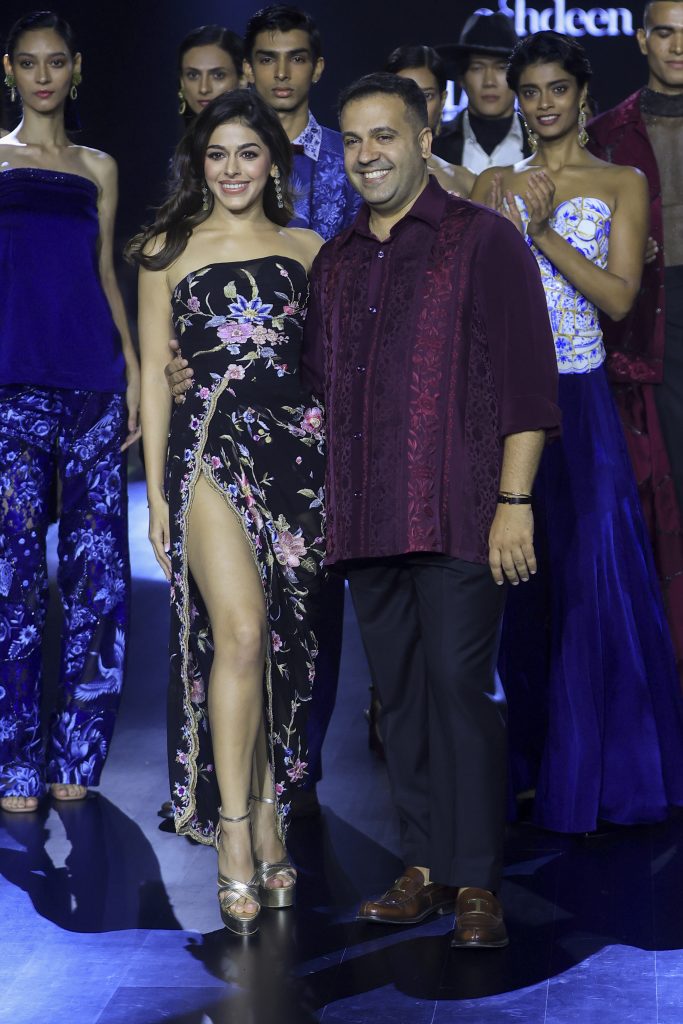
Dutch artist Patrick Bergsma and his broken ceramic pottery where bonsai grows is where Ashdeen found his stimuli, though his simple shapes complement the complex needlework techniques he uses to offer modern jackets. By Asmita Aggarwal Ashdeen Z. Lilaowala is a trained textile designer from the National Institute of Design, Ahmedabad (2002), with almost 22 years in this space, he decided to embark on a journey to really understand embroidery—2012 was when he decided to anchor the ship, launched his label. For a country which can’t get enough of embroidery, in any form, Ashdeen seems to have made the right choice, the only differentiator is, he doesn’t go where everyone has been, he uses these delicate age-old techniques on shapes and styles to serenade a younger audience, like his competition Patine. Growing up in Mumbai to a Parsi, working class parents, he was encouraged seeing his older sister study fashion design, and decided to follow her footsteps, at 17, he joined NID. Worked with NGOs, export houses, wrote extensively for magazines, his label was a result of providence, not premeditated. Ashdeen was working with a company in Los Angeles, used to import embroideries to America, till one day he made a Parsi gara for a friend, there was no looking back, he had found his market, from word-of-mouth. His experience was in-depth, working in the backend, he understood processes, techniques, markets, finance, how to run a business, and grew faster even though he started “late”. “I did my own shoots styling, wrote my press notes, it was a 360-degree learning, to know every aspect of the business,” he says. Twelve years in the business, with three stores (Mumbai, Delhi, and Hyderabad), Ashdeen believes embroidery is no longer a cultural aspect, it is all encompassing—you can wear a brocade jumpsuit, Parsi gara jacket or Kanjeevaram skirt. “Embroidery is part of our DNA, there is a new appreciation for it, consumers are ready to pay the price for the effort/labour intensive techniques. Honestly, 80 percent of my clientele is not Parsi, even though we have a dwindling population in India,” he admits. Parsis began trading with China in the early 17 century and saw these heavily embroidered pieces, they decided to bring it to India, Mumbai became a thriving centre. “Embroidery attained a new identity, it was Oriental, they adapted it for themselves—the jabla, wearing it, grew within the community. Trade blossomed, women kept the pieces, to be passed down to the next generation,” he explains. This year —birds, cranes, flora and fauna, chrysanthemums, peonies, roses will bloom on the LFW X FDCI Ashdeen line, almost looking like you are “painting with a needle”, inspired by the works of a Belgian artist, who creates magic with broken ceramic, letting a plant grow inside, almost giving you an image of an imposing floral arrangement. “Raised in a family of antique dealers, Patrick Bergsma was surrounded by art – using bonsai trees and using them in broken vessels, the visuals struck me,” says Ashdeen. It seemed as if fragments of time had been pieced together, almost like kintsugi, which he has attempted to portray in patchwork, without the Bollywood glam, simple shapes. Social media has put in so much pressure, how do you show classic ensembles, each piece is a labour of love, craftsmanship, so much consumption on Insta, how do we slow down? It is the question that plagues him. “It takes almost six weeks to make one piece,” he says, adding, “it is heavy on research, then polishing and finishing takes time. But I do feel this is where I find my creative stimuli. If I didn’t design, I would be a travel researcher and photographer,” he grins.
Luck doesn’t help, focus does: Payal
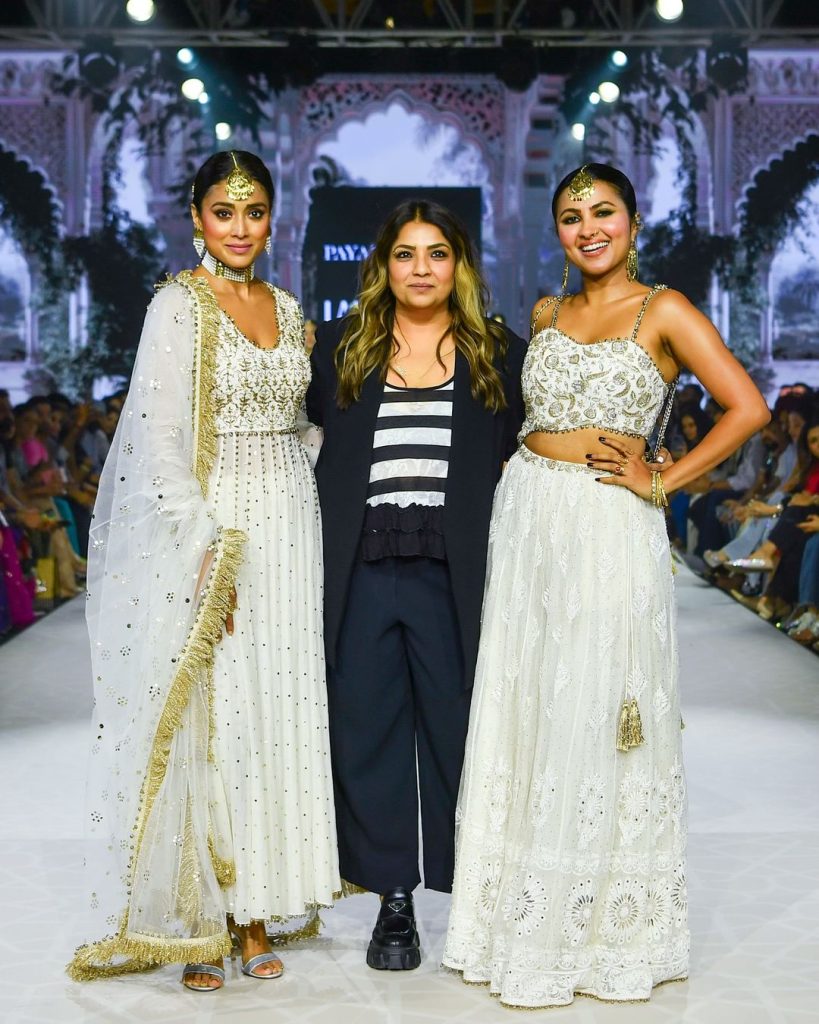
From her backless cholis to Aishwarya Rai wearing her award-winning Anarkali, Payal Singhal in 25 years of business has been consistent leaving theatrics to greenhorns, adopting practicality for survival. By Asmita Aggarwal Payal Singhal completes 25 years in the business of fashion, and if there is one designer who truly understands finances, it is the Mumbai-based guru of the “backless choli”. Her latest collaboration has been with the American sneaker company End State, that unfortunately could not be launched in India (due to laws changing) but is being sold in the US for $250. Designing the kicks with Stephanie Howard, ex-Nike designer, Payal says technology is the future as this one comes armed with a 3-chip futuristic approach. It is NFC based, interestingly they reached out to her, seeing her fan following (earlier they have collaborated with artists and musicians). “The shoe was a crossover between the East and West, June it was launched in the US, now sold online,” says Payal adding, it was inspired by Adivasi tattoos and she added her signature mukaish work, trying not to make it too Indian but global. You add brushed gold to this and you have a unisex sneaker. That’s not all. She has associated with Coach, also Namrata Lodha for hats inspired by the wheat farmers in Madhya Pradesh, she makes a line of kids wear, home, jewellery, resort wear as well as menswear, her portfolio is large and impressive. When she looks back, it is only resilience that helped stay afloat, keeping her head down and working, admitting “my career is not based on the luck factor” but a gradual graph upwards. She has survived covid, demonetisation, GST, and bad markets only to learn from those upheavals. “Innovation is the core of my brand; you cannot stick to a formula and make it work. I get bored easily, I need to be creative with my craft,” she adds. Twenty-five years is a long time to survive in the industry, when she started making Indo-Western with backless kurtas, to add sensuality, clients asked her “where is the back?” From 20-year-olds her customers, who spend more money than brides, Payal each season looks for excitement and freshness abandoning the complacency that comes with success. This year like always, there will be hallmark pieces—prints, fusion of art and architecture, shapes deconstructed and you cannot term her prints quirky or pretty. The backless choli remains her clients go to, and thus has been copied extensively too, the tasselling work added a new dimension to it several years ago when she started. “Luckily, I didn’t make any big errors, went slow, and sustained even during covid. We are self-funded, but tangibility and freedom helped us,” she adds. Payal has been a conservative businesswoman, never wanted to show off, flew under the radar, didn’t plan on opening a 10,000 feet store, when you visit her stores, “it is like having a chat with friends, not imposing or intimidating”. In 2005, she had a store in New York, which she shut down, even though she is the queen of collabs, she hasn’t ventured into the already crowded beauty segment, but came close to doing it. At 47, there is clarity of vision, every piece she wants to channel functionality and comfort. “Clothes should not be fussy, but easy, and clean, so repeatable. I always tell myself keep your eye on the prize, focus always works, and do not be in a hurry,” she adds. The LFW XFDCI line is a subtle nod to the 25 years, the first outfit showcased was the one she made, and won, for being the youngest designer in a Shopper’s Stop competition she took part in. “I was 15 years old, it was a national contest, the katarva cotton weave with a shadow effect won me the honour. Aishwarya Rai Bachchan has worn the winning Anarkali, I remember,” she laughs. There is nostalgia in the show, subtle panels of zardozi in gold, silver, and black, Mughal motifs. “My dad was an exporter and the biggest lesson he gave me was practicality,” she adds. Though Payal has no appetite for theatrics, “storytelling is important but I have done it without it,” she grins. The line is just in time for the festive season — extensive gotta-patti, creamy whites, tone on tone, ghungroos for embellishment!