
Upcycled Shimmer
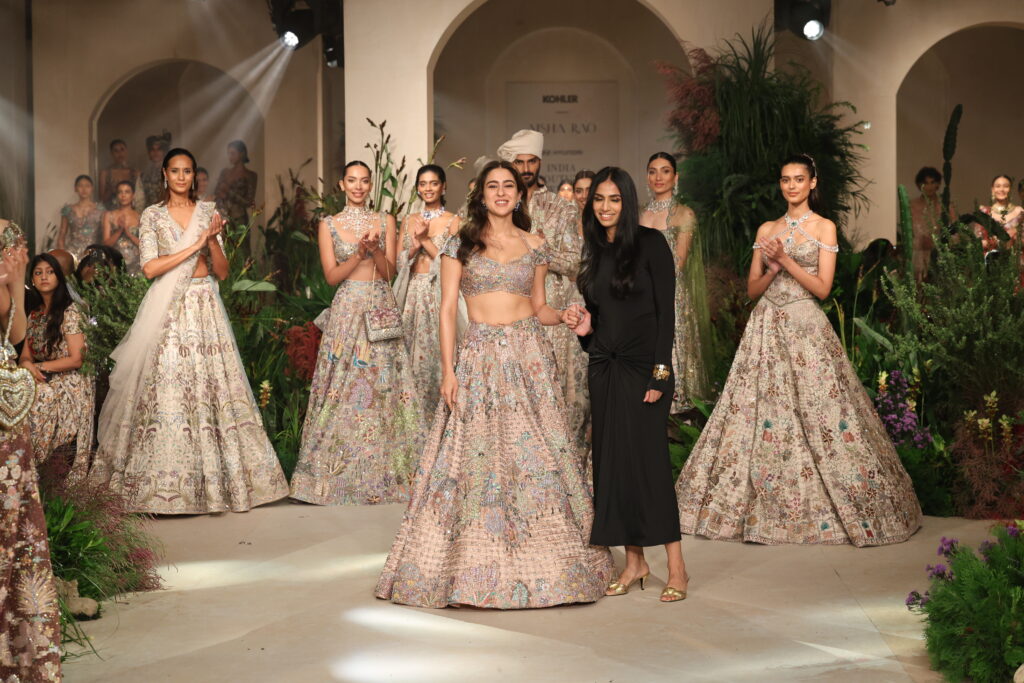
Hyderabad has emerged as a competition to Delhi-Mumbai for couture, even though the lawyer turned designer believes going green can be possible in couture! By Asmitaa Aggaarwal She is a lawyer, who always had an interest in environmental law, and decided to mix her two passions –legal eye with fashion. Upcycling, applique to molten metallics, Aisha Rao, from NUJS (law) to studying in Barcelona Istituto Europeo di Design, IED and then garment construction at Parsons New York, she knew her heart was in making clothes that bring out the vibrancy of India, its unabashed celebrations. Showcasing her line “Wild at heart” at the ICW for the first time, she has said ‘no’ to plastics for a long time, and was in fact debating whether she really wants to work in fashion, known to be the most polluting industry in the world. “Whenever you cut a bias skirt, there was a lot of waste generated, along with this was when we used sequins, bugle beads, bullions on the ‘khaat’. We wanted to find a way to use both these and we did, by upcycling them. I wanted to make a viable business, but reduce carbon footprints,” says Aisha. And of course, a degree in law always helps—specially when recently Bloomingdales sent her a contract she was able to maneuver dexterously. “Brides don’t understand the concept of waste, all they want is to look pristine,” she laughs. Mother of two kids, Aisha often finds inspiration in their stories, like Roald Dahl’s Matilda to Paper dolls, though Indian couture is enjoying the spotlight, with China slowing down–Ambani wedding, Prada introduced Italian version of Kolhapuris, LV embroidered bags. Sabyasachi Mukherjee has stated, he would like his jewellery to not be locked up but worn on linens and skirts. Plus, couture is now functional, not just about heavy lehenga cholis. “We are doing dresses you can wear at your friend’s wedding, the crystal one-piece blouse can be teamed up with palazzos, traditional peacock motifs top this is now your companion to a date night draped skirt,” she says. Couture was earlier reserved for the OGs, very tough for young people to break in, it is also manpower heavy and super expensive, till now Delhi, Mumbai and Kolkata were hubs the South largely ignored. Two designers have broken the glass ceiling and given Hyderabad, a great representation—Jayanti Reddy and Aisha Rao. “I have always loved the Banarasi weave, this year also it finds a representation, in my collections, pure gold zari saris in Kanchipuram. Girls have a mind of their own, they will wear a tiny beach blouse, but mom-in-law still prefers classic woven sari,” she laughs. Her kasavu tissue saree, zari with satins, have done well, for cocktails, to white weddings. “We did sequins overload in the Barcelona line, as an ode to Antoni Gaudi, the acclaimed Spanish architect, I’ve always wanted to tell a story,” she affirms. This season Aisha offers jackets with bustiers inside, a sweater shape you can add over your lehenga, with a smattering of aari work and zardozi. “I’m sitting in Hyderabad, so Bollywood is tough to crack for me, though what celebs wear is aspirational, gets instant results, when a lehenga sells in volumes, it is good for business,” she says. From palms, peacock colours, chintz, maximal flora, lush teak berry, there is a little bit of Aisha in each piece she crafts, “of coursen o lehenga comes within a pocket as that was my pain point at my own celebrations,” she concludes.
Bihar to custodian of Bal’s legacy
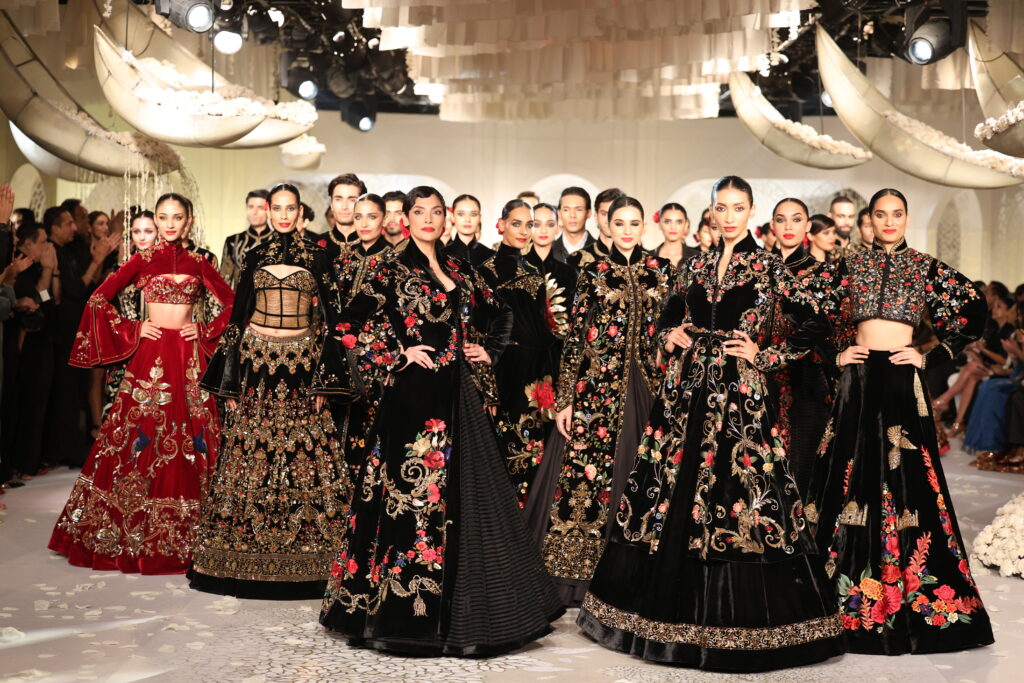
Tasnim Fraze, creative director Rohit Bal, brings garden of flowers from Kashmir in Matka silks and poetic khadi for ICW 2025. By Asmitaa Aggarwal It is quite a larger-than-life legacy of the iconic Rohit Bal to carry on his nimble shoulders but Tasnim Fraze, believes, “It’s an honour and a deeply personal responsibility. Everything he created came from a place of love — for Indian craft, the beauty of Kashmir, and the people who bring that beauty to life. I had the privilege of learning and growing under his guidance for over a decade. As Creative Director, my role now is to protect what he built and let it grow, with the hope that everything we create reflects the integrity and grace he always stood for.” His journey with Rohit Bal began in 2013, just after he graduated from design school Symbiosis International University, he began as a young designer in his team and over time, got the chance to be involved in more — from design to the business side of things. “Rohit Bal always valued growth and believed in continuous learning. He encouraged me to pursue further education, which led me to do my MBA at IIM Ahmedabad. That experience helped me understand how to balance creativity with business decisions. But the real learning came from working with him — being in the atelier, working with artisans, and watching how an idea would turn into something special in his hands,” he adds. The FDCI ICW collection called Kash-gul, draws inspiration from the landscape and poetry of Kashmir — especially from Gulistan, which means the “garden of flowers”. This collection connects with shared memory, craft, and tradition. “We’ve worked closely with artisans to preserve techniques that have been passed down over generations. We’ve used fabrics like Matka silk and velvet, with thread work and gold zardozi that add richness and depth. The motifs — peacock, lotus, and rose — were signature elements in Rohit Bal’s work, and they continue in this collection. What I have tried to retain is his sense of elegance and the quiet drama that made his work timeless,” he explains. Tasnim grew up in Bihar, grew up surrounded by culture, stories, and art. Bihar is also the land of hand-woven matka silk, and khadi was a part of daily life. “Being around these kinds of fabrics from a young age naturally drew me toward textiles and eventually, into fashion. Fashion became more serious for me during design school. And everything truly came together when I started working with Rohit Bal,” he confirms. Couture today is about meaning, he believes. Brides are looking for pieces that reflect who they are — not just garments that are heavy or ornate. “There’s a clear shift toward personal connection, craftsmanship, and quiet elegance,” he adds. For the festive season, what always works is a garment that feels intentional — something with clean construction, beautiful fabric, and quiet presence. When it’s made with care and worn with confidence, it never fails to leave an impression!
Choli out, sharara-peplum blouse in: Jayanti Reddy
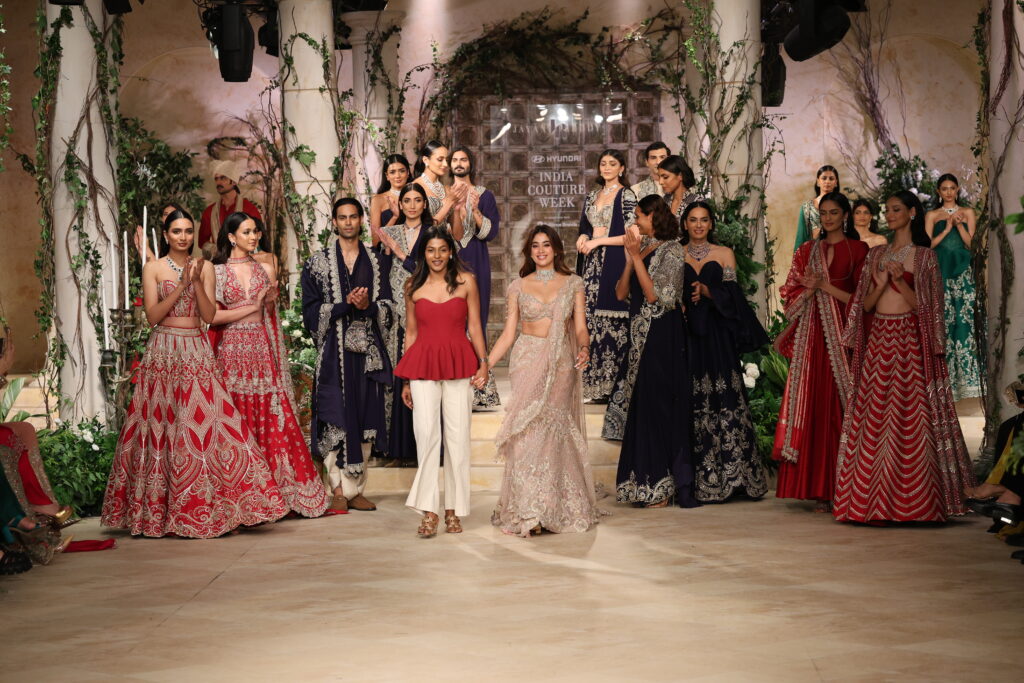
Banarasi weave interpretation is loved by South brides, for Jayanti Reddy Hyderabad has become a nerve center for couture. By Asmitaa Aggaarwal She comes from the city of pearls, and Hyderabadi elegance, known for her love for Birdi craft that she resuscitated, but in the last 13 years in fashion Jayanti Reddy, may have studied business in US, but at heart she knows couture is her first love. “I was doing one off pieces, heavily embellished for a select clientele, we mixed interesting shapes with comfort. Though the focus has been jewel tones and pastels, with a smattering of gold,” says Reddy. In these years there have been many inspirations—travel to textile art, even using leftover scraps patching them together to create new fabrics. Or woven panels with zardosi threadwork, made into slimmer skirts; new interpretation of Banaras with lighter more gossamer touches. “The lehenga choli is obsolete, it is now the Sharara and peplum with two sheer duppattas, and trail,” she explains. The South has become a hub for brides, the market is booming, it offers originality, variety as well as fantasy, for her Banarasi weaves are best sellers. “Capes, jackets to corsets offer a third dimension, and weddings are a mix of cultures. There is no set template of what will work, we need to keep evolving as brides do and frankly Bollywood wearing a Jayanti Reddy creates enormous awareness,” she concludes.
Insta helps boost revenue, says Nikhil Mehra
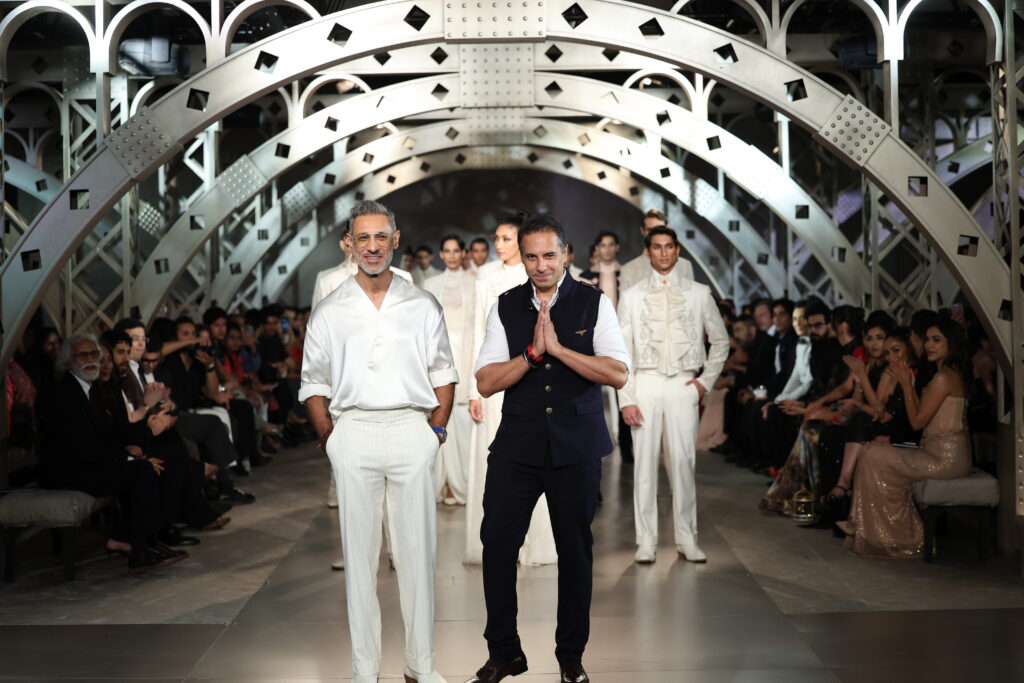
Gender fluid Shiva-Shakti has been a leitmotif for Nikhil Mehra as the younger brother in the duo Shantanu-Nikhil confirms menswear is where the real game is now! By Asmitaa Aggaarwal For 25 years now Nikhil Mehra, the younger sibling of the duo Shantnu and Nikhil has been on a trek, in the world of fashion, he calls it a journey of “self-exploration”. The focus has been on transforming men’s silhouettes, moving away from the idea that a man is simply a “caretaker’. “There is a sense of poetic femininity, where drapes are the mainstay. Women in S and N couture are portrayed as strong independent brides, rather than coy, not romantic so in some ways it has been a role reversal of sorts. “If you look at the history of couture it was considered the holy grail, unapproachable. Now for the last few years it is moving away from ostentation, display of wealth, with a lot more focus on experimentation,” says Nikhil. Maybe that’s why the obsession with red has dimmed, societal norms have been broken, brands are looking at watered down versions of couture—Anamika with AK-Ok and Tarun Tahiliani with OTT. “Less is more for us, we try to tell a story through minimalism, like our hand-crafted brooches, there may be a lack of abundance, but there is a definitive respect for crafts,” says Mehra. Though he questions, “just because it is $4000, should we say we have put 4,000-man hours making it? We don’t think like that? He works with sporty elements, as games is what keeps him going personally too, here too there is innovation—yarns are developed, mostly breathable knitted fabrics, wool blends. “Accessorizing has been a fun thing, so we channel military regalia, kamarband on shirts/sherwanis, merging two different worlds,” he adds. Nikhil admits post-colonization, we embraced colours vibrantly, as well as prints and refused to be cowed down by a Western aesthetic of black and greys. “Fantasy in fashion is before you are 22 years old, after running a business, you grow up really fast. The theme of Shiva Shakti, gender fluid has been constant in our lines, even as our brides have abandoned dupatta and decided to wear a lehenga with structured jackets, that she can wear with drainpipe pants later for a girl’s night out,” he smiles. Men have been neglected in fashion, he believes, so the brand took cognizance of it, “men are no longer a mere plus one, they have an identity of their own”. Pre-covid couture was only wedding wear, now it is about celebrating every moment, not just a D-day, anniversary, a personal milestone et al. “Paris Fashion week, celebs walked for Balenciaga, among others, so the showstopper is an important aspect, good for business. FB and insta generate revenue for us. People want to see what their icons are wearing,” he adds. His fav hues—dark navy and cherry, mix in this is deep emerald, slate greys and rubies. That’s why his line for ICW 2025 titled “Metropolis” serenades a global man, who takes his cultural identity with him. “We went to Moscow, St Petersburg, and Pitti Uomo, to Sardinia, a man now is unapologetically well dressed, he enjoys the process. That’s why menswear is more potent now than ever before,” he says. Vivan Mehra, his son, is now gearing up for Emerson college Boston, in filmmaking and acting, so like all doting fathers, Nikhil believes he gets this talent from his mom, Vidushi, a theatre actress. “I knew he was not going to study accounting or engineering, rather performing arts was calling. It was a toss up between football and acting, the latter won. In fact Karan Johar told him to watch a lot of Japanese films, watch finer nuances like lighting to understand 70 MM world,” he concludes.
Kadwa Banarasi to Alessandra Ambrosio
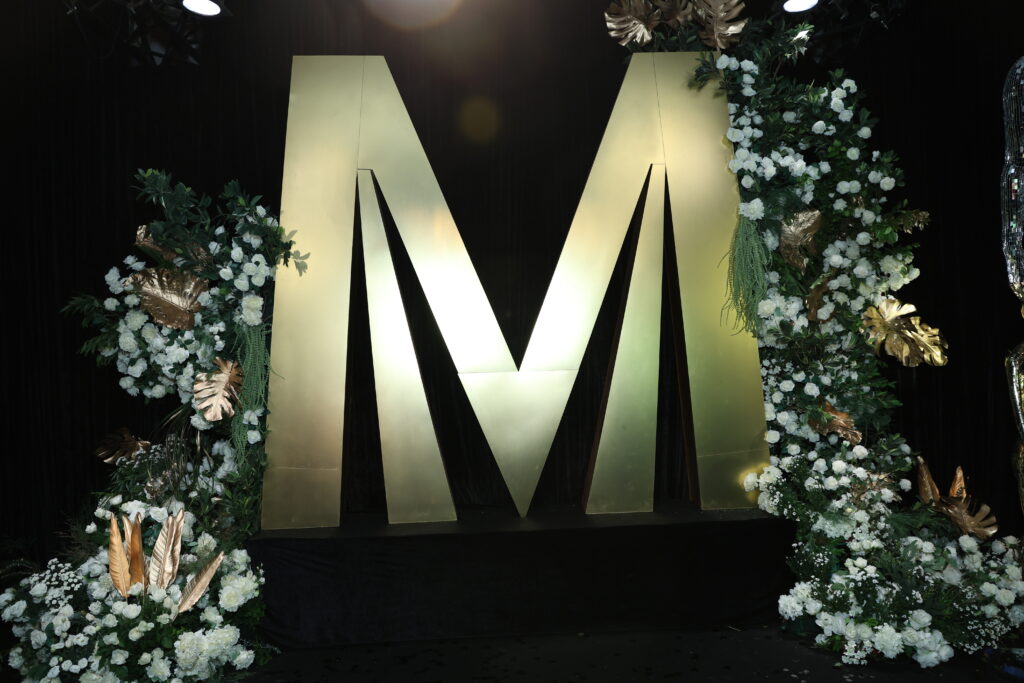
Crafts have a beautiful narrative—thus, Manish Malhotra can straddle two worlds effortlessly-the glam of Victoria’s Secret, Bebo as Poo, to the craft-soaked Phulkari. By Asmitaa Aggaarwal There is no doubt that Bollywood loves Manish Malhotra and maybe the sentiment is returned in full fervour –so after five years when he returned to India Couture Week 2025, he decided to change the format and not do a typical sit-down show with models in heavily embellished lehengas. A golden sequinned eagle stood watching us all in the corner, with a delicious spread in the middle, free seating, live music, and a studded galaxy of his A list star friends. The surprise was Victoria’s Secret Brazilian model Alessandra Ambrosio, in a pearl-embellished lehenga, as Tamanna and Fatima Sana Sheikh were in attendance, but the installations that caught everyone’s eye or should have were his experiments with Phulkari-titled “Living legend in thread”. “I love this embroidery from Punjab. It is also rooted by my culture, I’ve seen so many in my family wearing this, it is special to me, passed down to the next generation as an heirloom,” says Manish. Bollywood had become an intrinsic part of mainstream fashion with the takeover of the visual media, case in point Insta. Gen Z identifies with the DDLJ movie which is considered iconic for more reasons than one. In 1995, emerald green was not a colour that was acceptable for top actresses who were swathed in pinks and flaming red chiffons, but Manish took the leap of faith, added zari and pleats, and got Kajol, a.k.a Simran to dance, making generations fall in love with this romantic story by Aditya Chopra. He admits “Mehndi laga ke rakhana” still rings true in many weddings even now. And no one can forget Kareena Kapoor irreverence in “Kabhi Khushi Kabhi Gham” as “Poo”, or her moves in “Bole choodiyan” year 2000, where cropped asymmetrical blouse with sharara can still be pulled off in circa 2025. Though crafts play a huge role in the DNA of Indian fashion—the Kadwa Banarasi sari that Aishwarya Rai wore to Cannes many moons ago, woven by artisans in Varanasi took almost six months to make, truly celebrates India in its spirit. “Each motif is woven separately, intricate detailing, skilled artisans can only execute this, no loose ends at the back, these are heirloom pieces. For me Ash would be a perfect muse for this—as she embodies ageless style,” he concludes.
I’m old school, I respect crafts, not Insta: Tarun
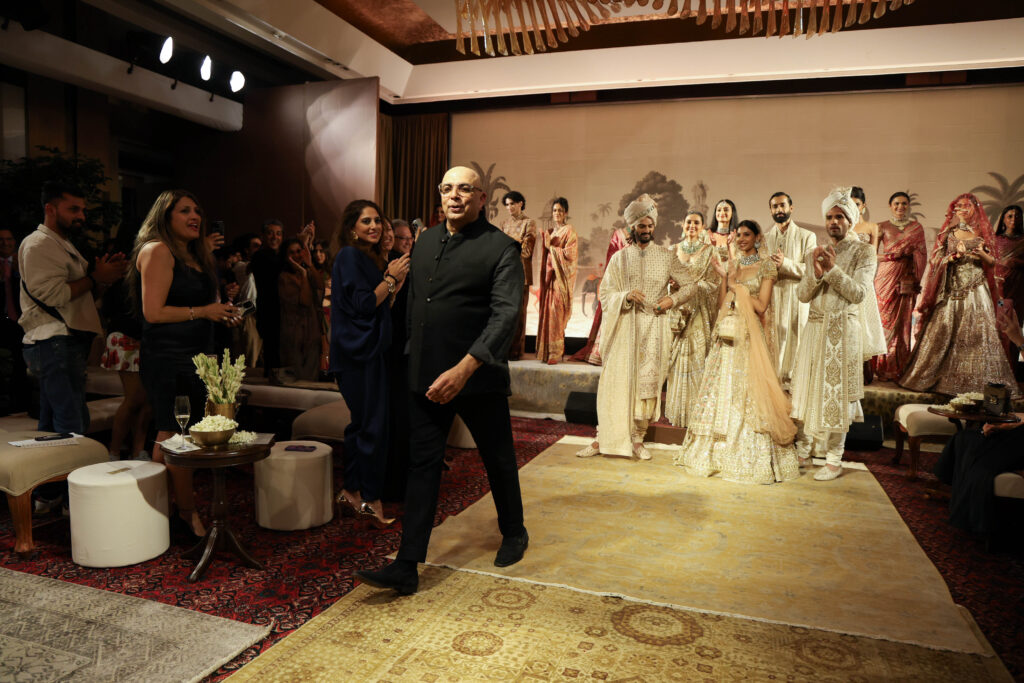
Alisha Chinai, Hindi poetry, lounge setting, and 30 years of drapes, kashida, and grandeur, TT tells us in an exclusive interview, he believes in embellishment not excess, style over trends, luxury that whispers at ICW 2025! By Asmitaa Aggaarwal You could see him personally supervising everything at the Oberoi, his football cap and mike on, “remove extra tulips, straighten the carpet, this doesn’t need to be here” as he geared up to open the luxe doors of the hotel for guests to celebrate 30 years in the business of fashion. Mogras in brass bowls, his sister Tina and wife Shalija for support, lounge setting with sofas and Banarasi brocade throws, model Sapna Kumar, a classic face in the industry for almost 25 years began the show. “TT the brand is all me — and all of the world I see, read, experience, and love. Whether it is architecture, sculpture, temple visits, or a fascination with drapes and how fabric falls on the body — it reflects my eye. But it’s also bigger than me. The brand is a collaboration: between design, craft, history, emotion, and identity. I have always seen clothing as a canvas to bring together intellect, sensuality, and functionality in the context of India- the past and our current modern reality,” he adds, about a line titled “Quintessence”. When you wear a TT you almost wear a bejewelled piece, no need for a diamond necklace, just gold zardozi saris with polkis as headbands are enough. He suggests shades of white, off white to butter coloured this season, light and frothy. “The greatest lesson has been to stay rooted while evolving. To honour our heritage, our crafts, our karigars — but to constantly reinterpret them for the times we live in. What has sustained us is not just design, but a deep commitment to precision, garment construction, and creating clothing that empowers the wearer with lightness, movement, and modernity. That has been our constant — evolution with integrity, says Tarun, as always dressed in black with his bundi and sneakers. The backs of his lehengas and cholis, corset style blouses looked as if a diamond crystal necklace swung as models moved, tousled hair waves, accompanied embroidered saris—aari work, dabka to pearl encrusted pallus. The androgynous dhotis men wore with short sherwanis, can be interchangeable, TT ensures in-built glam. But his ode to kashida and Pichhwai interpreted in an ultra-modern manner was befitting. Fashion has an uneasy relationship with languages, especially Hindi poetry, it was certainly a charming touch with a 30-year-old Alisha Chinai Indi-pop song “Made in India” playing at the crescendo. “Couture today is not just about spectacle — it’s about substance. We design with longevity in mind. For us, couture must move, breathe, and be re-worn. Whether it’s a corset paired with palazzos or a lehenga reimagined as separates, we encourage our brides to invest in pieces that they will cherish not just on their wedding day but long after — styled again, worn with joy. That, to me, is true luxury. However, it must make people dream, push techniques, and retain a sense of fantasy,” says Tarun. India has always loved ornamentation and jewellery— from temple architecture to miniature paintings — but there is a difference between embellishment and excess. “I do not think we need to get over embellishment; we need to refine it. I believe in craftsmanship that enhances, not overwhelms. Embroidery should follow the line of the garment, not drown it. There’s immense power in restraint — that is the evolution we are committed to,” he adds. Tarun believes fashion has changed through storytelling — not in a literal way, but through emotion, technique, and detail. His work often references miniature paintings, Mughal jaalis, and architectural motifs — but distilled in a way that speaks to today. “We often say our brides carry a bit of the past, making light for the present. That is the essence of India Modern. A modern bride does not want to be weighed down — she wants to float, she wants to move — and she wants to wear culture with pride, not burden. It is a visceral process, am not quite clear on how it meshes and fuses and emerges,” he explains. Has Insta made fashion frivolous? “There are both sides. Yes, there’s noise — but there is also access. I’m old school — I believe in deep understanding, in training, in respecting craft,” he says. He acknowledges that social media has opened doors. Imagery is powerful to say the least and people can see our craft and aesthetic from across the world instantly. What’s important is to stay authentic — because trends fade. “Real style endures,” he asserts. There is a growing controversy against Bollywood and showstoppers—”I’ve always said — I’m not against showstoppers; I’m against the idea that the show becomes only about them,” he adds. The real stars of couture are the craft, the clothes, and the karigars who bring them to life. That’s where the focus should be. Cinema and fashion have grown increasingly intertwined. Bollywood has an extraordinary reach, and when it aligns authentically with a brand’s philosophy, it can help amplify the message. But for us, the true showstoppers are — and will always be — the garments. “I’ve even had a bit of fun with the idea. One year, we draped a model entirely in fabric and pinned a sign on her that read ‘I am the showstopper.’ It was tongue-in-cheek, but it made the point. I don’t feel the need to do that anymore. The work speaks for itself,” he laughs. He says he would like to change the idea that couture is only for a moment. “I would like people to see couture as something that can be cherished over a lifetime — not just a fleeting Instagram post or a one-day affair. It should be heirloom-worthy, yes — but it should also be alive, wearable, joyful. Couture must find its way back into wardrobes, not stay locked in trunks,” he says. Each season he
Akshay likes ruffled feathers
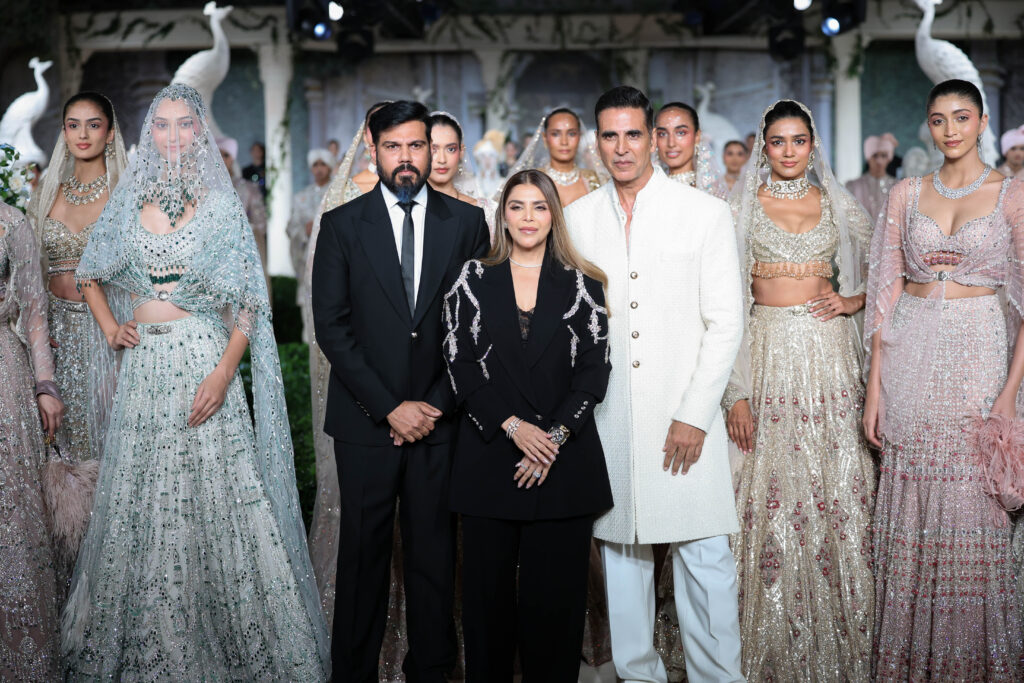
Bollywood superstar, avalanche of sequins, jazz crooner think Nat Cole King, crystal bustiers, Falguni-Shane Peacock made sure, everything glittered at ICW 2025. But you can wear your boyfriend’s denims with a pussy bow blouse and sequinned tunic they informed us! By Asmitaa Aggarwaal Remember a sitar maestro sitting in a lotus last year with the delicious Vicky Kaushal giving us increased heart beats? That’s Falguni and Shane Peacock, this time too for ICW 2025, the imposing set, looked straight out of a garden in Italy, with two giant white peacocks (befitting) in the middle. And of course, in this heady mix was Akshay ‘Khiladi’ Kumar, in dark glasses and all the right moves, thankfully he did not pull off a gravity defying stunt, but did bend down on his knees, giving us a taste of his usual irreverent fun! He spoke in Hindi, and admitted he is ramp walking after years, almost 12, “mini show but lots of hard work goes on behind it,” exclaimed Akshay. FSP had men with diamond danglers, capes in ink blue were larger-than-life; women flaunting faux feather boas, an avalanche of sequins, it was as if everything was crystallised. They skilfully combined their two loves– sequinned women perched on two stone peacocks, zardosi feathers languidly sprawling on lehengas, if you switch off the lights you can see an FSP outfit from afar. It makes us believe too much shine is never enough, in this invasion of an army of glitter were delicate pearl trimmed veils.The favourite undoubtedly was Archana Akhil Kumar in high waisted boyfriend jeans worn with a fully sequinned tunic and white pussy bow blouse which will soon become everyone’s go it-multiplicity of use. In FSP style, the glowing brooch clinched the tunic as models wore multiple mogra braids, the smell wafting through the Taj Palace Hall. “The way FSP presents themselves is purely international, but it’s made in India. I hope I get another chance to do this again, as I feel royal in my white sherwani,” Akshay added. Shane, with hints of blue in his beard, told us he had investigated so many minute details, but the show stopper was the most important one. Live music always has its advantages—and fashion show veteran singer Vasundhara Vee with a booming voice took charge (she has done shows with Ashish Soni, Ravi Bajaj, FDCI, Sabyasachi). Vee crooned jazz as La Vie En Rose (Edith Piaf), Dream a little dream of me (Doris Day), At Last (Etta James), A Thousand Years (Christina Perri), and L-O-V-E (Nat King Cole) made sure the hints of woven saris got a fleeting representation in an otherwise tornado of embellishments. Singing for the last 30 years the Assamese artist, studied at LSR, English (hons), grandchild of Pramathesh Chandra actor, director, and screenwriter of the 50s, who made the original “Devdas”. “Arts were a part of my family, Pratima Barua Pandey an Indian folk singer from the royal family of Gauripur, Western Assam’s Dhubri district, was my grandma. I think I inherited the love for tunes from her,” she smiles. Though when you sing love on tracks there are challenges versus when you are with a band, where you can tune and keep up the flow. “Pace of models changes, so you must make sure you are in tandem. I enjoy how fashion interacts with music, even though I have always been self-conscious, I did enjoy wearing the FSP shrug,” she concludes.
Amit invokes spirit of Margiela
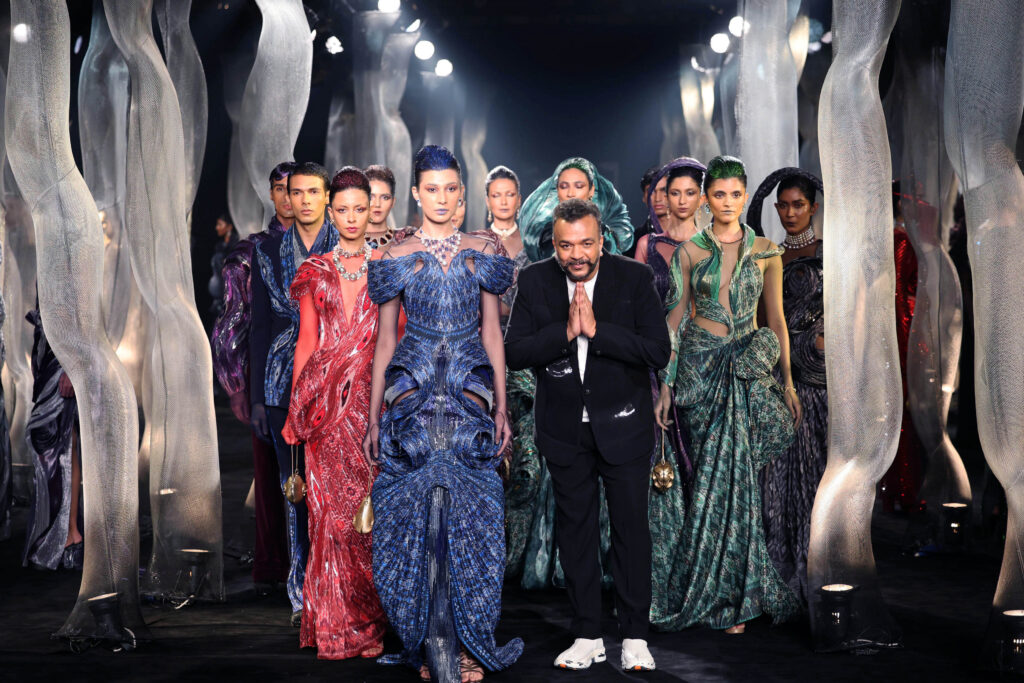
Fabric manipulation in its finest form, themes from the one directional arrow of “time” to now “DNA”, Amit Aggarwal tells us your old Banerasi and Ikkat can be your new cocktail gown, hand pleated and upcycled. By Asmitaa Aggaarwal There is always a lurking sense of inspiration, the industrial set, music that kind of makes you feel you are transported to a world into the future, slow but steady interpretation of textiles—and of course the Belgian 5, deconstructivist approach to design. Amit Aggarwal had his models’ faces covered just like the Martin Margiela, as he wanted everyone to focus on clothing, beautiful models often taking attention away from the artistry he felt—was imperative to observe. At ICW 2025, one noticed Amit pursuing unconventionality– fabric carved into waves, sheer used only as an accent, play of silver and charcoals, sensual touches of gooey chocolate as if it had melted on a gown-made its way all over as greys played peek-a-boo. By the way, a woman’s back is the most sensuous part of her body now, according to him, as silver mesh was worn inside velvety jackets, complemented with basket weave shoes. The beauty of it all was the gown moved mimicking the movement of the body, its curves, its nooks, and crannies. Amit kept colours at bay, only slight accents of reds and greens, his obsession with fabric manipulation, pleating and architectural shapes was evident. The line “Arcanum” denoting mysteries of the physical and spiritual worlds, also known as “elixir” was Japanese inspired probably what a Rei Kawakubo (Comme Des Garcons) would do, honouring our body’s imperfections, accepting it with the bulges, contortions, and misplaced cowls. The ode to ikkats and Banaras, in subtle purples to tangerine reds, told us our old sari can be your new cocktail dress, as men with minaudiere kept it androgynous, a contrast to the magnanimity of the line inspired by our DNA. You would wear this to a red carpet to make a statement. “We go beyond the last show where ‘Time’ was philosophised as a concept, some of the best stories of our life are written in this singular dimensional arrow. Time makes our stories denote that DNA is internal, we explore what it does to our life-takes us places we never thought we would explore,” says Amit. This year through the 25-minute show he narrated five different stories—Form, shape, grow to evolve to tie in every single tale that moved his soul. “Collections are never made in isolation. It started in my mind, a gradual process, actual pieces took four months, with styling and jewellery six months,” he explains. For Amit, style does not get boring if you keep evolving, pushing the same language forward, as a brand. It started as an inward journey, but soon he narrowed down on his favourites—Ikkat, hand woven upcycled, “creating a new narrative –a kind of benchmark for me,” he adds. The artistry could be seen in how he created water droplets through hand draping, as polymer, his constant companion along with Banarasi, were a runway spectacle. “I wanted the show to have a theatrical feeling, but you will see wearable versions of this in the store. For me sustainability denotes artisans trying to help them elevate craft frankly I’m bored of this question,” he says. For him his reused textiles embellished with hand twisted crystals was a way to show you need to be consistent, as he concludes, “Couture is feeling, an emotion, not just about jewellery and watches. Sustainability is the only way we should be living life.”
Little birdie told me…
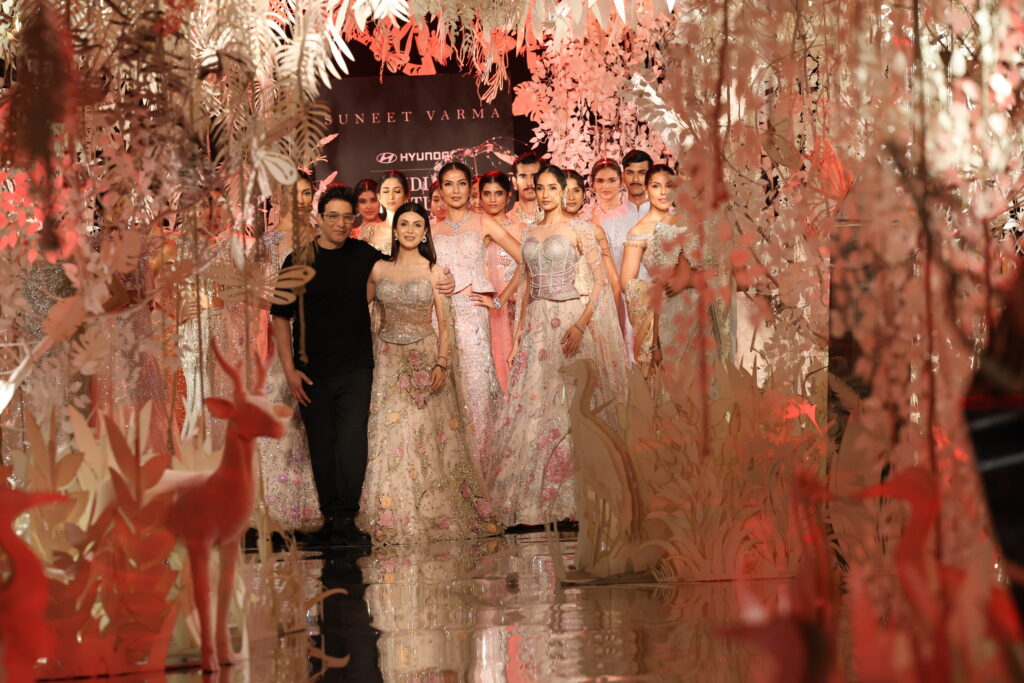
Swans as headdresses, garnets, and pearl wraps instead of cholis and of course the iconic ‘mover and shaker’ Helen on Monica Oh My darling, made Suneet accentuate all his first loves at ICW 2025. By Asmitaa Aggaarwal For many years one has noticed “dancing designers” the one famous for his enviable moves, Rohit Bal dressed in Jodhpurs and a crisp bandhgala has passed onto the next world leaving behind a mammoth legacy, but Suneet Varma is carrying forward that baton at ICW 2025 with his line “Sehr”. Of course, in his inimitable style— on Jaane Jaan dhoondta phir raha with Bebo’s moustached father Randhir Kapoor and bouffant Jaya Bachchan in the 70s hit Jiwani Diwani. Somehow red is taking a backstage in couture making way for white the “it” colour for the season–sometimes no colour is the best colour. Suneet’s ramp is always reflective, of shine, he is never apologetic about it– pristine white lilies, swans and white palms with sparkling lights took a bow. When you are around as long as Suneet, with ocean like experience – legendary Yves Saint Laurent to Judith Leiber, BMW, interiors, you know what works in a market that can’t get enough embellishment. Indians by DNA are celebratory, it is an inherent part of our cultural ethos. His love for old classic Bollywood songs is apparent, little birds were flying on headdresses, complemented with sequined gowns accentuating every curve of the body—visualise black, gold, boas, faux feathers. The dupatta hangs on nimble shoulders, though by its own willpower, it has got thinner, bulk reduced—just like brides don’t want anything that restricts their movement. Remember Samantha Jones in Sex and the City, played by Kim Cattrall with her unwavering loyalty to beaded bustiers, dripping flirtatiousness and bold pink flowers? Suneet kind of had that spirit of exuberance and nonchalance. Interestingly, shararas with zardosi on the notes of Monica… oh my darling took us back to Helen’s winged eyeliner, midnight blue eyeshadow and tiered ruffled dress, Suneet gave it a modern interpretation with gotta-patti style choga kurtas. Pearl wraps instead of cholis, exaggerated sleeves, gold has always had a hold on occasion wear, everyone’s favourite polkis and jadaus were crafted into a blouse, as if you are wearing a necklace around your bosom with pearls dancing on your back. Star daughter Riddhima Kapoor Sahni seemed comfortable on the catwalk, she exclaimed, “18 years ago I made my debut with Suneet, I’m here again now.” She also twirled for us, as Suneet clarified, “I live in my dream world –set, music presentation is part of who I am, obsessed with romantic music. Tried hard to change it to English sonatas but I can’t do it. This feels natural to me. Fashion is all I know how to do. I like to excel but in a non-competitive way. Thus, there is always debate on if this embroidered rose needs more crystals or whether sequins need better placement,” confesses Suneet. This season- isn’t about reds and rani pinks but lilacs, greys, and obsidian blacks, the shararas is the queen of silhouettes now, tighter, flared, Suneet took it a notch up with semi-precious garnets!
Luck by Design
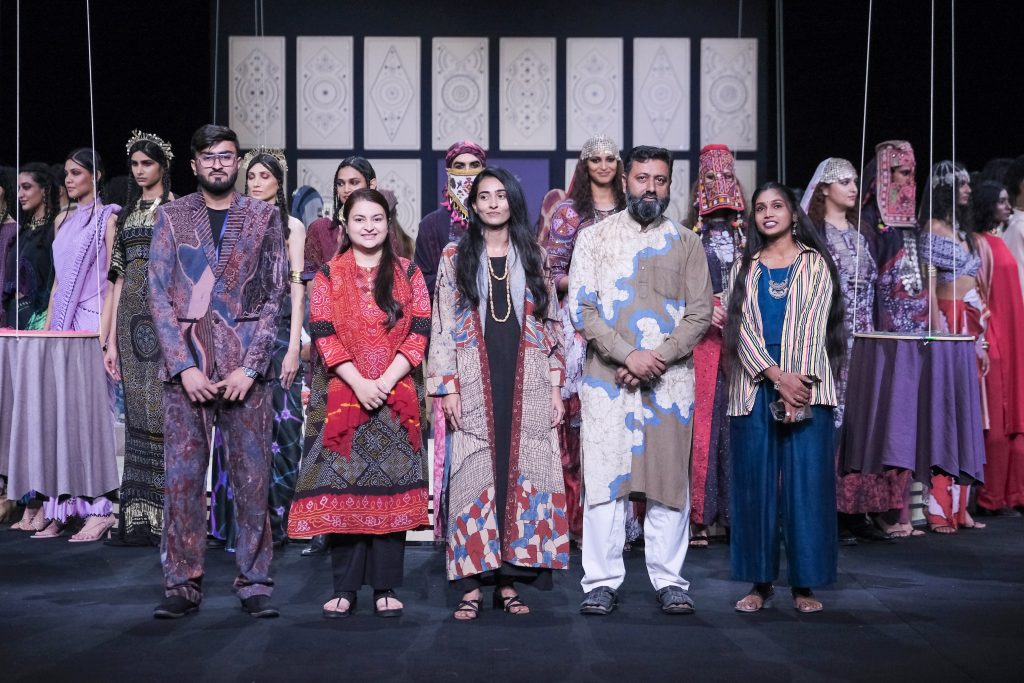
Somaiya Kala Vidya, is creating a space for artisans from Gujarat working with Bandhani, Ajrakh, block printing to applique, equipping them with skills that combine—marketability with design prowess-craft is just not art. By Asmita Aggarwal You would never expect a chemical engineer from the acclaimed NIT, Trichy to be working in the development sector, but there is a lot more to Nishit Sangomla than just his degree. He won the SBI Youth for India fellowship which took him to the Barefoot College, Rajasthan, established by visionary Bunker Roy in 1972, hoping to empower rural communities. In “Solar Mama”, how to fabricate solar panels, lights and photovoltaic circuits is taught 110 km from Jaipur, Tilonia village. Nishit began working with them, and it changed his life forever. He had found his true calling many years ago. Though he did notice it was dominated by women, as the men had gone to bigger cities to work in mines, never sent money home, forcing them to fend for themselves. Agriculture was not an option—but the region was loaded with crafts—they worked with leather, made durries, everything was laboriously hand-crafted—a gem waiting to be showcased to the world. “They are skilled, but did not know the technical aspects—marketing to supply chain management. After all, erstwhile kings wore crafts that are now museum pieces, all they needed was design direction,” says Nishit. This gave birth to the design lab they set up, to dig deeper into concepts, educate artisans, the seed of the idea came when Nishit met the legendary Judy Frater, an anthropologist from US, who came to Kutch, Gujarat in the 70s, the rest is history.. Judy, lived 30 years here, with artisans, particularly women embroiderers, studied their traditional crafts, Kala Raksha Trust she set up in 1993, to empower artisans. After the 2001 earthquake, she founded the Kala Raksha Vidhyalaya School in Meghpar, Anjar, Gujarat, the first design school for traditional skilled artisans. Bonus: they are setting up a natural dyeing research lab, which anyone can use. When he met Judy in 2016, she mentored Nishit, in 2019 she wanted to go back home, Nishit took over as the vision was clear. Bandhini, Shibori, Batik, weaving, block printing, patchwork to applique—artisans are taught how to modernise and sell. There were many hurdles he faced —in the one-year program, women artisans’ families were not comfortable to send them to a residency (12 women, 12 men trained every year, number varies). Interestingly, the age is dropping for students, earlier it was above 30, now younger artisans are joining, who had given up this generational skill. There are six modules— they can learn from street markets, retail stores, and exhibitions—colour development to trend forecast, experimenting with motifs, each skilled artisan is taught various verticals to enable him to be market ready. “When we take interesting calls like increasing dips in indigo the results are spectacular—innovation is the game,” he smiles, adding they also added violet to Ajrakh giving it a new spin. At LFW X FDCI Somaiya Kala Vidya showcased Ajrakh by Ziad Khatri, Alaicha (Mashru) by Amruta Vankar, ‘Anatomy’ by Mubbasirah Khatri, ‘Mystery’ by Muskan Khatri, ‘Tradition to modern’ by Shakil Ahmed, the school has now been taken over by Somaiya Trust, which is a prestigious educational institution based out of Maharashtra since 1942. Amrita Somaiya, who owns the school, has a Bachelor’s degree in Economics from Simmons College, Boston, and her husband did Chemical Engineering from Cornell University, a Master’s degree in Public Administration from Harvard University. Their family originally belongs to Kutch, Karamshi Jethabhai Somaiya, was an Indian educationist, who founded educational institutes in Maharashtra, was awarded the Padma Bhushan, Samir his son is carrying forward his legacy. “My father-in-law worked relentlessly after the earthquake to build Kutch, then my husband met Judy, as she was looking for opportunities to continue the craft work,” says Amrita. Amrita’s father is an architect, mother an interior designer, she inherited the love for aesthetics from them, crafts has been her mainstay, thus subsidised education for artisans at Somaiya Kala Vidya. “Real craft is handmade, each artisan who showcased had a personal story in the collection, like Shakeel bhai and the beautiful Batiks, it was contemporary, but soaked in craft,” she adds. An avid lover of textiles, from Ajrakh to Bandhini, hand woven is her go to, she spends time in clusters, and from grassroots understands how to bring awareness to the processes. Juhi Lakhwani, business development officer at Somaiya Kala Vidya, joined this year, but her experience is vast—she won the Naropa Fellowship, which took her to Ladakh. She worked with traditional artisans in carpet weaving, realised handicrafts are losing their identity, and wanted to teach them social entrepreneurship. “The products worked well, but Covid hit, we had to pause. The key was teaching them e-commerce, digital merchandising, it worked in their favour,” Juhi says. At Somaiya she helps them market their products, with design intervention—Soof, Rabari embroideries are much loved along with Batik. Somaiya Kal Vidya has opened another school in Karnataka, Bagalkot; they have a store in Prag Mahal in Bhuj. “The reason why Gen Z does not buy craft is the lack of awareness, they have been brainwashed by Westernisation. Artisans have saris and stoles, and silhouettes need to be taught to serenade a younger clientele,” Juhi adds. When you see artisans like Mubbasirah combine traditional Ajrakh blocks with hand painting, or Amruta’s new developments for Mashru, you know they are set to succeed. Alaicha translates to Mashru in Kutchi, it is associated with the Ahir community, each pattern reflects legacy —they have a new palette, in some ways redefined it. Mubassirah is the first female artisan to step into the male dominated Khatri Ajrakh artisans rejigging it with freehand painting! Craft is business now, not just art. “I began learning from my father six years ago after he returned from SKV, I’m the only woman in three generations from Ajrakhpur to take this up,” says Mubbasirah. Ajrakh means “leave it for a while” in Kutchi, it takes