

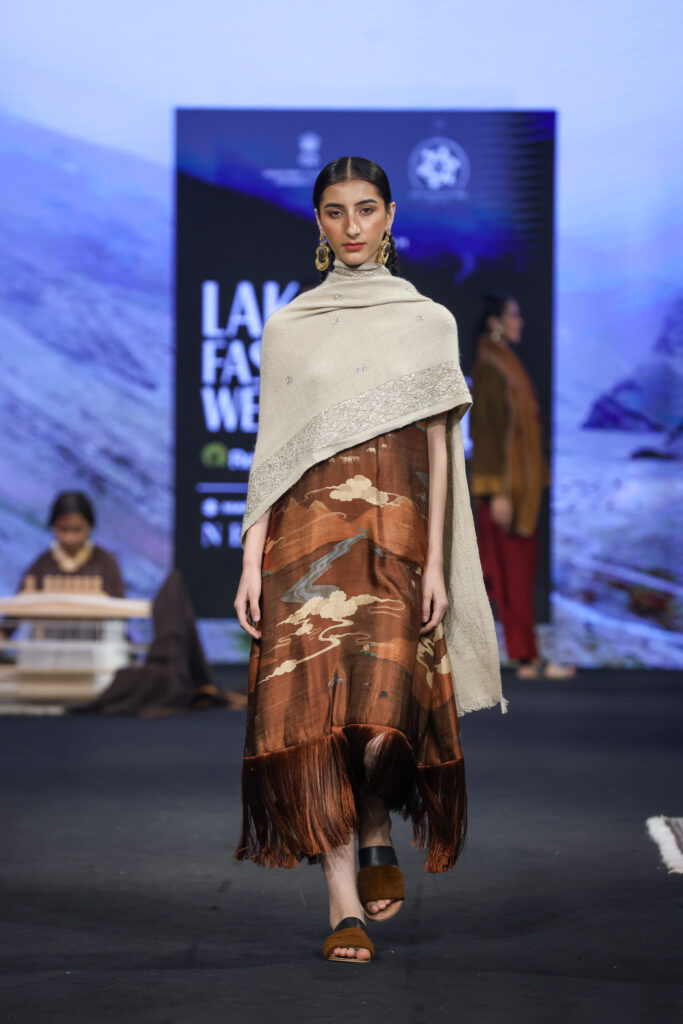
The sights and sounds of Ladakh’s nomadic community immortalized by Stanzin Palmo on sassy jackets, this LFW.
By Asmita Aggarwal
Even though Stanzin Palmo, who launched her brand Zilzom stayed in Ladakh only till she was 9 years old, moved to boarding school after that, the sights and sounds of the place she grew up in were always alive in her memory. She knew she would go back one day.



After NIFT Delhi where she studied leather design, she worked on skill development with 60 Ladakhi artisans, who weave wool. “I wanted to give Pashmina a Ladakhi identity, to also educate end customers about the beauty, time tested techniques. Clear some misconceptions too- that the finest pashmina doesn’t need to pass through a ring to be authentic,” she adds.
Ladakh is a community-based region, the whole family comes together to make a tent out of Yak hair and wool (known as Sitpa and Khullu), “Rebo”, takes three months to craft and is now going extinct. The natural oils in the yak hair make the tent naturally water-resistant. “When I met Mr Modi he told me Sulma (Made from warm wool, brocade, velvet, silk, or local twill-weave wool, nambu), Ladakhi clothing is so unique it must be exported all over the world,” she adds, saying her line is much more than Pashmina jackets and blazers.
This year, she has worked with lesser-known Zanskar wool, fully handmade, pure luxury, artisans wash, sort, and card the sheep wool by hand over several days before spinning and weaving the yarn, it offers extreme warmth. Its dense, multi-layered fibers provide heavy insulation suited for harsh high-altitude winters. “Spuruks are made out of this, it is sheep wool, resembles fur, and I have made accessories out of it. It is expensive as it is handcrafted and takes months to make a bag,” says Stanzin.
Her brand she believes is an ode to the nomadic community, which is fast vanishing from Ladakh, moving to cities to work as labourers—she has immortalised them in prints. “The inspiration is “Riyul”, “Ri” for mountains, and “Yul” or place on Ladakhi. All the labour-intensive techniques are fast vanishing from the region,” she explains.


With the solar panels being planned by the government, goats will not graze under them, they need the clear skies and environment that has been their lifeline for centuries is now being destroyed due to commercialisation. “The black crane is a very special bird which is now rarely sighted. Also I travelled to Karnak village where earlier 100 families were weaving now only 10 remain, rest have migrated,” she worries.
On Sonam Wangchuk, no comment, “I don’t want to make any political statements, but he has contributed to make Ladakh important globally,” she adds.
Schools and hospitals are two things that nomads lack, the fight is for survival, a lot of backlashes in Ladakh due to the Arogya Mandirs, 321 operational across the Union Territory of Ladakh. “I care about weavers, and local artisans who suffer as they are ready to move to cities and give up traditional techniques which made Ladakh’s Pashmina the most sought after,” she concludes.