
Charvet style shirts anyone?
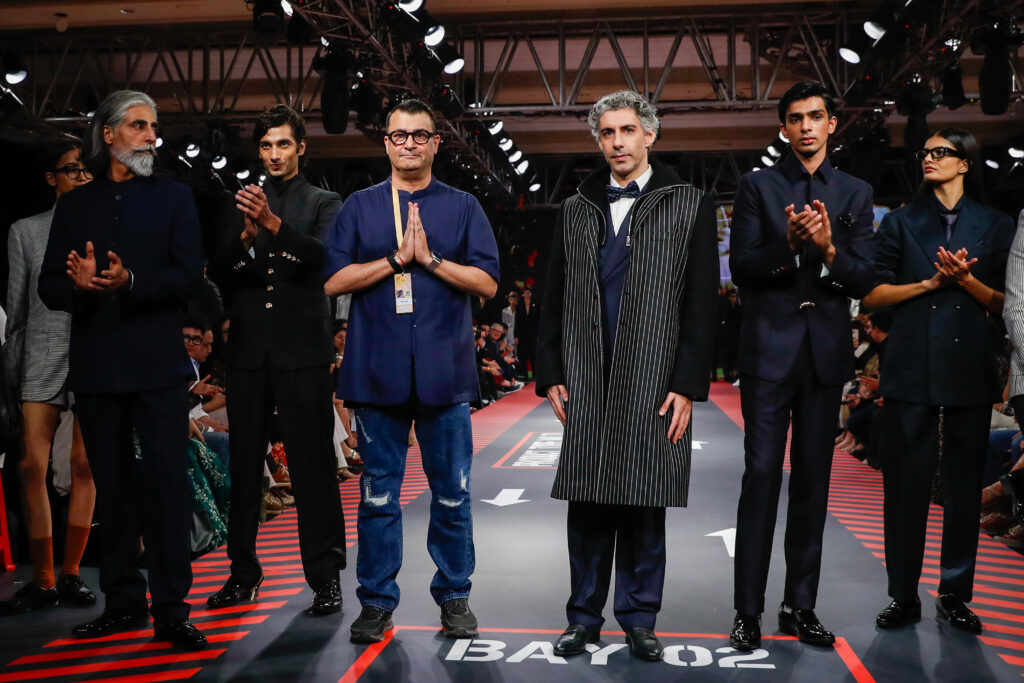
From styling SRK in Mayur suiting, showing in NY in 2005, Ashish Soni has taken the road less traveled-fit, tailoring over dabka and zardozi. Next move- Arvind Mills and Soni style! By Asmita Aggarwal He is the OG of fashion, started in 1991, 2000 launched couture in a country obsessed with embellishments and embroidery, but he stayed true to fit and tailoring. He was one of the first to participate at the Olympus Fashion Week in 2005, when no one in India cared about the artistry of a perfect sleeve, he had kind of mastered it. Ashish Soni has been using Arvind Mill fabrics for the last 30 years, though they are primarily known to be leaders in making denim, they have a vast range—linen, wool blends. Their Egyptian cottons are so superior that it ignited a desire to use them innovatively. The collection Ashish showcased at LFW X FDCI will go live in 16 stores all over the country, they will handle production, knowledge transfer will be Soni’s responsibility. “I am a tailor if your raw material is good, magic ensues,” he adds. Ashish has been interested in the quality of linens they offer, the count matters, spinning strength, “earlier it was 50-60 now it is 120 counts, finest linen, there are many technological advancements,” he explains, even their 100 percent bamboo fabric, feels like wearing silk. Arvind Mills shirting material is the finest which Charvet uses, (French shirt makers, 1838 in Paris, France, by Joseph-Christophe Charvet, now owned by Chanel) that royalty and celebs can’t get enough of is now being offered to a discerning Indian consumer. Wool blends, super 200 are the best in the world, it is twisted 120 times, per roll, to get that fine-ness, now it is 150 to 200, which is being used by Loro Piana and Brioni, is being offered to Ashish to work with, it is the first for him. Is the Indian customer ready for this kind of ultra luxe minus the dabka, does he understand it? “We are educating people, even tier 2 and 3 cities, like Indore and Raipur, they have crazy spending power like Chandigarh. If they don’t know how they will buy what is real luxury in terms of materials? Thus, I am also crafting a style book on how you can wear a suit ingeniously, this will hopefully tempt them to buy,” he smiles. A tier 3 customer may not have the time to come and buy, so Ashish is taking the product to them. In a Metro competition is high, so many brands, already heightened awareness exists. “There are no DLF Emporio in Pune or Raipur,” he says, adding, “If you look at menswear in organized retail, the numbers are much higher, but it is vastly ignored.” Interestingly Ashish began styling in the 90s when no one knew what it meant, as he never did lehengas, saris or sherwanis, it was commercially difficult to survive. “No one wanted to buy a Rs 5000 shirt, with no embroidery in the 90s. Old, affluent families used to purchase Raymond fabric and get a suit tailored, it was tough to survive, I began styling,” he confirms. His first job was styling SRK for Mayur suiting, in 1993 before “Dilwale” was released. Saif Ali Khan and hundred others in Bollywood followed for almost 30 years. He says, “A second opinion when you put up a collection works best, as a stylist has 3 D vision. He has a clearer view than a designer, as he is not emotionally involved in the line. Plus, new social media audience is more visual and has less patience,” he concludes.
Fashion must be socially, politically conscious
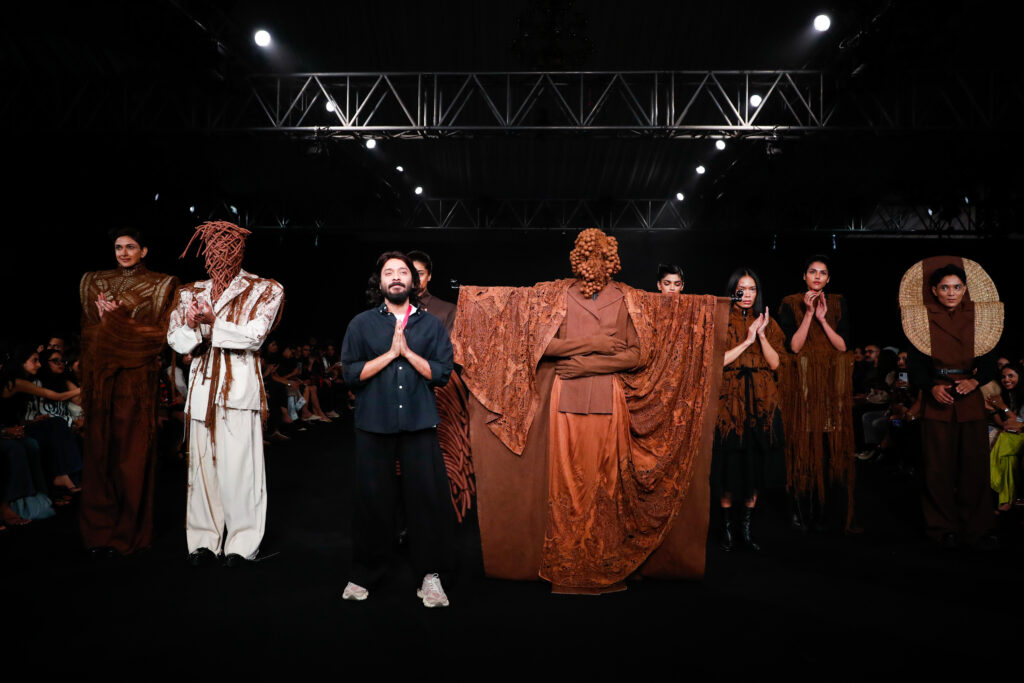
Water hyacinth gets converted into nifty baskets for gifting and packaging, as Anurag Gupta gives sex workers a dignified life training them in weaving water grass, Pacchu Tola, Biskohar. By Asmita Aggarwal It was a bright, sunny day, Anurag Gupta decided to visit Bharat Tex, his gaze fell on a stall from Bihar, and saw how beautifully the bags were crafted. “On a closer look it was water hyacinth, (Jalkumbhi) or water grass, mostly seen as a waste material,” he says. Locals have found a way to put it to good use by making mats, baskets, bags, as it is a much better and stronger alternative than jute. The NGO Anurag visited rescued sex workers more than 1300, trained them in this craft, “what I liked is that they ‘made’ artisans in Hajipur, on the border of Bihar-Jharkhand, didn’t work with existing ones. The idea was to offer them a dignified life which resonated with me,” he says. Anurag grew up in Biskohar, Uttar Pradesh, he realized there is raw material available there too, he wanted to highlight the marginalized, often not spoken or written about, especially women who work in red light districts. “My village is divided into two parts; Pacchu Tola, is a red light area, even though Biskohar survives on agricultural produce these patches face extreme poverty and helplessness. Women lack employment; I wanted to speak about their daily struggles, politicians come during elections, promise things, situations remain the same,” he says. Anurag will pay them to learn how to weave water hyacinth, start training 30 women, they can work from home, he has aptly titled it “Jal se Jivika”. “This can turn to custom packaging, boxes for corporate gifting, and the product is fully sustainable,” he remarks. For LFW x FDCI Anurag has worked with knitted textures, stepped out of his fantasy world, is making a “commercial” line, minus the avant-garde drama. Shapes remain experimental, knitwear is woven, combined with jacquards, and interesting textures. “We must talk about protests, as a community, it affects everyone. It is important for fashion to be politically conscious. Why should it be dominated by only Bollywood, stars, glamour?” he asks. His efforts have been to take the industry to the village, not other way round “we need to provide alternatives to people living on the fringes”. Social causes, putting a spotlight on what he internally and strongly believes in, Anurag felt he started with manual scavengers, but fashion media is partisan. “They look only at shiny people, privileged, don’t entertain me, maybe I’m not a people pleaser,” he confirms. Diet Sabya tried to police, and has fallen too in the trap of Elle, Vogue and Harper’s Bazaar, “big designers overshadow smaller ones who never get spoken about, just the top five are praised by magazines. How much will we talk about Sabyasachi. We know his contributions. We need to move on,” he concludes.
No Gucci or Balenciaga only Russia, says Sergey
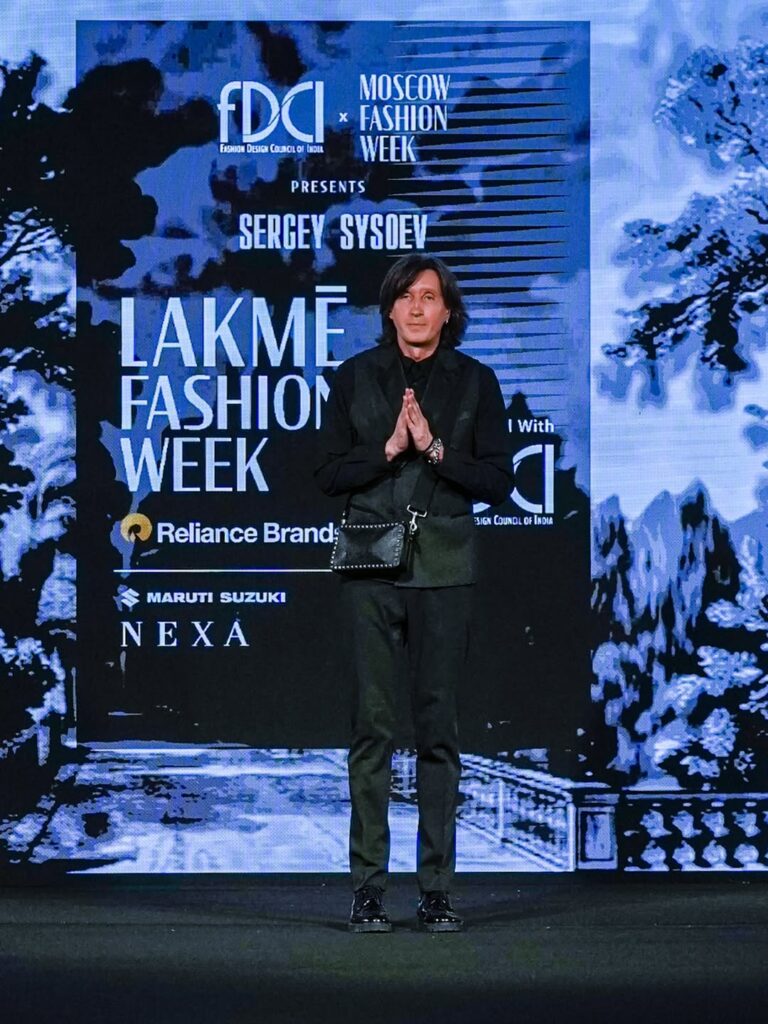
Even though Russians have made a mark on global fashion, Demna Gvasalia, Guram, Lotta Vokova, post the collapse of the Soviet Union, Sergey Sysoev believes he wants to revive traditional folk arts-Gzhel ceramics, Vologda lace, this LFW he pays homage to the fragrant flowers of Ivanovo. By Asmita Aggarwal On 26 December 1991, the Soviet Union was formally dissolved, due to many factors, primarily economic stagnation. Till then they never knew what Coca Cola tasted or how well Nikes glided. There was a time in Russia when there was no exposure to brands, today they are huge consumers with a market of $2.59–$2.6 billion. That’s not all. Russians are creatively heading global brands—-think Balenciaga by Georgian Demna Gvasalia, now Gucci, and his brother Guram both launched Vetements, to stylist Lotta Volkova, born in Vladivostok, Russia, now styles Miu Miu. Sergey Sysoev showcased at LFW XFDCI, a label he launched in 1996, teaches art history in Kosygin State University, Moscow. He says, the former USSR is more than just Matryoshka dolls, Vologda lace, Gzhel ceramics as old as 14 th century, and silk shawls. “I have never been to India, it is my first time, but I know about the intense and deep love for colours here, as well as age-old textiles. I may not be able to name any, but I remain fascinated by weaving heritage,” he says. After 30 years of working in the industry Sergey loves folk art and craft, like porcelain painting, which is often used in tableware. “In my last collection I paid homage to Russian native ornaments,” he confirms, like Slavic, Byzantine, and folk-art traditions. Gzhel lace has been his favourite, eight years ago he reinvented decorations, into a modern language so that younger customers are serenaded. “I’m happy Demna and Lotta are doing well globally, very proud. I never set out to pursue recognition outside my multicolored country, I want to dress women in Russia,” he smiles. He is hoping to collaborate and understand Indian cultural and embroidery techniques, expand his craft, without losing focus on Russia’s cultural identity. The government is supporting Moscow Fashion Week, earlier they only had Mercedes and Volvo Fashion Weeks, but Putin is making an effort to grow domestically. “We wanted to break free from systems set up by European countries, hoping to nurture ‘Made in Russia’, which looks at what our people want, not what Western brands dictate,” he adds. “The Sarafan traditional Russian dress is also being contemporized in linen with hand embroidery,” he explains, adding there is silk which also elevates the ensemble. He combined knitted fabrics and the flowers of the city of Ivanovo, as homage to his mentor, designer Slava Zaitsev, who was born there. Inspired by the beauty of the region, known as “City of Brides”, “Russian Manchester” as it has a burgeoning textile industry. At the LFW show on the sounds of church bells ringing, and birds chirping, he showed his mastery over crushing techniques, metallics in three colours, predominantly tangerine, exaggerated bows, Jacquards and sheer. “I like stripes, my embellishment is restricted to yokes, so that it doesn’t overpower the outfit,” he says. Though the crushed gold, bunched up waists offer comfort, along with pleated dresses. His effort was to be restrained, thus mixing different diverse patterns often clashing to drive home the idea that fashion doesn’t need to be linear. “I grew up listening to Bollywood songs, actors, many movies were re-watched in Russia, saw one on my flight here too, can’t recall the name. The story was about love, washed with music and colours. I’ve seen Russians wait outside hotels for hours hoping to catch a glimpse of their favourite movie stars,” he smiles. He admires the way Belgian great Dries Van Noten is inspired by India, how he uses the iconography, culture and its myriad aspects, dating back to his first trip to here in 1987. “His use of Ikat in 2022, Kalamkari, hand-painted and block-printed cotton as well as Kantha is spectacular,” he concludes.
Hey Barbie! looking swish in Mashru stripes
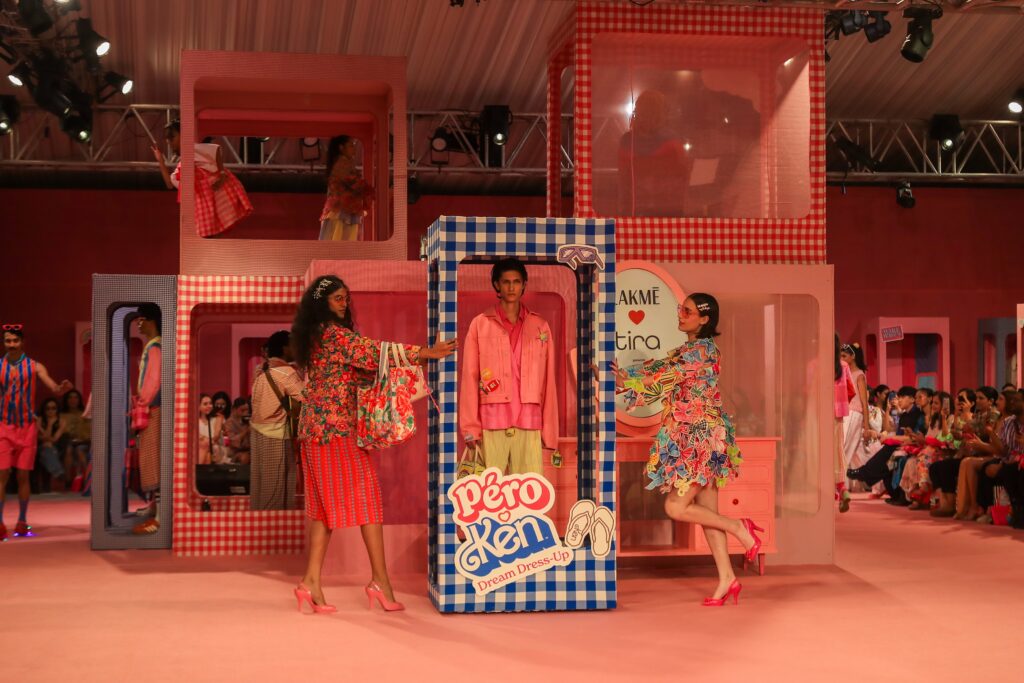
Aneeth Arora’s Barbie comes armed with the most crucial accessory, intellect, she dresses like Arundhati Roy and Meera Nair in Banarasi brocades and hand spun cotton, not in bodycon and her signature monochromatic swimsuit! Get ready for Barbie 2, Pero style. By Asmita Aggarwal You would never imagine Barbie and Aneeth Arora, two ends of the spectrum, one likes pink, the other banks on intellectual prowess! Interestingly, Arora is a risk taker, like collaborating with Hello Kitty and making it her own, Barbie for her is a versatile brand with unique storytelling. “Constraints help me think I feel challenged,” laughs Aneeth, showcasing at LFW X FDCI Barbie was created by Ruth Handler, debuted on March 9, 1959, at the American International Toy Fair, New York City, she was inspired during a European trip, 1956 when she saw the German Bild Lilli doll. Though Barbie’s body has been controversial since a 1958 Mattel-sponsored market study before the doll’s release, moms weren’t happy about having it “too much of a figure.” This 11-inch Barbie for Aneeth is not a doll, it is a journey, earlier children would play with paper dolls, but you had Barbies of all body types, colours, and professions when it started way back in 1959. You could dress her up any way you want. “Barbie loves dolling up, that’s where Pero comes in,” says Aneeth. She undertook deep R and D and believes Barbie can’t be put in a box; she had a pretty sporty and sexy wardrobe-vintage one dressed up in lace. Doll’s history is engaging, it started with Cabbage dolls created in the 70s, for girls to play. “My first Barbie was bought when I secured a good rank in school, so was the second, third one gifted. I am looking at Barbie not in the same way the world views her,” she says. Greta Gerwig’s Barbie movie starring Margot Robbie and Ryan Gosling, grossed over $1.4 billion globally. This theme fits in with Aneeth’s larger love for nostalgia, with a child-like, innocent approach to fashion; fantasy world that kids create while playing is what she has serenaded her. “Whether it is author Arundhati Roy or Meera Nair Pero fans, they will find their pieces from the Barbie collection,” she smiles. The theme is “dream dress up”, even though Pero for a buyer has always been a combo of textiles and intellect, for a thinking woman who knows her mind, is comfortable with her body. Like artist Mithu Sen or her long time friend Himashu Shani. She this time too offers “classics” as she calls them, along with fun, and playful clothing, breaking the stereotype that Barbie has to be a certain “blonde” only. Pink and Barbie are synonymous, Aneeth will do the “girlie hue” but in her own way, as it can have million tones. “I did have reservations because I wasn’t sure if the brand expected me to do their version of pink,” she laughs, adding, “There won’t be any pencil skirts or bodycon. The first swimsuit Barbie wore which was black and white has been given an interesting new avatar with Chevron stripes woven in Mashru,” she explains. “Barbie loves stripes,” says Aneeth. Few know that Japan has been one of the biggest markets for her, along with the US, Europe. For the girl who came from small-town Udaipur, is now retailing from 300 stores all over the world. “Japan respects handmade, funnily it has two extreme sides, one is textile the Zen side, other is crazy Harajuku, both co-exist peacefully,” she says. A bit like Aneeth, sometimes “more is less” for her, the underlined emotion remains nostalgia, childhoods are not very different whether they are in India or abroad as innocence remains a common thread. “So is curiosity, isn’t it?” she says. With economic downturn, wars and political uncertainty, does Aneeth look at fashion differently? “I am just trying to bring happiness to everyone’s lives despite the dark era. When you wake up and wear something that gives you joy, that matters,” she adds. On a serious note, 300 artisan families are associated with the brand and 3,000 others rely on her, “clothes can’t solve any problems, but at least they make you feel lighter on a dull day,” she says. Her staples Chanderi, Mashru from West Bengal, vibrant stripes, pink on pink done in Banaras, Kadwa, to jacquard introduces us to Barbie who loves Indian crafts. “We have also dressed her in hand spun cotton, as well as Banarasi Brocades,” she smiles. This time she has done jersey, hand knitted, flat bed, as a plastic doll she isn’t that flexible, this is new and expected for her, crochet added for an extra edge. She has channelled her famous song, “Life in plastic is so fantastic,” chorus from the 1997 hit “Barbie Girl” by the Danish-Norwegian dance-pop group Aqua with recycled plastic, with “Found Pero”. She is inspired by tiffin baskets called “Koodai”. It is a traditional, hand-woven South Indian basket, crafted using Chettinad plastic wire techniques in Tamil Nadu. “We have recycled plastic and made mini-Barbie bags,” she admits. Craft doesn’t need to be serious, even when she did Kullu intense textiles for Woolmark, many years ago, she felt the end consumer understood it better when you can add a bit of fun. “In a 20-minute show what can you really show, so I decided I want mine to be experimental. It is an experience we offer, you travel to a different world,” she says. The travesty is when Ralph Lauren uses Madras checks everyone writes about it, but here, they take crafts for granted. In a time when everything is AI and online frenzy, Aneeth opened a retail store. “I like doing things my way, when I am ready. When Barbie came to us there was this message, ‘you can be anything’ but I want to say, ‘you are already everything’,” she concludes.
Farmer’s son from coal mines wins Circular Design Challenge
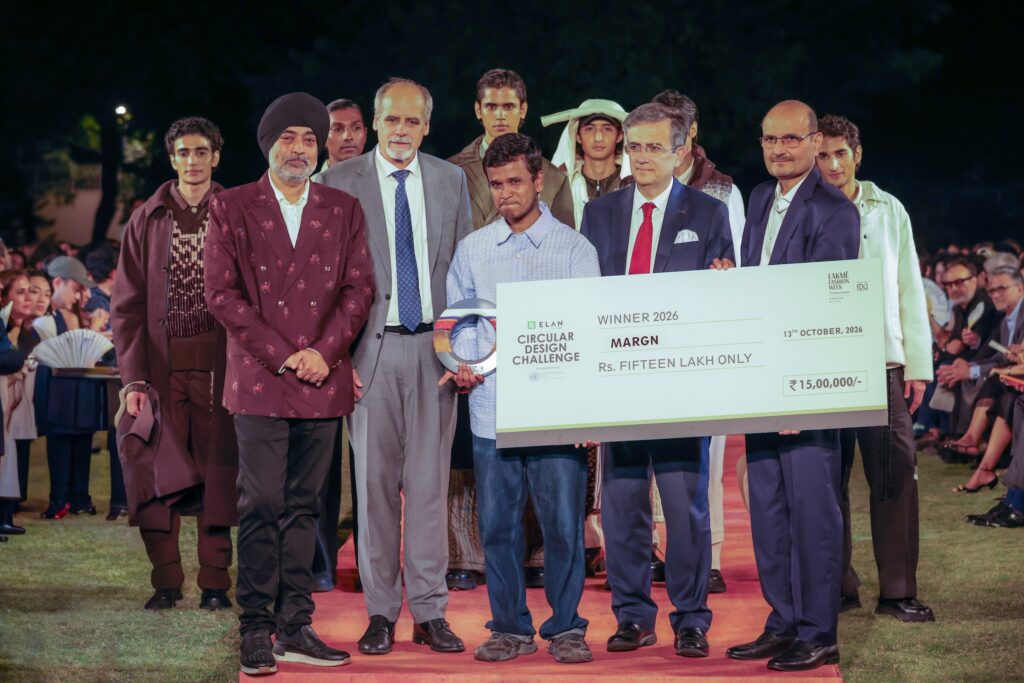
He saw how his father repaired an old umbrella, or sewed mom’s old saris into a mattress for 9 kids, Saurabh Maurya from Singrauli understands substantiality as he has lived it! By Asmita Aggarwal Saurabh Maurya is from a non-descript town of Singrauli, Madhya Pradesh, better known for the NTPC power plant, coal reserves, and mining, where most locals are employed. Like most impoverished children growing up in rural India who aspire for government jobs, Saurabh did too. He was encouraged at home to try for engineering and medicine, to give stability to his siblings, but it was a senior studying at NIFT who changed the course of a young, impressionable boy’s life forever. Saurabh decided to follow his heart, study fashion design in Bangalore-in hindsight it was the right move. He launched his label post graduating in 2019 believing that Margin or his brand Margn, will channel sustainability. “Isn’t that what margin means you have space to alter? I must confess where I came from no one even knows the word fashion,” he smiles. Quite apt! Eight years he has been working with the Lahaul, Darcha, Jhanjeli, and Spiti (Himalayan region) intermixing indigenous handcrafts with eponymous knits, creating a pool of 62 artisans, though he started with just three. “We added hand crochet and knits to this brewing cauldron along with my co-founder Rohit Yadav. This was part of our college project which made our hearts sing, so we continued,” he says. Rohit and he are vastly unique, the former loves finance and maths, Saurabh is free spirited, more creative. “I realised while living in Lahaul, tourism generates enormous waste-specially paragliding, he put that to good use along with recycled cotton. Parachutes were transformed into wind sheeters, trousers and work wear essentials like puffer jackets using mostly layering and appliques. “We mix knits with insulated material, but we haven’t forgotten Lahauli motifs, geometric, vibrant, multi-coloured nomadic patterns, which have won a GI tag too. As well as fruits, plants and flowers,” he explains. Most artisans don’t work in summer, they grow crops to sustain through the harsh winter, so Saurabh gave them more work when they are at home-warm, knitted caps, to covers. This wisdom came from watching his father crafting new things and repairing by age-old hand techniques. “He had no choice. I came from an impoverished family of 9 siblings. He taught us how to make things last as buying new or discarding broken things wasn’t an option,” he adds. His father resisted his attempts to work in fashion, he still doesn’t understand what he does, but after NIFT and much convincing he came around. “I had to tell them I could do it, give me a chance even though I had no angel investor or bank balance. When you are a farmer’s son, you are busy saving resources, you learn to live on little. I saw my father repair an umbrella with recycled plastic cover, make mattresses using my mom’s old torn saris,” he affirms. His CDC line is an homage to his indomitable spirit–titled “Origins”, how staying with him in the fields, sowing crops, he learnt life lessons, “how he would sell his crops, his strong ideals, perspective everything helped me reach where I am today,” he concludes.
Dearly beloved lehenga, you can be upcycled
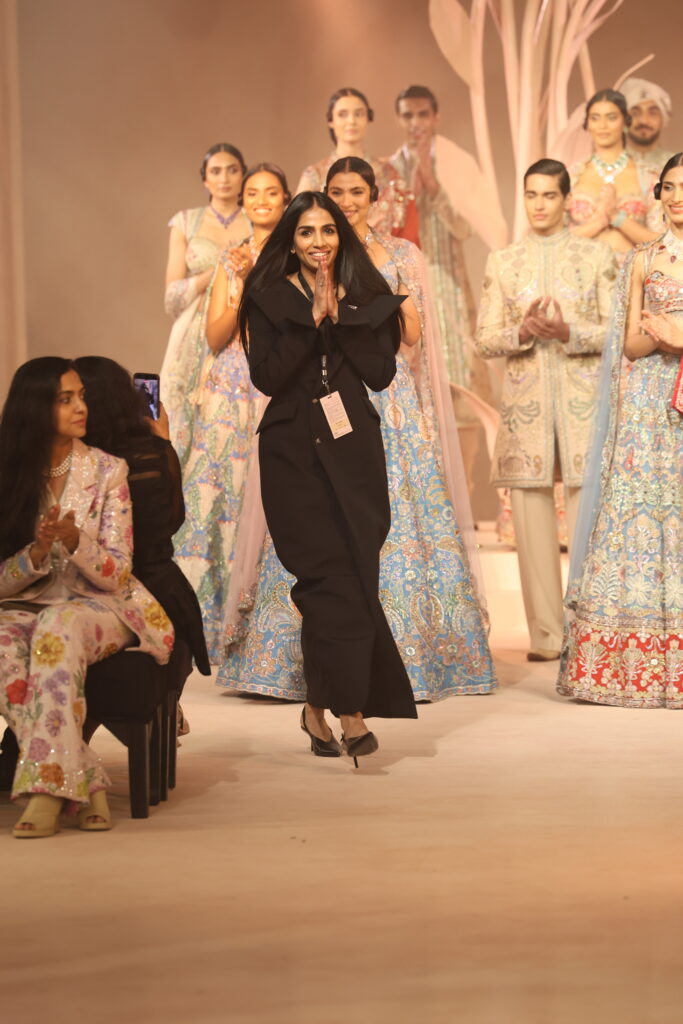
You buy an Aisha Rao due to its superlative design, just as the Tesla, bonus is it’s electric, same way as Hyderabad-based Aisha Rao recycles, creates own fabrics, keeping no room for wastage. This time see her twist on traditional South jewellery, designed for an intrepid bride. By Asmita Aggarwal Is Hyderabad the new Delhi? With the growing number of tech billionaires, cash inflow is enormous, and if you thought the South, unlike Mumbai, more understated, shied away from colour, Aisha Rao will prove you otherwise. With the moniker “Purposeful luxury” her ideology channels upcycling, applique and techniques like in-house fabric production, not keeping unnecessary inventory, but focusing less on D Day bridal look, more on surrounding events like mehndi, cocktails, sangeet, “established10 giants in bridal wear are already popular with brides I needed to look beyond that space,” she grins, adding “There is no distinction now between North or South dressing, it is a global template.” However, the designer who studied law from NUJS, went to Parsons and IED, Barcelona believes, subtle difference between North Vs South is that the latter won’t compromise in quality, even if that means shelling out big bucks. “I was feeling typecast as a mehndi designer, I wanted to look at other things. We decided to offer lighter lehengas, fewer kalis, and our embroideries are not weighty,” she adds. The waste of lining, lurex, dobby is recycled into bridal wear, the beauty lies in architecture inspired shapes and motifs. “Botanicals have been a mainstay, but we add a playful touch to it, using abstraction to make a point, we also have pockets in all our lehengas,” she explains. Aisha is a risk taker, she tied up with Kohler last year, to do metallics for the first time, focusing on “hardware”, this year it is homage to hues—but with an interesting theme—“Preyasi” in Sanskrit, translating to beloved. In literature this concept is recurring whether it is Anna Karenina (Leo Tolstoy), Wuthering Heights (Emily Brontë) or Pride and Prejudice (Jane Austen). “If you look at Mughal-e-Azam, Madhubala, there is love, longing, remembrance and final union,” she says. It may have been glamorized on 70 MM but there is an underlying tragedy as well as melancholy too. Like A R Rahman’s songs for the blockbuster “Taal”, unrequited love has been around for centuries. What’s engaging this year is her foray into fine jewellery, with Shree Jewellers, designing 25 precious pieces. One motif that spoke to her was the ubiquitous paisley. This quiet but impactful shape has been celebrated everywhere-Etro to European fashion houses for eons and no one is tired of it. She has reinterpreted the Telugu Mango mala, golden mangoes strung together, representing luck, growth, and fertility-shape is also known as a paisley but Rao has given it an Art Deco appeal. In traditional jewellery, Battu Mala is a classic bridal necklace, rows of coin-like medallions, can be worn as both a long necklace and a waist belt (Vaddanam). She has worked with Gutta Pusalu or in Telugu, “clusters of pearls”, it is generally passed on from mother to daughter worn with a Kanjeevaram. Though here it comes with a twist-Basra pearls and Navratan is the conventional format, Aisha has turned it around with diamond briolettes. “We made the diamonds look like pearls,” she smiles, a pop culture take on conventionality. The beauty of an Aisha Rao label is not to use big words like “reducing carbon footprints attempting to greenwash” but finding ways to reduce wastage, self-reliance, as they make their own fabrics, embroidery is woven in base material offering design intervention-in lace or mesh within the warp and weft. “We don’t want to depend on China or Korea for cheap fabrics, the key is the same as Tesla’s ideology, ‘you buy a Tesla for its design, the added advantage is its electric’,” she concludes.
Grooms get “lace-d” by Dolly J
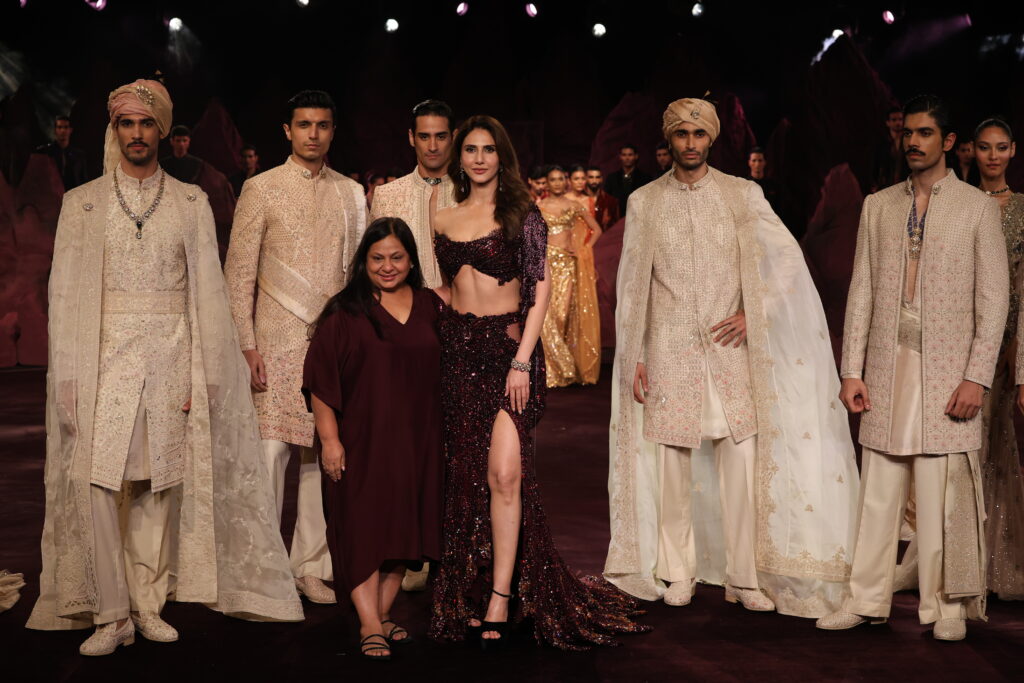
Designer brings the artistry of Kashida, jaali work as Kashmiri paisleys offer engaging textures; Vani Kapoor wears Brahm flower petals recreated in the trail of her aubergine gown, as menswear brings alive Jamevar embroidery. By Asmita Aggarwal The ICW set mimicked Himalayan mountains, abode of Lord Shiva, thus began on the chants of Aigiri Nandini, to Mahamrityunjaya, declaring how women today are unafraid, in more ways celebrating how they have come into their own. The spotlight wasn’t on a petite girl, who can carry off a slinky gown, but plus-size model/activist Sakshi Sindwani who managed to work it with equal ease. Dolly J studied at the Patna College of Art, grew up amongst gardens, mango farms, flowers, so the aromas of Floribunda, a large part of her carefree childhood in Patna, still fresh in her mind. Dolly began as an artist, “steel man” Subodh Gupta was her senior in college, she was known for sculptures and oil on canvas, till she moved to designing. “Brahm Kamal no one sees blooming, as just for a few hours at night it comes to life and dies, like the soul, it leaves with us-an invisible force. I was looking for the meaning of life, Hindu texts offer that infinite wisdom– the ephemerality of life and its vagaries,” says Dolly. Thus, Vaani Kapoor’s trail is the petal mimicking the Brahm Kamal, which shows up in the form of brooches and clutches. Dolly’s mother, a collector of textiles and art has been an integral part of design journey, the silver fans that she gave both the daughter, became ignition for her couture show just like the trunk full of Jamevars she left, collected over 90 years. “I have loved Kashida because of its intricacy, and to replicate the paisley was a task, as we embroidered it, took us almost six months, extremely delicate,” she adds. For the first time Dolly has introduced menswear, it comes emblazoned with lace, as she believes men are now wanting an X factor, “I’ve seen boys roaming around with swatches looking to match their bride’s lehenga. A large part is to also capture memories, plus social media pressure, they want to look equally good.” Couture has always felt deeply personal to Dolly Jhunjhunwala, it’s not about exquisite craftsmanship or beautiful silhouettes; it’s about the emotions they hold. “It can bring back nostalgia, mirror your mood, become a part of your story. For me, couture isn’t just fashion; it’s a feeling you carry with you, long after you’ve worn it,” says the self-taught designer. “My mother always said, ‘Never be afraid of failure.’ Those words have stayed with me throughout my life.” True couture is inherently sustainable, it is crafted to be treasured, preserved, and passed down through generations. After 20 years in fashion, Dolly believes, many times she has seen ups and downs, business has weathered storms, but your passion is still alive, you’re already halfway there. Her first runway show in India was in 2010, and it’s a moment she remembers with great fondness. The collection featured crochet kalidaar sarees adorned with intricate Pichwai-inspired embroidery. “Craftsmanship has always been the soul of our brand. Banarasi has been constant because of its rich heritage, though this year we’ve consciously taken a step back to explore new directions,” she adds. This year at ICW the focus has been on menswear, highlighting the beauty of Kashmiri kashida embroidery. “I’m also excited to bring at least ten sarees to the runway this year,” she adds. “I’m quite surprised by how adventurous, aware men have become when it comes to dressing. The new-age groom is more open to experimenting with silhouettes, colours, rather than following only traditional choices,” she explains. While classic sherwani will always hold its place for the D-day, the groom is looking for something more personal, an outfit that reflects his individuality and makes his celebration truly his own. “This year at ICW, I’m quite excited about how we have explored jaali work, created purely with weave of threads, with no cloth as the base and layered it over Kashmiri paisleys, creating a unique interplay of texture and artistry,” she adds. “Indians have always shared a deep emotional connection with embroidery, it is a celebration of artistry, heritage, and storytelling. For me, luxury is not about excess; we create lighter lehengas by using refined techniques, thoughtful detailing, that allows the beauty to shine without overwhelming the wearer,” says Dolly. “Gen Z wants to enjoy weddings, dancing, not like us sitting on the stage, when we got married, so we make purpose driven clothing for a conscious generation, so that it can also be reused. Of course, I bring my grandma and mom’s emotions in what I do, so that it has enduring value for me. We have pre-stitched, pre-draped, saris with jaali work on pallu and skirts,” she explains. “When I’m not designing, I’m someone who finds joy in the little things, spending time with my loved ones, observing the world around me, and drawing inspiration from everyday moments. I believe these experiences shape my creativity and keep me connected to life beyond fashion,” she concludes.
Best couture becomes an heirloom: Jayanti Reddy
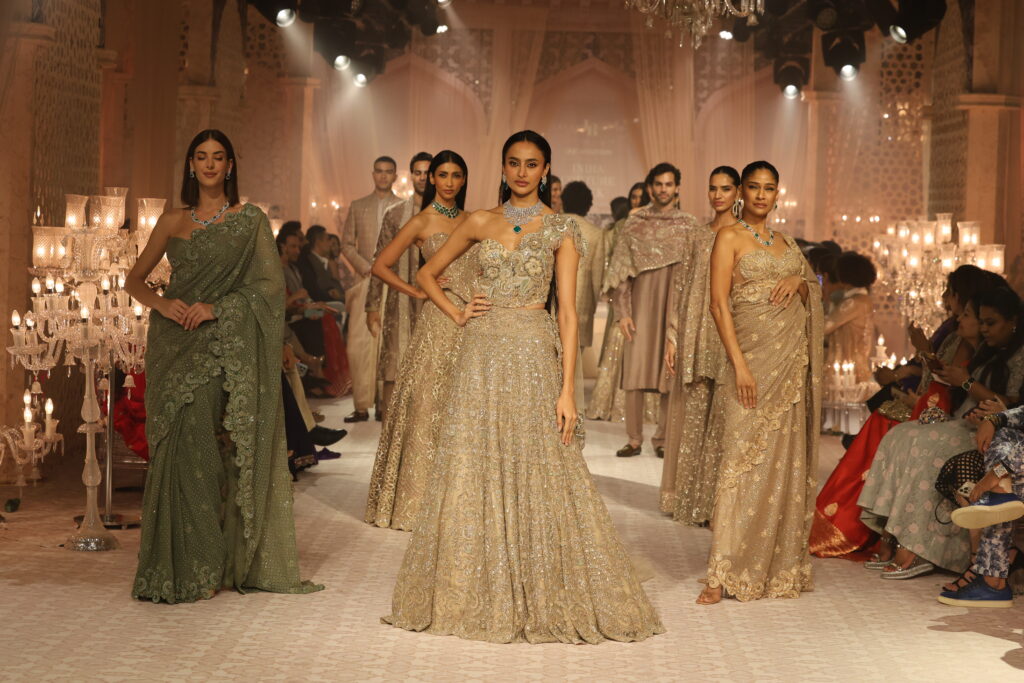
Jayanti Reddy believes good tailoring can be just as luxurious as heavy embroidery, balance is key, as she uses lighter base fabrics and strategic embroidery placement to offer brides unlimited comfort. By Asmita Aggarwal Hyderabad-based Jayanti Reddy has a sense of humour- despite being ferociously private, she says people assume “I’m constantly working or thinking about designs, but that’s not true! I’m a mom to a 4-year-old, that problem keeps me busier than couture does!” People rarely remember every embroidery detail—but they end up remembering how they felt, that’s how couture becomes part of family memories and milestones. “It’s something that’s preserved, not just worn once, that’s what makes it so special,” says Jayanti, who is known for her roomy shararas now a part of every modern bride’s to-buy list. Jayanti completed business administration and marketing from Case Western Reserve University, Ohio. She believes the biggest lesson she learnt coming from an established business family is that your reputation is everything. “Always deliver on your word. Relationships with clients matter more than quick wins. Stay grounded, no matter how much you grow,” she adds. The often-asked question is how every region has its own design language, but she believes both South and North have valued textiles and heirloom craftsmanship. “They just embrace grandeur and occasion dressing differently, Hyderabad has definitely evolved. There’s a younger, global client today who appreciates quiet over loud luxury,” she explains. Couture is made to last—not to be discarded after one season. Jayanti repurposed leftover textiles and embroideries across collections. “I believe longevity is the biggest form of sustainability. Luxury isn’t about ‘more’, but thoughtful decisions and beautiful construction, comfort and craftsmanship. Something you’ll still love 20 years later,” she says. After 15 years she has understood failure doesn’t mean you’re not talented. Fashion is as much a business as creativity, learn from what didn’t work. Resilience is probably the biggest competitive advantage. “My first show ever was at Lakme fashion week, Mumbai. I remember being far more nervous than excited. It was rooted in Indian textiles and craftsmanship. Looking back, I can see how much my aesthetic has evolved,” she confirms. She believes her contemporaries are doing well as there is a space for everyone to grow—Karan Torani is an incredible storyteller, has a strong brand language. Aisha Rao’s beautiful use of colour and prints, while Punit Balana brings fresh perspective and youthful aesthetic. “Banarasi has always fascinated me. We’ve worked with brocades, tissue, silks, zardozi, aari, dabka, naqshi and more. I enjoy taking traditional textiles into unexpected silhouettes. It’s about evolution. And this is what helps moving tradition forward,” she admits. She has admired legends, craft couture over the years- Tarun Tahiliani for his drapes, construction and timeless elegance—he’s influenced generations of designers. “Gaurav for pushing the boundaries of couture. His sculptural silhouettes, innovation and ability to blend art with fashion are truly remarkable. And I have to say, Manish’s ‘Maa’ collection left me completely in awe. It reminded all of us how powerful couture can be when vision and execution come together,” she adds. Men are the new adventurous lot and far more involved. They know what they like, they’re experimenting with colour and layering. Comfort is becoming just as important. They’re dressing for themselves, not just the bride, is the subtle difference she has observed. “This ICW there will be more structure, new layering, softer but stronger silhouettes,” she says, adding, heavy doesn’t always mean luxurious. Sometimes less is actually more. “Good tailoring can be just as luxurious as heavy embroidery, so I’d say balance is key.” She has used lighter base fabrics and strategic embroidery placement. It’s about celebrating Indian craftsmanship in a modern way. Looking at heritage through a contemporary lens. Biggest regret? “Not delegating earlier and trying to do everything myself. You build a stronger brand when you build a stronger team. Trends shouldn’t define couture. The best couture becomes an heirloom,” she concludes.
Patola, Kantha and Bandhini, get a new vocab
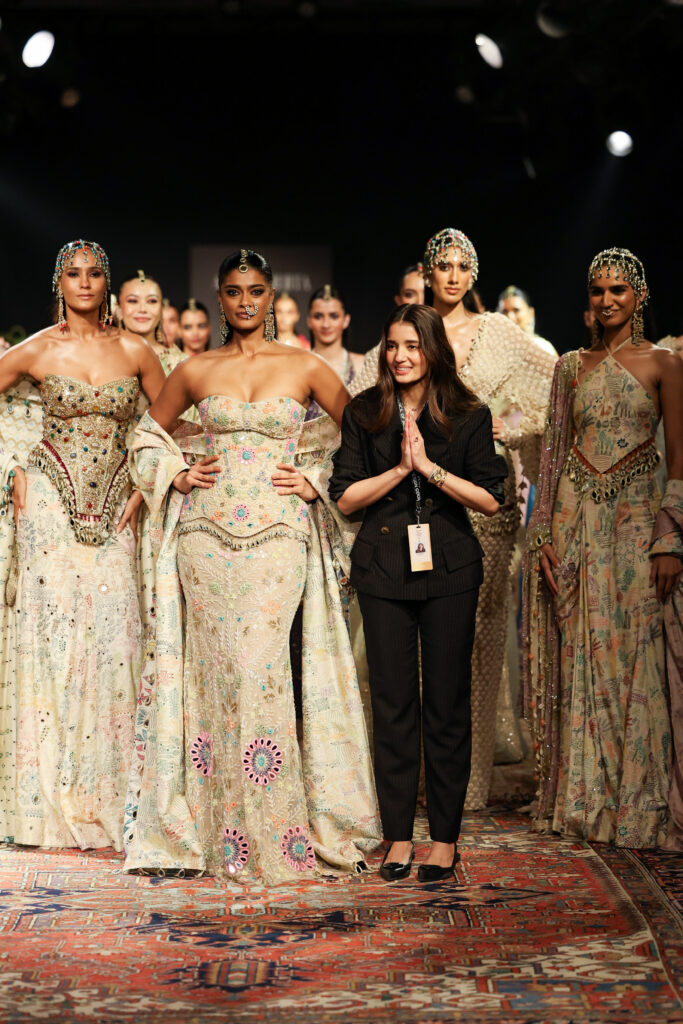
Whether it is Anshula Kapoor, or Suhana Khan, even Natasha Poonawala, Arpita Mehta dressed them in traditional crafts, with a modern twist. By Asmita Aggarwal “I’m a Gujarati, I grew up around Bandhini and mirror work, it is part of my DNA, most religious occasions at home, we would be dressed up. I saw my aunts, grandmom, mom in saris. I knew I would work with it,” says designer Arpita Mehta, who studied Apparel Manufacture and Dress Design from SNDT University in Mumbai, later interning with Manish Malhotra. The craft gradually found its way into bridal wear, but subtle difference was -it wasn’t done traditional Gujarati multi-coloured, loud way, but a more nuanced look. “I think I learn with every line I make, embroidery I can control in-house, but when you work with artisans you need to work around their deadlines. Real craft takes time-looms are to be worshipped,” she adds, smiling, “No piece will ever be the same wherein lies its beauty.” Two years back Arpita’s journey began working with Bandhani, she wanted to do justice to its appeal, but wanted it watered down. It wasn’t conventional shape-ghagra choli, it was tone-on-tone, single tone, neither did it have Kutchi or kori work. “It had more finesse, smaller bandhans were made, generally it is done on Gajji silk, she transferred it on crepes and georgettes, with cut dana. “I took away the colour and decided to offer pastels. This year she also made her closest friend feel special-Anshula Kapoor, producer Boney Kapoor’s daughter was getting married to a Gujarati screenwriter Rohan Thakkar. She wanted to wear Patola, double ikkat, so embroidery with applique with Patola motifs was her way to pay homage to childhood memories. “The dupatta was naturally-dyed Patola with gold thread embroidery, a tedious piece which took two months to execute. I don’t think I can ever make a piece like this again,” she admits, adding her mom also wore a Patola, but the burst of colour wasn’t to her liking. “For Anshula’s choli-skirt was Bandhani and Banaresi, I wanted to reinterpret it.” In May this year, Arpita decided to dress industrialist wife turned style maven Natasha Poonawala, in conjunction with stylist Rhea Kapoor for a charity ball in New York. “Kantha is a textile which hasn’t been explored in haute couture, so I deducted the drama and made it more versatile. “Couture should be relatable, not intimidating, but unique,” she confirms. ICW 2026 there are lehengas, saris, corsets and pencil skirts—she is big on textile, Bandhini, tissue, kantha combined, the potential is immense. As she moves on to the 16th year in business, she wants to be honest to her vision, go by gut feeling. “It is fun working with self-made brides, they exude confidence, are more organised, and make my job simpler. Unlike the privileged who can’t make up their minds, spoilt for choice,” she adds. Bollywood and social media have been a game changer, “everyone has an opinion, and that POV can also be bought for a price-it is a grey area,” she says, adding it is an additional advantage to be married to a “genius” Kunala Rawal, “we give each other candid feedback.” When she dressed Shah Rukh Khan’s daughter Suhana, in a tissue Muga silk sari, she loved it, “many young actresses may like corsets and gowns, but Suhana, loved the natural silk, ordered one in rose gold, kasab and tissue too.”
“Craft must have a newer design language”
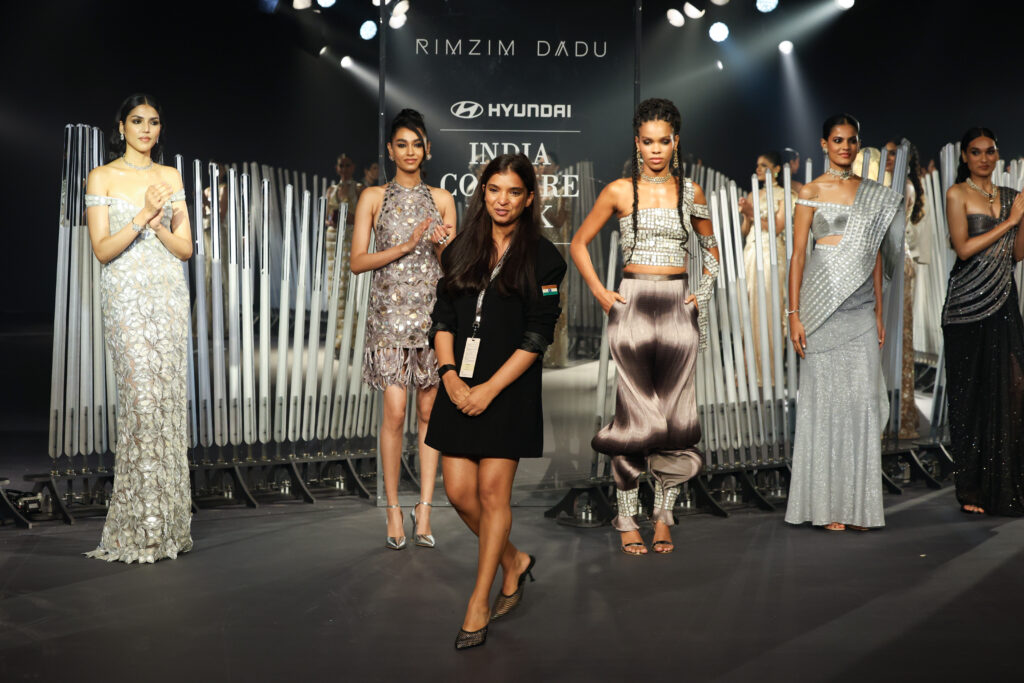
Offbeat materials has been Rimzim Dadu’s calling, even though she has mastered steel, this ICW, she tells us how she got manipulated by mother-of-pearl. By Asmita Aggarwal If you look at Rimzim Dadu’s DP on What’s App, it shows her pre-covid, pre two daughters, gallivanting in Ireland, Burren National Park, “the glaciokarst landscape fascinated me, but now I have no bandwidth to travel” says Dadu. When she began 16 years ago, the idea was to offer wearable pret, not chiffon, georgette, satin, all the things you would associate glamour with. She turned everything on its head-using industrial materials-metal, paper, acrylic, leather, silicon, wool, cording, twisting, shredding, hammering to make them supplicant, mould to her unconventional wishes. Think woven metal saris, silicon Jamdani, steel Patola, paying homage to crafts, in unique ways—whether it was the Lambani tribes of Gujarat or her experiments with mother-of-pearl this ICW 2026. Six years ago, she launched couture, labour intensive, channelling the ideology that technicality is couture, not the price of it. Take for example the leaf motif that has been crafted in metallic cords, hand cut and then sewn on lehengas. She confirms shapes are lighter now, even now despite working with offbeat materials she can never tell how each one will behave-slave or master. “I liked how real mother-of-pearl reflects light, I wanted to explore its potential, challenge myself again, start anew. I didn’t know how to sow it, break it into smaller pieces, buff it to give it shape by hand, each piece. There was no rule book, each collection for me is more about R & D,” she says. Most wonder how to preserve such delicate pieces, the only key is to keep away from moisture and light, she promises each customer, even if one wire goes astray, she will fix it, clean the hand made ensemble on request, to preserve its longevity. “For me it must remain in your wardrobe, as money is invested, from a design perspective I’m not following any trends, so these are one-of-a-kind,” she adds. She never looks at Indian craft as “sacred” rather approachable, it must turn into a conversation starter. Subconsciously she loves how one community has kept the flame of Patola alive. “Whatever I see I absorb like a sponge, like my exposure to mother-of-pearl jewellery, especially how the Nizams wore it with grandeur stayed with me. In Mughal architecture how inlay in marble is done, that technique became my ignition point,” she explains. The mother-of-pearl is made to look like Kundan, jadau, interesting to see in couture. “Thickness, weight, shells are varying how to sort them, as they are natural, has been a learning, with semi-precious stones,” she confirms. Small grids made, created patterns elongated to miniature to give a 3 D feel to placements! “I want my clothes to be clean and minimal, I don’t make exaggerated shapes for runway appeal,” she smiles, adding, “The funny thing about dressing men is they look for approval from their partners, while women know what they want.” Paris Fashion Week is on the cards, but the logistics have been a nightmare, even thinking about it stresses her out, “maybe one day, who doesn’t want to go there?” Will her signature metal weaving, steel cords make a splash this year too? “It’s something I can never give up, like I really admire how Anamika Khanna does her drapes, effortlessly,” she admits. Brides are not driven by brand names, for them craftsmanship matters, social media she believes helps get the story out, “let me tell you something which will give you perspective of the changing landscape of bridal wear. In 2016, when I launched the metallic sari, a bride-to-be said to me ‘I like it, but I will have to check with my mom-in-law if I can wear it to my reception.’ It was an alien looking garment, now brides are not seeking validation, they have done their research, know what they want,” she admits. Her fav-the fringe lehenga she made with metallic cords, in 2020, still her bestselling piece. “I don’t think I have mastered the art of materiality, but yes steel understands me and I can manipulate it,” she concludes with a grin.