
Akshay likes ruffled feathers
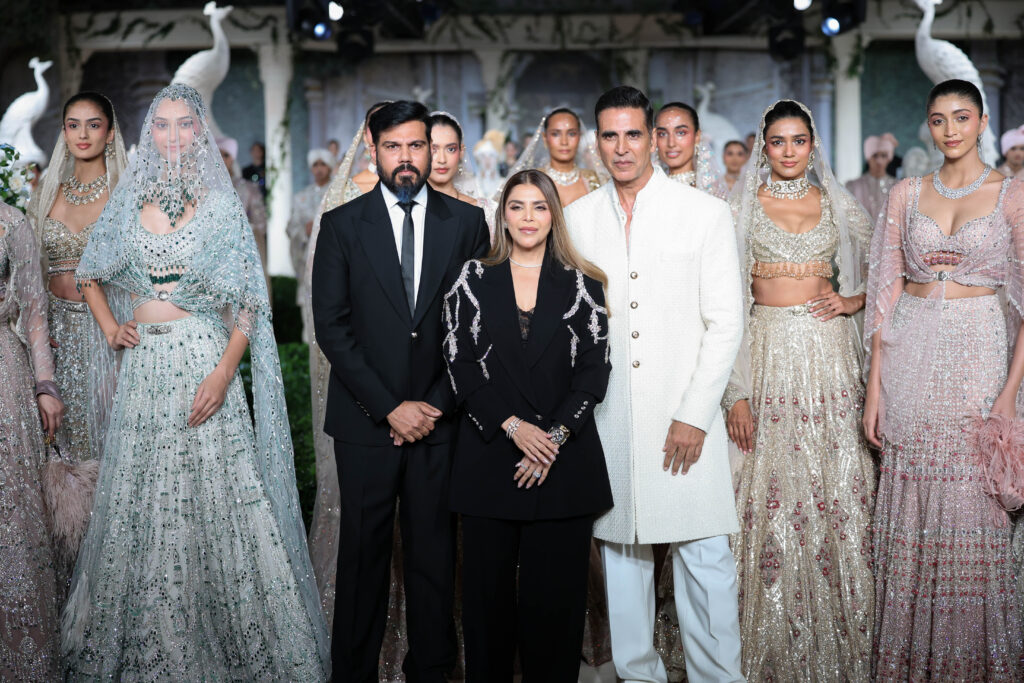
Bollywood superstar, avalanche of sequins, jazz crooner think Nat Cole King, crystal bustiers, Falguni-Shane Peacock made sure, everything glittered at ICW 2025. But you can wear your boyfriend’s denims with a pussy bow blouse and sequinned tunic they informed us! By Asmitaa Aggarwaal Remember a sitar maestro sitting in a lotus last year with the delicious Vicky Kaushal giving us increased heart beats? That’s Falguni and Shane Peacock, this time too for ICW 2025, the imposing set, looked straight out of a garden in Italy, with two giant white peacocks (befitting) in the middle. And of course, in this heady mix was Akshay ‘Khiladi’ Kumar, in dark glasses and all the right moves, thankfully he did not pull off a gravity defying stunt, but did bend down on his knees, giving us a taste of his usual irreverent fun! He spoke in Hindi, and admitted he is ramp walking after years, almost 12, “mini show but lots of hard work goes on behind it,” exclaimed Akshay. FSP had men with diamond danglers, capes in ink blue were larger-than-life; women flaunting faux feather boas, an avalanche of sequins, it was as if everything was crystallised. They skilfully combined their two loves– sequinned women perched on two stone peacocks, zardosi feathers languidly sprawling on lehengas, if you switch off the lights you can see an FSP outfit from afar. It makes us believe too much shine is never enough, in this invasion of an army of glitter were delicate pearl trimmed veils.The favourite undoubtedly was Archana Akhil Kumar in high waisted boyfriend jeans worn with a fully sequinned tunic and white pussy bow blouse which will soon become everyone’s go it-multiplicity of use. In FSP style, the glowing brooch clinched the tunic as models wore multiple mogra braids, the smell wafting through the Taj Palace Hall. “The way FSP presents themselves is purely international, but it’s made in India. I hope I get another chance to do this again, as I feel royal in my white sherwani,” Akshay added. Shane, with hints of blue in his beard, told us he had investigated so many minute details, but the show stopper was the most important one. Live music always has its advantages—and fashion show veteran singer Vasundhara Vee with a booming voice took charge (she has done shows with Ashish Soni, Ravi Bajaj, FDCI, Sabyasachi). Vee crooned jazz as La Vie En Rose (Edith Piaf), Dream a little dream of me (Doris Day), At Last (Etta James), A Thousand Years (Christina Perri), and L-O-V-E (Nat King Cole) made sure the hints of woven saris got a fleeting representation in an otherwise tornado of embellishments. Singing for the last 30 years the Assamese artist, studied at LSR, English (hons), grandchild of Pramathesh Chandra actor, director, and screenwriter of the 50s, who made the original “Devdas”. “Arts were a part of my family, Pratima Barua Pandey an Indian folk singer from the royal family of Gauripur, Western Assam’s Dhubri district, was my grandma. I think I inherited the love for tunes from her,” she smiles. Though when you sing love on tracks there are challenges versus when you are with a band, where you can tune and keep up the flow. “Pace of models changes, so you must make sure you are in tandem. I enjoy how fashion interacts with music, even though I have always been self-conscious, I did enjoy wearing the FSP shrug,” she concludes.
Little birdie told me…
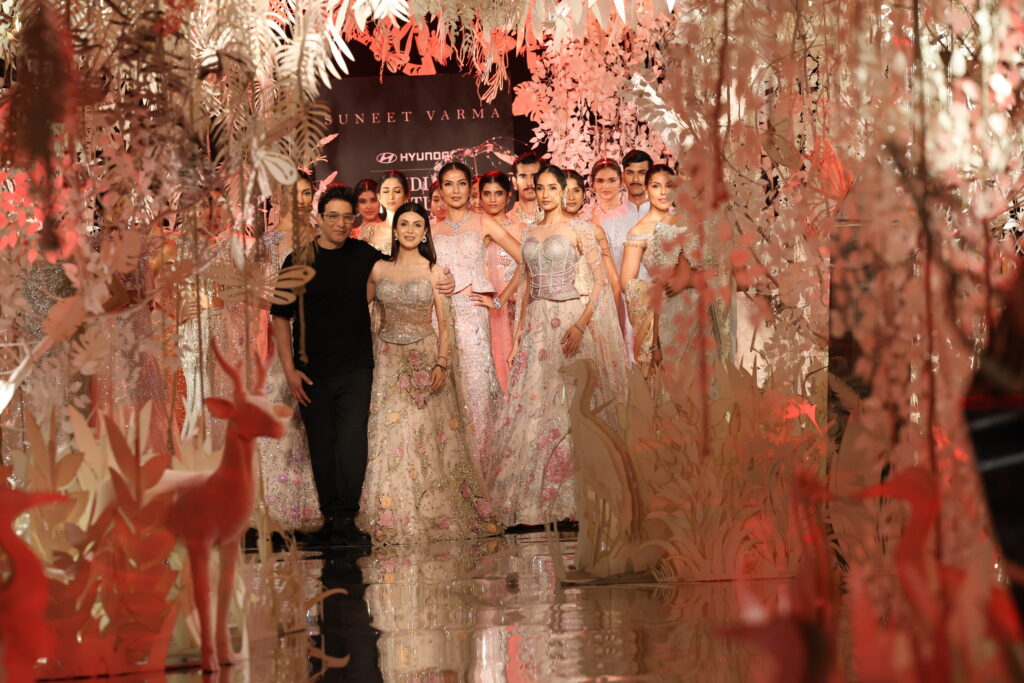
Swans as headdresses, garnets, and pearl wraps instead of cholis and of course the iconic ‘mover and shaker’ Helen on Monica Oh My darling, made Suneet accentuate all his first loves at ICW 2025. By Asmitaa Aggaarwal For many years one has noticed “dancing designers” the one famous for his enviable moves, Rohit Bal dressed in Jodhpurs and a crisp bandhgala has passed onto the next world leaving behind a mammoth legacy, but Suneet Varma is carrying forward that baton at ICW 2025 with his line “Sehr”. Of course, in his inimitable style— on Jaane Jaan dhoondta phir raha with Bebo’s moustached father Randhir Kapoor and bouffant Jaya Bachchan in the 70s hit Jiwani Diwani. Somehow red is taking a backstage in couture making way for white the “it” colour for the season–sometimes no colour is the best colour. Suneet’s ramp is always reflective, of shine, he is never apologetic about it– pristine white lilies, swans and white palms with sparkling lights took a bow. When you are around as long as Suneet, with ocean like experience – legendary Yves Saint Laurent to Judith Leiber, BMW, interiors, you know what works in a market that can’t get enough embellishment. Indians by DNA are celebratory, it is an inherent part of our cultural ethos. His love for old classic Bollywood songs is apparent, little birds were flying on headdresses, complemented with sequined gowns accentuating every curve of the body—visualise black, gold, boas, faux feathers. The dupatta hangs on nimble shoulders, though by its own willpower, it has got thinner, bulk reduced—just like brides don’t want anything that restricts their movement. Remember Samantha Jones in Sex and the City, played by Kim Cattrall with her unwavering loyalty to beaded bustiers, dripping flirtatiousness and bold pink flowers? Suneet kind of had that spirit of exuberance and nonchalance. Interestingly, shararas with zardosi on the notes of Monica… oh my darling took us back to Helen’s winged eyeliner, midnight blue eyeshadow and tiered ruffled dress, Suneet gave it a modern interpretation with gotta-patti style choga kurtas. Pearl wraps instead of cholis, exaggerated sleeves, gold has always had a hold on occasion wear, everyone’s favourite polkis and jadaus were crafted into a blouse, as if you are wearing a necklace around your bosom with pearls dancing on your back. Star daughter Riddhima Kapoor Sahni seemed comfortable on the catwalk, she exclaimed, “18 years ago I made my debut with Suneet, I’m here again now.” She also twirled for us, as Suneet clarified, “I live in my dream world –set, music presentation is part of who I am, obsessed with romantic music. Tried hard to change it to English sonatas but I can’t do it. This feels natural to me. Fashion is all I know how to do. I like to excel but in a non-competitive way. Thus, there is always debate on if this embroidered rose needs more crystals or whether sequins need better placement,” confesses Suneet. This season- isn’t about reds and rani pinks but lilacs, greys, and obsidian blacks, the shararas is the queen of silhouettes now, tighter, flared, Suneet took it a notch up with semi-precious garnets!
After 25 years “waste is gold”
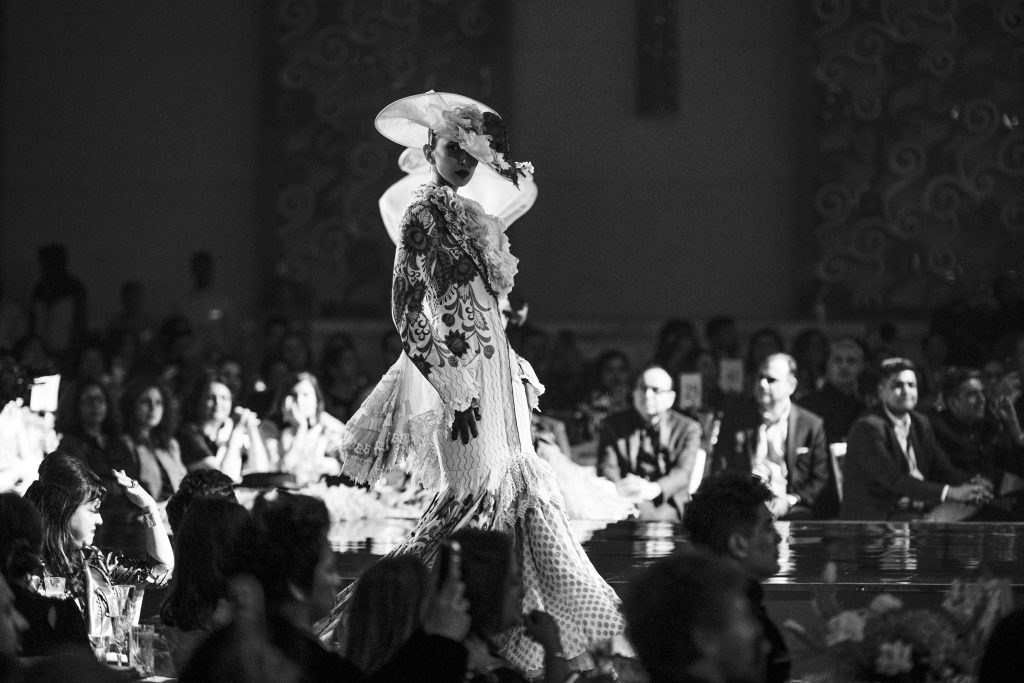
As fashion celebrates its silver jubilee, what is clear now is —sustainability is the only way to go forward, and designers have already taken the lead! By Asmitaa Aggarwal It was a reunion of sorts, designers came in droves, some who had not been seen for over 20 years—Anshu Arora of The Small Shop to Raghavendra Rathore, Ritu Beri, Monisha Jaising, Nikki Mahajan, once doyens of their field, today reticent. FDCI X LFW got them together—after all it was the time of celebrations—25 years of the fashion world! The Jio Convention Centre, Mumbai was where almost 300 people congregated—the most known faces, who have uplifted the barometer of design, innovation, and ingenuity—made a heady blueprint to go forward. Almost 33 designers recreated archival ensembles from 2000 onwards, with 60 models (Lisa Hayden to Lisa Ray), the biggest pool, with Indian-American actor Kal Penn as the host (Van Wilder, The Namesake, TV series House), who not only laughed at himself, but also asked an interesting question to Bollywood dreamboat Kareena Kapoor. “What do you think of fashion critics?” She candidly replied, “They are as important as film critics—they should keep designers on their toes.” Manish Malhotra when asked about his jewels glimmering on his sherwani admitted it was a “hard sell” and someone rightly said, “All this madness is therapeutic I would have it any other way.” Kareena confessed, “make and hair stylists the real stars as they make us look amazing. My darling brother Manish is here. Maybe I will come again on the catwalk not as size zero but owning my body completely”. For 25 seasons she walked as show stopper, once pregnant with her son Taimur, “most emotional moment for me, though my only hope is I don’t fall on the ramp, even if I do, I can get up with dignity. I also suck my tummy in a little,” she laughs. The show had Ritu Beri (2006), Tarun Tahiliani (2000), Monisha Jaising (2002), Rajesh Pratap Singh (2012), Raw Mango, Anshu Arora (2004), Anamika Khanna (2004), Manish Malhotra (2001) outfits recreated, among others. “As I reflect on the 25th year of Lakmé Fashion Week, I am reminded of the incredible journey fashion has taken in India. I had the privilege of opening the very first Lakmé Fashion Week in Delhi in 2000. Looking back, it’s nostalgic to see how far fashion has come—from a time when we could barely fill a room to today, where we are overflowing with a passionate audience. Creativity now permeates everything—the way people dress, the way they express themselves, and the way fashion is embraced in everyday life. It is a testament to how the industry has evolved, pushing boundaries and shaping a more vibrant, dynamic fashion landscape,” says Ritu Beri who started in 1990. She was the first one to do a show in Paris, headed a French fashion house Jean Louis Scherrer, and in 2010 won the Chevaliere des arts et des Lettres award. Though after 25 years one thing was clear—waste was gold now. Nagpur-based Shruti Sancheti, made hair bands, bags, scrunchies out of katrans, and has managed to get orders for it. There is undoubtedly a stream of attempts to be sustainable –the value of the ensembles made from it was Rs 30,000, says Urvashi Kaur. “We create textiles out of fabric, trying to be zero waste, but the beauty is that we are able to craft one-of-a-kind pieces, the key is to be able to shift consumer behaviour,” says Urvashi. On this it’s kantha, and her undying love for tussars, all hand-woven wonders she works with as the market is showing renewed interest, buyers want to know about their garment and how it is made. There seems to be a good churn happening, fashion weeks are a great platform for designers to express themselves visually. “We lost great design somewhere in the greed to keep selling, opulence and money wanting to show status. But the question is how do you contribute to a community. If your work does not hold meaning that money is not happy money. Young people are facing climate change, we have capitalist exploitative businesses, but we must find a way to keep our beautiful traditions alive,” she adds. Bangalore-based Mani Shankar, believes the customer has also changed, each city has its own nomenclature– “Delhi loves bling, so I make it, I must survive also. But the Rs 30000 fabric manipulation linen kurta sells well too, it is our USP,” he adds. “The last 25 years have been momentous in shaping what we now call the Indian fashion industry. Specifically, the last 10 have seen accelerated growth for many brands due to the various initiatives of the FDCI and the influx of corporatisation. I’m truly hoping the next decade is all about true growth, appreciative of all categories of fashion not limited only to bridal couture. I look forward to this next chapter,” says Ashish Soni. For 17 years he has been in the business of fashion, and Nachiket Barve, believes fashion is evolving with more awareness. He has launched a new line of enzyme washed denims for Rs16000, admits he has understood the market better. “I adapted. Design is a dialogue between the customer and you, you can’t be stuck in time or resist change. I look within. We are going to do more business and growth. India’s biggest strength is craftsmanship and willingness to change which will hold us in good stead,” he adds. Akshat Bansal of the experimental label Bloni, showed how he managed to do bio mimicry of a crocodile skin with Shibori, plus his additions of stainless-steel architectural materials on a tailored jacket. Some places you can also see ghungroos, as he sells the silk organza Japanese weave, with reflective properties for Rs 2,50000 lakhs. It comes with Savile Row tailoring, and a mix of various engaging techniques, custom designed. He is one of the bold, new designers who are taking fashion to the next level—see his silk felt raw fabric, it was waste that weavers
I have a child-like curiosity: Rahul Mishra
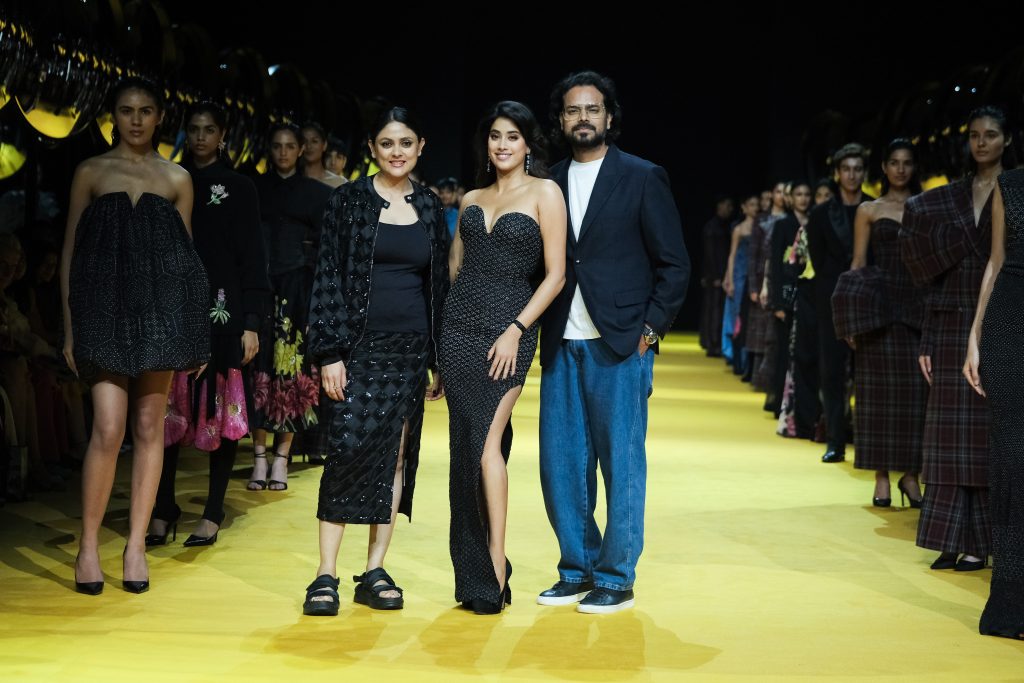
In a freewheeling chat, Rahul Mishra talks about his deep connection with spirituality, Trikaldarshi Brahma, his Paris Couture Week ‘Cityscape’ and ‘Crow’ ensembles, why Bandhani is important as we revisit the present while keeping the “rear-view” mirrors open to pay homage to the past. By Asmitaa Aggarwal He did create a buzz with Gen Z favourite Jahnvi Kapoor getting out of a Nexa, with paparazzi following her, a group of photographers, an event she handles almost every day bravely, they follow her. The set was rear view mirrors, almost 50 of them lined in the show area, as the yesteryear beauty Parveen Bobbi iconic Raat Baki from Namal Halal played in the background. Cutwork jackets, patchwork denims were interesting, some Issey Miyake style, space suit sleeves, and in this mix was Mithun Chakravarthy iconic moves on “Jimmy Jimmy aa ja” and Sanjay Dutt’s rehearsed steps on “Tamma tamma Loke” as the background score. Rahul Mishra and his quiet but impactful wife Divya, presented their line AFEW, at the LFW X FDCI showcasing for the silver jubilee of India Fashion Week, with exaggerated shoulders, big bold flowers, in sequins of course, pants came covered with net. The eye grabbers were exaggerated waists a bit like Comme des Garçons but his interpretation of Bandhani was engaging, in above the knee dresses with exaggerated shoulders, sleeves and bows. The check coats, his continued love affair with flowers, padding and bulges, appliqued hens on jackets, with golden paws, as well as Matrix style black floor length coats explained his love for the unpredictable. “We discovered Henri Rousseau (French post-impressionist painter) work which is on display in this collection as well as the art of Pichwai, but my belief is when you want to create something new you have things which are old like Bandhani. It is like you are driving a fast car, but you have to keep looking at the rear-view mirror to see what you are leaving behind. Crafts become the idea and you create a new version of it,” he says. He took many cultural references from the Silk Route, the products are deeply rooted in traditional craftsmanship. AFEW used painterly old motifs which were found when the Silk Route started, then thrived. “Silk route was an exchange of art, culture and motifs; it was not just about trade. This collection looks at various ideas whether it is from Japan or the Kutch region,” says Rahul. So you have Tanchoi or what Rousseau has done, but in the collection, there is a simplification of all those ideas, few find their own relevance. “Something which is easy, but beautiful,” he explains, adding, “My mind I feel kind of works way too much in multiple directions. Stargazing late at night using my amazing telescope which is the most scientific portable telescope available. I keep wondering about life and cosmos, I also read the Gita, try to connect wit myself. I observe insects–amazing creatures. My mind is never quiet, I am always thinking, maybe I need meditation. I feel I have more ideas but less time,” he smiles. He admits he is sensitive about his surroundings, especially of news. “It lives rent free in my mind. Divya tells me sometimes thoughtlessness is needed, I am sometimes absent minded also. I’m dreaming and thinking. Thoughts entangle me. Maybe it’s not the best thing, but it is a big fuel for finding new ideas and perspective,” he explains. Fashion is quite personal for Rahul, it is about his fears, experiences, tales, dreams, and it comes as an inspiration, out of an observation. “I share my ideas with the team. The way the human mind works is amazing. I can see the person, who is creating an artwork, how it comes from collective thought and dream into an entire garment. I think trends are the most overused ideas. Humans try to discover patterns in almost everything. If it is constellation and trends are based on human emotions, trends are powerful things, but I don’t care about them. I feel like there can be micro trends. The globe is one–generation on Insta and is savvy with technology. People get influenced very easily with choices,” he confesses. He believes the addiction to social media is so deep, that we are making free choices we feel, but we aren’t. “When you look at today’s world nobody can escape –we are victims to ideas and losing cultural identity as trends are strong,” he adds. The magnificence of his creations for Paris Couture Week, can be seen in the way he has constructed a “Cityscape” ensemble, because how cities are now it’s not about how much time it took, but how big skyscrapers made him feel. “No one can escape trends, it’s impossible. The Crow ensemble is a thought I was living with for a long period of time. It was a trigger point for me. Cityscape, when I look around to see how we have made concrete jungles,” he explains. Crows are scavengers, it became his leitmotif after his father passed away, “you look at everything. You render the bird–it looks realistic and fits into my story telling. These hits and trials take lots of re- improvement–it is not linear, and takes a lot of time. It is an attempt to showcase artistry at its best,” he says. If you look at his Insta page, he tries to add a series of celebrities— from Priyanka Chopra and her daughter’s beautiful moments to singer Shreya Ghoshal whom he “finds amazing. We pay respect to all regions of the world; we fulfil all requests. Whether it is Liza from Thailand for her first performance, Queen Latifa for Grammy, Mindy Kaling, Fan Bing Bing or Poorna Jagannathan. This is not our focus. We are very humbled. All celebs are global — Indian or Chinese,” he adds. Rahul is also a man of collaborations–Tod’s was happening for a long time — it was a right fit. Italian and Indian handmade craftsmanship; it was sold out even after the pricing has gone three times
Butterfly Effect by Somya
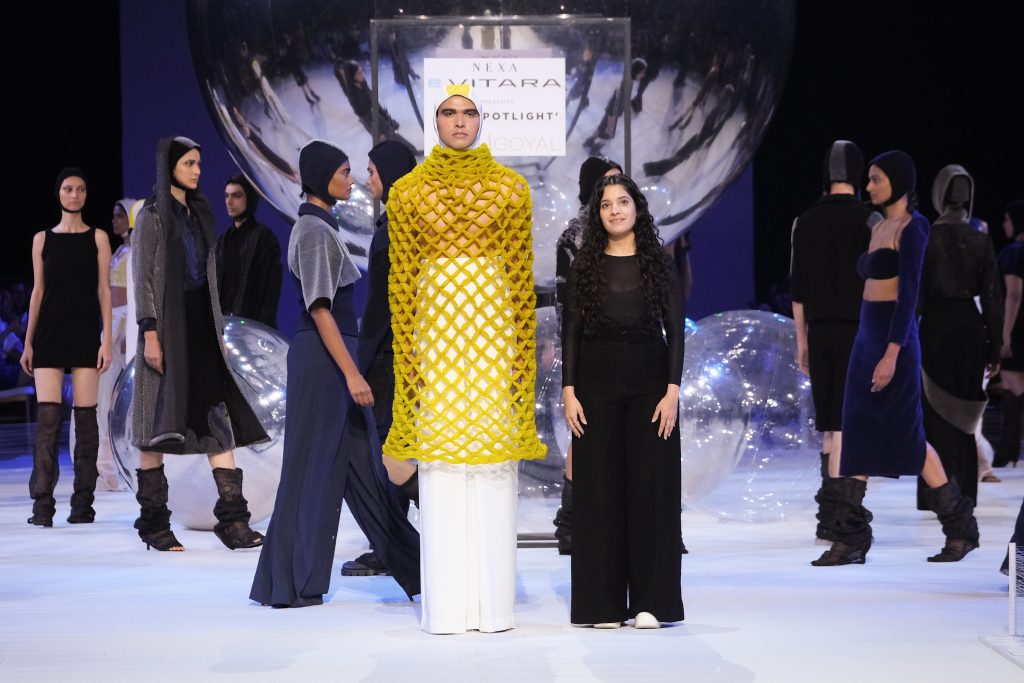
Repair and reuse are Somya Goyal’s mantras, as she works with Bemberg to tackle global warming, intermingling with fabrics created out of waste, converted into cords, in her line “Pivot”. By Asmitaa Aggarwal Her father has been running a successful label Rich Look for the last 30 years in Delhi, but Somya Goyal, the Nexa Spotlight designer at LFW X FDCI knew she wanted to do her own thing. After studying fashion design at Pearl Academy, in 2019 she took the leap of faith, launched her label. “Since childhood I have seen my father create menswear, I developed a love for textiles, early on, playing with transparent cords, wanting to make things that are not worn by everybody in the same room—breaking similar-ness,” says Somya, 30. Hoping to offer uniqueness, clothes with personality, material explorations, unconventionality, 3 D textures, playfulness, these were her templates. “There are two types of clothing—classic, and statement pieces, which are edgy,” she adds. She begins with a texture, then adds hand embroidery, maybe she learnt this and more at her internship with Bodice by Ruchika Sachdeva, and a few short-term courses from Central Saint Martins. “I understood the business aspects from my father—production to marketing, how he used to communicate with clients, maintain a relationship, he taught me well,” she smiles adding, her first show was in GenNext 2022 at LFW. Her USP remains repurposed transparent cords, made from surplus leftover fabrics, crafting new textures, as she stuck to classics—charcoals, electric blues, ombré and mori greens giving each look a Star Trek look, a kind of “transport me back to the mothership” with the set resembling a futuristic stage. She experiments with PVC, metallic wires, horse hair sheets, jute, and cotton cords, using also hemp, bamboo, Bemberg, and crystals sometimes for a constructed jacket. Minor details make a major impact like Raglan sleeves, placement embroidery, Bemberg being sustainable, it has a cooling effect on the wearer tackling humidity well. “Hemp and tencel add wearability and you get a lot of use out of it,” she confirms. The oversized look works well for Somya, as “Pivot” the name of her collection, uses the theme of “Butterfly effect”, one small step leads to a huge transformation—she took that too. “Clients want comfort, after covid that has stayed, plus, we also give repair services,” she concludes.
Bengali Babus
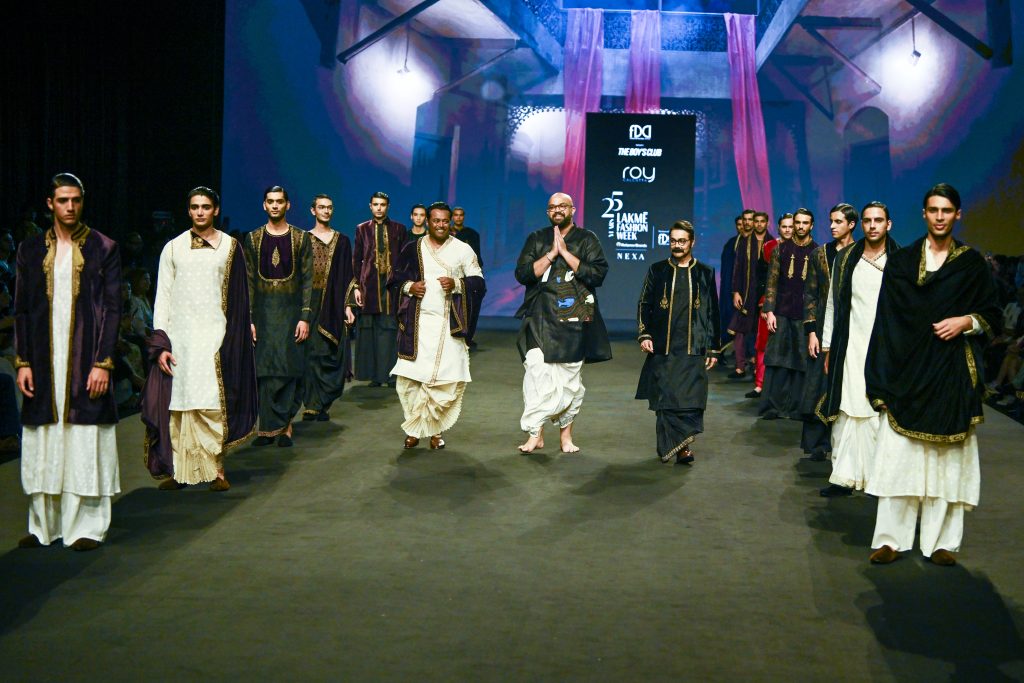
18 century “babu” culture of Bengal dandies gets a fashionable makeover by Abhishek Roy through his smooth velvets and zardozi. By Asmitaa Aggarwal What happens when you grow up in a fulfilling environment away from the craziness of city life in Santiniketan? Well, you have an alternate world view just like Abhishek Roy from Kolkata. Showcasing at the FDCI Menswear show Boys Club, he admits his bachelors and post grad from the historic place, sharpened his mind. Since 2014 he has done costumes for Bangla films like “Bonkesh”, and 2015 launched his label with an inclination towards textiles. For years he has upcycled weaves, specially kanthas, along with Jamdanis, but what’s interesting is his love affair with zardozi. Though he effortlessly amalgamates velvet with Jamdani in his line “Nawabs of Bengal” paying a tribute to Bengal’s rich culture, babus of the 18th century smattered with crafts like “alpona Naksha”. “Santiniketan has multi-cultural diversity, what we learn is not from a syllabus but the sustainable environment. Plus, my grandfather was a professor here and first muralist of India, Shuken Ganguly along with the iconic Nandlal Bose,” he says. What is reflected in his line is what he observed and soaked in as a child growing up in Santiniketan, there was no entertainment, so he began designing outfits for theatre, using paper cutting and moulding techniques to flower ornaments– he loved creating characters through costumes, it interested him. “It was an adrenaline rush doing movies,” he laughs. His FDCI line has shawls, kalidar and side slit kurtas, Sherwanis, bandhgalas, to dhotis something he wears which got him the attention of the Nawab of Pataudi Saif Ali Khan. He loved the pleated pure muslin ones, and soon a relationship developed. “Saif is in touch with his Bengali roots due to his mom Sharmila Tagore. I visited the Musheerabad Museum to understand the zardozi influence on Bengali culture,” says Abhishek. His next is uplifting Kesh weave, where you mix old saris with khadi, adding applique to elevate the look!
Boy from Biskohar
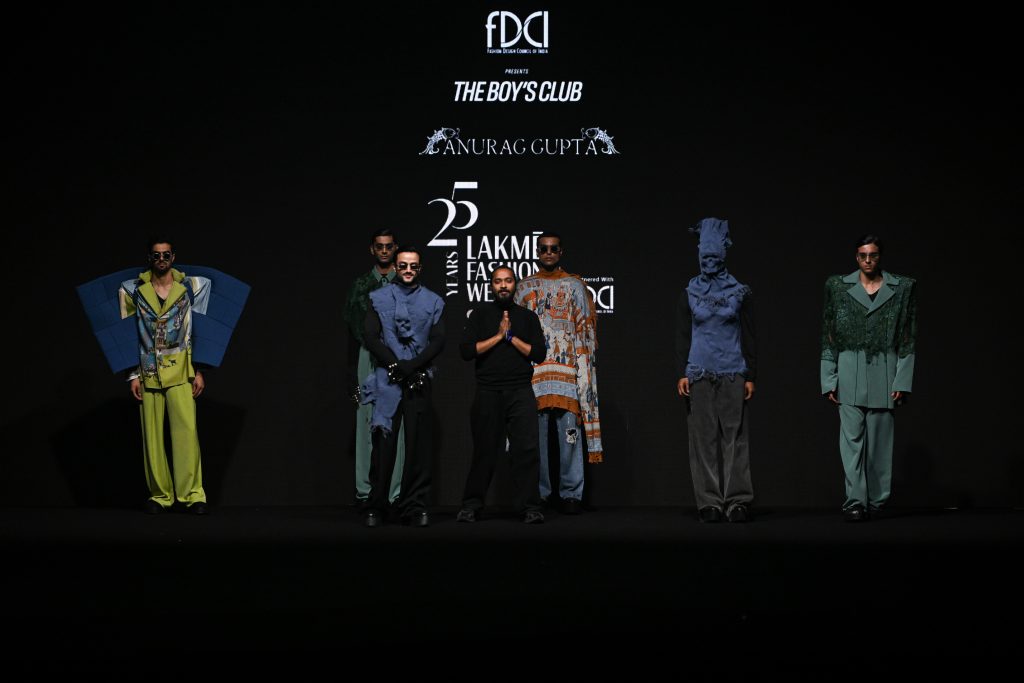
Anurag Gupta’s 3D, jacquard knits and intense screen prints tell us you can do a lot with menswear sans sequins. By Asmitaa Aggarwal Imagine growing up in a village, Biskohar, (Itwa) not so far from Ayodhya, the city of Lord Ram, in a home where forget conversations about fashion, there were not even “pucca” roads, what catapulted him was sheer grit. Anurag Gupta has a lot to be proud of, when he walks the ramp after the FDCI Boys Club menswear show this season at the Lakme Fashion Week 2025. NIIFT (Northern India Institute of Fashion Technology) kind of changed his life, along with a teacher who came to his nondescript school, (near the Nepal border) from Allahabad and taught him not just English but gave him the wings to fly away to the Metro city-Delhi. “I knew I had to leave, the place was too mind constricting, I had big dreams, but no exposure, I didn’t know one word of English so had to learn and unlearn everything as I wasn’t born in privilege,” he says. In 2018, he launched his label, in a glitzy world of fashion knowing that survival here is a challenge- but he did hone his skills- under Varun Bahl and Manish Arora for five years to grasp the business and marketing ethos maybe quirkiness too. “Biskohar had no internet, while I was growing up, but what did help me was that I was curious—even though the only channel was DD and scraps of newspapers from which I got information. My parents ran a medical store, so income was just barely enough,” says Anurag. Fashion for him was an escape, he admired Hrithik Roshan’s dance steps to his sunshine yellow tees, denim jackets in Kaho Na Pyaar Hai, so any hopes of his father to make him an IAS or engineer were incompatible. “I never had that kind of education,” he admits. Anurag admits unlike the swish set he is not inspired by Maldives or Seychelles, rather things he observes around him—sports shoes knitting process, which he converted into necklines, or his intricate screen prints which are laborious but the results are stupendous. “I have developed jacquard knits, deconstructed garments—used from door handles to medical equipment, tyres, tubes to make a line that is also paying homage to 3-D printing,” he admits. Fashion can be daunting-so in 2023, when he read Ambedkar’s book and was inspired to do a collection on “The Failed Promises” (1943) on the exploitation in manual scavenging, how it should be abolished, due to the ignominy, he says many were not interested to write about him. “I am the outsider, and will remain so,” he confesses. Maybe that’s why his line “Metamorphosis” is personal as it encapsulates his story, of how from his “cocoon” he emerged victorious-flew away. Though along the way he has included artists who have inspired him– MC Escher to movements like the Industrial Revolution. “The Dutch artist Maurits C. Escher (1898-1972) had a profound effect on me-specially his ‘mental imagery,’ which gave birth to puzzling architectural mazes and bizarre optical effects,” he concludes.
Khadi adopts new ‘vibe’
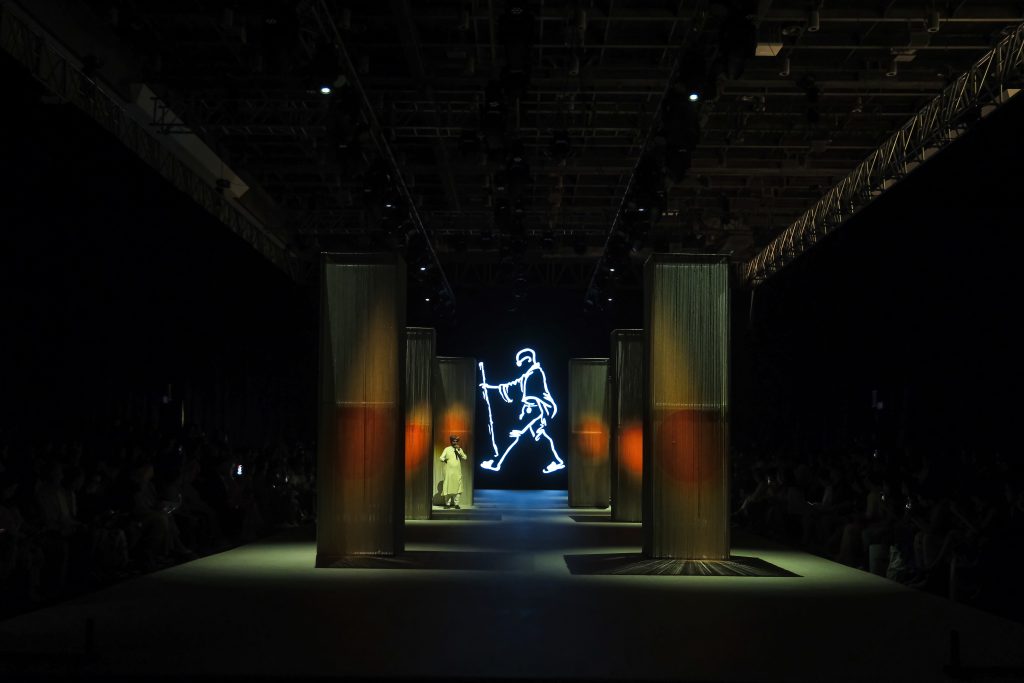
Hoping to wean away GenZ from fast fashion, Co-Ek has launched khadi resort wear-think wrap skirts and summer dresses. By Asmitaa Aggarwal It is always invigorating to observe seismic changes in the way Khadi has been perceived and elevated— leaving its traditional starchiness, adopting a modern nomenclature. This year Co-Ek (Centre for Excellence for Khadi), powered by Khadi and Village Industries Commission (KVIC), crafts dresses instead of saris. It was a concerted move, to serenade GenZ, maybe learning from Moscow Fashion Week, where Nargis Zaidi, head of apparel Co-Ek met khadi lovers, who told her “My grandmother was a Gandhian, I love its imperfections.” The shapes of khadi are now global, jackets skirts, pants, layered magic, inner wear, relaxed fits, also in the process Co-Ek recycles and upcycled katrans, channels circularity while creating statement pieces. “When we sort out fabrics, we do it colour wise, indigos stitched together for example, to offer a discerning palette,” says Nargis. Khadi is a versatile fabric, it may be Swadeshi, but it has international appeal, as she had gone ahead and crafted blazers with it. Since 2021 her efforts have been to start a new narrative, break mindsets and barriers, introduce new colourways (yellow and reds, or charcoals and reds). “We were trying to tell a story—paying homage to little things that often go unnoticed, but impact sustainability, that’s why you see tiny embroidered beetles on resort wear; our line of gamchas, we had the yardage increased while weaving to create wrap skirts,” she adds, hoping this will be an effective alternative to GenZ shopping at Zara and H & M. For the FDCI khadi show, at LFW 2025 she took her experience working with FabIndia and Avaram, forward, by weaving it in Bengal, Gujarat, Punjab to down South, each region bringing along its uniqueness. “We have students from fashion colleges coming to do final projects on khadi which is heartening. A Japanese fashion lover from Tokyo wrote to me on how she was doing her thesis on khadi. Unfortunately, in India, we take it for granted, globally they love the natural textures,” she adds. Hand spun, keeps you cool in summer and warm in winter, organic, a politically powerful fabric, no fabric has this much history!
Clothes with feelings
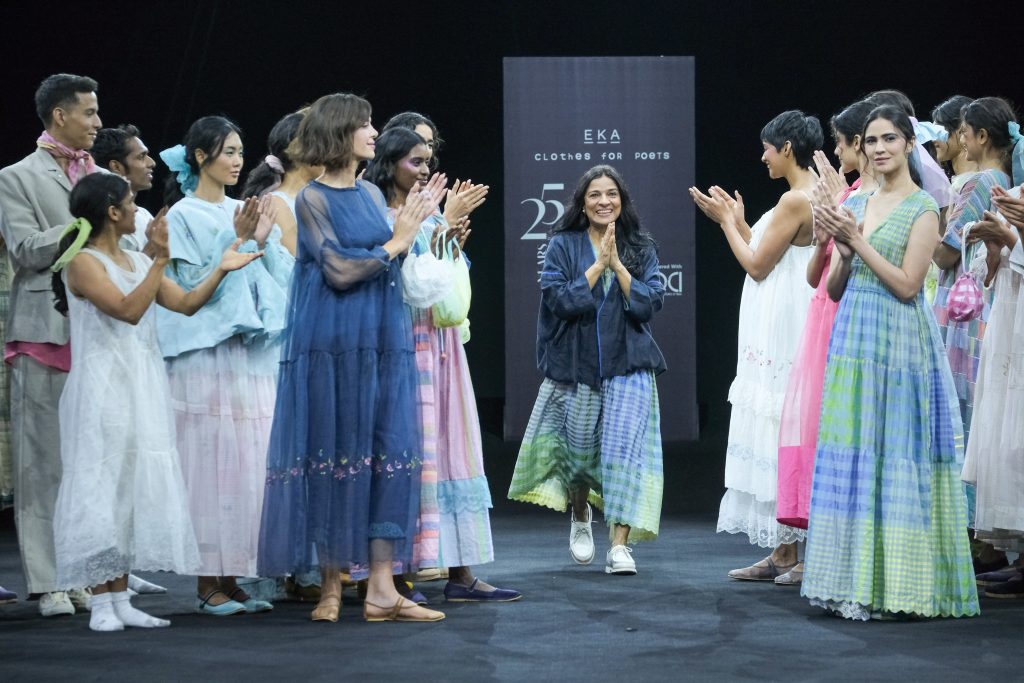
From serenading poets to artists, Rina Singh’s Eka is a case study of craft upliftment. By Asmita Aggarwal If clothes could have feelings Eka would be a right fit! Rina Singh, who built a brand, brick by brick, over 13 years believes it took years of developing product knowledge and working closely with clusters and weavers that helped her finally launch a brand. Unlike Gen Z who know marketing, but learn about product excellence along the way, their skills are so polished that business turns out to be good! “They do it right out of college, I took several years to have the courage and wherewithal to launch my label,” says Rina, adding, “the world of design has changed unequivocally.” Eka and Eka Core are two different ethos—but same mothership, the latter is ready-to-wear, younger, less moody, uses archival textiles and repurposes, so circular in ethos. Rina overdyes it, uses quilting, makes it trans-seasonal as most are leftover fabrics. Eka is known for its love for hand spun and slow, thus the making process is not instant and takes a year of planning. She took a concerted decision to be on the ramp, after a hiatus, to offer woven wonders from Bhagalpur, Banaras, Kota to Bengal, telling a story in Muslin, lace, inspired by Amer, Jaipur with its imposing mirror mosaics, for LFW this year, but she has interpreted it differently—appliqué to tiny embroidered motifs. The idea was to have movement in clothing, like choreography, how clothes adapt to the body and its wearer; as the DNA of the label remains the same every year, but the inspirations are rooted in craft upliftment. You may have boxy trousers, laces only show shifts in moods, things you can wear from Kutch to Tokyo, as it remains feminine, layered, and translucent—this time it’s silks, gossamer and diaphanous. “Sandeep my husband, is a pillar of support—he manages operations, so I am free to design, it takes a huge load off me, in the last decade, he has been a backbone. But I have learnt marketing needs to be loud, brands must have their own voice, and over the years I have learnt not to be rigid about my product,” she adds. Kurukshetra where she was born to agriculturalists, made a deep impact on her psyche growing up, she valued crafts and the “thinking before doing” process of clothing, where you deliberate rather than buy –it is laborious, time consuming, and expensive, but it is also timeless and hand spun, the beauty is unmatched. “I come from a Rajput family where traditionally women invest in weaves, pearls and Kashida, as well as vintage shawls, they understand aesthetics,” she says. Working with the European markets, especially Japan, Rina believes the real jewel in the crown in India is ready to wear, yet we are focussed on weddings, a money churner. “I know the Indian woman likes to be comfortable, yet classy, so why not give her craft-soaked offerings with hints of colour?” she concludes.
Residual Memories
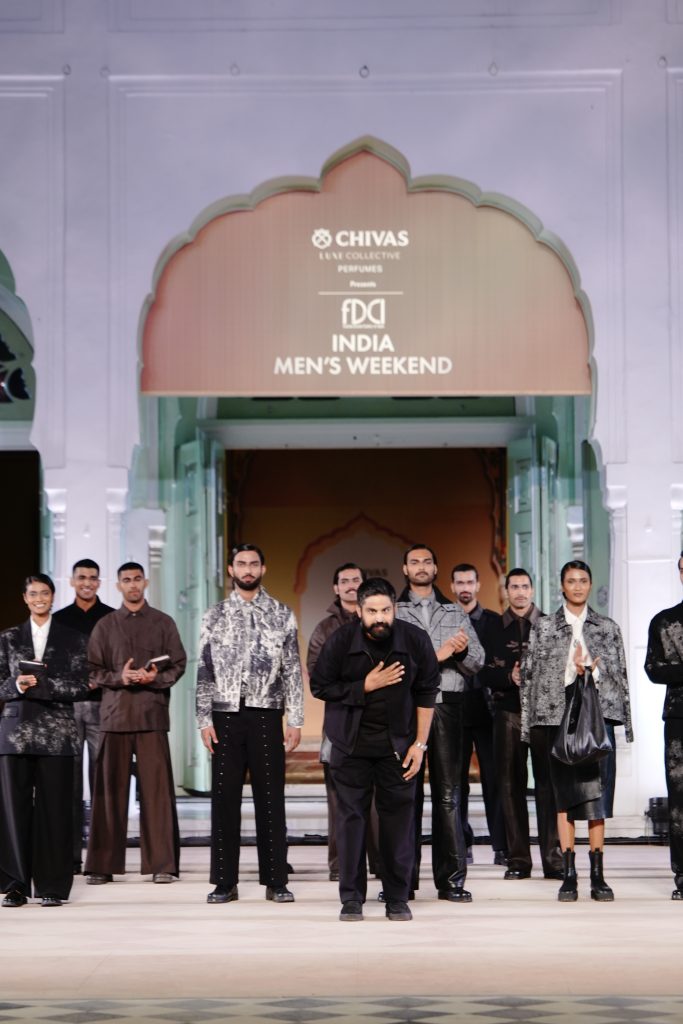
Sushant Abrol, inspired by the ideology of “what is left behind” pays homage to his late brother Samir, through molten metallics, abstract kantha and silver coated denim. Asmita Aggarwal Five years ago, when Sushant Abrol’s brother Squadron Leader Samir Abrol’s brother, died in a crash, he went to the crash site, and noticed boundaries were put in place. It was an emotional time, with his mother, who had lost a young son, the tarmac had ripped, he saw shiny metal pieces strewn across, and one such was right next to his shoes. He quietly picked it up, put it in his pocket, it had a screw left in it, a molten piece of burnt aircraft. He thought to himself this is what gets left behind of a once mighty plane, thus the name of his men’s wear line for Chivas X FDCI “Residual”. “When I looked closely, I saw how deformed metal has become, almost charred,” says Sushant of the label Countrymade. Only three hues – black, silver and grey form the basis of his line, the patterns come from them — cotton, leather coated, metallics, along with hand tucking to add a third dimension mirroring the look of how metal burns and kind of turns inwards or folds. He has added many effects— burnt, tears and charred look, as well as denim and frays, as well as hand done applique. Such is the attention to detail, if you look closely the buttons resemble broken plane parts. Out of fabric scraps, he has created a camouflage pattern, like residual pieces, to make a ‘whole’. The speciality of the collection is a unique coating on denim — silver, then enzyme wash treatment to erode it – giving a washed out look. Images of metal textures, fuselage look of an aircraft is done with rivets. “We have coated cotton, wet-looking, almost slippery, like leather, even though kantha is our USP we incorporate it every year, we have ‘residual stitches’ which have a different interpretation. No motifs were used, allowed kantha to flow, abstract shapes, in any direction it wanted—unpredictable,” says Sushant. Molten lines which have been moved or disturbed, sunset images reflecting faded memories, embroidered denims give us a sneak peek into how he wanted to recreate a scene that has been stuck in the recesses of his memory. The consumer must know what he is wearing, where is it coming from, what’s the story behind it? Not too loud, or restrained but commercially viable clothing, after all, he runs a business. “I do seasonal lines, and just returned from a Paris trade show, where I discovered they like cuts to be away from the body, but in India we still like a fitter appeal-diametrically opposite,” he concludes.