
Insta helps boost revenue, says Nikhil Mehra
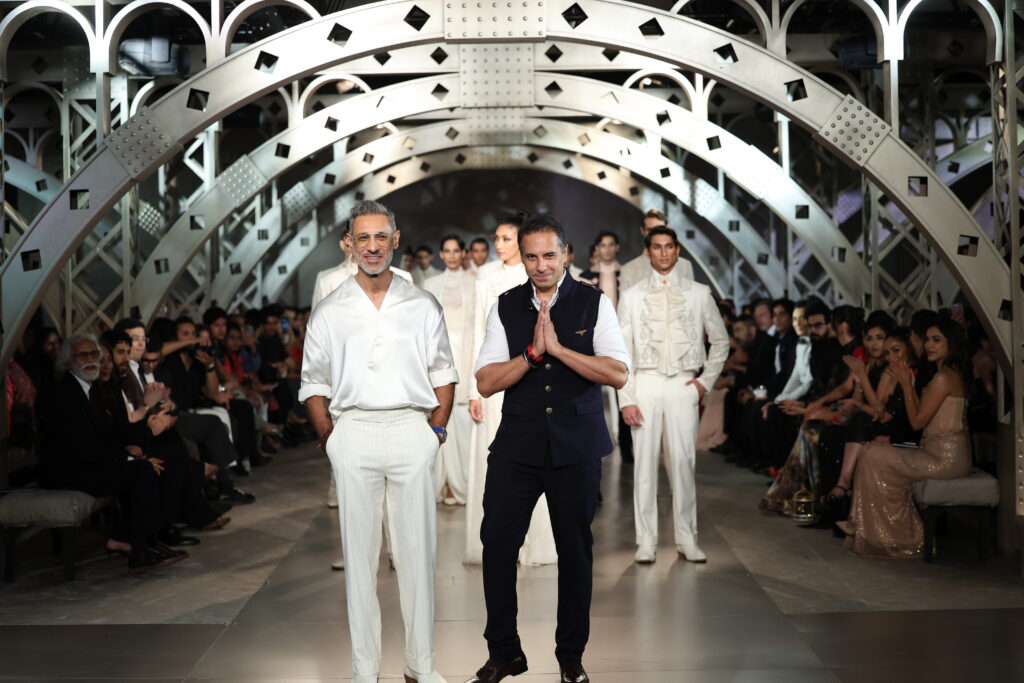
Gender fluid Shiva-Shakti has been a leitmotif for Nikhil Mehra as the younger brother in the duo Shantanu-Nikhil confirms menswear is where the real game is now! By Asmitaa Aggaarwal For 25 years now Nikhil Mehra, the younger sibling of the duo Shantnu and Nikhil has been on a trek, in the world of fashion, he calls it a journey of “self-exploration”. The focus has been on transforming men’s silhouettes, moving away from the idea that a man is simply a “caretaker’. “There is a sense of poetic femininity, where drapes are the mainstay. Women in S and N couture are portrayed as strong independent brides, rather than coy, not romantic so in some ways it has been a role reversal of sorts. “If you look at the history of couture it was considered the holy grail, unapproachable. Now for the last few years it is moving away from ostentation, display of wealth, with a lot more focus on experimentation,” says Nikhil. Maybe that’s why the obsession with red has dimmed, societal norms have been broken, brands are looking at watered down versions of couture—Anamika with AK-Ok and Tarun Tahiliani with OTT. “Less is more for us, we try to tell a story through minimalism, like our hand-crafted brooches, there may be a lack of abundance, but there is a definitive respect for crafts,” says Mehra. Though he questions, “just because it is $4000, should we say we have put 4,000-man hours making it? We don’t think like that? He works with sporty elements, as games is what keeps him going personally too, here too there is innovation—yarns are developed, mostly breathable knitted fabrics, wool blends. “Accessorizing has been a fun thing, so we channel military regalia, kamarband on shirts/sherwanis, merging two different worlds,” he adds. Nikhil admits post-colonization, we embraced colours vibrantly, as well as prints and refused to be cowed down by a Western aesthetic of black and greys. “Fantasy in fashion is before you are 22 years old, after running a business, you grow up really fast. The theme of Shiva Shakti, gender fluid has been constant in our lines, even as our brides have abandoned dupatta and decided to wear a lehenga with structured jackets, that she can wear with drainpipe pants later for a girl’s night out,” he smiles. Men have been neglected in fashion, he believes, so the brand took cognizance of it, “men are no longer a mere plus one, they have an identity of their own”. Pre-covid couture was only wedding wear, now it is about celebrating every moment, not just a D-day, anniversary, a personal milestone et al. “Paris Fashion week, celebs walked for Balenciaga, among others, so the showstopper is an important aspect, good for business. FB and insta generate revenue for us. People want to see what their icons are wearing,” he adds. His fav hues—dark navy and cherry, mix in this is deep emerald, slate greys and rubies. That’s why his line for ICW 2025 titled “Metropolis” serenades a global man, who takes his cultural identity with him. “We went to Moscow, St Petersburg, and Pitti Uomo, to Sardinia, a man now is unapologetically well dressed, he enjoys the process. That’s why menswear is more potent now than ever before,” he says. Vivan Mehra, his son, is now gearing up for Emerson college Boston, in filmmaking and acting, so like all doting fathers, Nikhil believes he gets this talent from his mom, Vidushi, a theatre actress. “I knew he was not going to study accounting or engineering, rather performing arts was calling. It was a toss up between football and acting, the latter won. In fact Karan Johar told him to watch a lot of Japanese films, watch finer nuances like lighting to understand 70 MM world,” he concludes.
Barefoot doc of craft: Ritu Kumar
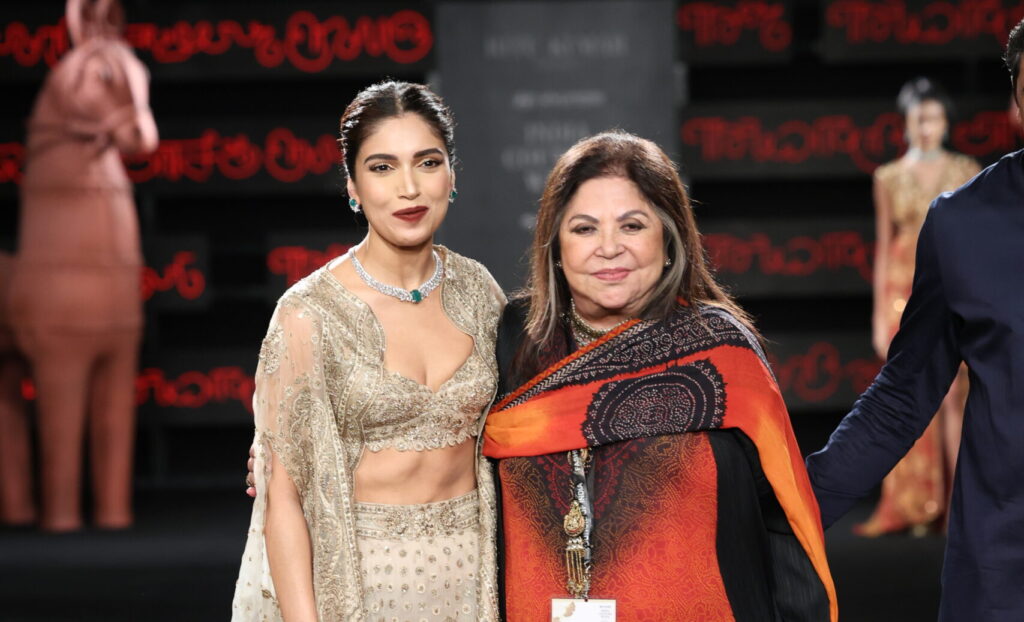
No one can tell one bridal outfit from another. No one has time and dedication in this computer age for crafts, laments Ritu Kumar. By Asmitaa Aggaarwal In the 60s she was the first to do the classic ready-to-wear bridal, as traditional woven saris were the norm, now Ritu Kumar sees a huge change, due to the number of options available in couture. “The palette is not structured anymore, Bengal they still wear red Banarasi, but D-Day hues have a new handwriting of pastels, shapes remain conventional, as Gen Z innovates. There is an introduction of beads, sequins, and pearls, we are doing Europe with a mix of India in couture renditions,” says Ritu. When she began in Serampore (Calcutta), there were no books on crafts available, no one knew about the beauty of Machilipatnam to Ajrakh, but zardozi always found glory. “Not a page was written about Indian textiles, now there is huge awareness about crafts; we are one of the few countries who have retained our luxe heritage. I have worked with some outstanding people in this field-textile art historian Jasmeen Dhamija to Laila Tyabji, enriching my journey,” she adds, saying Martand Singh and people like him were the “barefoot doctors of craft—truly academic nourishers.” In the 70s no one knew about India as for 200 years we were ruled by the British, colonised, they took the paisley and machine printed it on fabrics, sold it back to us, she explains. But true to her craft Ritu took the hand block print to the prestigious Pret-a-porter show in the 70s France, filling the vacuum which she has detailed in her book Costumes and Textiles of Royal India. She is ready for her new book, just finished editing, on contemporary India her journey from the 60s to now. “Our hand block print saris did so well that soon Surat and Banaras started abandoning polka dots and doing hand block prints,” she smiles, adding sequins never permeated into her aesthetic. Interestingly she says, everything in bridal looks the same, can’t tell from the other, made in Farrukhabad or Bengal no one knows, which needs to change. Fashion, she says, must make a social impact, as we have an ingenious handwriting, it is alive on the ramp not in museums like other countries, it is being worn from Lajpat Nagar to Dilli Haat as well as couture week catwalks. “India is an engaging phenomenon, but what I would love to do most is revive the Kani shawl which no one has been able to as it is such a complex weave, like Chintz, my perennial favourite,” she admits. It is so special that it can never be copied! In this computer world, she says no one has the patience for crafts, to understand its nuances, sit and learn. “I am a painter but I don’t know the vegetable dyes used to make paintings—I am just a catalyst, artisans are the showstoppers,” she says. Rinku aka Sharmila Tagore whom Ritu knows since her Calcutta days wore the Begum of Bhopal’s joda, for her wedding to Pataudi wanted Kareena to do the same. Ritu took on the task, 5 months, contacting Mughal emperor Wajid Ali Shah’s old karigars, from Metiabruz (Calcutta) to repair the 300-year-old gold sequins one by one, and get the gold zari woven again that had got torn off. “It was worth the time, and dedication,” she signs off.
Kadwa Banarasi to Alessandra Ambrosio
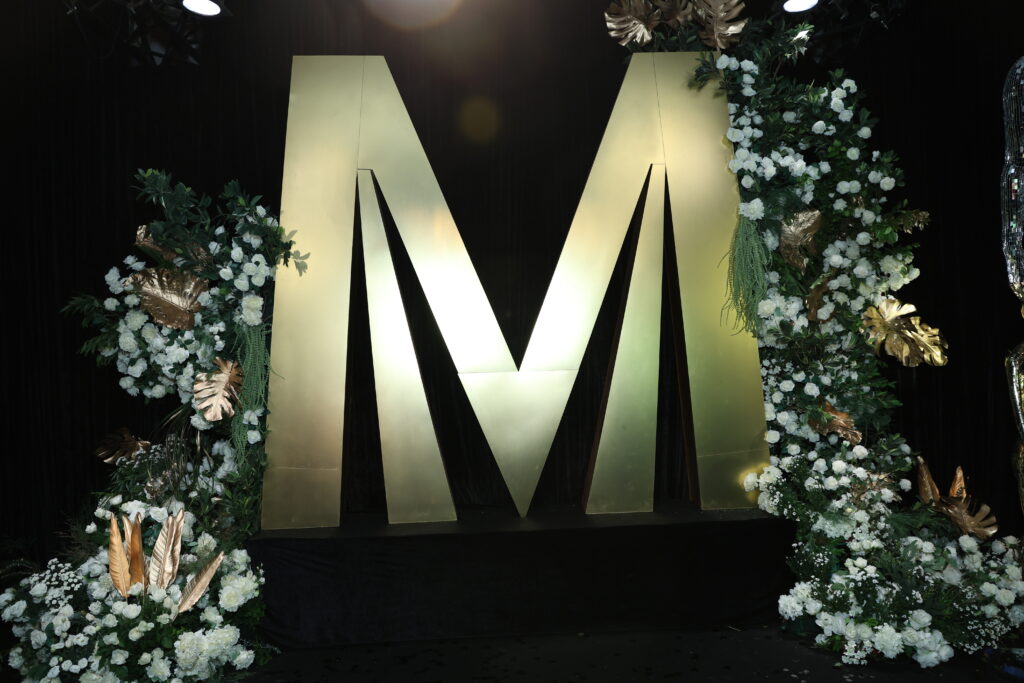
Crafts have a beautiful narrative—thus, Manish Malhotra can straddle two worlds effortlessly-the glam of Victoria’s Secret, Bebo as Poo, to the craft-soaked Phulkari. By Asmitaa Aggaarwal There is no doubt that Bollywood loves Manish Malhotra and maybe the sentiment is returned in full fervour –so after five years when he returned to India Couture Week 2025, he decided to change the format and not do a typical sit-down show with models in heavily embellished lehengas. A golden sequinned eagle stood watching us all in the corner, with a delicious spread in the middle, free seating, live music, and a studded galaxy of his A list star friends. The surprise was Victoria’s Secret Brazilian model Alessandra Ambrosio, in a pearl-embellished lehenga, as Tamanna and Fatima Sana Sheikh were in attendance, but the installations that caught everyone’s eye or should have were his experiments with Phulkari-titled “Living legend in thread”. “I love this embroidery from Punjab. It is also rooted by my culture, I’ve seen so many in my family wearing this, it is special to me, passed down to the next generation as an heirloom,” says Manish. Bollywood had become an intrinsic part of mainstream fashion with the takeover of the visual media, case in point Insta. Gen Z identifies with the DDLJ movie which is considered iconic for more reasons than one. In 1995, emerald green was not a colour that was acceptable for top actresses who were swathed in pinks and flaming red chiffons, but Manish took the leap of faith, added zari and pleats, and got Kajol, a.k.a Simran to dance, making generations fall in love with this romantic story by Aditya Chopra. He admits “Mehndi laga ke rakhana” still rings true in many weddings even now. And no one can forget Kareena Kapoor irreverence in “Kabhi Khushi Kabhi Gham” as “Poo”, or her moves in “Bole choodiyan” year 2000, where cropped asymmetrical blouse with sharara can still be pulled off in circa 2025. Though crafts play a huge role in the DNA of Indian fashion—the Kadwa Banarasi sari that Aishwarya Rai wore to Cannes many moons ago, woven by artisans in Varanasi took almost six months to make, truly celebrates India in its spirit. “Each motif is woven separately, intricate detailing, skilled artisans can only execute this, no loose ends at the back, these are heirloom pieces. For me Ash would be a perfect muse for this—as she embodies ageless style,” he concludes.
I’m old school, I respect crafts, not Insta: Tarun
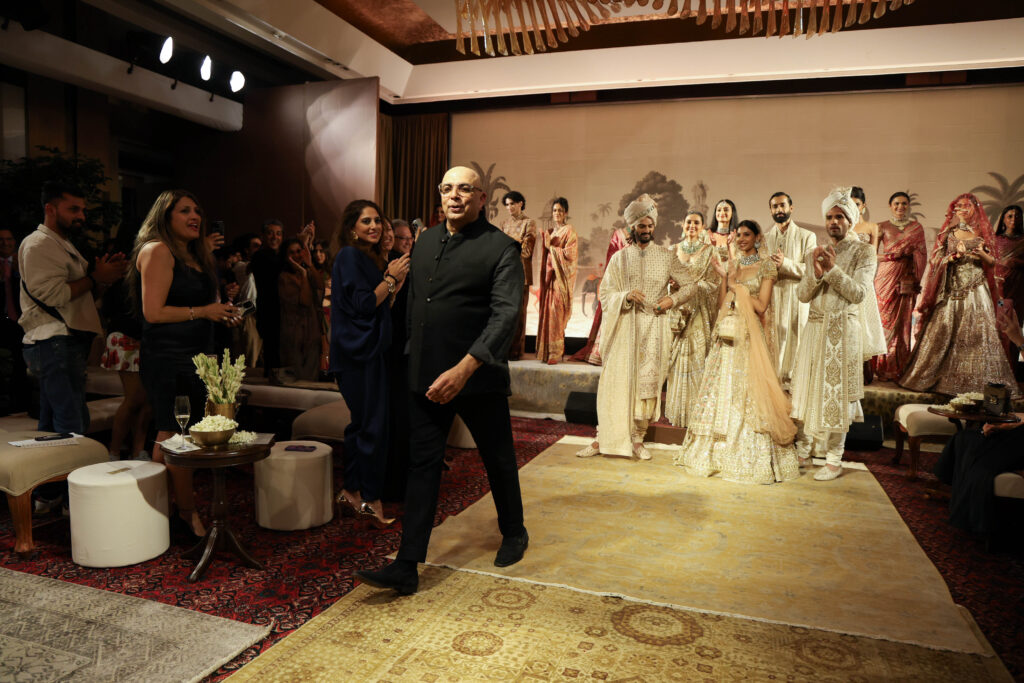
Alisha Chinai, Hindi poetry, lounge setting, and 30 years of drapes, kashida, and grandeur, TT tells us in an exclusive interview, he believes in embellishment not excess, style over trends, luxury that whispers at ICW 2025! By Asmitaa Aggaarwal You could see him personally supervising everything at the Oberoi, his football cap and mike on, “remove extra tulips, straighten the carpet, this doesn’t need to be here” as he geared up to open the luxe doors of the hotel for guests to celebrate 30 years in the business of fashion. Mogras in brass bowls, his sister Tina and wife Shalija for support, lounge setting with sofas and Banarasi brocade throws, model Sapna Kumar, a classic face in the industry for almost 25 years began the show. “TT the brand is all me — and all of the world I see, read, experience, and love. Whether it is architecture, sculpture, temple visits, or a fascination with drapes and how fabric falls on the body — it reflects my eye. But it’s also bigger than me. The brand is a collaboration: between design, craft, history, emotion, and identity. I have always seen clothing as a canvas to bring together intellect, sensuality, and functionality in the context of India- the past and our current modern reality,” he adds, about a line titled “Quintessence”. When you wear a TT you almost wear a bejewelled piece, no need for a diamond necklace, just gold zardozi saris with polkis as headbands are enough. He suggests shades of white, off white to butter coloured this season, light and frothy. “The greatest lesson has been to stay rooted while evolving. To honour our heritage, our crafts, our karigars — but to constantly reinterpret them for the times we live in. What has sustained us is not just design, but a deep commitment to precision, garment construction, and creating clothing that empowers the wearer with lightness, movement, and modernity. That has been our constant — evolution with integrity, says Tarun, as always dressed in black with his bundi and sneakers. The backs of his lehengas and cholis, corset style blouses looked as if a diamond crystal necklace swung as models moved, tousled hair waves, accompanied embroidered saris—aari work, dabka to pearl encrusted pallus. The androgynous dhotis men wore with short sherwanis, can be interchangeable, TT ensures in-built glam. But his ode to kashida and Pichhwai interpreted in an ultra-modern manner was befitting. Fashion has an uneasy relationship with languages, especially Hindi poetry, it was certainly a charming touch with a 30-year-old Alisha Chinai Indi-pop song “Made in India” playing at the crescendo. “Couture today is not just about spectacle — it’s about substance. We design with longevity in mind. For us, couture must move, breathe, and be re-worn. Whether it’s a corset paired with palazzos or a lehenga reimagined as separates, we encourage our brides to invest in pieces that they will cherish not just on their wedding day but long after — styled again, worn with joy. That, to me, is true luxury. However, it must make people dream, push techniques, and retain a sense of fantasy,” says Tarun. India has always loved ornamentation and jewellery— from temple architecture to miniature paintings — but there is a difference between embellishment and excess. “I do not think we need to get over embellishment; we need to refine it. I believe in craftsmanship that enhances, not overwhelms. Embroidery should follow the line of the garment, not drown it. There’s immense power in restraint — that is the evolution we are committed to,” he adds. Tarun believes fashion has changed through storytelling — not in a literal way, but through emotion, technique, and detail. His work often references miniature paintings, Mughal jaalis, and architectural motifs — but distilled in a way that speaks to today. “We often say our brides carry a bit of the past, making light for the present. That is the essence of India Modern. A modern bride does not want to be weighed down — she wants to float, she wants to move — and she wants to wear culture with pride, not burden. It is a visceral process, am not quite clear on how it meshes and fuses and emerges,” he explains. Has Insta made fashion frivolous? “There are both sides. Yes, there’s noise — but there is also access. I’m old school — I believe in deep understanding, in training, in respecting craft,” he says. He acknowledges that social media has opened doors. Imagery is powerful to say the least and people can see our craft and aesthetic from across the world instantly. What’s important is to stay authentic — because trends fade. “Real style endures,” he asserts. There is a growing controversy against Bollywood and showstoppers—”I’ve always said — I’m not against showstoppers; I’m against the idea that the show becomes only about them,” he adds. The real stars of couture are the craft, the clothes, and the karigars who bring them to life. That’s where the focus should be. Cinema and fashion have grown increasingly intertwined. Bollywood has an extraordinary reach, and when it aligns authentically with a brand’s philosophy, it can help amplify the message. But for us, the true showstoppers are — and will always be — the garments. “I’ve even had a bit of fun with the idea. One year, we draped a model entirely in fabric and pinned a sign on her that read ‘I am the showstopper.’ It was tongue-in-cheek, but it made the point. I don’t feel the need to do that anymore. The work speaks for itself,” he laughs. He says he would like to change the idea that couture is only for a moment. “I would like people to see couture as something that can be cherished over a lifetime — not just a fleeting Instagram post or a one-day affair. It should be heirloom-worthy, yes — but it should also be alive, wearable, joyful. Couture must find its way back into wardrobes, not stay locked in trunks,” he says. Each season he
Akshay likes ruffled feathers
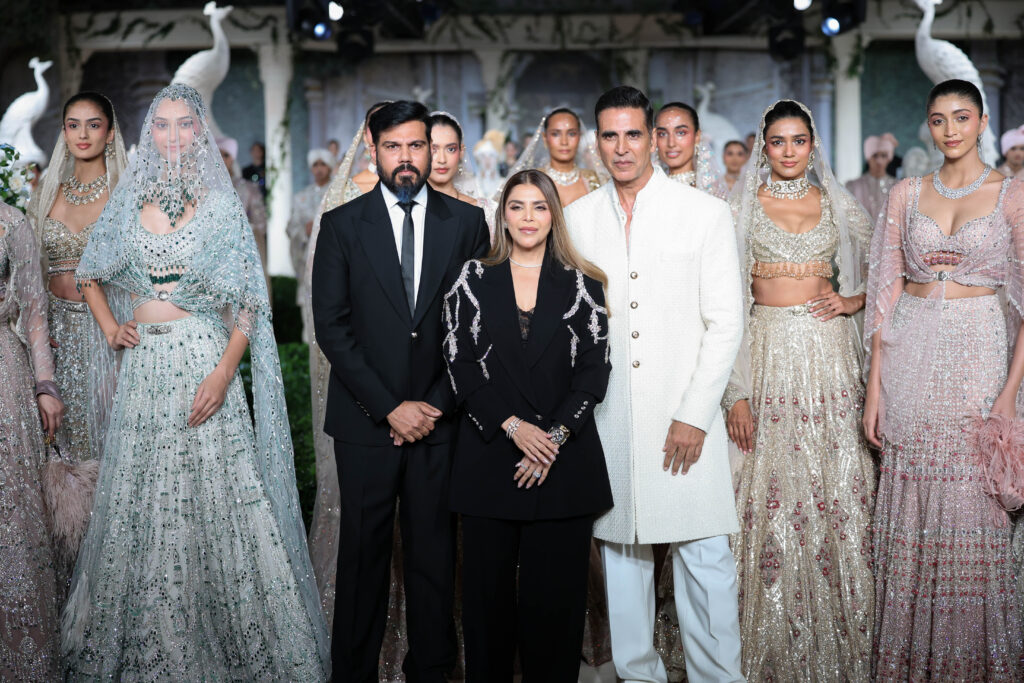
Bollywood superstar, avalanche of sequins, jazz crooner think Nat Cole King, crystal bustiers, Falguni-Shane Peacock made sure, everything glittered at ICW 2025. But you can wear your boyfriend’s denims with a pussy bow blouse and sequinned tunic they informed us! By Asmitaa Aggarwaal Remember a sitar maestro sitting in a lotus last year with the delicious Vicky Kaushal giving us increased heart beats? That’s Falguni and Shane Peacock, this time too for ICW 2025, the imposing set, looked straight out of a garden in Italy, with two giant white peacocks (befitting) in the middle. And of course, in this heady mix was Akshay ‘Khiladi’ Kumar, in dark glasses and all the right moves, thankfully he did not pull off a gravity defying stunt, but did bend down on his knees, giving us a taste of his usual irreverent fun! He spoke in Hindi, and admitted he is ramp walking after years, almost 12, “mini show but lots of hard work goes on behind it,” exclaimed Akshay. FSP had men with diamond danglers, capes in ink blue were larger-than-life; women flaunting faux feather boas, an avalanche of sequins, it was as if everything was crystallised. They skilfully combined their two loves– sequinned women perched on two stone peacocks, zardosi feathers languidly sprawling on lehengas, if you switch off the lights you can see an FSP outfit from afar. It makes us believe too much shine is never enough, in this invasion of an army of glitter were delicate pearl trimmed veils.The favourite undoubtedly was Archana Akhil Kumar in high waisted boyfriend jeans worn with a fully sequinned tunic and white pussy bow blouse which will soon become everyone’s go it-multiplicity of use. In FSP style, the glowing brooch clinched the tunic as models wore multiple mogra braids, the smell wafting through the Taj Palace Hall. “The way FSP presents themselves is purely international, but it’s made in India. I hope I get another chance to do this again, as I feel royal in my white sherwani,” Akshay added. Shane, with hints of blue in his beard, told us he had investigated so many minute details, but the show stopper was the most important one. Live music always has its advantages—and fashion show veteran singer Vasundhara Vee with a booming voice took charge (she has done shows with Ashish Soni, Ravi Bajaj, FDCI, Sabyasachi). Vee crooned jazz as La Vie En Rose (Edith Piaf), Dream a little dream of me (Doris Day), At Last (Etta James), A Thousand Years (Christina Perri), and L-O-V-E (Nat King Cole) made sure the hints of woven saris got a fleeting representation in an otherwise tornado of embellishments. Singing for the last 30 years the Assamese artist, studied at LSR, English (hons), grandchild of Pramathesh Chandra actor, director, and screenwriter of the 50s, who made the original “Devdas”. “Arts were a part of my family, Pratima Barua Pandey an Indian folk singer from the royal family of Gauripur, Western Assam’s Dhubri district, was my grandma. I think I inherited the love for tunes from her,” she smiles. Though when you sing love on tracks there are challenges versus when you are with a band, where you can tune and keep up the flow. “Pace of models changes, so you must make sure you are in tandem. I enjoy how fashion interacts with music, even though I have always been self-conscious, I did enjoy wearing the FSP shrug,” she concludes.
Little birdie told me…
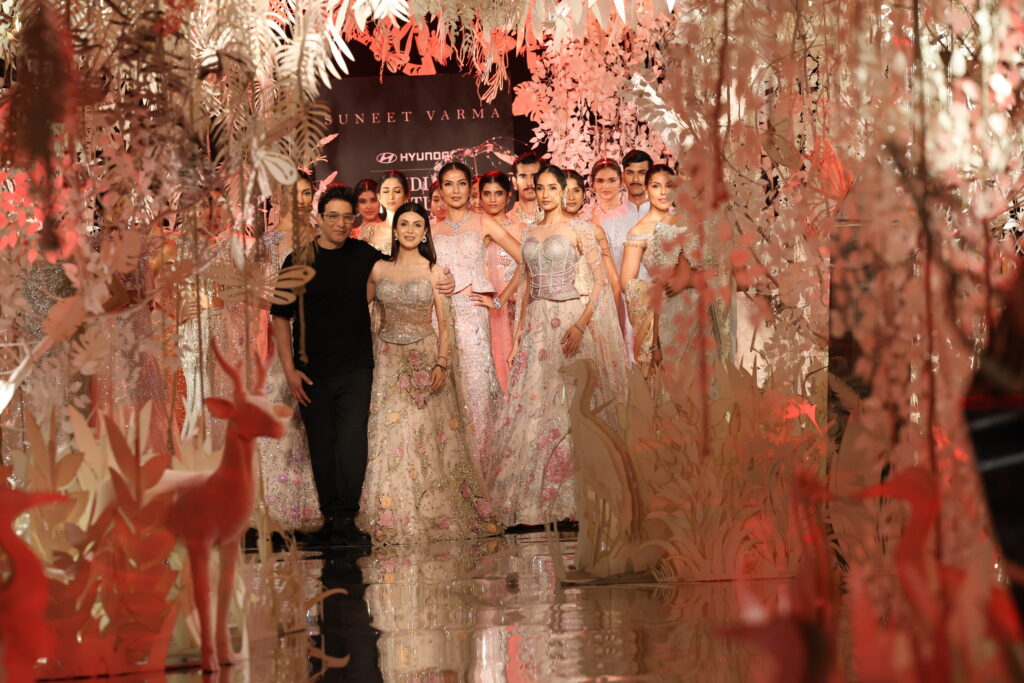
Swans as headdresses, garnets, and pearl wraps instead of cholis and of course the iconic ‘mover and shaker’ Helen on Monica Oh My darling, made Suneet accentuate all his first loves at ICW 2025. By Asmitaa Aggaarwal For many years one has noticed “dancing designers” the one famous for his enviable moves, Rohit Bal dressed in Jodhpurs and a crisp bandhgala has passed onto the next world leaving behind a mammoth legacy, but Suneet Varma is carrying forward that baton at ICW 2025 with his line “Sehr”. Of course, in his inimitable style— on Jaane Jaan dhoondta phir raha with Bebo’s moustached father Randhir Kapoor and bouffant Jaya Bachchan in the 70s hit Jiwani Diwani. Somehow red is taking a backstage in couture making way for white the “it” colour for the season–sometimes no colour is the best colour. Suneet’s ramp is always reflective, of shine, he is never apologetic about it– pristine white lilies, swans and white palms with sparkling lights took a bow. When you are around as long as Suneet, with ocean like experience – legendary Yves Saint Laurent to Judith Leiber, BMW, interiors, you know what works in a market that can’t get enough embellishment. Indians by DNA are celebratory, it is an inherent part of our cultural ethos. His love for old classic Bollywood songs is apparent, little birds were flying on headdresses, complemented with sequined gowns accentuating every curve of the body—visualise black, gold, boas, faux feathers. The dupatta hangs on nimble shoulders, though by its own willpower, it has got thinner, bulk reduced—just like brides don’t want anything that restricts their movement. Remember Samantha Jones in Sex and the City, played by Kim Cattrall with her unwavering loyalty to beaded bustiers, dripping flirtatiousness and bold pink flowers? Suneet kind of had that spirit of exuberance and nonchalance. Interestingly, shararas with zardosi on the notes of Monica… oh my darling took us back to Helen’s winged eyeliner, midnight blue eyeshadow and tiered ruffled dress, Suneet gave it a modern interpretation with gotta-patti style choga kurtas. Pearl wraps instead of cholis, exaggerated sleeves, gold has always had a hold on occasion wear, everyone’s favourite polkis and jadaus were crafted into a blouse, as if you are wearing a necklace around your bosom with pearls dancing on your back. Star daughter Riddhima Kapoor Sahni seemed comfortable on the catwalk, she exclaimed, “18 years ago I made my debut with Suneet, I’m here again now.” She also twirled for us, as Suneet clarified, “I live in my dream world –set, music presentation is part of who I am, obsessed with romantic music. Tried hard to change it to English sonatas but I can’t do it. This feels natural to me. Fashion is all I know how to do. I like to excel but in a non-competitive way. Thus, there is always debate on if this embroidered rose needs more crystals or whether sequins need better placement,” confesses Suneet. This season- isn’t about reds and rani pinks but lilacs, greys, and obsidian blacks, the shararas is the queen of silhouettes now, tighter, flared, Suneet took it a notch up with semi-precious garnets!
After 25 years “waste is gold”
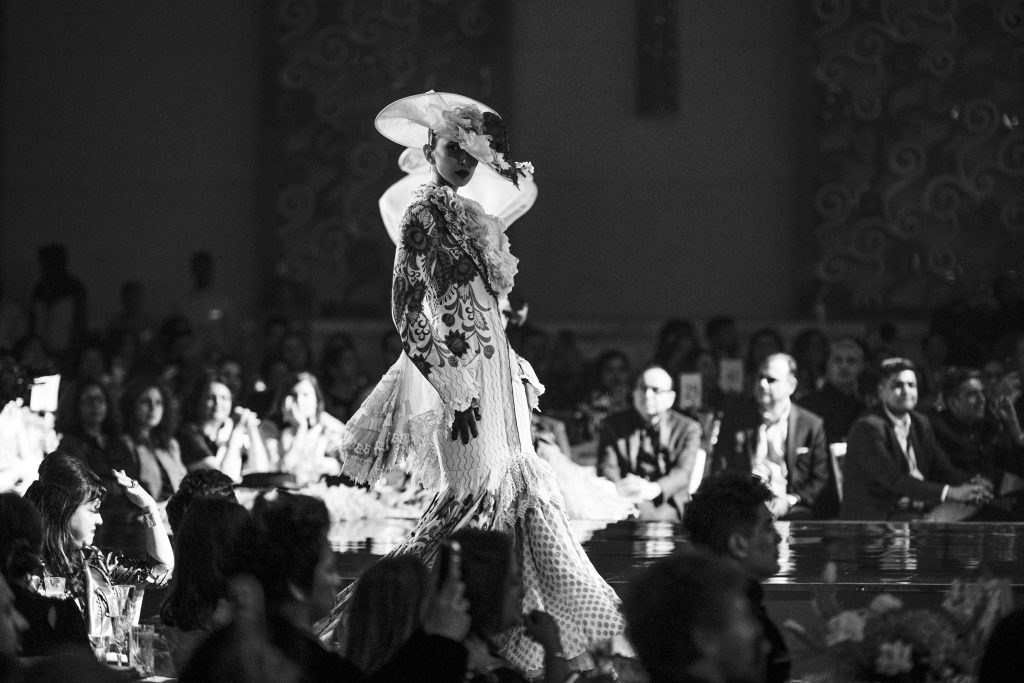
As fashion celebrates its silver jubilee, what is clear now is —sustainability is the only way to go forward, and designers have already taken the lead! By Asmitaa Aggarwal It was a reunion of sorts, designers came in droves, some who had not been seen for over 20 years—Anshu Arora of The Small Shop to Raghavendra Rathore, Ritu Beri, Monisha Jaising, Nikki Mahajan, once doyens of their field, today reticent. FDCI X LFW got them together—after all it was the time of celebrations—25 years of the fashion world! The Jio Convention Centre, Mumbai was where almost 300 people congregated—the most known faces, who have uplifted the barometer of design, innovation, and ingenuity—made a heady blueprint to go forward. Almost 33 designers recreated archival ensembles from 2000 onwards, with 60 models (Lisa Hayden to Lisa Ray), the biggest pool, with Indian-American actor Kal Penn as the host (Van Wilder, The Namesake, TV series House), who not only laughed at himself, but also asked an interesting question to Bollywood dreamboat Kareena Kapoor. “What do you think of fashion critics?” She candidly replied, “They are as important as film critics—they should keep designers on their toes.” Manish Malhotra when asked about his jewels glimmering on his sherwani admitted it was a “hard sell” and someone rightly said, “All this madness is therapeutic I would have it any other way.” Kareena confessed, “make and hair stylists the real stars as they make us look amazing. My darling brother Manish is here. Maybe I will come again on the catwalk not as size zero but owning my body completely”. For 25 seasons she walked as show stopper, once pregnant with her son Taimur, “most emotional moment for me, though my only hope is I don’t fall on the ramp, even if I do, I can get up with dignity. I also suck my tummy in a little,” she laughs. The show had Ritu Beri (2006), Tarun Tahiliani (2000), Monisha Jaising (2002), Rajesh Pratap Singh (2012), Raw Mango, Anshu Arora (2004), Anamika Khanna (2004), Manish Malhotra (2001) outfits recreated, among others. “As I reflect on the 25th year of Lakmé Fashion Week, I am reminded of the incredible journey fashion has taken in India. I had the privilege of opening the very first Lakmé Fashion Week in Delhi in 2000. Looking back, it’s nostalgic to see how far fashion has come—from a time when we could barely fill a room to today, where we are overflowing with a passionate audience. Creativity now permeates everything—the way people dress, the way they express themselves, and the way fashion is embraced in everyday life. It is a testament to how the industry has evolved, pushing boundaries and shaping a more vibrant, dynamic fashion landscape,” says Ritu Beri who started in 1990. She was the first one to do a show in Paris, headed a French fashion house Jean Louis Scherrer, and in 2010 won the Chevaliere des arts et des Lettres award. Though after 25 years one thing was clear—waste was gold now. Nagpur-based Shruti Sancheti, made hair bands, bags, scrunchies out of katrans, and has managed to get orders for it. There is undoubtedly a stream of attempts to be sustainable –the value of the ensembles made from it was Rs 30,000, says Urvashi Kaur. “We create textiles out of fabric, trying to be zero waste, but the beauty is that we are able to craft one-of-a-kind pieces, the key is to be able to shift consumer behaviour,” says Urvashi. On this it’s kantha, and her undying love for tussars, all hand-woven wonders she works with as the market is showing renewed interest, buyers want to know about their garment and how it is made. There seems to be a good churn happening, fashion weeks are a great platform for designers to express themselves visually. “We lost great design somewhere in the greed to keep selling, opulence and money wanting to show status. But the question is how do you contribute to a community. If your work does not hold meaning that money is not happy money. Young people are facing climate change, we have capitalist exploitative businesses, but we must find a way to keep our beautiful traditions alive,” she adds. Bangalore-based Mani Shankar, believes the customer has also changed, each city has its own nomenclature– “Delhi loves bling, so I make it, I must survive also. But the Rs 30000 fabric manipulation linen kurta sells well too, it is our USP,” he adds. “The last 25 years have been momentous in shaping what we now call the Indian fashion industry. Specifically, the last 10 have seen accelerated growth for many brands due to the various initiatives of the FDCI and the influx of corporatisation. I’m truly hoping the next decade is all about true growth, appreciative of all categories of fashion not limited only to bridal couture. I look forward to this next chapter,” says Ashish Soni. For 17 years he has been in the business of fashion, and Nachiket Barve, believes fashion is evolving with more awareness. He has launched a new line of enzyme washed denims for Rs16000, admits he has understood the market better. “I adapted. Design is a dialogue between the customer and you, you can’t be stuck in time or resist change. I look within. We are going to do more business and growth. India’s biggest strength is craftsmanship and willingness to change which will hold us in good stead,” he adds. Akshat Bansal of the experimental label Bloni, showed how he managed to do bio mimicry of a crocodile skin with Shibori, plus his additions of stainless-steel architectural materials on a tailored jacket. Some places you can also see ghungroos, as he sells the silk organza Japanese weave, with reflective properties for Rs 2,50000 lakhs. It comes with Savile Row tailoring, and a mix of various engaging techniques, custom designed. He is one of the bold, new designers who are taking fashion to the next level—see his silk felt raw fabric, it was waste that weavers
I have a child-like curiosity: Rahul Mishra
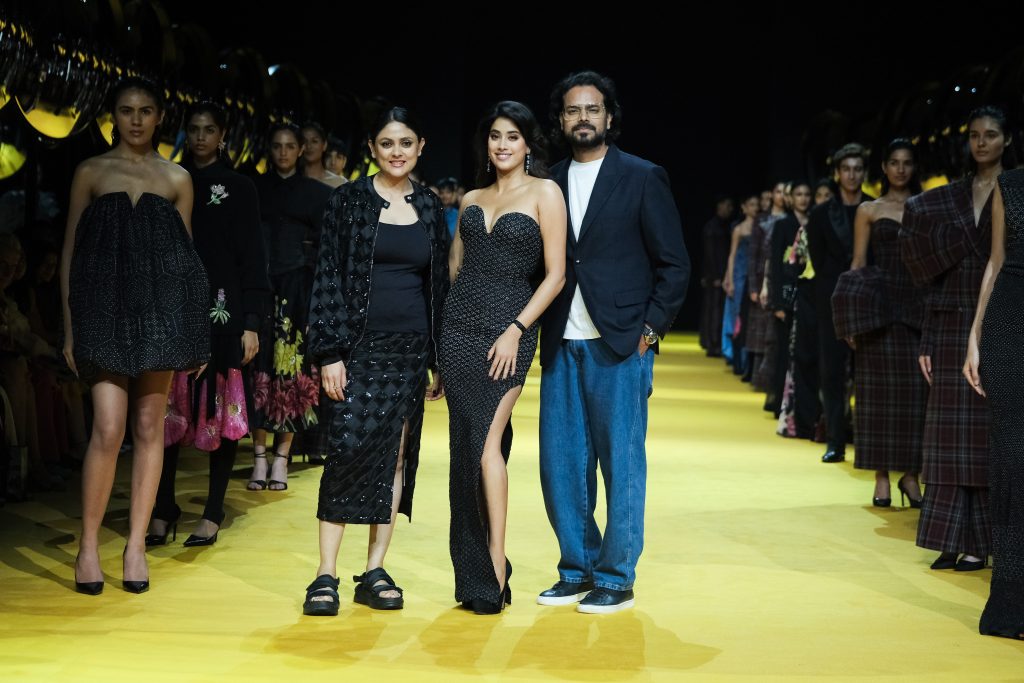
In a freewheeling chat, Rahul Mishra talks about his deep connection with spirituality, Trikaldarshi Brahma, his Paris Couture Week ‘Cityscape’ and ‘Crow’ ensembles, why Bandhani is important as we revisit the present while keeping the “rear-view” mirrors open to pay homage to the past. By Asmitaa Aggarwal He did create a buzz with Gen Z favourite Jahnvi Kapoor getting out of a Nexa, with paparazzi following her, a group of photographers, an event she handles almost every day bravely, they follow her. The set was rear view mirrors, almost 50 of them lined in the show area, as the yesteryear beauty Parveen Bobbi iconic Raat Baki from Namal Halal played in the background. Cutwork jackets, patchwork denims were interesting, some Issey Miyake style, space suit sleeves, and in this mix was Mithun Chakravarthy iconic moves on “Jimmy Jimmy aa ja” and Sanjay Dutt’s rehearsed steps on “Tamma tamma Loke” as the background score. Rahul Mishra and his quiet but impactful wife Divya, presented their line AFEW, at the LFW X FDCI showcasing for the silver jubilee of India Fashion Week, with exaggerated shoulders, big bold flowers, in sequins of course, pants came covered with net. The eye grabbers were exaggerated waists a bit like Comme des Garçons but his interpretation of Bandhani was engaging, in above the knee dresses with exaggerated shoulders, sleeves and bows. The check coats, his continued love affair with flowers, padding and bulges, appliqued hens on jackets, with golden paws, as well as Matrix style black floor length coats explained his love for the unpredictable. “We discovered Henri Rousseau (French post-impressionist painter) work which is on display in this collection as well as the art of Pichwai, but my belief is when you want to create something new you have things which are old like Bandhani. It is like you are driving a fast car, but you have to keep looking at the rear-view mirror to see what you are leaving behind. Crafts become the idea and you create a new version of it,” he says. He took many cultural references from the Silk Route, the products are deeply rooted in traditional craftsmanship. AFEW used painterly old motifs which were found when the Silk Route started, then thrived. “Silk route was an exchange of art, culture and motifs; it was not just about trade. This collection looks at various ideas whether it is from Japan or the Kutch region,” says Rahul. So you have Tanchoi or what Rousseau has done, but in the collection, there is a simplification of all those ideas, few find their own relevance. “Something which is easy, but beautiful,” he explains, adding, “My mind I feel kind of works way too much in multiple directions. Stargazing late at night using my amazing telescope which is the most scientific portable telescope available. I keep wondering about life and cosmos, I also read the Gita, try to connect wit myself. I observe insects–amazing creatures. My mind is never quiet, I am always thinking, maybe I need meditation. I feel I have more ideas but less time,” he smiles. He admits he is sensitive about his surroundings, especially of news. “It lives rent free in my mind. Divya tells me sometimes thoughtlessness is needed, I am sometimes absent minded also. I’m dreaming and thinking. Thoughts entangle me. Maybe it’s not the best thing, but it is a big fuel for finding new ideas and perspective,” he explains. Fashion is quite personal for Rahul, it is about his fears, experiences, tales, dreams, and it comes as an inspiration, out of an observation. “I share my ideas with the team. The way the human mind works is amazing. I can see the person, who is creating an artwork, how it comes from collective thought and dream into an entire garment. I think trends are the most overused ideas. Humans try to discover patterns in almost everything. If it is constellation and trends are based on human emotions, trends are powerful things, but I don’t care about them. I feel like there can be micro trends. The globe is one–generation on Insta and is savvy with technology. People get influenced very easily with choices,” he confesses. He believes the addiction to social media is so deep, that we are making free choices we feel, but we aren’t. “When you look at today’s world nobody can escape –we are victims to ideas and losing cultural identity as trends are strong,” he adds. The magnificence of his creations for Paris Couture Week, can be seen in the way he has constructed a “Cityscape” ensemble, because how cities are now it’s not about how much time it took, but how big skyscrapers made him feel. “No one can escape trends, it’s impossible. The Crow ensemble is a thought I was living with for a long period of time. It was a trigger point for me. Cityscape, when I look around to see how we have made concrete jungles,” he explains. Crows are scavengers, it became his leitmotif after his father passed away, “you look at everything. You render the bird–it looks realistic and fits into my story telling. These hits and trials take lots of re- improvement–it is not linear, and takes a lot of time. It is an attempt to showcase artistry at its best,” he says. If you look at his Insta page, he tries to add a series of celebrities— from Priyanka Chopra and her daughter’s beautiful moments to singer Shreya Ghoshal whom he “finds amazing. We pay respect to all regions of the world; we fulfil all requests. Whether it is Liza from Thailand for her first performance, Queen Latifa for Grammy, Mindy Kaling, Fan Bing Bing or Poorna Jagannathan. This is not our focus. We are very humbled. All celebs are global — Indian or Chinese,” he adds. Rahul is also a man of collaborations–Tod’s was happening for a long time — it was a right fit. Italian and Indian handmade craftsmanship; it was sold out even after the pricing has gone three times
Butterfly Effect by Somya
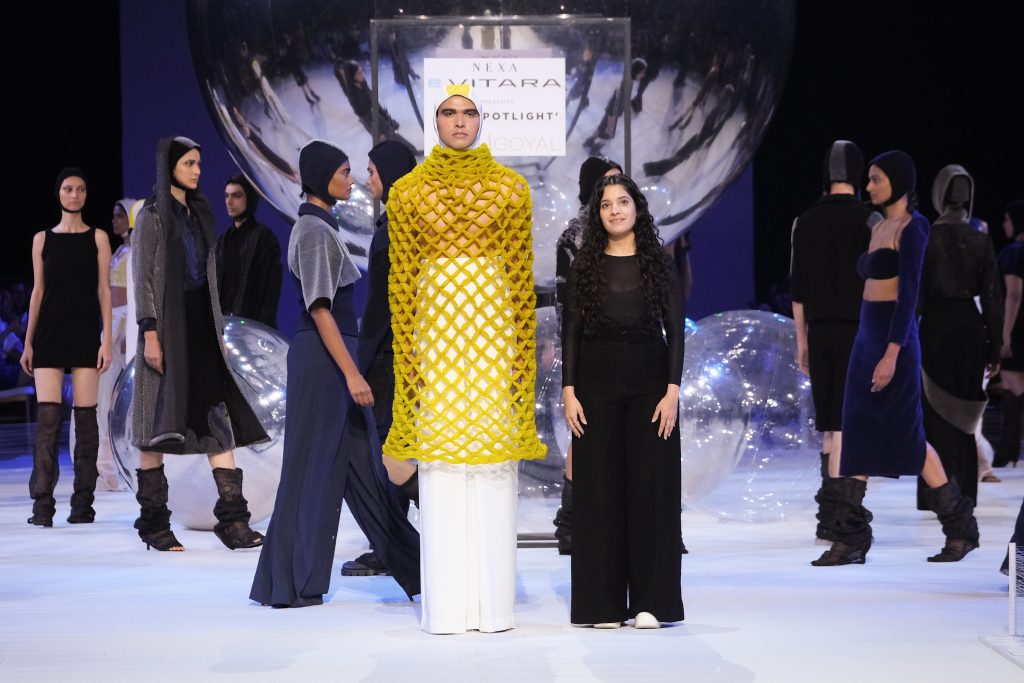
Repair and reuse are Somya Goyal’s mantras, as she works with Bemberg to tackle global warming, intermingling with fabrics created out of waste, converted into cords, in her line “Pivot”. By Asmitaa Aggarwal Her father has been running a successful label Rich Look for the last 30 years in Delhi, but Somya Goyal, the Nexa Spotlight designer at LFW X FDCI knew she wanted to do her own thing. After studying fashion design at Pearl Academy, in 2019 she took the leap of faith, launched her label. “Since childhood I have seen my father create menswear, I developed a love for textiles, early on, playing with transparent cords, wanting to make things that are not worn by everybody in the same room—breaking similar-ness,” says Somya, 30. Hoping to offer uniqueness, clothes with personality, material explorations, unconventionality, 3 D textures, playfulness, these were her templates. “There are two types of clothing—classic, and statement pieces, which are edgy,” she adds. She begins with a texture, then adds hand embroidery, maybe she learnt this and more at her internship with Bodice by Ruchika Sachdeva, and a few short-term courses from Central Saint Martins. “I understood the business aspects from my father—production to marketing, how he used to communicate with clients, maintain a relationship, he taught me well,” she smiles adding, her first show was in GenNext 2022 at LFW. Her USP remains repurposed transparent cords, made from surplus leftover fabrics, crafting new textures, as she stuck to classics—charcoals, electric blues, ombré and mori greens giving each look a Star Trek look, a kind of “transport me back to the mothership” with the set resembling a futuristic stage. She experiments with PVC, metallic wires, horse hair sheets, jute, and cotton cords, using also hemp, bamboo, Bemberg, and crystals sometimes for a constructed jacket. Minor details make a major impact like Raglan sleeves, placement embroidery, Bemberg being sustainable, it has a cooling effect on the wearer tackling humidity well. “Hemp and tencel add wearability and you get a lot of use out of it,” she confirms. The oversized look works well for Somya, as “Pivot” the name of her collection, uses the theme of “Butterfly effect”, one small step leads to a huge transformation—she took that too. “Clients want comfort, after covid that has stayed, plus, we also give repair services,” she concludes.
Bengali Babus
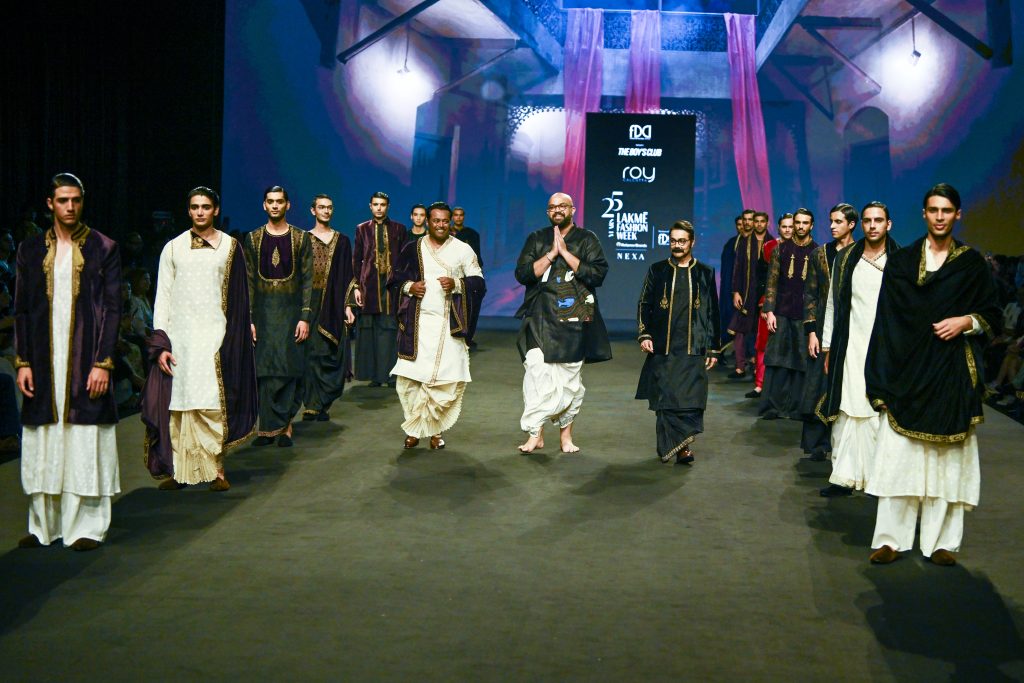
18 century “babu” culture of Bengal dandies gets a fashionable makeover by Abhishek Roy through his smooth velvets and zardozi. By Asmitaa Aggarwal What happens when you grow up in a fulfilling environment away from the craziness of city life in Santiniketan? Well, you have an alternate world view just like Abhishek Roy from Kolkata. Showcasing at the FDCI Menswear show Boys Club, he admits his bachelors and post grad from the historic place, sharpened his mind. Since 2014 he has done costumes for Bangla films like “Bonkesh”, and 2015 launched his label with an inclination towards textiles. For years he has upcycled weaves, specially kanthas, along with Jamdanis, but what’s interesting is his love affair with zardozi. Though he effortlessly amalgamates velvet with Jamdani in his line “Nawabs of Bengal” paying a tribute to Bengal’s rich culture, babus of the 18th century smattered with crafts like “alpona Naksha”. “Santiniketan has multi-cultural diversity, what we learn is not from a syllabus but the sustainable environment. Plus, my grandfather was a professor here and first muralist of India, Shuken Ganguly along with the iconic Nandlal Bose,” he says. What is reflected in his line is what he observed and soaked in as a child growing up in Santiniketan, there was no entertainment, so he began designing outfits for theatre, using paper cutting and moulding techniques to flower ornaments– he loved creating characters through costumes, it interested him. “It was an adrenaline rush doing movies,” he laughs. His FDCI line has shawls, kalidar and side slit kurtas, Sherwanis, bandhgalas, to dhotis something he wears which got him the attention of the Nawab of Pataudi Saif Ali Khan. He loved the pleated pure muslin ones, and soon a relationship developed. “Saif is in touch with his Bengali roots due to his mom Sharmila Tagore. I visited the Musheerabad Museum to understand the zardozi influence on Bengali culture,” says Abhishek. His next is uplifting Kesh weave, where you mix old saris with khadi, adding applique to elevate the look!