
Life comes a ‘Crcle’
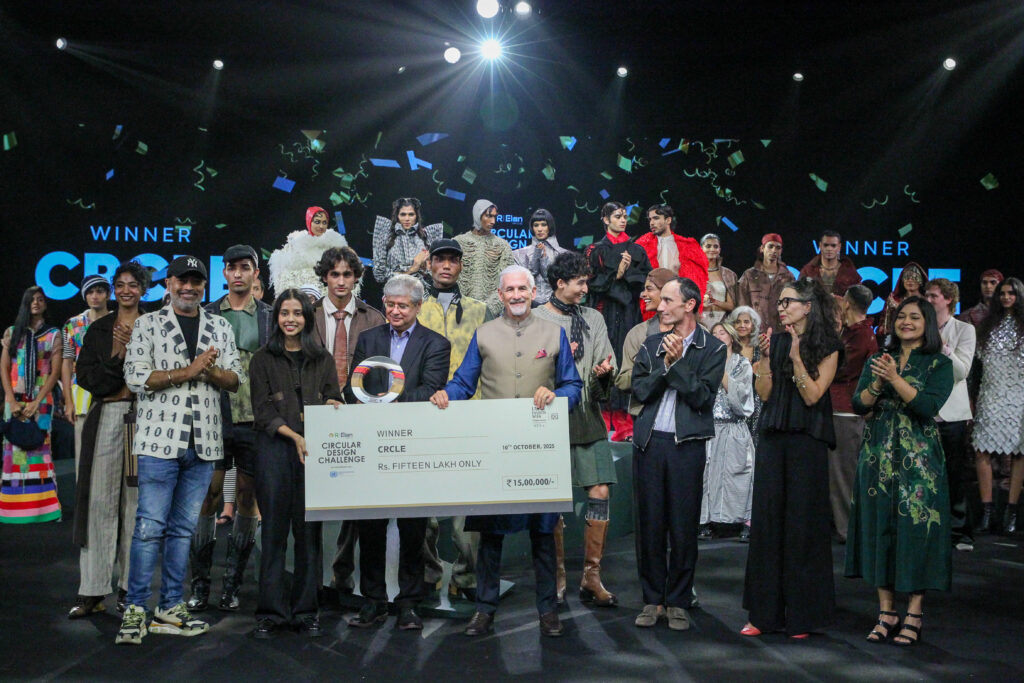
From Veganwool to banana leather, CDC finalist Varshne B is crafting a unique trek to not “save the planet” but give cool alternatives and watch out for her stainless steel bags. By Asmita Aggarwal Varshne B founded Crcle in 2024, born and raised in Chennai, after studying fashion design from NIFT, Chennai, she works with . She admits she loved two things—drawing and dressing up. Though growing up with no internet, only newspapers and few fashion magazines, she knew one day, she will close the proverbial “loop”, thus the moniker Crcle. “In college, I was alarmed at the waste fashion produces, I knew I wanted to do something in this field. Paulo Coelho quote rang in my ears— ‘Planet doesn’t need saving, we do’. It resonated with me and I decided to study design. For me ‘save the planet’ is a sign of human arrogance, we need to look within,” she explains. She began with weganool, 100 p c sustainable, zero-waste woven satin fabric, plant-based and a chemical-free, cruelty-free wool alternative from the Calotropis plant. She also works with banana leather. “Both are innovative and environmentally friendly materials, the latter is extracted from the banana plant, made from the stems and pseudo stems of the banana,” she adds. Way better than traditional animal and synthetic leather, though she also works with indigenous crafts like khadi, hand woven denims, and kala cotton. “We collect discarded materials from factories,” she adds. Like Balenciaga, she also has her version of the stainless-steel bag, refashioned from scraps and leather offcuts, sourced from metal units and leather factories in Chennai. She combines this with crochet, natural dyeing, and embroidery, “I like working with material innovations, converting leather belts into coasters, making a new version of lifestyle products,” she explains, adding, “we create unisex products, using natural dyes.” Mats are hand woven in Tamil Nadu, crochet from women’s groups, plus recycling waste through India Waste Group, where they collect studio waste, discarded pieces, and make something new with it. “Circular Design Challenge has given me this opportunity and I hope I can spread the message that we need to consume consciously,” she concludes.
Meet next supermodels –Sky and Ava
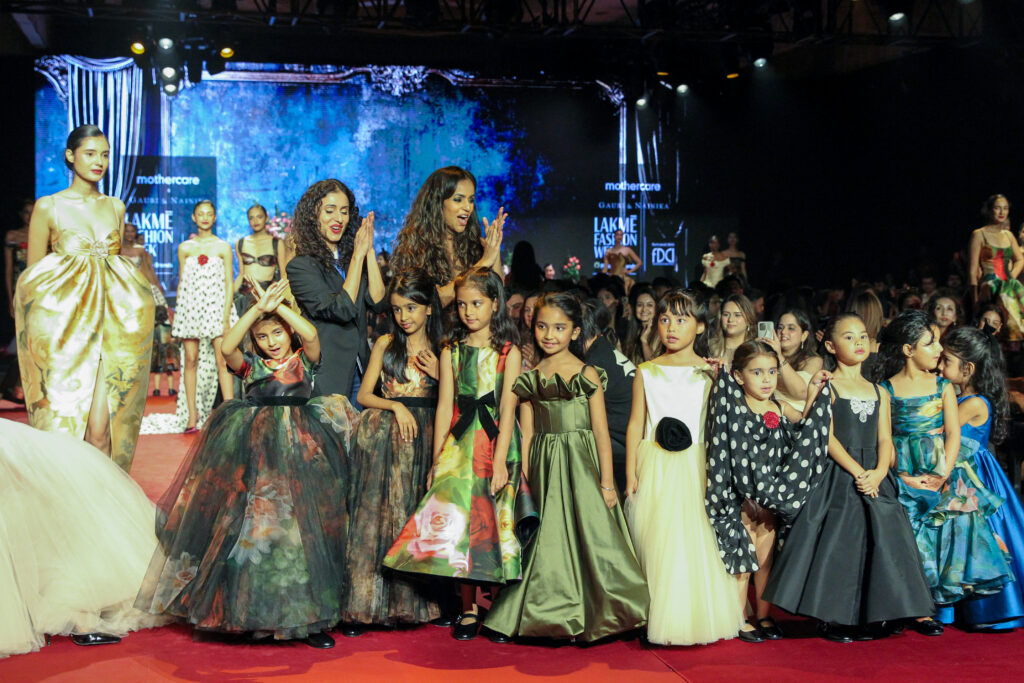
Nainika and Gauri’s daughters, give the catwalk some serious twirls, while Satya Paul announces Bollywood dreamboat Aditi Rao Hydari as their creative collaborator. By Asmita Aggarwal What happens when you have a live DJ, some moon, stars, and sun, mingling with the philosophy of “Papa don’t preach”. Well Shubhika knows young women, like quirky pink lehengas, she also believes dressing need not be about zardozi or kantha, but irreverent bags that come with pearl handles and sun shaped minaudieres. LFW X FDCI shows saw an influx of small dreamboats-including Nayanika’s daughter, as their tie up with Mothercare was surprising. Associated with red carpet, extravagant dressing, Priyanka Chopra in their backless neoprene number, it was a sea change from black gowns paraded with veils, and five-year-olds, in their floral full skirts beginning the show. Balloon and classic Balenciaga style envelope dresses, their signature big bows, polka dots, bunched up skirts channelled the spirit of the swinging 70s. Volume was their thing with tiered dresses in pleasing monochromes, European corsetry, a bit like what Scarlett O’hara wore in “Gone with the Wind”. Exaggerated and pixelated flowers on charcoal gowns, ruffled, and tiered, they decided to get Ava (Gauri) and Sky (Nainika) their daughters’ debut on runway. “We wanted to make clothes that sell—be glam, and introduce Princess dresses for girls (range for 3 to 6 years, some velvet suits for boys as well as bow ties). There is a book we used to read to our daughters–Kate and the Spanish Princess by James Mayhew, the whole show was inspired by this,” says Nainika. If you saw the Panniers or side hoops that they included it takes you back to the 17th and 18th centuries, a technique used to extend the width of the skirts. “Sky my daughter used to love the book, how the main character becomes part of a painting and gets to dress like a princess. We never made clothes for our daughters, though they saw us work all these 20 years. This was one opportunity to do so with Mothercare, it is a year-long collaboration, we have done 30 styles,” she adds. They used Mikado silk, tulle, printed luxe Duchess satin, using boning, bustle, and crinolines, very Marie Antionette styles. The empire cuts and tulip shapes were exaggerated, high lows used, in pure silk and chiffons, they abandoned polyester. “The prints were dark and moody, like an Albert Fernand-Renault painting or a Caravaggio, like an oil on canvas, with big roses,” she adds, admitting they didn’t name the collection, feeling it should be interpreted by the viewer in his own way. Satya Paul is undoubtedly a legacy brand, which understood that an Indian woman no matter how many gowns she wears, or aspires to buy will always wear saris. Almost 70 percent of our population thrives on it. Puneet Nanda and his father Satya Paul started this amazing journey in the 90s, with Genesis Luxury and till today their prints have been their showstoppers. David Abraham and Rakesh Thakore, creative directors of the brand, began with parrot green shoes, draped cowl saris, with bold flowers. And, of course hints of shimmer as their contrasts were engaging —deep blues worn with black and white stripes. From graphic to abstract prints saris worn as neck scarves, not pallas, one shoulder gowns in baby pinks, accompanied by long coats, sometimes knotted at the waist, they got circles, and dots printed as waists were cinched with leather belts. What is new is Bollywood beauty from Hyderabad, Aditi Rao Hydari, as their creative collaborator. “I am so excited, in fact thrilled to be a part of this. It is great to think creatively, play with fabrics, constantly come up with ideas, it is part of my DNA, part of who I am. Satya Paul is for women who own their femininity, it celebrates authenticity. It is a brand that is evolving like women do. I’m dreaming many, many dreams,” says Hydari.
After 25 years “waste is gold”
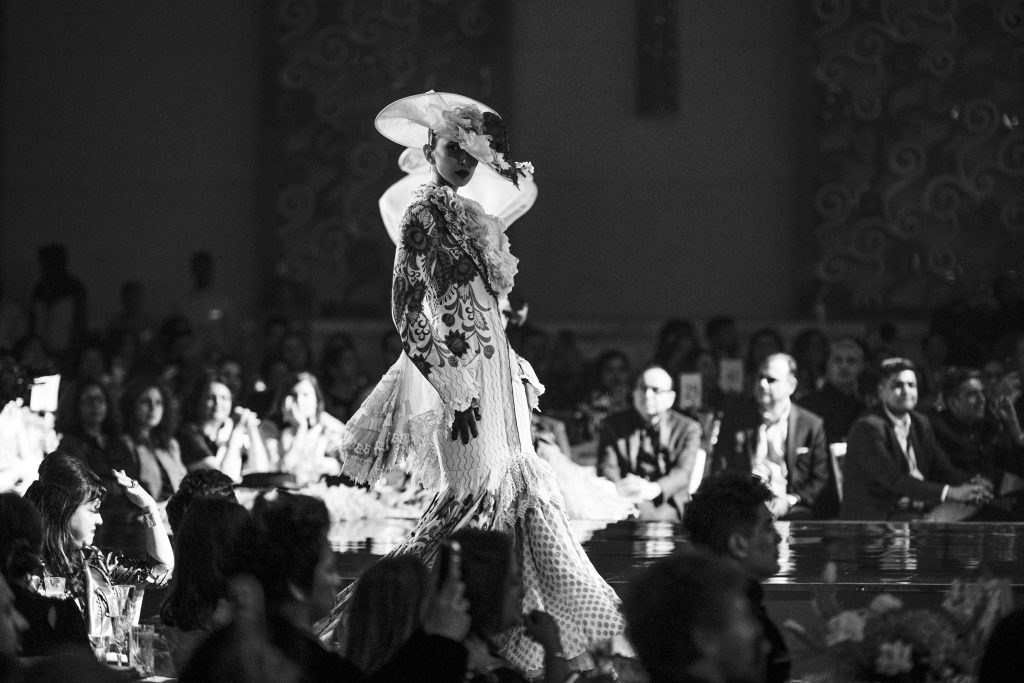
As fashion celebrates its silver jubilee, what is clear now is —sustainability is the only way to go forward, and designers have already taken the lead! By Asmitaa Aggarwal It was a reunion of sorts, designers came in droves, some who had not been seen for over 20 years—Anshu Arora of The Small Shop to Raghavendra Rathore, Ritu Beri, Monisha Jaising, Nikki Mahajan, once doyens of their field, today reticent. FDCI X LFW got them together—after all it was the time of celebrations—25 years of the fashion world! The Jio Convention Centre, Mumbai was where almost 300 people congregated—the most known faces, who have uplifted the barometer of design, innovation, and ingenuity—made a heady blueprint to go forward. Almost 33 designers recreated archival ensembles from 2000 onwards, with 60 models (Lisa Hayden to Lisa Ray), the biggest pool, with Indian-American actor Kal Penn as the host (Van Wilder, The Namesake, TV series House), who not only laughed at himself, but also asked an interesting question to Bollywood dreamboat Kareena Kapoor. “What do you think of fashion critics?” She candidly replied, “They are as important as film critics—they should keep designers on their toes.” Manish Malhotra when asked about his jewels glimmering on his sherwani admitted it was a “hard sell” and someone rightly said, “All this madness is therapeutic I would have it any other way.” Kareena confessed, “make and hair stylists the real stars as they make us look amazing. My darling brother Manish is here. Maybe I will come again on the catwalk not as size zero but owning my body completely”. For 25 seasons she walked as show stopper, once pregnant with her son Taimur, “most emotional moment for me, though my only hope is I don’t fall on the ramp, even if I do, I can get up with dignity. I also suck my tummy in a little,” she laughs. The show had Ritu Beri (2006), Tarun Tahiliani (2000), Monisha Jaising (2002), Rajesh Pratap Singh (2012), Raw Mango, Anshu Arora (2004), Anamika Khanna (2004), Manish Malhotra (2001) outfits recreated, among others. “As I reflect on the 25th year of Lakmé Fashion Week, I am reminded of the incredible journey fashion has taken in India. I had the privilege of opening the very first Lakmé Fashion Week in Delhi in 2000. Looking back, it’s nostalgic to see how far fashion has come—from a time when we could barely fill a room to today, where we are overflowing with a passionate audience. Creativity now permeates everything—the way people dress, the way they express themselves, and the way fashion is embraced in everyday life. It is a testament to how the industry has evolved, pushing boundaries and shaping a more vibrant, dynamic fashion landscape,” says Ritu Beri who started in 1990. She was the first one to do a show in Paris, headed a French fashion house Jean Louis Scherrer, and in 2010 won the Chevaliere des arts et des Lettres award. Though after 25 years one thing was clear—waste was gold now. Nagpur-based Shruti Sancheti, made hair bands, bags, scrunchies out of katrans, and has managed to get orders for it. There is undoubtedly a stream of attempts to be sustainable –the value of the ensembles made from it was Rs 30,000, says Urvashi Kaur. “We create textiles out of fabric, trying to be zero waste, but the beauty is that we are able to craft one-of-a-kind pieces, the key is to be able to shift consumer behaviour,” says Urvashi. On this it’s kantha, and her undying love for tussars, all hand-woven wonders she works with as the market is showing renewed interest, buyers want to know about their garment and how it is made. There seems to be a good churn happening, fashion weeks are a great platform for designers to express themselves visually. “We lost great design somewhere in the greed to keep selling, opulence and money wanting to show status. But the question is how do you contribute to a community. If your work does not hold meaning that money is not happy money. Young people are facing climate change, we have capitalist exploitative businesses, but we must find a way to keep our beautiful traditions alive,” she adds. Bangalore-based Mani Shankar, believes the customer has also changed, each city has its own nomenclature– “Delhi loves bling, so I make it, I must survive also. But the Rs 30000 fabric manipulation linen kurta sells well too, it is our USP,” he adds. “The last 25 years have been momentous in shaping what we now call the Indian fashion industry. Specifically, the last 10 have seen accelerated growth for many brands due to the various initiatives of the FDCI and the influx of corporatisation. I’m truly hoping the next decade is all about true growth, appreciative of all categories of fashion not limited only to bridal couture. I look forward to this next chapter,” says Ashish Soni. For 17 years he has been in the business of fashion, and Nachiket Barve, believes fashion is evolving with more awareness. He has launched a new line of enzyme washed denims for Rs16000, admits he has understood the market better. “I adapted. Design is a dialogue between the customer and you, you can’t be stuck in time or resist change. I look within. We are going to do more business and growth. India’s biggest strength is craftsmanship and willingness to change which will hold us in good stead,” he adds. Akshat Bansal of the experimental label Bloni, showed how he managed to do bio mimicry of a crocodile skin with Shibori, plus his additions of stainless-steel architectural materials on a tailored jacket. Some places you can also see ghungroos, as he sells the silk organza Japanese weave, with reflective properties for Rs 2,50000 lakhs. It comes with Savile Row tailoring, and a mix of various engaging techniques, custom designed. He is one of the bold, new designers who are taking fashion to the next level—see his silk felt raw fabric, it was waste that weavers
I have a child-like curiosity: Rahul Mishra
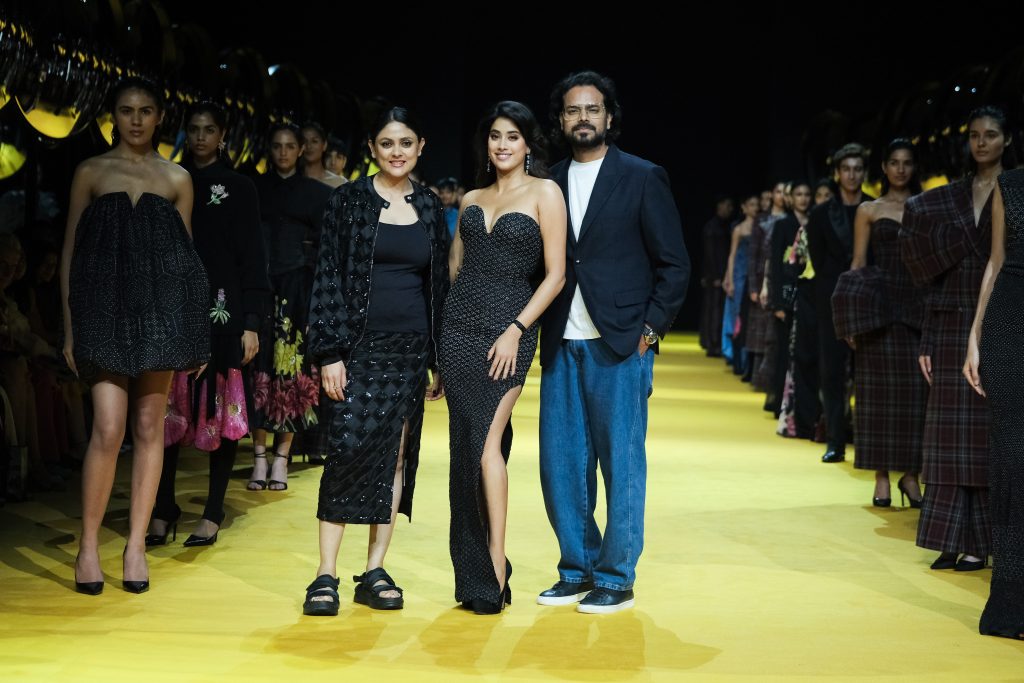
In a freewheeling chat, Rahul Mishra talks about his deep connection with spirituality, Trikaldarshi Brahma, his Paris Couture Week ‘Cityscape’ and ‘Crow’ ensembles, why Bandhani is important as we revisit the present while keeping the “rear-view” mirrors open to pay homage to the past. By Asmitaa Aggarwal He did create a buzz with Gen Z favourite Jahnvi Kapoor getting out of a Nexa, with paparazzi following her, a group of photographers, an event she handles almost every day bravely, they follow her. The set was rear view mirrors, almost 50 of them lined in the show area, as the yesteryear beauty Parveen Bobbi iconic Raat Baki from Namal Halal played in the background. Cutwork jackets, patchwork denims were interesting, some Issey Miyake style, space suit sleeves, and in this mix was Mithun Chakravarthy iconic moves on “Jimmy Jimmy aa ja” and Sanjay Dutt’s rehearsed steps on “Tamma tamma Loke” as the background score. Rahul Mishra and his quiet but impactful wife Divya, presented their line AFEW, at the LFW X FDCI showcasing for the silver jubilee of India Fashion Week, with exaggerated shoulders, big bold flowers, in sequins of course, pants came covered with net. The eye grabbers were exaggerated waists a bit like Comme des Garçons but his interpretation of Bandhani was engaging, in above the knee dresses with exaggerated shoulders, sleeves and bows. The check coats, his continued love affair with flowers, padding and bulges, appliqued hens on jackets, with golden paws, as well as Matrix style black floor length coats explained his love for the unpredictable. “We discovered Henri Rousseau (French post-impressionist painter) work which is on display in this collection as well as the art of Pichwai, but my belief is when you want to create something new you have things which are old like Bandhani. It is like you are driving a fast car, but you have to keep looking at the rear-view mirror to see what you are leaving behind. Crafts become the idea and you create a new version of it,” he says. He took many cultural references from the Silk Route, the products are deeply rooted in traditional craftsmanship. AFEW used painterly old motifs which were found when the Silk Route started, then thrived. “Silk route was an exchange of art, culture and motifs; it was not just about trade. This collection looks at various ideas whether it is from Japan or the Kutch region,” says Rahul. So you have Tanchoi or what Rousseau has done, but in the collection, there is a simplification of all those ideas, few find their own relevance. “Something which is easy, but beautiful,” he explains, adding, “My mind I feel kind of works way too much in multiple directions. Stargazing late at night using my amazing telescope which is the most scientific portable telescope available. I keep wondering about life and cosmos, I also read the Gita, try to connect wit myself. I observe insects–amazing creatures. My mind is never quiet, I am always thinking, maybe I need meditation. I feel I have more ideas but less time,” he smiles. He admits he is sensitive about his surroundings, especially of news. “It lives rent free in my mind. Divya tells me sometimes thoughtlessness is needed, I am sometimes absent minded also. I’m dreaming and thinking. Thoughts entangle me. Maybe it’s not the best thing, but it is a big fuel for finding new ideas and perspective,” he explains. Fashion is quite personal for Rahul, it is about his fears, experiences, tales, dreams, and it comes as an inspiration, out of an observation. “I share my ideas with the team. The way the human mind works is amazing. I can see the person, who is creating an artwork, how it comes from collective thought and dream into an entire garment. I think trends are the most overused ideas. Humans try to discover patterns in almost everything. If it is constellation and trends are based on human emotions, trends are powerful things, but I don’t care about them. I feel like there can be micro trends. The globe is one–generation on Insta and is savvy with technology. People get influenced very easily with choices,” he confesses. He believes the addiction to social media is so deep, that we are making free choices we feel, but we aren’t. “When you look at today’s world nobody can escape –we are victims to ideas and losing cultural identity as trends are strong,” he adds. The magnificence of his creations for Paris Couture Week, can be seen in the way he has constructed a “Cityscape” ensemble, because how cities are now it’s not about how much time it took, but how big skyscrapers made him feel. “No one can escape trends, it’s impossible. The Crow ensemble is a thought I was living with for a long period of time. It was a trigger point for me. Cityscape, when I look around to see how we have made concrete jungles,” he explains. Crows are scavengers, it became his leitmotif after his father passed away, “you look at everything. You render the bird–it looks realistic and fits into my story telling. These hits and trials take lots of re- improvement–it is not linear, and takes a lot of time. It is an attempt to showcase artistry at its best,” he says. If you look at his Insta page, he tries to add a series of celebrities— from Priyanka Chopra and her daughter’s beautiful moments to singer Shreya Ghoshal whom he “finds amazing. We pay respect to all regions of the world; we fulfil all requests. Whether it is Liza from Thailand for her first performance, Queen Latifa for Grammy, Mindy Kaling, Fan Bing Bing or Poorna Jagannathan. This is not our focus. We are very humbled. All celebs are global — Indian or Chinese,” he adds. Rahul is also a man of collaborations–Tod’s was happening for a long time — it was a right fit. Italian and Indian handmade craftsmanship; it was sold out even after the pricing has gone three times
Butterfly Effect by Somya
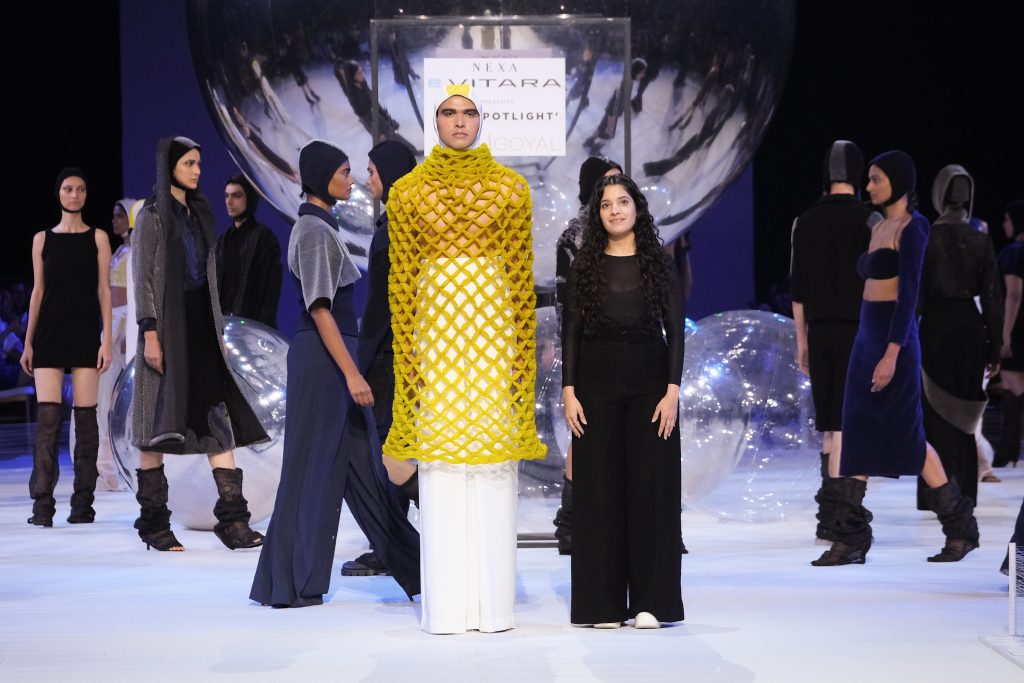
Repair and reuse are Somya Goyal’s mantras, as she works with Bemberg to tackle global warming, intermingling with fabrics created out of waste, converted into cords, in her line “Pivot”. By Asmitaa Aggarwal Her father has been running a successful label Rich Look for the last 30 years in Delhi, but Somya Goyal, the Nexa Spotlight designer at LFW X FDCI knew she wanted to do her own thing. After studying fashion design at Pearl Academy, in 2019 she took the leap of faith, launched her label. “Since childhood I have seen my father create menswear, I developed a love for textiles, early on, playing with transparent cords, wanting to make things that are not worn by everybody in the same room—breaking similar-ness,” says Somya, 30. Hoping to offer uniqueness, clothes with personality, material explorations, unconventionality, 3 D textures, playfulness, these were her templates. “There are two types of clothing—classic, and statement pieces, which are edgy,” she adds. She begins with a texture, then adds hand embroidery, maybe she learnt this and more at her internship with Bodice by Ruchika Sachdeva, and a few short-term courses from Central Saint Martins. “I understood the business aspects from my father—production to marketing, how he used to communicate with clients, maintain a relationship, he taught me well,” she smiles adding, her first show was in GenNext 2022 at LFW. Her USP remains repurposed transparent cords, made from surplus leftover fabrics, crafting new textures, as she stuck to classics—charcoals, electric blues, ombré and mori greens giving each look a Star Trek look, a kind of “transport me back to the mothership” with the set resembling a futuristic stage. She experiments with PVC, metallic wires, horse hair sheets, jute, and cotton cords, using also hemp, bamboo, Bemberg, and crystals sometimes for a constructed jacket. Minor details make a major impact like Raglan sleeves, placement embroidery, Bemberg being sustainable, it has a cooling effect on the wearer tackling humidity well. “Hemp and tencel add wearability and you get a lot of use out of it,” she confirms. The oversized look works well for Somya, as “Pivot” the name of her collection, uses the theme of “Butterfly effect”, one small step leads to a huge transformation—she took that too. “Clients want comfort, after covid that has stayed, plus, we also give repair services,” she concludes.
Luck by Design
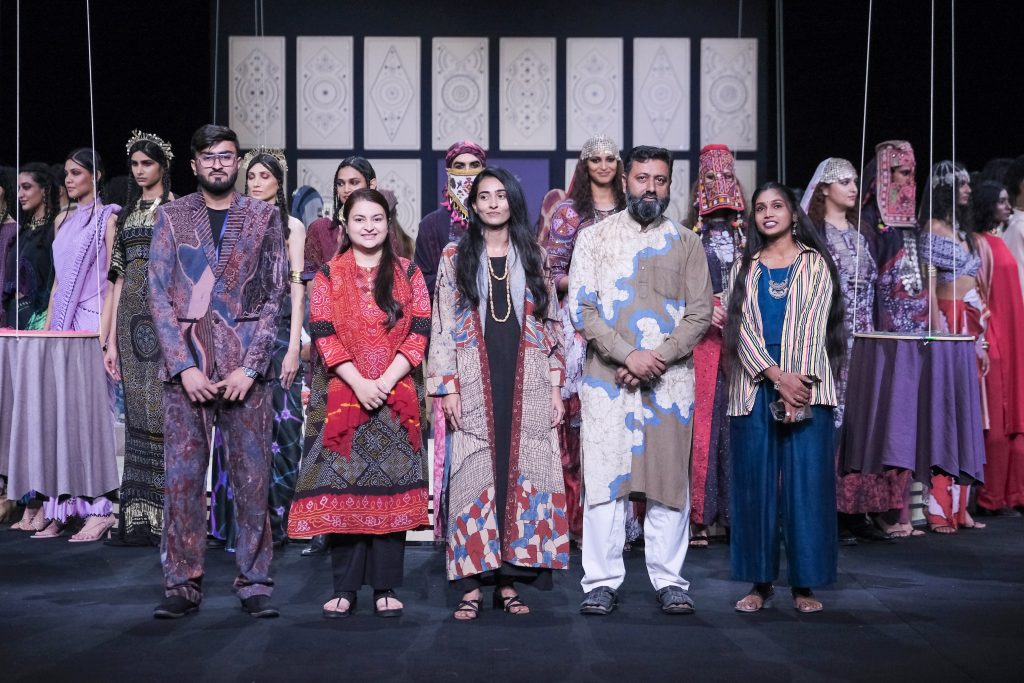
Somaiya Kala Vidya, is creating a space for artisans from Gujarat working with Bandhani, Ajrakh, block printing to applique, equipping them with skills that combine—marketability with design prowess-craft is just not art. By Asmita Aggarwal You would never expect a chemical engineer from the acclaimed NIT, Trichy to be working in the development sector, but there is a lot more to Nishit Sangomla than just his degree. He won the SBI Youth for India fellowship which took him to the Barefoot College, Rajasthan, established by visionary Bunker Roy in 1972, hoping to empower rural communities. In “Solar Mama”, how to fabricate solar panels, lights and photovoltaic circuits is taught 110 km from Jaipur, Tilonia village. Nishit began working with them, and it changed his life forever. He had found his true calling many years ago. Though he did notice it was dominated by women, as the men had gone to bigger cities to work in mines, never sent money home, forcing them to fend for themselves. Agriculture was not an option—but the region was loaded with crafts—they worked with leather, made durries, everything was laboriously hand-crafted—a gem waiting to be showcased to the world. “They are skilled, but did not know the technical aspects—marketing to supply chain management. After all, erstwhile kings wore crafts that are now museum pieces, all they needed was design direction,” says Nishit. This gave birth to the design lab they set up, to dig deeper into concepts, educate artisans, the seed of the idea came when Nishit met the legendary Judy Frater, an anthropologist from US, who came to Kutch, Gujarat in the 70s, the rest is history.. Judy, lived 30 years here, with artisans, particularly women embroiderers, studied their traditional crafts, Kala Raksha Trust she set up in 1993, to empower artisans. After the 2001 earthquake, she founded the Kala Raksha Vidhyalaya School in Meghpar, Anjar, Gujarat, the first design school for traditional skilled artisans. Bonus: they are setting up a natural dyeing research lab, which anyone can use. When he met Judy in 2016, she mentored Nishit, in 2019 she wanted to go back home, Nishit took over as the vision was clear. Bandhini, Shibori, Batik, weaving, block printing, patchwork to applique—artisans are taught how to modernise and sell. There were many hurdles he faced —in the one-year program, women artisans’ families were not comfortable to send them to a residency (12 women, 12 men trained every year, number varies). Interestingly, the age is dropping for students, earlier it was above 30, now younger artisans are joining, who had given up this generational skill. There are six modules— they can learn from street markets, retail stores, and exhibitions—colour development to trend forecast, experimenting with motifs, each skilled artisan is taught various verticals to enable him to be market ready. “When we take interesting calls like increasing dips in indigo the results are spectacular—innovation is the game,” he smiles, adding they also added violet to Ajrakh giving it a new spin. At LFW X FDCI Somaiya Kala Vidya showcased Ajrakh by Ziad Khatri, Alaicha (Mashru) by Amruta Vankar, ‘Anatomy’ by Mubbasirah Khatri, ‘Mystery’ by Muskan Khatri, ‘Tradition to modern’ by Shakil Ahmed, the school has now been taken over by Somaiya Trust, which is a prestigious educational institution based out of Maharashtra since 1942. Amrita Somaiya, who owns the school, has a Bachelor’s degree in Economics from Simmons College, Boston, and her husband did Chemical Engineering from Cornell University, a Master’s degree in Public Administration from Harvard University. Their family originally belongs to Kutch, Karamshi Jethabhai Somaiya, was an Indian educationist, who founded educational institutes in Maharashtra, was awarded the Padma Bhushan, Samir his son is carrying forward his legacy. “My father-in-law worked relentlessly after the earthquake to build Kutch, then my husband met Judy, as she was looking for opportunities to continue the craft work,” says Amrita. Amrita’s father is an architect, mother an interior designer, she inherited the love for aesthetics from them, crafts has been her mainstay, thus subsidised education for artisans at Somaiya Kala Vidya. “Real craft is handmade, each artisan who showcased had a personal story in the collection, like Shakeel bhai and the beautiful Batiks, it was contemporary, but soaked in craft,” she adds. An avid lover of textiles, from Ajrakh to Bandhini, hand woven is her go to, she spends time in clusters, and from grassroots understands how to bring awareness to the processes. Juhi Lakhwani, business development officer at Somaiya Kala Vidya, joined this year, but her experience is vast—she won the Naropa Fellowship, which took her to Ladakh. She worked with traditional artisans in carpet weaving, realised handicrafts are losing their identity, and wanted to teach them social entrepreneurship. “The products worked well, but Covid hit, we had to pause. The key was teaching them e-commerce, digital merchandising, it worked in their favour,” Juhi says. At Somaiya she helps them market their products, with design intervention—Soof, Rabari embroideries are much loved along with Batik. Somaiya Kal Vidya has opened another school in Karnataka, Bagalkot; they have a store in Prag Mahal in Bhuj. “The reason why Gen Z does not buy craft is the lack of awareness, they have been brainwashed by Westernisation. Artisans have saris and stoles, and silhouettes need to be taught to serenade a younger clientele,” Juhi adds. When you see artisans like Mubbasirah combine traditional Ajrakh blocks with hand painting, or Amruta’s new developments for Mashru, you know they are set to succeed. Alaicha translates to Mashru in Kutchi, it is associated with the Ahir community, each pattern reflects legacy —they have a new palette, in some ways redefined it. Mubassirah is the first female artisan to step into the male dominated Khatri Ajrakh artisans rejigging it with freehand painting! Craft is business now, not just art. “I began learning from my father six years ago after he returned from SKV, I’m the only woman in three generations from Ajrakhpur to take this up,” says Mubbasirah. Ajrakh means “leave it for a while” in Kutchi, it takes
Bengali Babus
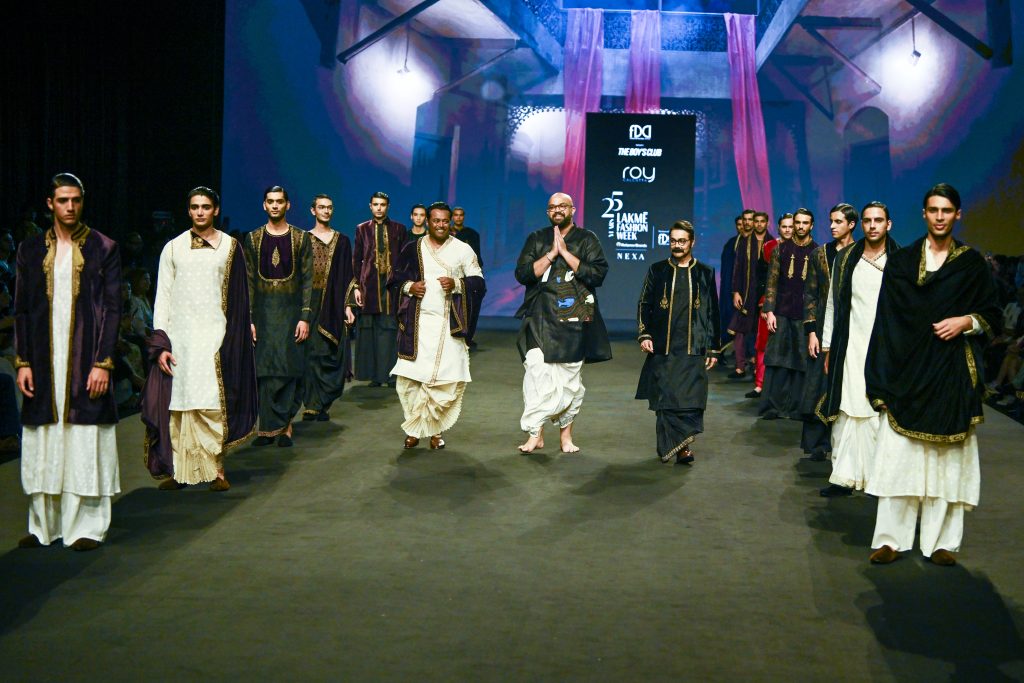
18 century “babu” culture of Bengal dandies gets a fashionable makeover by Abhishek Roy through his smooth velvets and zardozi. By Asmitaa Aggarwal What happens when you grow up in a fulfilling environment away from the craziness of city life in Santiniketan? Well, you have an alternate world view just like Abhishek Roy from Kolkata. Showcasing at the FDCI Menswear show Boys Club, he admits his bachelors and post grad from the historic place, sharpened his mind. Since 2014 he has done costumes for Bangla films like “Bonkesh”, and 2015 launched his label with an inclination towards textiles. For years he has upcycled weaves, specially kanthas, along with Jamdanis, but what’s interesting is his love affair with zardozi. Though he effortlessly amalgamates velvet with Jamdani in his line “Nawabs of Bengal” paying a tribute to Bengal’s rich culture, babus of the 18th century smattered with crafts like “alpona Naksha”. “Santiniketan has multi-cultural diversity, what we learn is not from a syllabus but the sustainable environment. Plus, my grandfather was a professor here and first muralist of India, Shuken Ganguly along with the iconic Nandlal Bose,” he says. What is reflected in his line is what he observed and soaked in as a child growing up in Santiniketan, there was no entertainment, so he began designing outfits for theatre, using paper cutting and moulding techniques to flower ornaments– he loved creating characters through costumes, it interested him. “It was an adrenaline rush doing movies,” he laughs. His FDCI line has shawls, kalidar and side slit kurtas, Sherwanis, bandhgalas, to dhotis something he wears which got him the attention of the Nawab of Pataudi Saif Ali Khan. He loved the pleated pure muslin ones, and soon a relationship developed. “Saif is in touch with his Bengali roots due to his mom Sharmila Tagore. I visited the Musheerabad Museum to understand the zardozi influence on Bengali culture,” says Abhishek. His next is uplifting Kesh weave, where you mix old saris with khadi, adding applique to elevate the look!
Boy from Biskohar
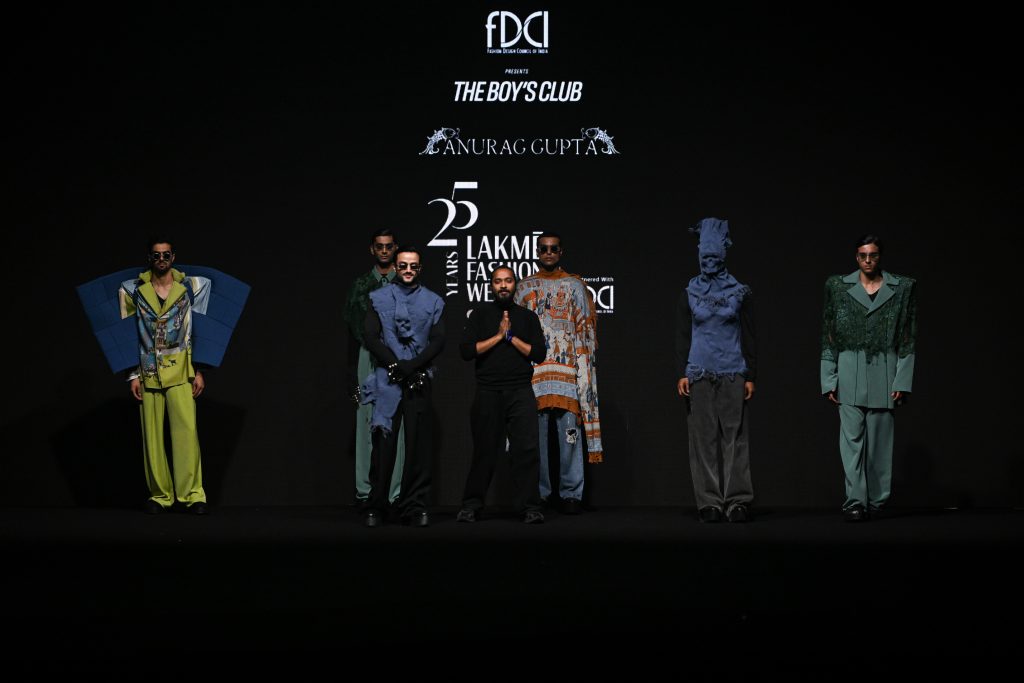
Anurag Gupta’s 3D, jacquard knits and intense screen prints tell us you can do a lot with menswear sans sequins. By Asmitaa Aggarwal Imagine growing up in a village, Biskohar, (Itwa) not so far from Ayodhya, the city of Lord Ram, in a home where forget conversations about fashion, there were not even “pucca” roads, what catapulted him was sheer grit. Anurag Gupta has a lot to be proud of, when he walks the ramp after the FDCI Boys Club menswear show this season at the Lakme Fashion Week 2025. NIIFT (Northern India Institute of Fashion Technology) kind of changed his life, along with a teacher who came to his nondescript school, (near the Nepal border) from Allahabad and taught him not just English but gave him the wings to fly away to the Metro city-Delhi. “I knew I had to leave, the place was too mind constricting, I had big dreams, but no exposure, I didn’t know one word of English so had to learn and unlearn everything as I wasn’t born in privilege,” he says. In 2018, he launched his label, in a glitzy world of fashion knowing that survival here is a challenge- but he did hone his skills- under Varun Bahl and Manish Arora for five years to grasp the business and marketing ethos maybe quirkiness too. “Biskohar had no internet, while I was growing up, but what did help me was that I was curious—even though the only channel was DD and scraps of newspapers from which I got information. My parents ran a medical store, so income was just barely enough,” says Anurag. Fashion for him was an escape, he admired Hrithik Roshan’s dance steps to his sunshine yellow tees, denim jackets in Kaho Na Pyaar Hai, so any hopes of his father to make him an IAS or engineer were incompatible. “I never had that kind of education,” he admits. Anurag admits unlike the swish set he is not inspired by Maldives or Seychelles, rather things he observes around him—sports shoes knitting process, which he converted into necklines, or his intricate screen prints which are laborious but the results are stupendous. “I have developed jacquard knits, deconstructed garments—used from door handles to medical equipment, tyres, tubes to make a line that is also paying homage to 3-D printing,” he admits. Fashion can be daunting-so in 2023, when he read Ambedkar’s book and was inspired to do a collection on “The Failed Promises” (1943) on the exploitation in manual scavenging, how it should be abolished, due to the ignominy, he says many were not interested to write about him. “I am the outsider, and will remain so,” he confesses. Maybe that’s why his line “Metamorphosis” is personal as it encapsulates his story, of how from his “cocoon” he emerged victorious-flew away. Though along the way he has included artists who have inspired him– MC Escher to movements like the Industrial Revolution. “The Dutch artist Maurits C. Escher (1898-1972) had a profound effect on me-specially his ‘mental imagery,’ which gave birth to puzzling architectural mazes and bizarre optical effects,” he concludes.
Khadi adopts new ‘vibe’
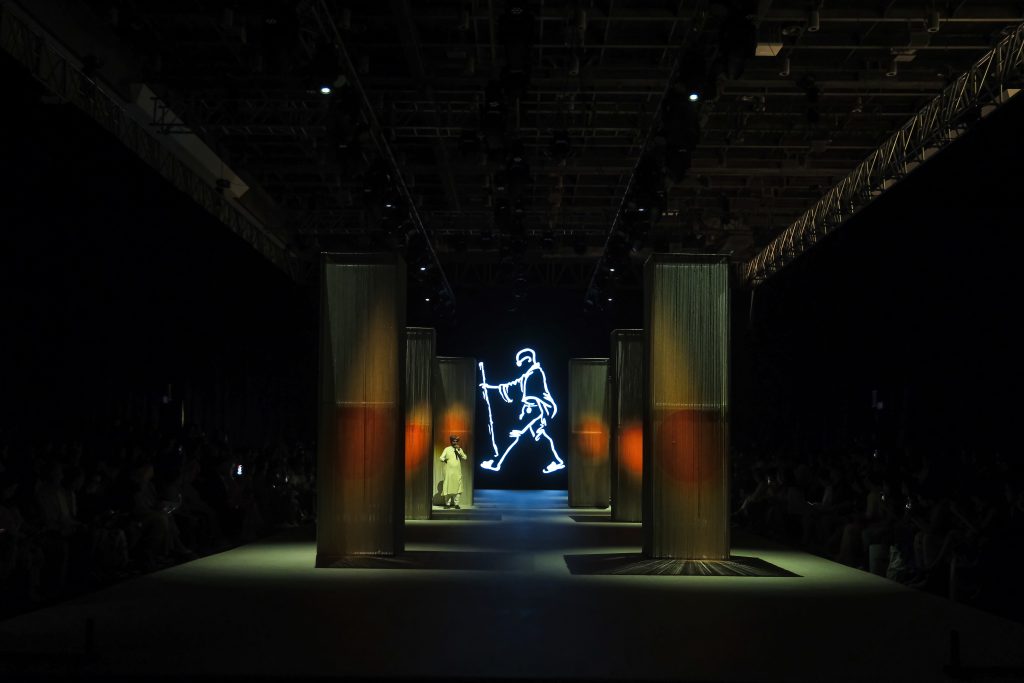
Hoping to wean away GenZ from fast fashion, Co-Ek has launched khadi resort wear-think wrap skirts and summer dresses. By Asmitaa Aggarwal It is always invigorating to observe seismic changes in the way Khadi has been perceived and elevated— leaving its traditional starchiness, adopting a modern nomenclature. This year Co-Ek (Centre for Excellence for Khadi), powered by Khadi and Village Industries Commission (KVIC), crafts dresses instead of saris. It was a concerted move, to serenade GenZ, maybe learning from Moscow Fashion Week, where Nargis Zaidi, head of apparel Co-Ek met khadi lovers, who told her “My grandmother was a Gandhian, I love its imperfections.” The shapes of khadi are now global, jackets skirts, pants, layered magic, inner wear, relaxed fits, also in the process Co-Ek recycles and upcycled katrans, channels circularity while creating statement pieces. “When we sort out fabrics, we do it colour wise, indigos stitched together for example, to offer a discerning palette,” says Nargis. Khadi is a versatile fabric, it may be Swadeshi, but it has international appeal, as she had gone ahead and crafted blazers with it. Since 2021 her efforts have been to start a new narrative, break mindsets and barriers, introduce new colourways (yellow and reds, or charcoals and reds). “We were trying to tell a story—paying homage to little things that often go unnoticed, but impact sustainability, that’s why you see tiny embroidered beetles on resort wear; our line of gamchas, we had the yardage increased while weaving to create wrap skirts,” she adds, hoping this will be an effective alternative to GenZ shopping at Zara and H & M. For the FDCI khadi show, at LFW 2025 she took her experience working with FabIndia and Avaram, forward, by weaving it in Bengal, Gujarat, Punjab to down South, each region bringing along its uniqueness. “We have students from fashion colleges coming to do final projects on khadi which is heartening. A Japanese fashion lover from Tokyo wrote to me on how she was doing her thesis on khadi. Unfortunately, in India, we take it for granted, globally they love the natural textures,” she adds. Hand spun, keeps you cool in summer and warm in winter, organic, a politically powerful fabric, no fabric has this much history!
Nikki’s Khadi Resort wear
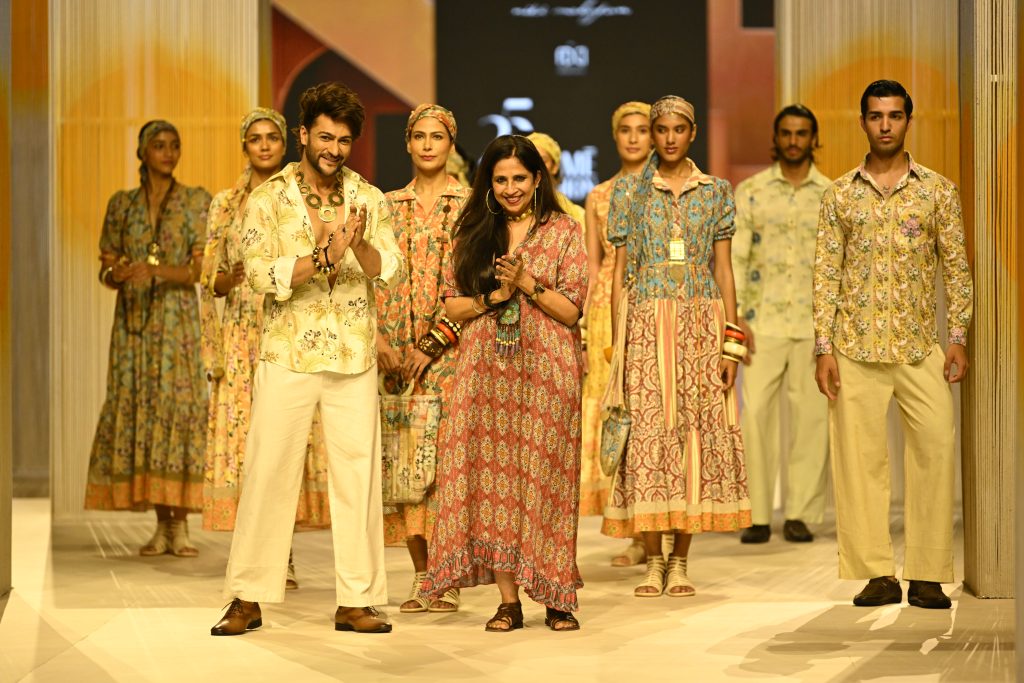
After 42 years in fashion, perfecting block printing, Nikki Mahajan pays tribute to khadi not through predictable kurtas, but dresses with baroque elements and French prints. By Asmitaa Aggarwal She began almost 42 years ago, in the 80s when she was newly married, at 20, studying in Lady Shri Ram college of Commerce, English literature, had no clue even about the word fashion, she would call herself a “tailor”. But Nikki Mahajan knew when she was taught needle work and smocking in Loreto Convent school, Delhi, she started making clothes and embroidered it herself for her friends’ moms — this would be her calling! Ten years ago, the business dynamic altered, she moved to working with Japan, Middle East and US markets, special collections, about after 42 years in the business. Self-taught, the 62-year-old knows the challenges of running a brand, “In the late 80s, there wasn’t any fashion school, only polytechnics, which were not considered great, but I found my way around,” she says. She used to take her two kids to play tennis in DLTA, Delhi where she saw the exodus of Kashmiri women, in the early 90s, sitting opposite, looking for work, she decided to help, hired them as embroiderers utilizing their skill and providing employment. “Bindiya Judge’s store Signature in Hauz Khas Village, was the first one that sold luxury designer wear, but unlike today’s generation, we had to find our own niche,” she explains. For the FDCI khadi show at the LFW, Nikki has done what she does best-block printing, which even her Japanese clients love (she made a 3000-piece line for Anthropologie too). She found a way to make the uneven blocks as they are hand done into some form of evenness by digitizing it for her buyers abroad who wanted “sameness”. “I digitize the fragments I get while visiting various museums all over the word-Egypt to Uzbekistan, Amsterdam to France, and this line is an amalgamation of all those shared experiences,” she confirms. She takes pics and then makes a collage and starts work on the storyboard. To this she added Baroque elements and French prints, dexterously executed on Khadi, even though she works with mostly cotton and silk, she loved the textiles and unevenness khadi offered. “When you wear linen it crushes easily, khadi doesn’t and that’s its beauty–I discovered and admire its slubbiness,” says Nikki. Fashion is now easier. It has Pinterest, Instagram, the new breed of designers are intrepid, they aren’t insecure, it’s the same masala box, but they are cooking up a storm with it. She is back on the runway after 10 years, but decided not to make the usual kurta with khadi rather went opposite-resort wear, carefree and fluid!