
Bihar to custodian of Bal’s legacy
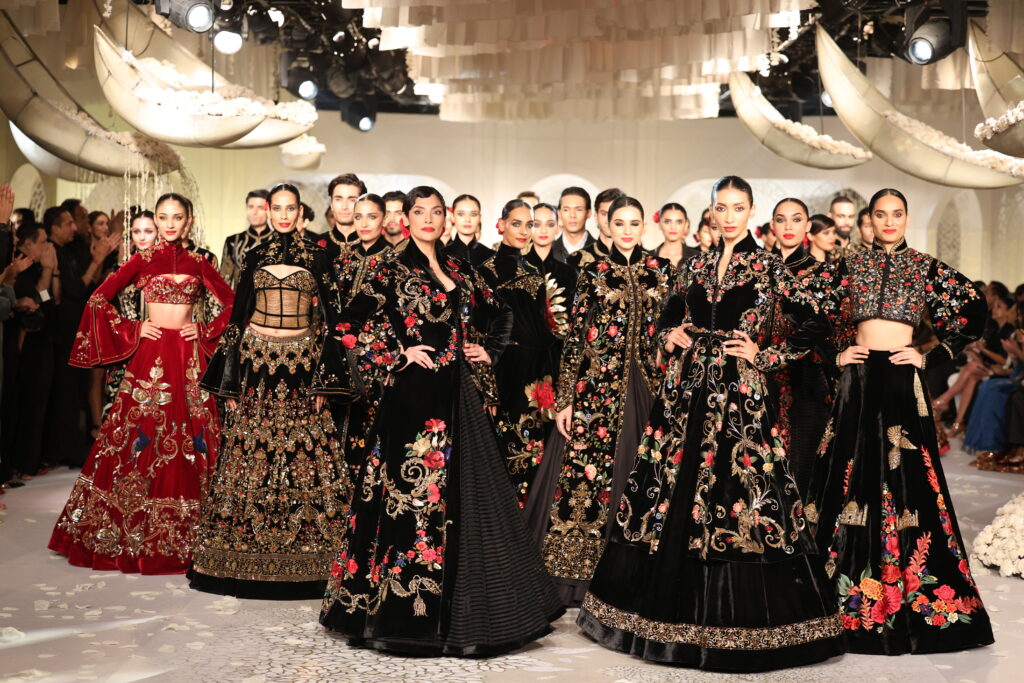
Tasnim Fraze, creative director Rohit Bal, brings garden of flowers from Kashmir in Matka silks and poetic khadi for ICW 2025. By Asmitaa Aggarwal It is quite a larger-than-life legacy of the iconic Rohit Bal to carry on his nimble shoulders but Tasnim Fraze, believes, “It’s an honour and a deeply personal responsibility. Everything he created came from a place of love — for Indian craft, the beauty of Kashmir, and the people who bring that beauty to life. I had the privilege of learning and growing under his guidance for over a decade. As Creative Director, my role now is to protect what he built and let it grow, with the hope that everything we create reflects the integrity and grace he always stood for.” His journey with Rohit Bal began in 2013, just after he graduated from design school Symbiosis International University, he began as a young designer in his team and over time, got the chance to be involved in more — from design to the business side of things. “Rohit Bal always valued growth and believed in continuous learning. He encouraged me to pursue further education, which led me to do my MBA at IIM Ahmedabad. That experience helped me understand how to balance creativity with business decisions. But the real learning came from working with him — being in the atelier, working with artisans, and watching how an idea would turn into something special in his hands,” he adds. The FDCI ICW collection called Kash-gul, draws inspiration from the landscape and poetry of Kashmir — especially from Gulistan, which means the “garden of flowers”. This collection connects with shared memory, craft, and tradition. “We’ve worked closely with artisans to preserve techniques that have been passed down over generations. We’ve used fabrics like Matka silk and velvet, with thread work and gold zardozi that add richness and depth. The motifs — peacock, lotus, and rose — were signature elements in Rohit Bal’s work, and they continue in this collection. What I have tried to retain is his sense of elegance and the quiet drama that made his work timeless,” he explains. Tasnim grew up in Bihar, grew up surrounded by culture, stories, and art. Bihar is also the land of hand-woven matka silk, and khadi was a part of daily life. “Being around these kinds of fabrics from a young age naturally drew me toward textiles and eventually, into fashion. Fashion became more serious for me during design school. And everything truly came together when I started working with Rohit Bal,” he confirms. Couture today is about meaning, he believes. Brides are looking for pieces that reflect who they are — not just garments that are heavy or ornate. “There’s a clear shift toward personal connection, craftsmanship, and quiet elegance,” he adds. For the festive season, what always works is a garment that feels intentional — something with clean construction, beautiful fabric, and quiet presence. When it’s made with care and worn with confidence, it never fails to leave an impression!
Batik has unique monotones: Madhumita
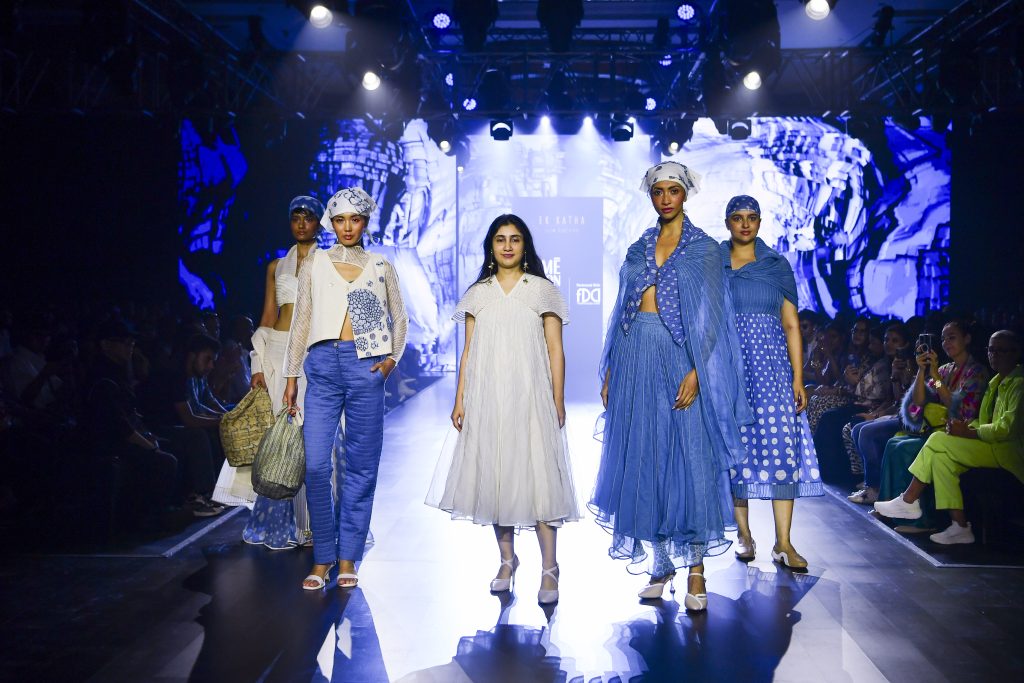
Working with Batik master craftsman Shakil Khatri for the last ten years in Gujarat, to revive the 1000-year-old tradition using vegetable dyes, Madhumita Nath of Ek Katha hopes to serenade a young audience with reimagined crafts. By Asmita Aggarwal She studied textiles at NIFT Mumbai and JJ School of Art, the Mumbai-raised, Nagpur-born Madhumita Nath of the label Ek Katha took time to launch her label. She came from a renowned family of science mavericks, with her grandfather Prof. M. C. Nath, moving from Dhaka to India, setting up the Biochemistry institute, in 1946, Nagpur. Most family members are Ph.Ds, so when she decided to study textiles, it was met with “surprise.” 2016, was the year when she decided she would like to concentrate on Kutch weavers, she sought advice from mentor Kudeep Gadwi, who took her to meet artisans exposing her to lesser-known jewels like Batik from Mundra, Gujarat. The “khakan” is made locally, earlier they used oil of a seed, not paraffin wax to dye, but now only four families are left out of hundreds who have abandoned this process, six in the adjoining village— digital printing killed traditional art. “You can make digitals in Rs 15 to Rs 30 per meter, which ends up in Dadar market, it is quick. Ancient techniques, 1,000 years old, have a subtle layering, the beauty of it has been erased due to bulk digital prints. Batik used vegetable dyes, chemical- free, laborious, painstaking but excellent,” says Madhumita. Master craftsman Shakil Khatri’s family has been batik block printing for six generations, using oil of the pilu tree (Salvadora persica), locally known as kakhan, as a resist. As it is thick and sensitive to heat—the oil can only be used in the morning. Kutch batik left natural dyes shifted to naphthol-based ones, but Shakil sticks to sustainable processes, he makes 12 shades of natural colours from indigo, rust iron, turmeric, pomegranate skin, madder and onion after he was trained at the Kala Raksha, in innovative ways. He gave life to Batik with new designs, artisans in Batik Kutch are Khatris, Kutchi-speaking Muslims. “Khatri didn’t give up block making, his gradations due to the layering is unmatched,” says Nath, who in 2018, made a line for the Sustainable fashion day in Spain with The Circular Project. “I am not a businesswoman, when Covid struck, I shut shop for two years,” she says. Providence gave her an amazing opportunity to learn from an incubator program for women entrepreneurs, NSRCEL, started by the Indian Institute of Management, Bangalore, in 2023. IIM (Bangalore) has partnered with Goldman Sachs, Capgemini and Maruti also. “I received helpful inputs on the financial aspects of running a business, for six months through the management institute. It was a learning to see where I belong, how to survive when you do slow fashion, meet investors, pitch in front of them,” she adds. Apparel Export Promotion Council (AEPC) membership helped her figure out how small batches of hand-made can be exported to the US and the Middle-East. “I wanted to do something craft-based, but I am not a sustainability warrior,” she admits, as she worked with kala cotton, reducing carbon footprints with hand-made techniques. “I love crafts, bazaars, haats, seeing lots of stuff stacked up, and the beauty of Batik is that it is monotone, unique in so many wonderful ways,” she adds. Generally, she admits, Gujarat is often associated with colourful embroidery. “I did start with Ajrakh, but soon shifted to Batik, Kala cotton is not glamorous, but I know North Indians will be hesitant, but the Japanese will buy it at any price, as they know its value. When you can get a heavily embroidered piece for Rs 10,000 anywhere, why would anyone but pure, natural, plain fabrics? Many don’t realise the artistry,” she confesses. For LFWXFDCI, Nath has combined Batik with fabric cording, using khadi and kala cotton from Bengal, also paying homage to Kota Doria, adding delicate, subtle textures to create flowy shapes. Her love for patchwork, cutwork and quilting used in abundance can be seen, without serenading waist defining silhouettes, yet the line is young in appeal. “I would like to do B2B exports in the future —I know I have to build my capacity first,” she concludes.
Arundhati Roy, Mira Nair, Kiran Rao and me share common artistic goals: Aneeth Arora
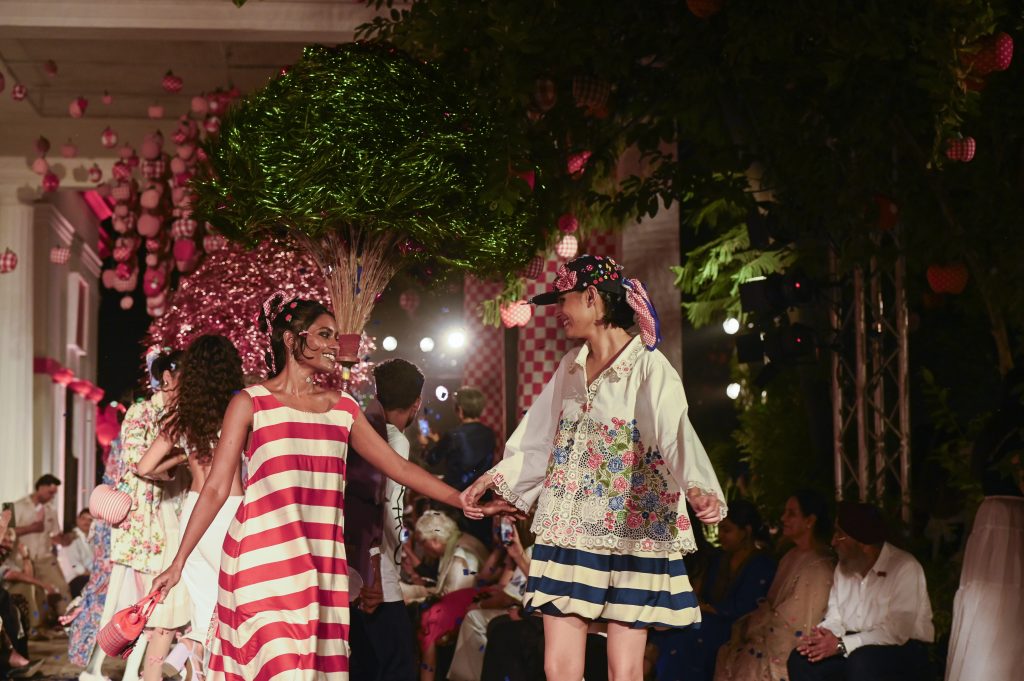
From little hearts floating on smocked dresses, Hello Kitty nostalgia, to intensive embroidery details, as well as design interventions on textiles, Aneeth Arora celebrates 15 years of Pero with a FDCI show at LFW. It has been a long road from Udaipur to creating a million-dollar business for this craft crusader. By Asmita Aggarwal Udaipur is a quiet town, very underexposed, living in a microcosm, but Aneeth Arora’s mom wore Garden saris, and Babita (the erstwhile Bollywood actress, better known as Kareena Kapoor’s mom) inspired kurtas and churidar sets, she loved fashion. She stitched clothes for a young Aneeth, from leftover fabrics from her grandfather’s kurtas—replete with cartoons, laces, patches, and flowers. “I do not know how she had children’s catalogues, Korean looking kids in them. In my friend’s circle when I went down to play in a middle-class housing society, in the evening, my dresses were admired. ‘The girls would say ‘look what Aneeth is wearing today’. My mom was quick too so every week I had a new one on,” says Aneeth, who opened the LFWXFDCI 2024 at 13 Barakhamba Road, in the capital. Entire building resembled a child’s birthday party! Thus, “nostalgia” plays a huge role in all her collections, this year is special, she celebrates 15 years of her brand, it is the core of her ideology. “There is a seriousness when we work with textiles, I thought there must be a lightness when we present it to the world,” she smiles. When her sojourn began, very few buyers understood textiles, there was no dearth of craft, but it did need refinement. Either they would starch the Jamdani too much or the wool was too coarse making the wearer extremely uncomfortable. Intervention must be from the yarn stage, is what she learnt at NID, Ahmedabad, also garments must feel good against the skin—like her Kullu Pattus, soft merino wool, refined, and it has been wholeheartedly embraced, the dyes used to bleed now they do not. When you see a Pero outfit, you will always notice little hearts floating around, somewhere there is romance, even though when she started, she was not sure if the buyer would like it, she would hide them in folds. It was her way of giving love to them through embroidered hearts, later this became one of her many intimate signatures. After two years Pero’s show is back, it is much anticipated, as she works with handloom, she wants nothing to be rushed—woven textures take time to execute. Pero shows whether it is a pajama party, or “Cuckoo and Co.”, with mad hatters or “Alice in Wonderland” are a treat for the audience, and what she is successfully able to do, is present textiles minus the rigidity, rather than being academic about techniques she makes it fun. “I learnt this from my mom, she would teach me through stories, she would sing ‘State and capital’ to me and I know it till today. I could never mug up or memorise, but storytelling always worked,” she grins, maybe that’s why you see models dancing, as confetti burst on the runway, it is part of her expression of style, transporting you into the world of a child, where she creates her own universe. In her press kits there is always a piece of Pero, once a year she shares her joy of crafting a collection, and like Coco Chanel she loves the flower Camellia, maybe because it represents resilience unlike other delicate ones, it can withstand harsh winters. “I like it, as it is underrated, the rose is considered the king, but I call camellia a modest rose,” she adds, even though Aneeth can never be seen donning florals, she is more of a Baby Breath or Forget-Me-Nots, the little blue flowers, kind of person. Unlike Rahul Mishra, or even Gaurav Gupta who in their own ways are marketing crafts to a global audience through Paris Fashion Week, Aneeth does trade shows, if given an opportunity she would love to. “Globally they don’t know our story, only our product,” she admits, Pero is available in 350 stores worldwide in 35 countries. Few know her fans extend beyond the swish set—she has ace photographer Dayanita Singh who comes and shares her latest projects, Booker prize winner Arundhati Roy works in her Patparganj studio known for the bright red letterbox standing outside like a modern-day mural, Mira Nair the famed filmmaker is a diehard Pero fan. “I am not much of a reader but I love pictures, I am a book collector and I have everything from art to architecture, we have always attracted alternate artists, like-minded individuals, filmmaker Kiran Rao whose film Laapataa Ladies is India’s entry for the Oscars. There is an honest relationship with them, pure appreciation from both sides,” she adds. Even as the world is corporatizing and fashion brands have been taken over by ABFRL and Reliance brands, Aneeth like Yohji Yamamoto or Issey Miyake does not want to sell her business—she wants to be small but impactful. She never invested in a huge retail space. “I do believe there is a right time for things to happen, the universe is a big planner, I want to create a space where I can tell my own story,” she admits. This LFW she is paying homage to the culture of DIY, GenZ loves making their own clothes. She has indulged in old textiles cutting them up and making new ones -patchwork—maybe it is grandma core but she has elevated it with French knots and crochet. There are beautiful Calcutta bedsheets in white poplin with red embroidery that have been converted into easy dresses. It also resembles Hungarian table cloth Aneeth saw, and loved the austere lines. Her constants have been Mashru and Patan checks, Chanderi and Maheshwar done in a DIY way, she mixed fabric together. But what about those who cannot afford a Rs 50,000 Pero dress? Some years back she had a capsule line titled “Lazy Pero” where embroideries were less,
Tiger Tales
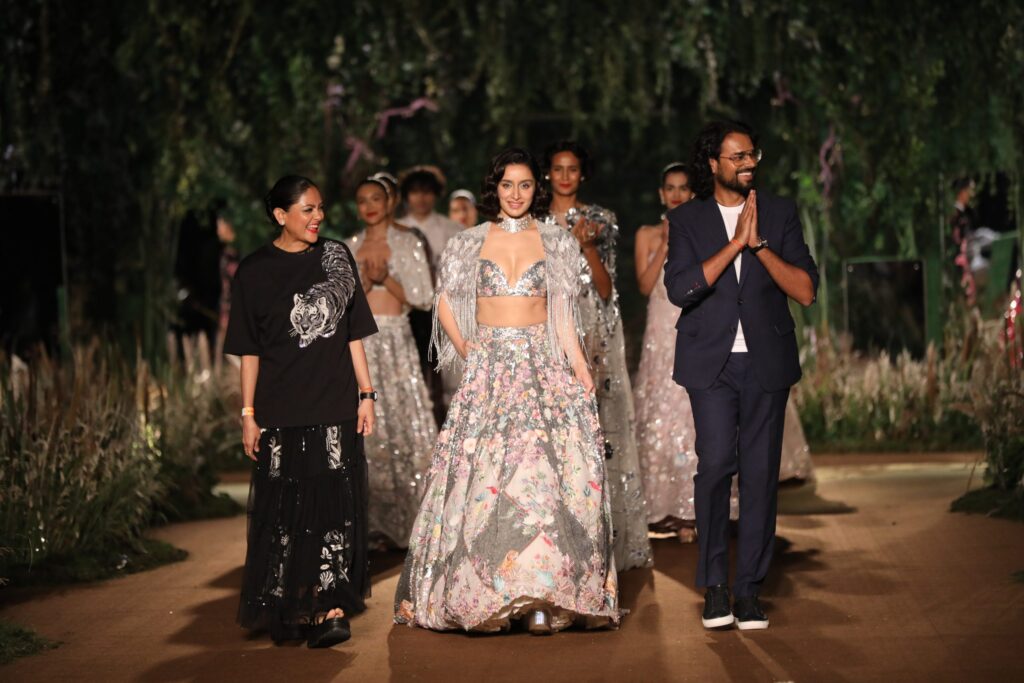
Couturier Rahul Mishra is a conversation starter, a dialogue initiator thats why couture for him is about a narrative that transcends the discussion about silhouettes, shapes or forms. ICW 2023 was an ode to sequins, flowers and the king of the jungle! By Asmita Aggarwal
Aroma of Roses
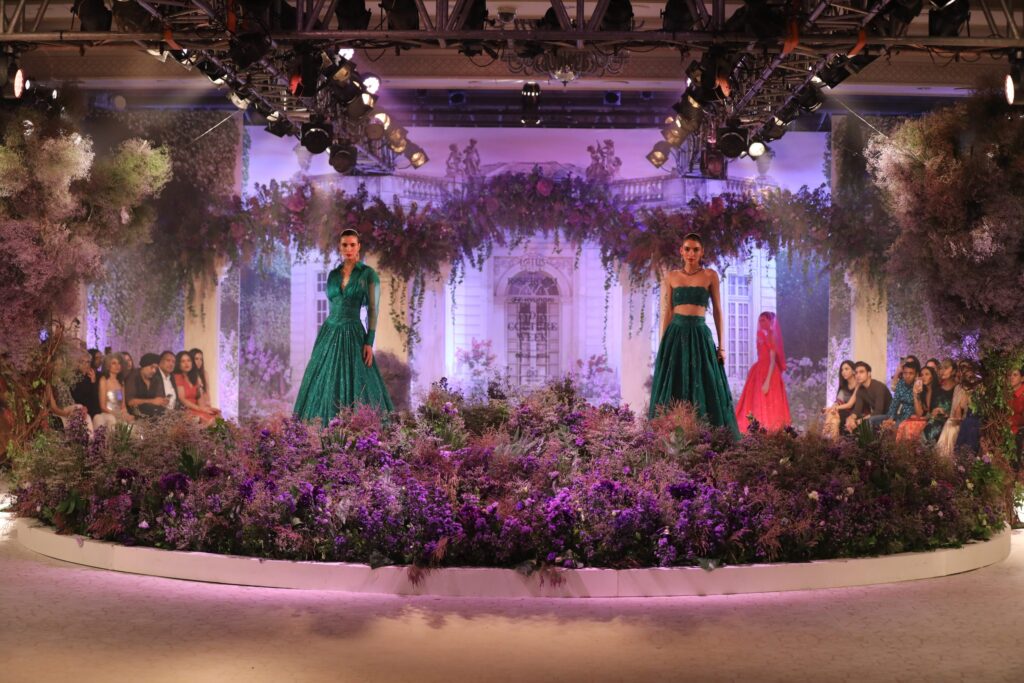
Isha J debuts with a line with the perfect showstopper the curvaceous Vani Kapoor, displaying a collection that combined Chikankari with lace, and of course sinful washboard abs. By Asmita Aggarwal
Layered Intrusions
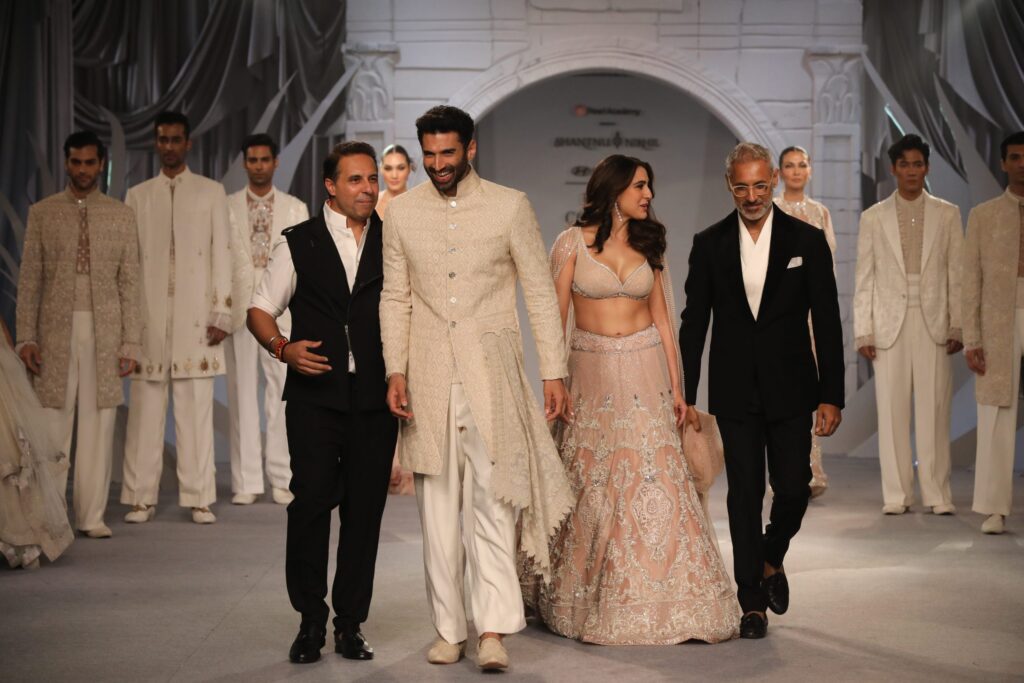
Serenading layering, separates and fluidity the market-savvy brothers Shantnu and Nikhil, complete 24 years with almost 16 stores domestically. At ICW they managed to add dollops of deliciousness with Aditya Roy Kapur and the pint sized beauty Sara Ali Khan. But the coup was Nikhil Mehras 16-year-old son Vivhan, making his catwalk debut. By Asmita Aggarwal
Wizards of Time
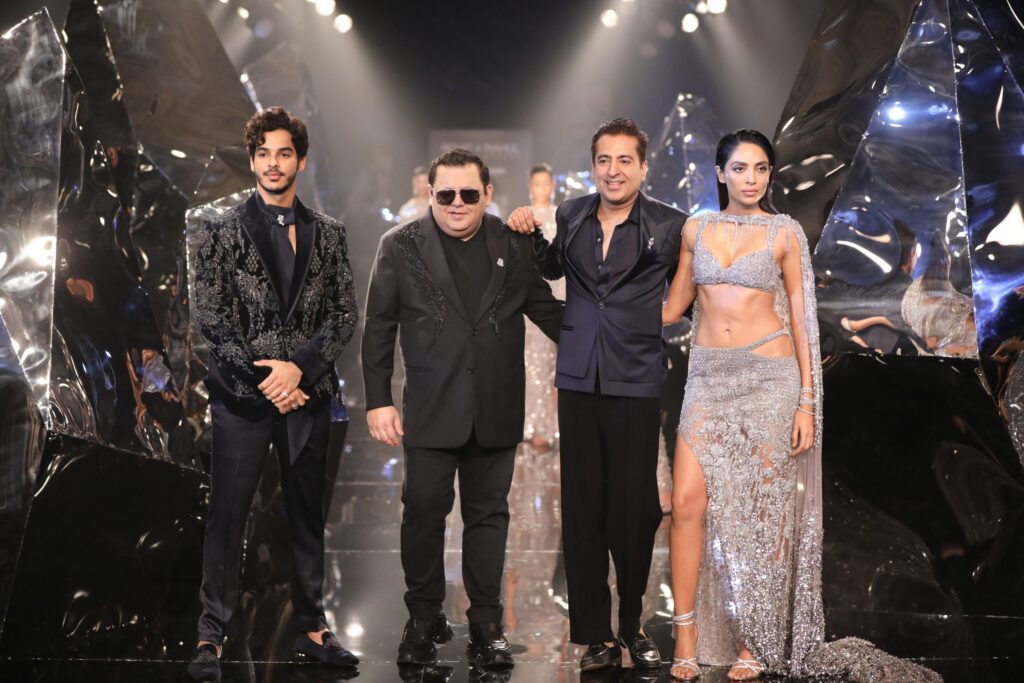
From Fibonacci to Equinox, the admiration for Maths and its lasting solutions have fascinated the duo, who have been on this creative journey together for 25 years, and counting. ICW 2023 was about romancing 3D embroideries and just like their themes, the precision it echoes, is mirrored in cuts. By Asmita Aggarwal
Elegance in motion
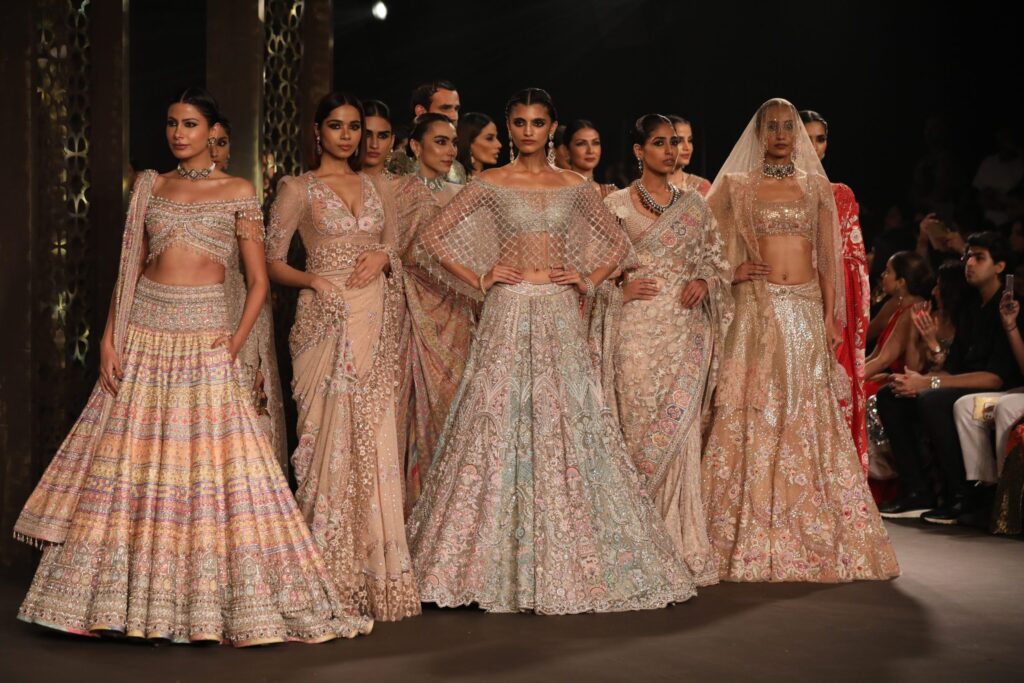
Even though nothing is for Eternity, in this ephemeral human world, except change, whether it is love or integrity, Tarun Tahiliani proves, it can be, with an unmatched ode to elegance, in his distinct style, urging us to love and relove at ICW 2023. By Asmita Aggarwal
The World Within
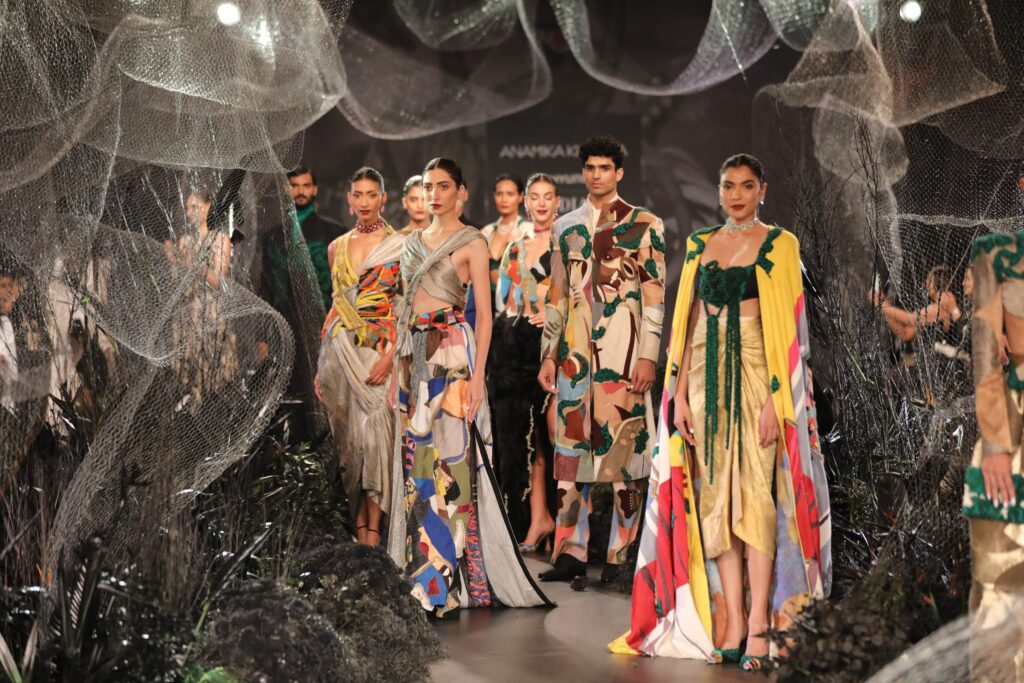
Anamikas 25 year journey has been one of revelation and grandeur, this year too, she brings alive the magic of zardosi and pearls her two constant companions, expressions of love, with some unadulterated charm added by the lithe Athiya Shetty. By Asmita Aggarwal
Past Is Now
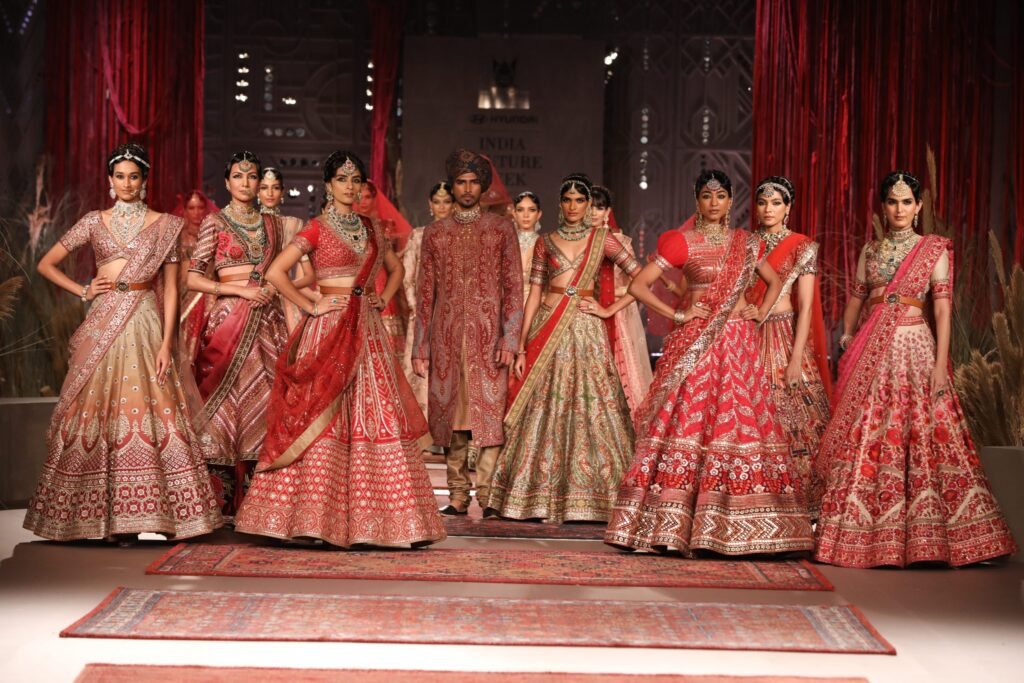
The past always finds an embellished way to catch up with the present in J J Valayas offerings which came drizzling with Sufi music by a live band headed by Sahil Vasudeva and of course some embroidered swans frolicking on midnight blue lehengas. By Asmita Aggarwal