
Best couture becomes an heirloom: Jayanti Reddy
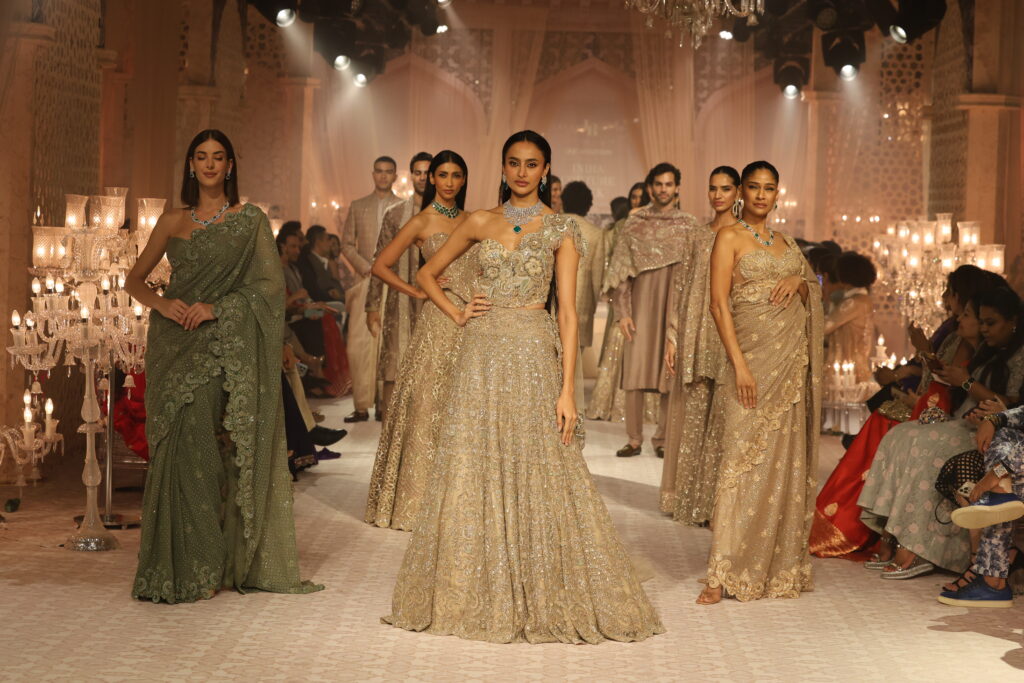
Jayanti Reddy believes good tailoring can be just as luxurious as heavy embroidery, balance is key, as she uses lighter base fabrics and strategic embroidery placement to offer brides unlimited comfort. By Asmita Aggarwal Hyderabad-based Jayanti Reddy has a sense of humour- despite being ferociously private, she says people assume “I’m constantly working or thinking about designs, but that’s not true! I’m a mom to a 4-year-old, that problem keeps me busier than couture does!” People rarely remember every embroidery detail—but they end up remembering how they felt, that’s how couture becomes part of family memories and milestones. “It’s something that’s preserved, not just worn once, that’s what makes it so special,” says Jayanti, who is known for her roomy shararas now a part of every modern bride’s to-buy list. Jayanti completed business administration and marketing from Case Western Reserve University, Ohio. She believes the biggest lesson she learnt coming from an established business family is that your reputation is everything. “Always deliver on your word. Relationships with clients matter more than quick wins. Stay grounded, no matter how much you grow,” she adds. The often-asked question is how every region has its own design language, but she believes both South and North have valued textiles and heirloom craftsmanship. “They just embrace grandeur and occasion dressing differently, Hyderabad has definitely evolved. There’s a younger, global client today who appreciates quiet over loud luxury,” she explains. Couture is made to last—not to be discarded after one season. Jayanti repurposed leftover textiles and embroideries across collections. “I believe longevity is the biggest form of sustainability. Luxury isn’t about ‘more’, but thoughtful decisions and beautiful construction, comfort and craftsmanship. Something you’ll still love 20 years later,” she says. After 15 years she has understood failure doesn’t mean you’re not talented. Fashion is as much a business as creativity, learn from what didn’t work. Resilience is probably the biggest competitive advantage. “My first show ever was at Lakme fashion week, Mumbai. I remember being far more nervous than excited. It was rooted in Indian textiles and craftsmanship. Looking back, I can see how much my aesthetic has evolved,” she confirms. She believes her contemporaries are doing well as there is a space for everyone to grow—Karan Torani is an incredible storyteller, has a strong brand language. Aisha Rao’s beautiful use of colour and prints, while Punit Balana brings fresh perspective and youthful aesthetic. “Banarasi has always fascinated me. We’ve worked with brocades, tissue, silks, zardozi, aari, dabka, naqshi and more. I enjoy taking traditional textiles into unexpected silhouettes. It’s about evolution. And this is what helps moving tradition forward,” she admits. She has admired legends, craft couture over the years- Tarun Tahiliani for his drapes, construction and timeless elegance—he’s influenced generations of designers. “Gaurav for pushing the boundaries of couture. His sculptural silhouettes, innovation and ability to blend art with fashion are truly remarkable. And I have to say, Manish’s ‘Maa’ collection left me completely in awe. It reminded all of us how powerful couture can be when vision and execution come together,” she adds. Men are the new adventurous lot and far more involved. They know what they like, they’re experimenting with colour and layering. Comfort is becoming just as important. They’re dressing for themselves, not just the bride, is the subtle difference she has observed. “This ICW there will be more structure, new layering, softer but stronger silhouettes,” she says, adding, heavy doesn’t always mean luxurious. Sometimes less is actually more. “Good tailoring can be just as luxurious as heavy embroidery, so I’d say balance is key.” She has used lighter base fabrics and strategic embroidery placement. It’s about celebrating Indian craftsmanship in a modern way. Looking at heritage through a contemporary lens. Biggest regret? “Not delegating earlier and trying to do everything myself. You build a stronger brand when you build a stronger team. Trends shouldn’t define couture. The best couture becomes an heirloom,” she concludes.
Farming in Hajipur village to LFW with wool indigo denim
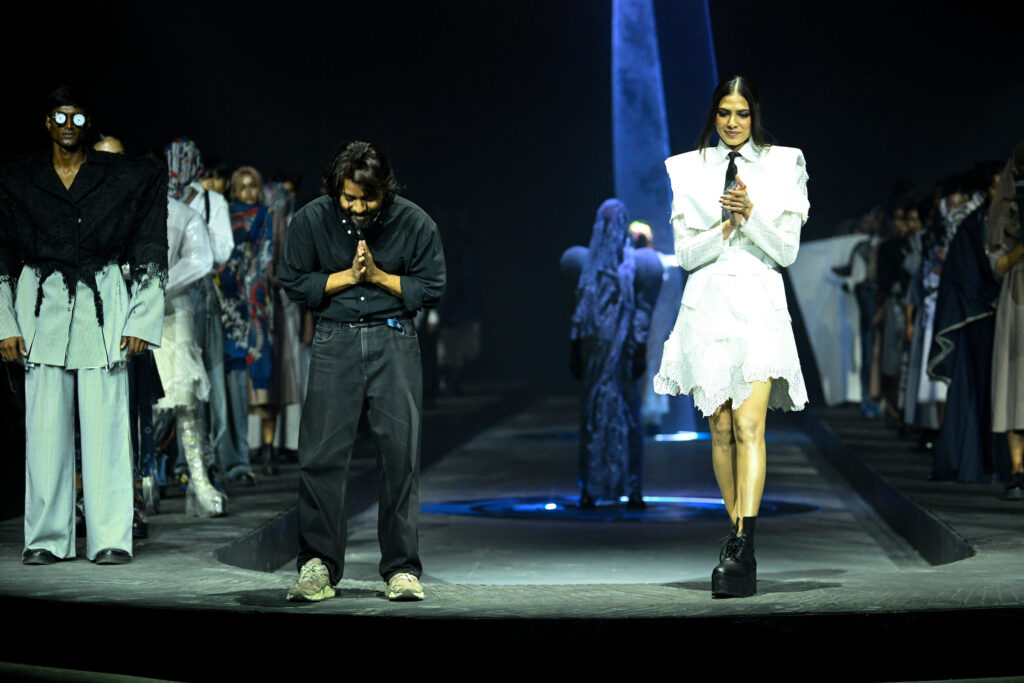
Farmer’s son Satendra Singh and Dilip Singh meet Anurag Gupta to showcase their experiments with indigo dyed wool in IIT Delhi paving way for jeans you can wear in winter, keep warm! By Asmita Aggarwal He is from a non-descript village, Hajipur, tehsil Saipau, Dholpur, on the MP-UP border, in Rajasthan, born to a farmer, his dreams were beyond the fields everyday he grew up watching. Satendra Singh’s school bag was hand sewn at home out of leftover Urea bags that came for crops nourishment, mom used to cut and stitch two handles on them, which went with his blue faded pants and rubber chappals. He decided to work on textiles, graduated from the Indian Institute of Handloom Technology, Jodhpur, and then from Bhilwara did his B Tech in textile chemistry. Cleared the entrance for IIT Delhi, to do his M Tech in textile engineering, little did he know his thesis would take him to LFW X FDCI runway. Can we make denim in wool for colder climates? You can’t wear denim in winter, is there an alternative for it? These were the questions that were swirling in his mind, when he began working with Prof B S Butola, Department of Textile and Fibre engineering, who told him to try indigo dyeing wool, it took two years to perfect this project! “The fabulous part about IIT is it gives you money for research, the challenge was to make denim in wool, machine washable at home,” he says. The product was handloom, wool Merino from Australia, so he decided to show the prototype to Levi’s. They loved it, and saw potential. Indigotex Private Limited, his company, is an IIT Delhi–originated startup, focused on R&D in innovative, sustainable textiles, protective textiles, and waterless technologies to reduce water consumption in textile industry. The company’s first product, IndiWool™️ Denim, is a wool-based, all-weather denim fabric that is machine washable. “Indigotex is developing ECOTEX wool and wool-blended machine-washable fabrics and indigenous lightweight breathable extreme-cold textile solutions (up to −30 °C) for the Indian Army which till now is wearing imported fabrics, in Siachen,” he says. They are funded by FITT-IIT Delhi, SIDBI and Ministry of Textiles. His trip to Bharat Tex he recalls a funny incident, with just his bag, after office, carrying samples, he knew nobody, “any foreigner going into a denim stall I followed and showed them my work, came back to IIT as I had no money.” Indian wool is underutilized as it’s too coarse, almost 70 per cent goes waste, farmers burn it, he says. In his village farming is only 4-5 months, rest of the time no work, in Dholpur, there’s no industry, unemployment, poverty, his idea was to start wool indigo industry there-with his company Indigotex. Designer Anurag Gupta decided to work with new materials like wool denim, for LFW, though his journey began from a village Biskohar, Ayodhya, in 2018, he knew it was going to be experimental. “Covid changed me. I decided I won’t work with craft but do something out-of-the-box,” he adds. In fashion they shy away from innovation, want to play safe as long as it is lucrative, he feels. He started working with knits, when most knitting units were shutting down, no work for them, exports affected due to high tariffs. “Knits are not considered a craft, but I decided to make knits in jacquards—overturned bird eye, ribbed, tuck, which no one wanted to do in small quantities, somehow I convinced them,” says Anurag. His signature though has been deconstruction, adding textures, subverting the template, cutting, slashing, which he says, “wasn’t accepted by clients, it was tough to survive for me. My themes too were unique-manual scavengers which no fashion journalist wanted to write about.” The wool experiment with Satender Singh, makes it softer and the roughness goes out, less water consumption, in more ways than one it is sustainable, also this wool after washing doesn’t shrink. “The surface is smooth and wearable and doesn’t feel itchy! Satendra Singh and Dilip Singh’s collaboration was a eureka moment for me,” he adds. Inspired by 18th century Japanese painter Utagawa Kuniyoshi, Anurag liked his landscapes, women, Kabuki actors, cats, and mythical animals, especially Samurais, seaside islands to dragons. “Fashion magazines make me feel like an outsider, also I’m not a people pleaser, rich privileged kids get more easy coverage as they are in the party gang, we know jugaad, started from scratch,” he laughs. He signs of by saying he wanted to show a film he made on pollution, a video as a brand, how it is affecting human life.
Khadi is subtle luxe: Shruti Sancheti
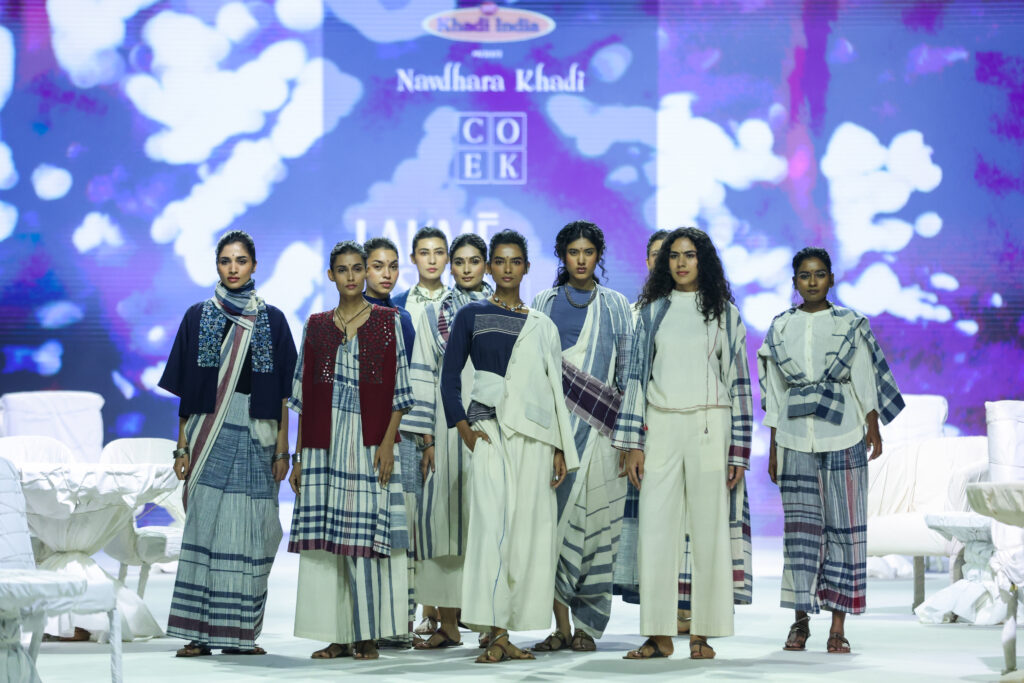
Adding Gond, Warli art, making motifs quirky, weaving magic in handloom clusters of Vidarbha, Shruti Sancheti gives Khadi a new spin to serenade Gen Z with her pret label Across 29. By Asmita Aggarwal When Grammy winning pianist Charu Suri (Shayan, Best Contemporary Instrumental Album, known for blending Indian raagas with jazz) decided to wear Indian handicrafts, it was a hurrah moment as the trench style jacket in Maheshwari silk and tissue was a winner. The beauty of it was techniques used, jacquard, aari, dabka to Resham. In the business of fashion for the last 15 years, Nagpur-based Shruti Sancheti, says the style was Anarkali that resembled a gown, as Charu is from Central India, she added temple borders in Kosa silk that reminded her what her dad gave her mother (she is a Marathi mixed with South Indian roots). “Charu flew me down to Los Angeles, I styled her along with Suhani Pittie jewellery, I used a simple weave, added block prints to insides of the jacket—used Kutch karigiri, Kashmiri stitches, she wanted to look her age not like a fashionista. She depended on me as her fashion acumen was limited but she was sure she wanted to take heritage with her on a global stage, explains Shruti. Showing at the FDCI X LFW khadi showcase, she admits Gen Z associates khadi with a coarse, slubby fabric, mostly for older women, but with better treatments, they have observed it is more fluid, can be made up to 200 counts. “I don’t think Gen Z cares about virtues of Khadi, cool in summer and warm in winter, but the Japanese buyers loved it, so we decided to talk to them in their language—of separates, structured jackets not predictable saris,” she adds. There are many techniques—Nasi, silk or cotton from handloom clusters in Vidarbha, Maharashtra to Geech, or Geech Dana Bandhej, from Rajasthan, she has crafted within the line, working with Dhapewada cluster 20 kms from Nagpur. Her mul-mul cotton comes from Sausar, Lodhikheda, and Mohgaon handloom cluster in Chhindwara, Madhya Pradesh. “Koshti sub-caste of Hindus, specialized in weaving Magtha, patterned borders using Dobby,” she explains. Today there are 7000 weaving families, but only less than 500 families are weaving. Shruti recently launched her pret brand “Across 29” hoping to represent crafts from the 29 states of India, done in textiles, as separates for a younger audience, including the Nagpur check and stripes, more international in its appeal, thinner, originally only restricted to saris, now she has made trousers and shirts. “We did a test drive of it in Paris and were pleasantly surprised at the response,” she smiles. She added Gond and Warli art, but not in its traditional format of women making rangoli, but quirky motifs like dolls walking dogs with sunglasses, or a tiger driving a scooter, she has taken creative liberties to serenade those who are disconnected from textiles. Her book “Weaves of Vidarbha” encapsulates the stories, and tales of the artisans, and their forgotten craft told through woven wonders. In hues of moss green, ivory, charcoal, you can mix, and match the wrap skirts in textured khadi. “Khadi is really quiet luxury, hand spun, time consuming and built to last,” she concludes.
Meet Lambani tribe from Tanda
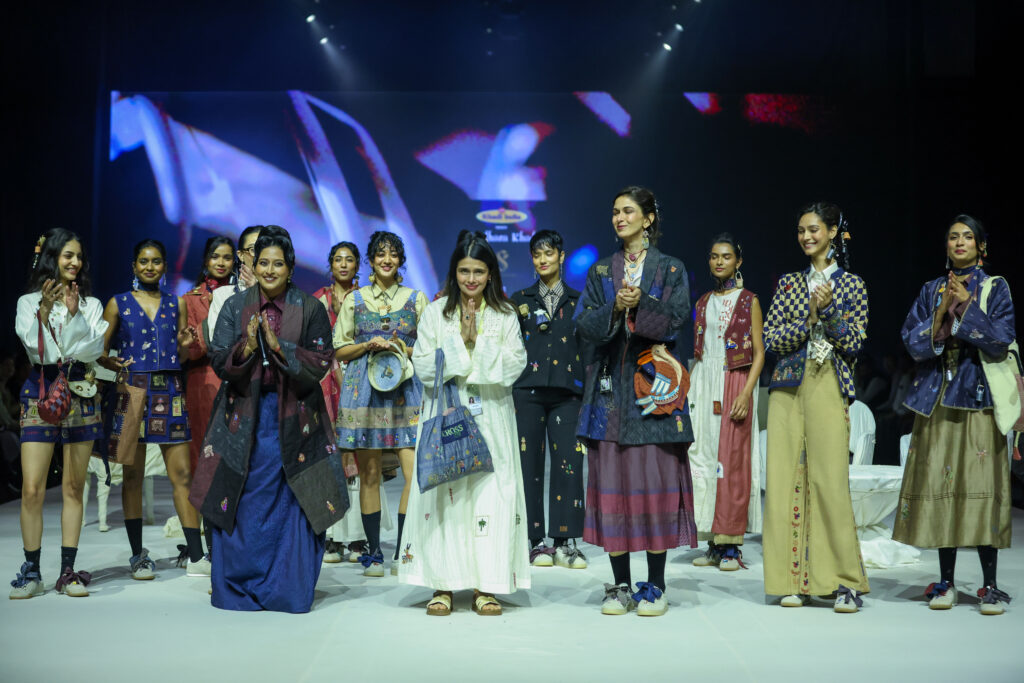
Emblazoned with seashells, mirrors, colorful threadwork khadi gets a cool makeover with tribal women from Sandur’s deft hand work at the FDCI Khadi showcasing. By Asmita Aggarwal The beauty of Khadi is in its enviable properties—summer cool and winter warmth, when you combine empowerment and women artisans in this mix, it becomes a movement of sorts. Sandur Kushala Kala Kendra (SKKK) has tied up with Co-Ek, (Centre of Excellence for Khadi), an initiative by the Ministry of MSME and KVIC, attempting to make Khadi young, cool and fresh. SKKK is working with tribal Lambani women from Tanda of Susheelanagar, a nomadic community, almost 500 artisans, hoping to make them self-reliant. Further the Khadi Commission equipped them with handlooms, Ambar charakas, so this year at LFW they will be showcasing their cotton khadi—hand spun spinning, weaving, and natural dyeing. Villages of Yeswantnagar, Krishnanagar, and Sandur, is using Ambar charkha, with 76 skilled women executing intricate Sandur Lambani embroidery. SKKK has worked to preserve the Lambani craft, won the UNESCO Seal of Excellence for Handicrafts in South Asia and has the Geographical Indication (GI) tag for “Sandur Lambani hand embroidery”. The inspiration has been nifty checks at Victoria and Albert Museum; here is the twist rather than uniformity they added surprises in the warp and weft. This was executed by the Devanga weaving community, artisans with 40-year experience who previously worked with the Karnataka Khadi Gramodyoga Samyukta Sangha, Hubballi, the only BIS-certified national flagmaker. “We have worked with Bijli embroidery, ‘lightning’ work, reflective, has a sparkling effect. It is space dyeing, with a chambray effect, looks complicated, but is simple,” says Nargis Zaidi, head, Apparels at the Centre of Excellence for Khadi. The Khadi unit currently employs around 98 weavers, but most clusters are set in their ways, hesitant to experiment, adds Nargis. The Lambanis use vivacious hues, red to indigos, but Co-Ek has toned them down, offering classic shapes, kedia tops, reversible jackets. “There is an increased awareness amongst youngsters about hand-made, hand embroidered, it is like a limited edition sneaker for them in some ways,” adds Nargis. Shruthi Muniyappa from Sandur Kushala Kala Kendra, says, “2023 a Guinness World Record was set at Hampi for the largest display of Lambani items. Artisans are skilled at block printing, and khadi production, our attempt is to make women breadwinners.” The patch work embroidery, mirrors and white metal jewellery along with seashells, intermingled with coloured threads makes each piece unique, as it carries 500 years of legacy, when they moved from Rajasthan to South India for trading, in Karnataka- 16th century!
Anamika to support 101 artisans
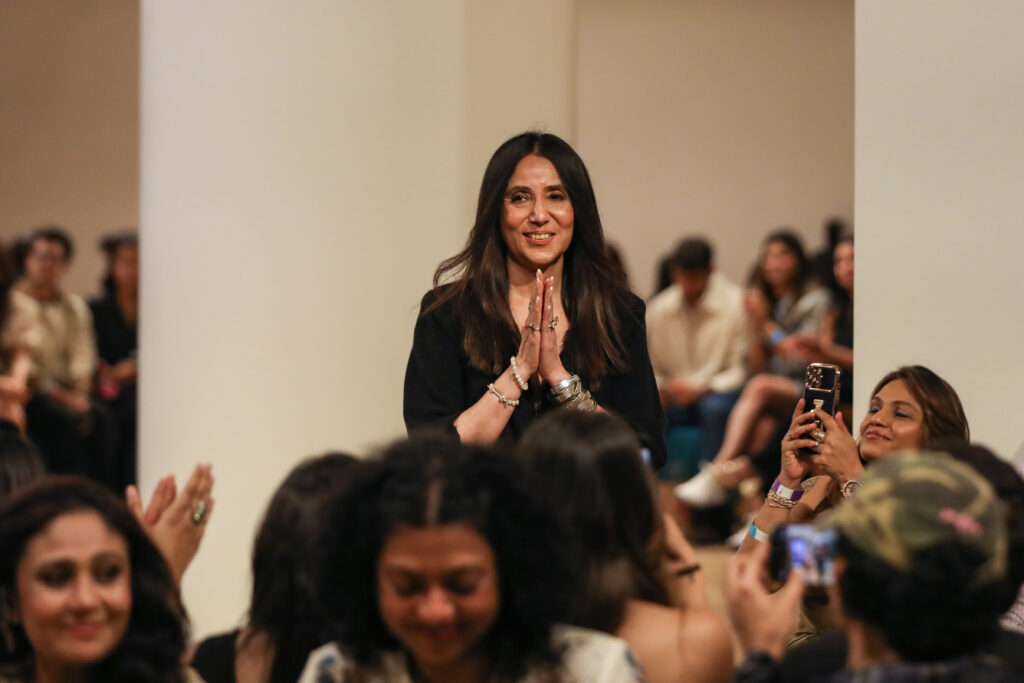
She is a tour de force in fashion, most sought after but she is wanting to give back generously, by making artisans from various clusters in Gond and Pichwai self-reliant, that’s her mission for the next three years. By Asmita Aggarwal Anamika Khanna has been a trooper of sorts ever since she won the Damania Award in 1995, her journey has been interesting in more ways than one. “I didn’t know then what was even one meter of cloth,” she laughs. Today she is Sonam and sister Rhea Kapoor’s go to! So, when she went as a newcomer to London Fashion Week, “putting yourself as a new label AK-OK was a challenge, we got an overwhelming response”, says the Kolkata-based guru of meaningful details. Though she was impressed by the working style, professionalism in London, it was simply “humbling”. At AK-OK, which she is showing at LFW X FDCI is for her “what we dream we do, hoping to offer global pret, this product has the wherewithal to become that”. Couture is hand crafted, we can’t compromise, completely hand done, nothing digital, even the jewellery perspective is Western with an Indian soul, wear it in New York or Dibrugarh. “We mix ancient temple motifs, with contemporary acrylic, 3-D printing, and two dynamic materials. I’m having a lot of fun with AK-OK (began when she was unwell, her twins would ask her AK- are you ok?), it is limitless, feel like a child in a candy store,” giggles Khanna. Though the designer now wants to give back, her new project is making women artisans 101 (she doesn’t know how she got that number in her mind) financially independent-craft clusters over the next three years. “Let’s say the Gond or Pichwai artisans, the idea is to spotlight them, as I use their craft in my bridal wear, hoping it brings awareness to the clusters and make women self-reliant. This will be a recurring initiative not a one-time passion but will continue,” says Anamika. Her fame has crossed borders, European Commission President Ursula Von der Leye wore her fitted bandhgala satin silk self-on-self, handmade embroidered on Jan 26, this year. “I knew she would like something like that, seeing her crisp no nonsense suits,” says Anamika. Her more recent love has been double ikkat Patola, sometimes she uses it as a traditional sari, other times as a base to enhance different experiments, mixing it with lace and Banarasi. Patola is sourced from Swadesh (Reliance Foundation to support master artisans like Kanubhai Salvi and Hema Patel, GI-certified handwoven in Patan, Gujarat, almost 750 years old). Though her one desire remains unfulfilled– to dress the iconic actress Rekha, her beauty frozen in time, “she would look ethereal in our organza sari, wouldn’t like to alter her look, or personality,” says Anamika. Dressing Rashmika Mandanna, from Coorg, in a rust-orange silk saree with a bold red border inspired by “Deccan Temple” embroidery in antique gold for her D day with Vijay Deverakonda. “We had to tone down the brief, or it would look like a costume, not too ethnic India,” she clarifies. It took two months to create, several months for R and D, as “research couldn’t be random”. She explains how concepts varied from shikar; they indulge in down South motifs for Vijay as well as South temple structures for the veil for Rashmika. Her two boys have made a place for themselves outside the shadow of their mom—Viraj the shy twin is an artist, Vishesh, has a master’s degree in design from Central Saint Martins. “He is in touch with Gen Z, I don’t know them, this is a big advantage, so I listen. He is the one who sent me sketches for menswear and I really respect his opinion. We three are good for each other,” she says. Her LFW line is an homage to flowers she loves, like Coco Chanel, her obsession with camellias, plus she is looking at an alternative to fur, vegan and sustainable. “We have explored knits, versatility is the key here, Japanese fabric was added for the first time, denim was cut and slashed last time, this year we have taken a detour. I work with my instinct to design for women, knowing what they want,” she signs off.
Kala Cotton adds character
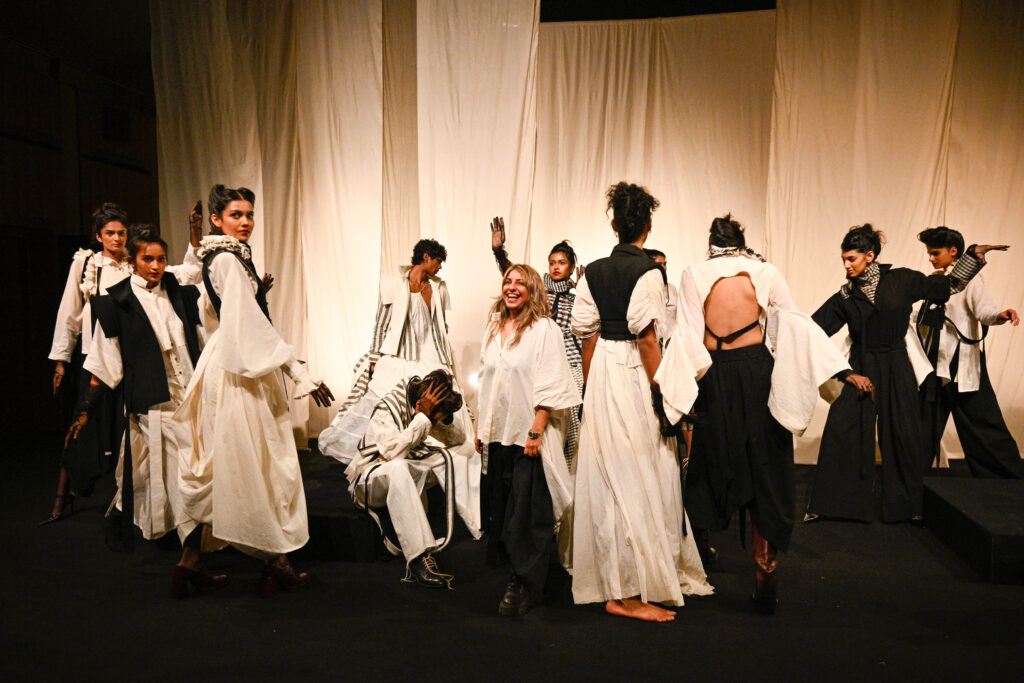
Sohaya Mishra is a 90s girl, she has seen the transformation from Doordarshan to AI, with Chola, she attempts to offer kala cotton with detachable Victorian collars. By Asmita Aggarwal Goa-based Sohaya Mishra is closely related to Nepalese actress Manisha Koirala, the doe eyed wonder who wowed us all in “Ek ladki ko dekha” by Vidhu Vinod Chopra in 1942-A love Story. Mishra is not new to this crazy world of fashion—she started a stylist in Channel V, after a master’s in psychology dressing VJs who were style icons. Yudhishthir VJ to Pia Rai Chowdhary, Ranveer Shorey. “The fun in all this was no internet, only using your wits and vision, trusting your judgment and instinct. It was generally my ideas, worked closely with tailors, remember this was the 90s no Pinterest or chat GPT,” she laughs. When she made VJ Anushka Manchanda wear a big, pink quilted jacket, paired with pants shouting with 100 buckles that moved up and down as she moved, she knew she had broken the template. “I’m petite, I would stand on a stool to dress Gaurav Kapoor, VJs really defined fashion, music and style are soulmates,” says Sohaya. She tried her hand at Bollywood styling but felt it was too chaotic, she attributes it to her being too young and inexperienced, and couldn’t grapple with Hindi movie world complexities. “The 90s was analogue now it’s Doordarshan to AI, completely digital, impersonal and somewhat scary, deep fakes are fearsome- what’s real and concocted, line is blurring,” she admits. Her label Chola, which goes by her pet name, in its 11th year, channels the ideology — edgy, not boring, not trendy but comfy, well made, breathable, oversized. “Initially things were simple, I have a 6-year-old son, I wanted the slow life and Goa offers that. I didn’t want him to be around an iPad, but beaches, sunshine and sports,” she laughs, adding “who knows next there may be interstellar travel?” Earlier, Sohaya was consumed by deconstruction, now it’s frilly and feminine, sharp and tailored sometimes, reflecting how she changed as a person. “This year at LFW X FDCI I wanted to pay homage to monochrome, not thinking of colour. I like waking up to fields, calmness of the ocean inspires me,” she adds. Quilting is her favourite along with fabric manipulation, along with kala cotton, Jamdanis to Chanderis offer character in clothing -backless shirts, Victorian removable collars, detachable drama, pedal pushers. “My clothes are unisex, why can’t men wear skirts?” she concludes, adding, “I make clothes I wear, no embroidery or embellishment, just pure fun.”
Veshti with a tuxedo-Anyone?
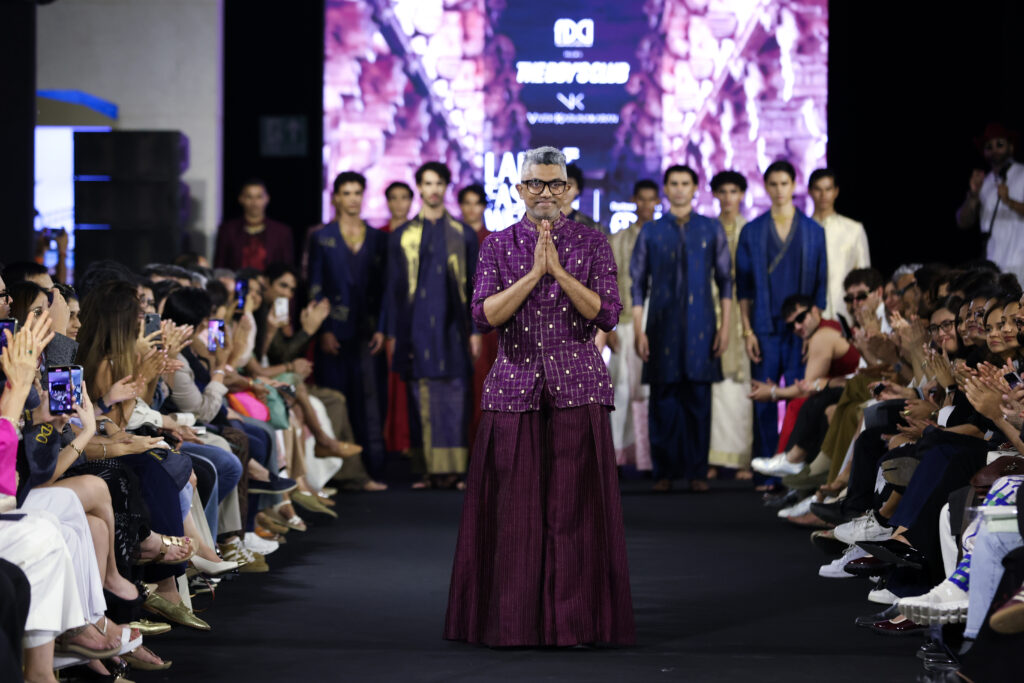
The veshti has found unadulterated love—now it can be worn with silk kurtas, bandhgala et al, Vivek Karunakaran shows us at FDCI Boys Club show at LFW! By Asmita Aggarwal Veshti is in and how! This culturally rooted piece of attire has found a new life with Gen Z adopting it, Vivek Karunakaran believes he has been a catalyst of sorts. “Whether it is lungi, dhoti or veshti, it has been reimagined, North Indian wear it uniquely, down South, or Sri Lanka has its own versions in sarongs. This rectangular piece of fabric is now a red-carpet staple too,” he adds. Vivek is a designer who celebrates his heritage and the Chendamangalam sari, hand woven cotton sari from Ernakulam, Kerala with its puliyilakara (tamarind leaf border), a thin black line that runs with sari’s selvedge, extra-weft chuttikara and stripes-checks of varying width. Vivek works with many such woven wonders in fact reveals that Ram Raj, a South Indian brand has been promoting Veshtis, extremely popular, in Bollywood, Kollywood and even Mollywood. Abhishek and Amitabh Bachchan wear lungis which has again brought the spotlight on it. In Chennai Veshtis are worn in silk, Kerala in fine muslin (Mund), border is in zari (kasavu). “In Chennai it is in Kanjeevaram, tissue, silk and thin pinstripes. We have checkered ones with zari inserts. In fact, in Kolkata we did a pop up, veshti we teamed up with a tuxedo, did very well,” he smiles. This drape evokes a sense of nostalgia, there is an emotion associated with it, veshti also comes with co-ords or a silk kurta, or shirt, a bandhgala and a kamarband, sounds crazy but it’s beautiful, he chuckles. “If you notice how Rashmika Mandana and Vijay Devakonda wore their heritage–veshti, gold and temple motifs, elegant yet luxe,” he adds. The 40-50 age group has it in their wardrobe, but Gen Z maybe needs to go for the stitched ones, like the pre-stitched sari. “Hyderabad is really the Delhi of the South, less is more doesn’t work here, they have a strong visual aesthetic: love zari plus texturing. Having said that South Indian bling comes with an in-built grace, Delhi’s a bit loud,” he laughs. His latest line for Lakme Fashion Week X FDCI “Thangam”, or “gold”, channels the feeling that he is the cultural ambassador of the South. “My grandma saved something in gold for my mom, it is vintage, she told my mom to pass it on to me. Gold is not jewellery, it represents permanence, reminds you of precious moments,” he says. His love for Tamil script has only grown over the years, it is one of the oldest in the world, starting with his line “Idam”, wearing it on your sleeve, literally and metaphorically. “When you see Tamil script on the back of a bomber or jacket, it makes you curious, conversation starter, everything has a deeper meaning,” he adds. Fascinated by “Thirukurral”, by 18th century Tamil poet Thiruvalluvar, his 1339 passages on how we should live our lives spoke to Vivek. His jackets come with words of wisdom “There is a space to grow with humility” or “Choose your work carefully as it’s going to be the biggest passion of your life”. Though his ingenious innovation on Madras checks is engaging, he created hand blocks and converted them to checks, printed them, even though many American brands have used it as “exotic India” trope; traditionally they are used on cotton lungis. “This draped fabric is frankly unisex, if you notice carefully, it has the jasmine placement embroidery on the elbow reminding you of the time when you go a temple and the flower seller outside measures the garland for the Gods inside, by elongating it till his elbow, and then cutting it. It is not a logo on the chest, it is a story we are narrating,” he explains. For women his veshtis came in silk with applique and translucent borders. “We dressed a bride in Sri Lanka with a red organza veshti and jasmine embroidery,” he concludes.
Pondicherry, French, silk velvet printing
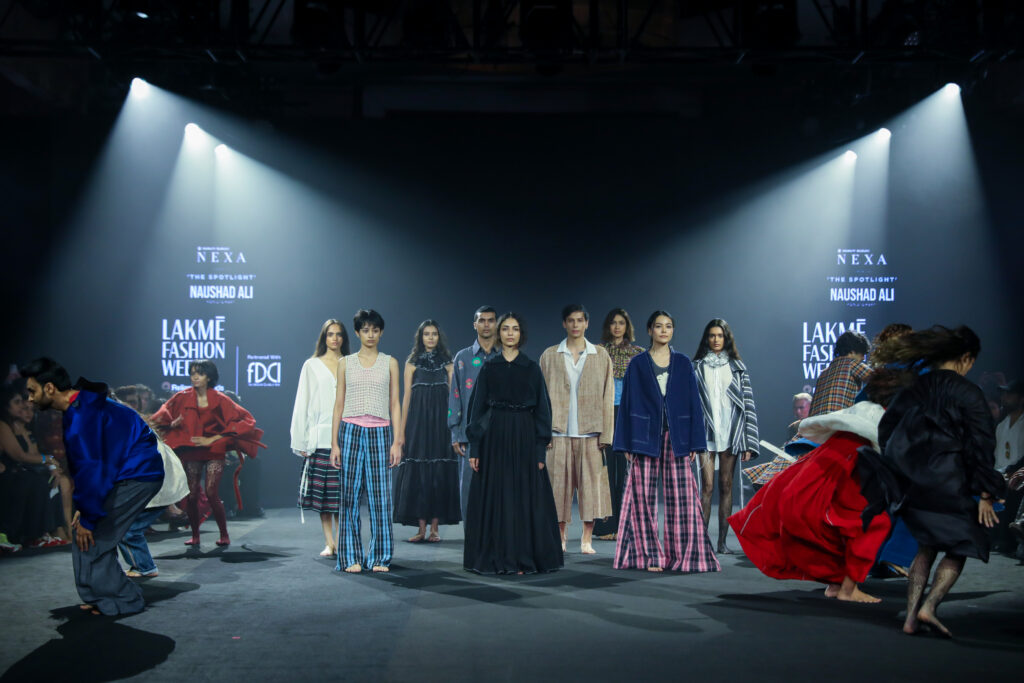
Craft-soaked Bandhini to experiments with Chikankari, Naushad Ali adds a European influence to Indian textiles serenading a global buyer. By Asmita Aggarwal His father is a textile merchant, based in Pondicherry, so Naushad Ali grew up surrounded by fabrics from Bengal to Orissa, he would sit on the bundle and watch TV as a young boy. His interest grew to study fine arts, and cleared NIFT Chennai, where he studied textile design. “Auroville had a huge influence on me—specially its multi-cultural approach. The predominant French influence, people from different nationalities co-existing teaches you how the world has no boundaries. When I began my brand, I knew it had to be global,” he adds. He believes there is a lot of misconception around textiles, it is only restricted to Indian wear, but you can channel French elegance with a kurta. “A lot of my friends shut down businesses in Covid, it is an interesting and challenging time, every day I see new brands on Insta, who will survive only time will tell,” says Naushad. Celebrating ten years of his brand, the NEXA spotlight winner, believes his USP is showcasing textiles in a refreshing way, just like the poster on his office wall, “Why should sustainability be boring?” He keeps researching, when he takes up a craft, admits, “when you buy from us, you know its depth, like our Chikankari, we have introduced it with a stronger identity, used in a contemporary way. Just like Bandini and indigo, two of our signatures with a distinct European influence,” he explains. The play is in the motifs rather than the conventional paisley; it is more global in its appeal and demeanour. “We live in one world due to Insta, but I maintain the dignity of the technique I work with, though the result is a cocktail with my interesting ingredients. I fear monotony, each piece must not be repetitive,” he says. His experiments with silk velvet printing, maintaining the consistency of the ink, became his bestseller. “I am a Tamilian, grew up in the South, if you observe Indian women, while shopping at Nalli, they know their saris, quality of gold, and are aware of what they are paying for. Same with Bengal, women value crafts, and culture. After all, fashion is a desirable product, it must 100 pc look good,” he explains. LFW X FDCI 2025 he is focusing on yarn dyed indigo, denims hand woven in Bengal, South Indian checks from Madurai, without abandoning his USP Jamdani. “Now I see a uniformity in dressing, everyone looks the same, but a white shirt can look different depending on the personality of the wearer, and most importantly region-South to North,” he confesses, adding people used to dress for themselves in the past, now that spirit is lost somewhere with social media onslaught. Interestingly, he talks of the rising culture of thrifting, like the jacket he made for his Pondichéry based French client Vincent. His son wore it 10 year later and sent him a picture, the key is trendless clothing, it may lie in your cupboard, but is never obsolete. “We wanted to open with contemporary freestyle dance to establish a connection with the clothing, channeling the spirit of exchange of garments act on the ramp. We all love dressing each other, there is joy in it,” he explains about his presentation. Does one need money to survive in fashion? He has an engaging hypothesis—you can be privileged to inherit dad’s burgeoning business, but have zero design sensibility. “Creativity and commerce must co-exist,” he reiterates, adding, “I like to address the feminine side in menswear, embroidered silk shirts, gender fluid, simple tailoring, spotlight on fits. The future is responsible fashion, that withstands the test of time,” he concludes.
Who needs a showstopper? asks Ankur
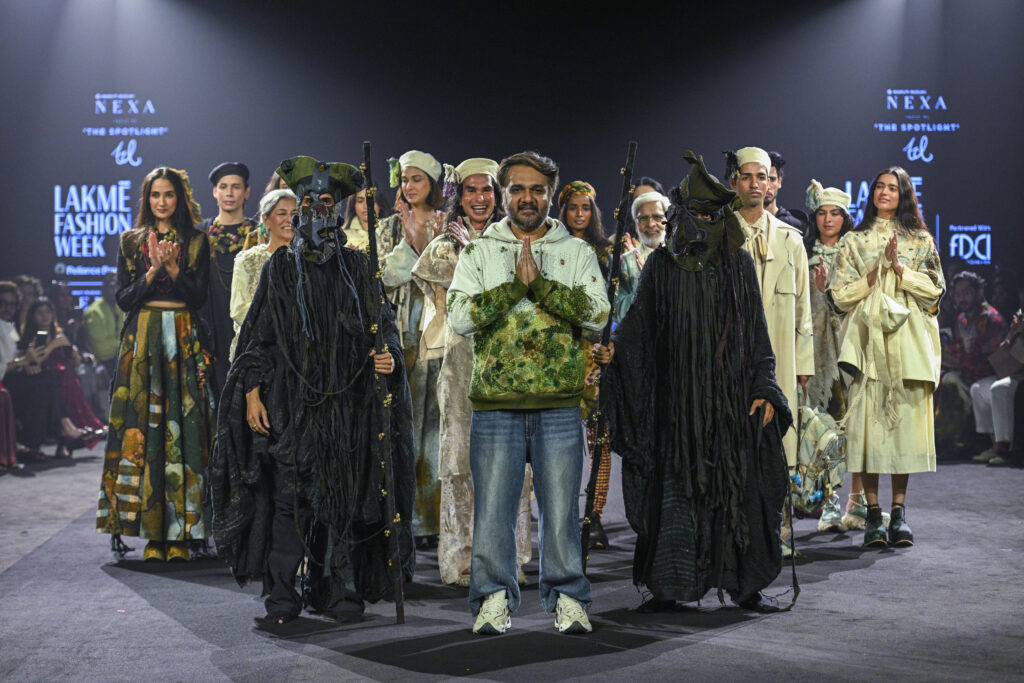
Converting waste into textural garments with a strong sense of identity, Ankur Verma of Til tells us, 3 months to craft one cape, several artisans create magic with just the power of discarded fabrics. By Asmita Aggarwal If experience counts for anything in life, Ankur Verma of Til would be the flagbearer. From Bottega Veneta to Armani, Sabyasachi Mukherjee to Varun Bahl, Ankur Verma has been there! Sometimes a “pause” in life helps you rethink, and re-access, thus his line “Breathe”, though he is gearing up for the Fashion Trust Arabia, representing India in Doha. “Til” the moniker for his label, or body textures— wrinkles, freckles has been his muse, though vibrancy is in his DNA, this time he channeled a softer palette—ivory, blacks, beige, combined this with patchwork, upcycling and created something new from something old. If you look closely, there are artistic traits in him that he employs to make things other than fashion—like the Doll house, completely made from waste—including cushions to sofas, furniture. It started as an idea for his six-year-old daughter, ignited the desire to take it forward by making dolls, charms, jewellery, even brooches. Intermingling organza and sheer, an easy line, with textural layering, experimental and innovative. This is despite the fact he admits “capital backing is not strong for young designers, this kind of work needs a lot of investment. It is entirely done by hand, one installation took three months to craft as it is laborious. “We used zardosi technique and the most expensive item I have in my collection is almost Rs 125000, a fully worked on jacket. Believe me when we started it was tough to sell something completely done by hand for Rs 22,000! Now there is a sea change in customer understanding,” he admits. From the pintuck kurta he wore, to creating garments entirely out of waste, it is free size, like the cape shawl. You can throw it on anything—jackets, sari, and even roomy pants. Nexa is celebrating its tenth anniversary, and they have selected three past winners Naushad Ali, Ankur Verma and SWGT. “Fashion is not just about lehenga-cholis, this doesn’t represent our culture. Look at how streetwear is burgeoning, hoodies to track suits, who would have thought this would ever happen?” he asks. People in India go after tags, “Made in Italy”, “Made in France”, what about Made in India? Isn’t there pride in this? he questions. “I’m old school, I do not browse through shows sitting on my couch. I believe in personal touch, you cannot see detailing online, even if you zoom in. I do not want to spend on photoshoots to serenade my buyers,” he says. Men, he believes are experimental, most of his women’s wear is being adopted by men, a corporate honcho inquired if Ankur could add collars on a woman’s jacket so that he could wear it! “My Afghani hoodie kurta is unisex, much loved,” he adds. One of the few who believes celeb showstoppers add nothing to the show, that’s why he convinced his 72-year-old father to walk the ramp again, both age inclusive and breaking boundaries of the “ideal face”.
Sari dress anyone?
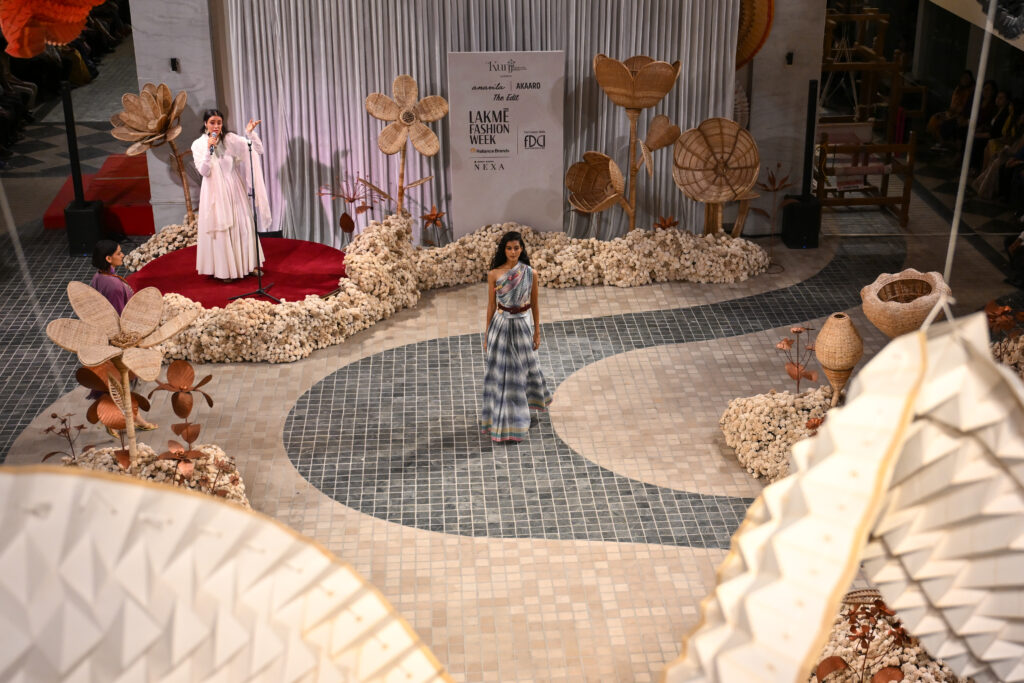
The opening show of the LFW X FDCI by Anavila Mishra and Gaurav Jai Gupta along with in house designers from The Kunj displayed the prowess of the sari, which is now not restricted by pleats and palla but has found a new disposition—jackets, Obi belts and knots. By Asmita Aggarwal Imagine being surrounded by art, culture and heritage, at the first glance at the roof of The Kunj, by the Ministry of Textiles, you are smitten by saris Ikkat, Pathani, Kota Dorias, Mekhla Chaddars, Narayan Peths, Sambalpuri to Maheshwaris, draped in Origami, by the inimitable Ankon Mitra, as you glance up. The waft of mogras on your wrist, and the cobbled ramp complete with wicker flowers, could there be a more befitting opening for the FDCI X LFW? After all, India is a nation known for its hand work, intricacy, and design thinking. The carved wooden pillars Chettinad style strike you, with their austerity on all three floors. Though everyone’s favourite undoubtedly was Suhail Bhan a Kashmiri Pandit, who has been perfecting the art of Bharatnatyam, setting the flow with his dexterous presentation. “I started learning dance when I was 12, learning from Justin, an American! I practise two hours daily, and teach also. Some are surprised to see men dancing, but they look so beautiful, it is an altogether different energy. Today there was more improvisation, as we danced for 20 minutes. Dance is about grace, control, and expressions, as well as how you involve the audience in your journey. I sing also, learnt for a year, it helps in dance,” says Suhail. Live music by classical singer Deveshi Sahgal began the opening show by Anavila Mishra, muslins and her unabashed love for whites. But what’s new is the sari is no longer being worn with palla and pleats, but jackets. “Sarmast”, references the Deccan, from the state of Wajd, thus the ode to handwoven linen, but it was a joy to see the Kerala Kasavu sari rubbed shoulders with pant suits on the notes of Aaoge Jab Tum by the inimitable Ustad Rashid Khan, an eternal fav. Saris came with Obi belts, trench coats, roomy Japanese jackets, telling us there are many ways to wear them. Blush pink looks fab in handloom cotton, as Kimono-style jackets revved up saris, lace bows in the hair completed the look. The show had “The Edit” by seven in-house designers of The Kunj curated by DC Handlooms Amrit Raj. “The look that we presented was entirely woven from waste like all our products, we showed styles on a male model, but all four garments are unisex. The kurta is a kurta dress, then a two-way top, jacket was reversible. The Kunj has been a great place for us to meet customers, and design for them accordingly, generating this level of work with artisans. We upcycle other people’s waste, this is my first experiment with B 2 C, it’ll help develop a deeper relationship with the customer,” says Bhavya Goenka of the label Iro Iro. Pedal looms we have used, natural dyes, extra weft technique to weave waste, Rohingya refugees have embroidered on linen. Interestingly, the belt has arrived and so has the long jacket, the broader the better, the Kutchi mirror work jackets, Ikkats in maroons, traditional saris draped almost sinuously around the body, pleats misplaced and palla disappearing, gave a peek into how innovatively the sari has metamorphosed.