
Upcycled Shimmer
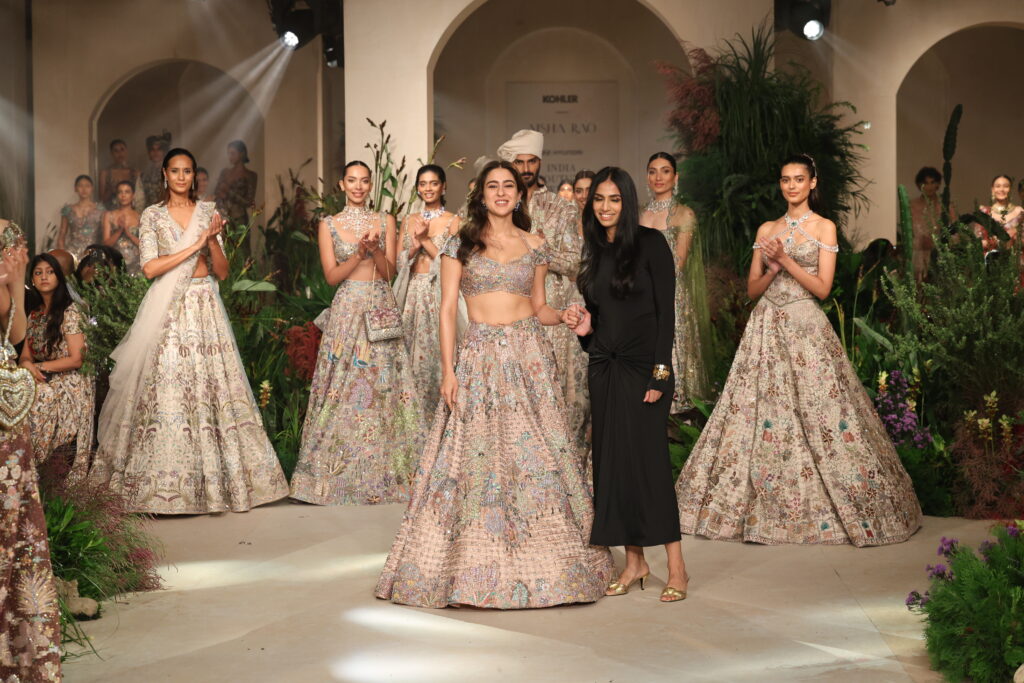
Hyderabad has emerged as a competition to Delhi-Mumbai for couture, even though the lawyer turned designer believes going green can be possible in couture! By Asmitaa Aggaarwal She is a lawyer, who always had an interest in environmental law, and decided to mix her two passions –legal eye with fashion. Upcycling, applique to molten metallics, Aisha Rao, from NUJS (law) to studying in Barcelona Istituto Europeo di Design, IED and then garment construction at Parsons New York, she knew her heart was in making clothes that bring out the vibrancy of India, its unabashed celebrations. Showcasing her line “Wild at heart” at the ICW for the first time, she has said ‘no’ to plastics for a long time, and was in fact debating whether she really wants to work in fashion, known to be the most polluting industry in the world. “Whenever you cut a bias skirt, there was a lot of waste generated, along with this was when we used sequins, bugle beads, bullions on the ‘khaat’. We wanted to find a way to use both these and we did, by upcycling them. I wanted to make a viable business, but reduce carbon footprints,” says Aisha. And of course, a degree in law always helps—specially when recently Bloomingdales sent her a contract she was able to maneuver dexterously. “Brides don’t understand the concept of waste, all they want is to look pristine,” she laughs. Mother of two kids, Aisha often finds inspiration in their stories, like Roald Dahl’s Matilda to Paper dolls, though Indian couture is enjoying the spotlight, with China slowing down–Ambani wedding, Prada introduced Italian version of Kolhapuris, LV embroidered bags. Sabyasachi Mukherjee has stated, he would like his jewellery to not be locked up but worn on linens and skirts. Plus, couture is now functional, not just about heavy lehenga cholis. “We are doing dresses you can wear at your friend’s wedding, the crystal one-piece blouse can be teamed up with palazzos, traditional peacock motifs top this is now your companion to a date night draped skirt,” she says. Couture was earlier reserved for the OGs, very tough for young people to break in, it is also manpower heavy and super expensive, till now Delhi, Mumbai and Kolkata were hubs the South largely ignored. Two designers have broken the glass ceiling and given Hyderabad, a great representation—Jayanti Reddy and Aisha Rao. “I have always loved the Banarasi weave, this year also it finds a representation, in my collections, pure gold zari saris in Kanchipuram. Girls have a mind of their own, they will wear a tiny beach blouse, but mom-in-law still prefers classic woven sari,” she laughs. Her kasavu tissue saree, zari with satins, have done well, for cocktails, to white weddings. “We did sequins overload in the Barcelona line, as an ode to Antoni Gaudi, the acclaimed Spanish architect, I’ve always wanted to tell a story,” she affirms. This season Aisha offers jackets with bustiers inside, a sweater shape you can add over your lehenga, with a smattering of aari work and zardozi. “I’m sitting in Hyderabad, so Bollywood is tough to crack for me, though what celebs wear is aspirational, gets instant results, when a lehenga sells in volumes, it is good for business,” she says. From palms, peacock colours, chintz, maximal flora, lush teak berry, there is a little bit of Aisha in each piece she crafts, “of coursen o lehenga comes within a pocket as that was my pain point at my own celebrations,” she concludes.
Tara Sutaria swathed in gold
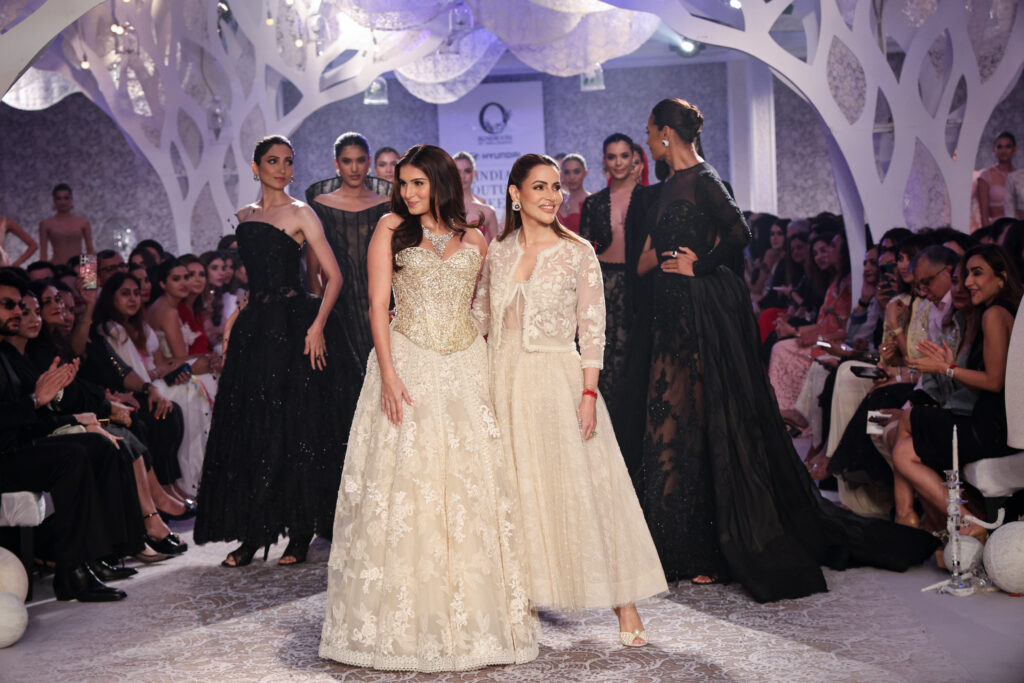
Organza-lace saris, to jewel tones, Isha Jajodia’s Roseroom, channels femininity to self-love and frees you from weighty embellishment as her 18 k gold plated corsets tell us heavy metal is in! By Asmitaa Aggarwal It was a set that kept the mood light and frothy—white, lace, dimly lit, as velvety carpets channeled luxe along with silver candle stands gracefully placed. An army of eager cameramen, pouts, sea of kitten heels, Herve Leger style bodycon dresses, off the catwalk (there in), gave competition to the dainty lehengas armed with sporty jackets, capes, gilets, and a whole lot of quiet glitter that Isha Jajodia gave us for ICW 2025. Bonus: there isn’t one way to wear a lehenga, and yes you can add a little drama with lace trails and charming pearls dancing on lehengas. Isha decided to give us doses of time travel, with 20s flapper dresses with swinging beads, flaming reds, draped skirts moved around lithe thighs of Archana Akhil Kumar (she’s a timeless beauty), and corsets sat around toned bodies. In this subtle mix was Bollywood beauty Tara Sutaria preening, looking delicious in a gold corset. “I love lace and white, corsets are very flattering, they make me feel feminine and elegant,” said the actress. This one took five months to make, and declared that a modern bride is very cool, ready to break norms. Your dreams of being swathed in 18 karat gold plating has come true! Corsets, made in Paris, designed by Isha Jajodia, known for her love affair with hand woven lace is giving intrepid women a taste of heavy metal. With changing ideology, couture is adapting—femininity, romance, drapes have become the frontrunner of expression winning over the earlier heaviness of zardozi. “Whispers of love” is Isha’s ode to self-love, the woman she was, to the woman she is becoming, kind of notes to herself. “It is a line born out of love and longing, as I am at a time in my life when I am at ease with everything,” she smiles. For ICW 2025, she confirms things happen, as they are willed, a divine timing unfolds, thus you can see the softness yet strength in the line, as some pieces have no embroidery. With her travels to Paris, Hong Kong, Dubai, she only fell deeper in love with timeless pieces that can be worn as heirlooms. “It has taken us six months to create corsets, gold with ivory pearl embellishments, almost elevating them to a piece of art, speaking intricately,” she explains. Corsets enhance a woman’s curves, you can wear them with almost anything-dhoti pants, palazzos, draped skirts, lehengas to traditional saris. A vacation picture taken ten years ago, of an intricate door carving found its way on to the corset, in Paris that she revisited; even though she fails to recall the decadent palace, the memory of it stays alive. Organza silks and chiffons, can express the story of pastels and jewel tones, but Isha says clothing needs to be ageless. She has an advantage—her son is 19, to her husband’s children in their late 30s, her friends in their 40s give her enough exposure to varied tastes. “Comfort even in occasion wear is primary, you can wear a skirt not a lehenga later with a tuxedo jacket. Now there is multiplicity of use,” she explains. Her gowns with bustles, extensive use of boning on skirts, head veils complete the look for a chic modern bride. “I design for a bride who is self-assured, doesn’t shy away from expressing what she feels,” she adds. With the influx of Instagram, its far and wide reach, brings with it the definitive celeb angle, even though she believes a showstopper is overhyped. She chose someone who is from South Mumbai, not so much in the news, has quiet elegance so it worked well. “Anything an actress wears works, like the ivory and ice blue gown on Jacqueline Fernandes still does well, or the minty hued pre-draped, organza-lace sari with an embroidered bralet, as well as the introduction of red-hot pink this year,” she affirms. The digital invasion gets at least 30 to 40% business, especially from social media, even if there are 20 orders a month, it makes good business sense. Though couture needs a more hands-on approach. “Insta has really upped our game, we have orders from different parts of the world, recently one from Bermuda, most unexpected,” she concludes.
After 25 years “waste is gold”
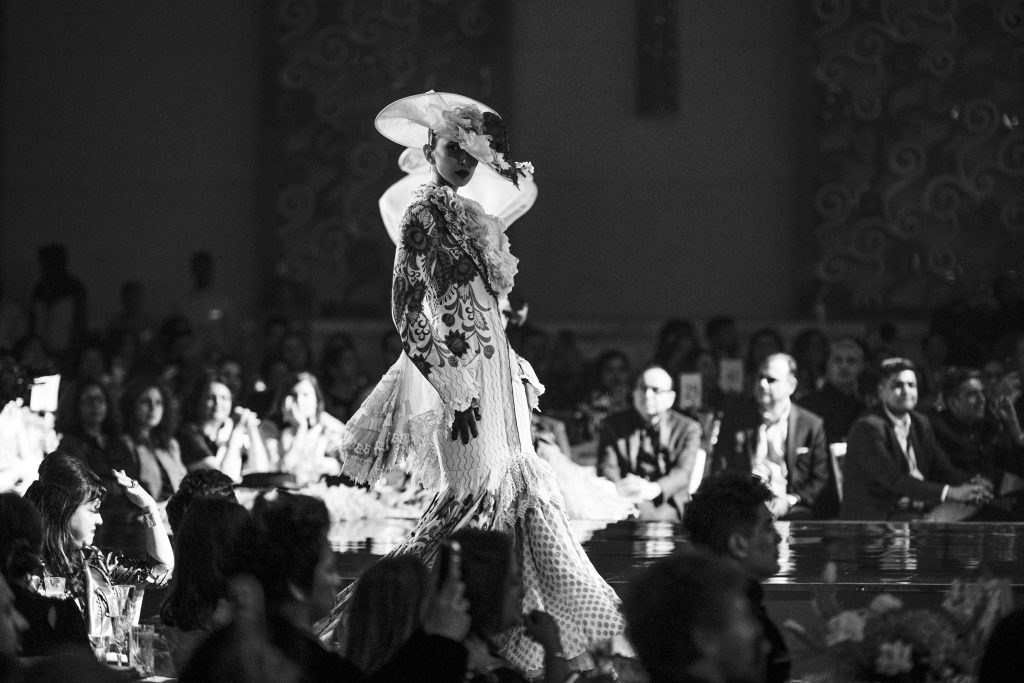
As fashion celebrates its silver jubilee, what is clear now is —sustainability is the only way to go forward, and designers have already taken the lead! By Asmitaa Aggarwal It was a reunion of sorts, designers came in droves, some who had not been seen for over 20 years—Anshu Arora of The Small Shop to Raghavendra Rathore, Ritu Beri, Monisha Jaising, Nikki Mahajan, once doyens of their field, today reticent. FDCI X LFW got them together—after all it was the time of celebrations—25 years of the fashion world! The Jio Convention Centre, Mumbai was where almost 300 people congregated—the most known faces, who have uplifted the barometer of design, innovation, and ingenuity—made a heady blueprint to go forward. Almost 33 designers recreated archival ensembles from 2000 onwards, with 60 models (Lisa Hayden to Lisa Ray), the biggest pool, with Indian-American actor Kal Penn as the host (Van Wilder, The Namesake, TV series House), who not only laughed at himself, but also asked an interesting question to Bollywood dreamboat Kareena Kapoor. “What do you think of fashion critics?” She candidly replied, “They are as important as film critics—they should keep designers on their toes.” Manish Malhotra when asked about his jewels glimmering on his sherwani admitted it was a “hard sell” and someone rightly said, “All this madness is therapeutic I would have it any other way.” Kareena confessed, “make and hair stylists the real stars as they make us look amazing. My darling brother Manish is here. Maybe I will come again on the catwalk not as size zero but owning my body completely”. For 25 seasons she walked as show stopper, once pregnant with her son Taimur, “most emotional moment for me, though my only hope is I don’t fall on the ramp, even if I do, I can get up with dignity. I also suck my tummy in a little,” she laughs. The show had Ritu Beri (2006), Tarun Tahiliani (2000), Monisha Jaising (2002), Rajesh Pratap Singh (2012), Raw Mango, Anshu Arora (2004), Anamika Khanna (2004), Manish Malhotra (2001) outfits recreated, among others. “As I reflect on the 25th year of Lakmé Fashion Week, I am reminded of the incredible journey fashion has taken in India. I had the privilege of opening the very first Lakmé Fashion Week in Delhi in 2000. Looking back, it’s nostalgic to see how far fashion has come—from a time when we could barely fill a room to today, where we are overflowing with a passionate audience. Creativity now permeates everything—the way people dress, the way they express themselves, and the way fashion is embraced in everyday life. It is a testament to how the industry has evolved, pushing boundaries and shaping a more vibrant, dynamic fashion landscape,” says Ritu Beri who started in 1990. She was the first one to do a show in Paris, headed a French fashion house Jean Louis Scherrer, and in 2010 won the Chevaliere des arts et des Lettres award. Though after 25 years one thing was clear—waste was gold now. Nagpur-based Shruti Sancheti, made hair bands, bags, scrunchies out of katrans, and has managed to get orders for it. There is undoubtedly a stream of attempts to be sustainable –the value of the ensembles made from it was Rs 30,000, says Urvashi Kaur. “We create textiles out of fabric, trying to be zero waste, but the beauty is that we are able to craft one-of-a-kind pieces, the key is to be able to shift consumer behaviour,” says Urvashi. On this it’s kantha, and her undying love for tussars, all hand-woven wonders she works with as the market is showing renewed interest, buyers want to know about their garment and how it is made. There seems to be a good churn happening, fashion weeks are a great platform for designers to express themselves visually. “We lost great design somewhere in the greed to keep selling, opulence and money wanting to show status. But the question is how do you contribute to a community. If your work does not hold meaning that money is not happy money. Young people are facing climate change, we have capitalist exploitative businesses, but we must find a way to keep our beautiful traditions alive,” she adds. Bangalore-based Mani Shankar, believes the customer has also changed, each city has its own nomenclature– “Delhi loves bling, so I make it, I must survive also. But the Rs 30000 fabric manipulation linen kurta sells well too, it is our USP,” he adds. “The last 25 years have been momentous in shaping what we now call the Indian fashion industry. Specifically, the last 10 have seen accelerated growth for many brands due to the various initiatives of the FDCI and the influx of corporatisation. I’m truly hoping the next decade is all about true growth, appreciative of all categories of fashion not limited only to bridal couture. I look forward to this next chapter,” says Ashish Soni. For 17 years he has been in the business of fashion, and Nachiket Barve, believes fashion is evolving with more awareness. He has launched a new line of enzyme washed denims for Rs16000, admits he has understood the market better. “I adapted. Design is a dialogue between the customer and you, you can’t be stuck in time or resist change. I look within. We are going to do more business and growth. India’s biggest strength is craftsmanship and willingness to change which will hold us in good stead,” he adds. Akshat Bansal of the experimental label Bloni, showed how he managed to do bio mimicry of a crocodile skin with Shibori, plus his additions of stainless-steel architectural materials on a tailored jacket. Some places you can also see ghungroos, as he sells the silk organza Japanese weave, with reflective properties for Rs 2,50000 lakhs. It comes with Savile Row tailoring, and a mix of various engaging techniques, custom designed. He is one of the bold, new designers who are taking fashion to the next level—see his silk felt raw fabric, it was waste that weavers
I have a child-like curiosity: Rahul Mishra
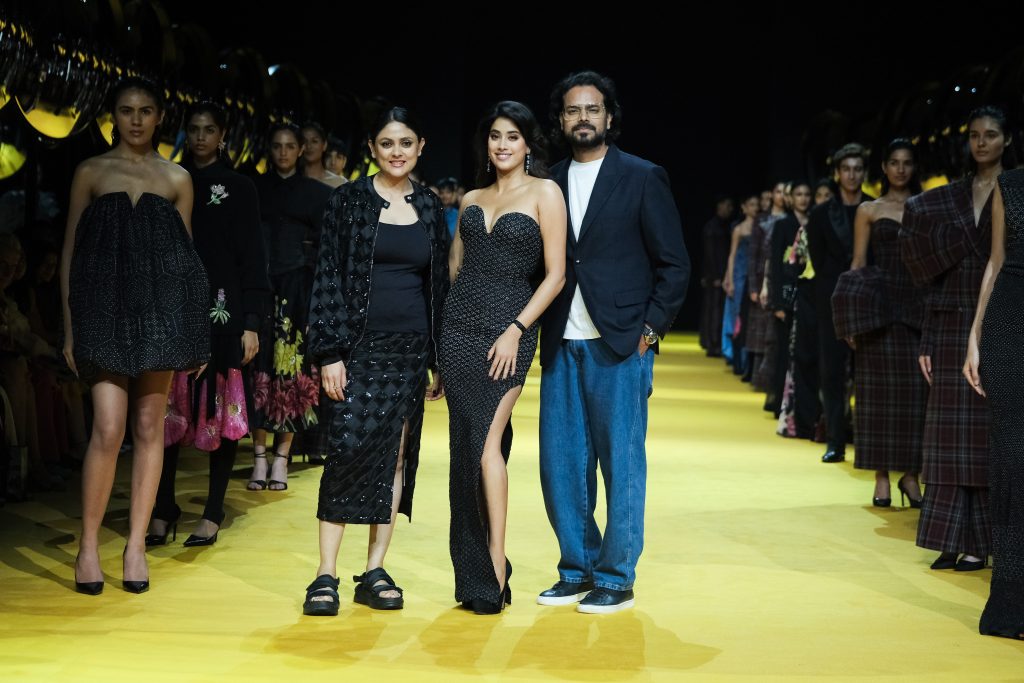
In a freewheeling chat, Rahul Mishra talks about his deep connection with spirituality, Trikaldarshi Brahma, his Paris Couture Week ‘Cityscape’ and ‘Crow’ ensembles, why Bandhani is important as we revisit the present while keeping the “rear-view” mirrors open to pay homage to the past. By Asmitaa Aggarwal He did create a buzz with Gen Z favourite Jahnvi Kapoor getting out of a Nexa, with paparazzi following her, a group of photographers, an event she handles almost every day bravely, they follow her. The set was rear view mirrors, almost 50 of them lined in the show area, as the yesteryear beauty Parveen Bobbi iconic Raat Baki from Namal Halal played in the background. Cutwork jackets, patchwork denims were interesting, some Issey Miyake style, space suit sleeves, and in this mix was Mithun Chakravarthy iconic moves on “Jimmy Jimmy aa ja” and Sanjay Dutt’s rehearsed steps on “Tamma tamma Loke” as the background score. Rahul Mishra and his quiet but impactful wife Divya, presented their line AFEW, at the LFW X FDCI showcasing for the silver jubilee of India Fashion Week, with exaggerated shoulders, big bold flowers, in sequins of course, pants came covered with net. The eye grabbers were exaggerated waists a bit like Comme des Garçons but his interpretation of Bandhani was engaging, in above the knee dresses with exaggerated shoulders, sleeves and bows. The check coats, his continued love affair with flowers, padding and bulges, appliqued hens on jackets, with golden paws, as well as Matrix style black floor length coats explained his love for the unpredictable. “We discovered Henri Rousseau (French post-impressionist painter) work which is on display in this collection as well as the art of Pichwai, but my belief is when you want to create something new you have things which are old like Bandhani. It is like you are driving a fast car, but you have to keep looking at the rear-view mirror to see what you are leaving behind. Crafts become the idea and you create a new version of it,” he says. He took many cultural references from the Silk Route, the products are deeply rooted in traditional craftsmanship. AFEW used painterly old motifs which were found when the Silk Route started, then thrived. “Silk route was an exchange of art, culture and motifs; it was not just about trade. This collection looks at various ideas whether it is from Japan or the Kutch region,” says Rahul. So you have Tanchoi or what Rousseau has done, but in the collection, there is a simplification of all those ideas, few find their own relevance. “Something which is easy, but beautiful,” he explains, adding, “My mind I feel kind of works way too much in multiple directions. Stargazing late at night using my amazing telescope which is the most scientific portable telescope available. I keep wondering about life and cosmos, I also read the Gita, try to connect wit myself. I observe insects–amazing creatures. My mind is never quiet, I am always thinking, maybe I need meditation. I feel I have more ideas but less time,” he smiles. He admits he is sensitive about his surroundings, especially of news. “It lives rent free in my mind. Divya tells me sometimes thoughtlessness is needed, I am sometimes absent minded also. I’m dreaming and thinking. Thoughts entangle me. Maybe it’s not the best thing, but it is a big fuel for finding new ideas and perspective,” he explains. Fashion is quite personal for Rahul, it is about his fears, experiences, tales, dreams, and it comes as an inspiration, out of an observation. “I share my ideas with the team. The way the human mind works is amazing. I can see the person, who is creating an artwork, how it comes from collective thought and dream into an entire garment. I think trends are the most overused ideas. Humans try to discover patterns in almost everything. If it is constellation and trends are based on human emotions, trends are powerful things, but I don’t care about them. I feel like there can be micro trends. The globe is one–generation on Insta and is savvy with technology. People get influenced very easily with choices,” he confesses. He believes the addiction to social media is so deep, that we are making free choices we feel, but we aren’t. “When you look at today’s world nobody can escape –we are victims to ideas and losing cultural identity as trends are strong,” he adds. The magnificence of his creations for Paris Couture Week, can be seen in the way he has constructed a “Cityscape” ensemble, because how cities are now it’s not about how much time it took, but how big skyscrapers made him feel. “No one can escape trends, it’s impossible. The Crow ensemble is a thought I was living with for a long period of time. It was a trigger point for me. Cityscape, when I look around to see how we have made concrete jungles,” he explains. Crows are scavengers, it became his leitmotif after his father passed away, “you look at everything. You render the bird–it looks realistic and fits into my story telling. These hits and trials take lots of re- improvement–it is not linear, and takes a lot of time. It is an attempt to showcase artistry at its best,” he says. If you look at his Insta page, he tries to add a series of celebrities— from Priyanka Chopra and her daughter’s beautiful moments to singer Shreya Ghoshal whom he “finds amazing. We pay respect to all regions of the world; we fulfil all requests. Whether it is Liza from Thailand for her first performance, Queen Latifa for Grammy, Mindy Kaling, Fan Bing Bing or Poorna Jagannathan. This is not our focus. We are very humbled. All celebs are global — Indian or Chinese,” he adds. Rahul is also a man of collaborations–Tod’s was happening for a long time — it was a right fit. Italian and Indian handmade craftsmanship; it was sold out even after the pricing has gone three times
Butterfly Effect by Somya
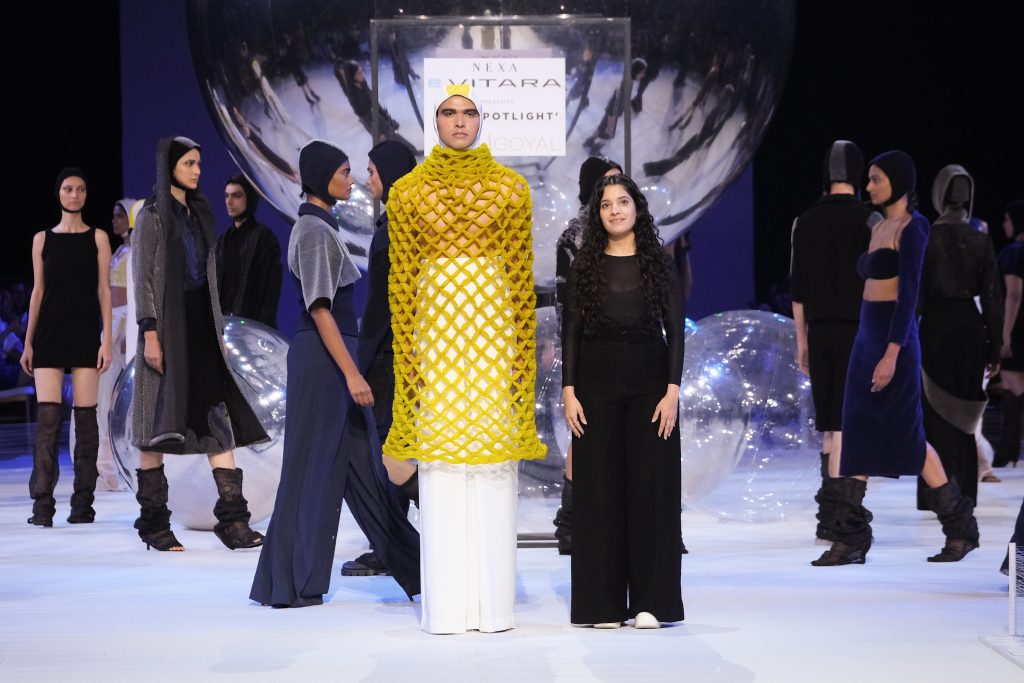
Repair and reuse are Somya Goyal’s mantras, as she works with Bemberg to tackle global warming, intermingling with fabrics created out of waste, converted into cords, in her line “Pivot”. By Asmitaa Aggarwal Her father has been running a successful label Rich Look for the last 30 years in Delhi, but Somya Goyal, the Nexa Spotlight designer at LFW X FDCI knew she wanted to do her own thing. After studying fashion design at Pearl Academy, in 2019 she took the leap of faith, launched her label. “Since childhood I have seen my father create menswear, I developed a love for textiles, early on, playing with transparent cords, wanting to make things that are not worn by everybody in the same room—breaking similar-ness,” says Somya, 30. Hoping to offer uniqueness, clothes with personality, material explorations, unconventionality, 3 D textures, playfulness, these were her templates. “There are two types of clothing—classic, and statement pieces, which are edgy,” she adds. She begins with a texture, then adds hand embroidery, maybe she learnt this and more at her internship with Bodice by Ruchika Sachdeva, and a few short-term courses from Central Saint Martins. “I understood the business aspects from my father—production to marketing, how he used to communicate with clients, maintain a relationship, he taught me well,” she smiles adding, her first show was in GenNext 2022 at LFW. Her USP remains repurposed transparent cords, made from surplus leftover fabrics, crafting new textures, as she stuck to classics—charcoals, electric blues, ombré and mori greens giving each look a Star Trek look, a kind of “transport me back to the mothership” with the set resembling a futuristic stage. She experiments with PVC, metallic wires, horse hair sheets, jute, and cotton cords, using also hemp, bamboo, Bemberg, and crystals sometimes for a constructed jacket. Minor details make a major impact like Raglan sleeves, placement embroidery, Bemberg being sustainable, it has a cooling effect on the wearer tackling humidity well. “Hemp and tencel add wearability and you get a lot of use out of it,” she confirms. The oversized look works well for Somya, as “Pivot” the name of her collection, uses the theme of “Butterfly effect”, one small step leads to a huge transformation—she took that too. “Clients want comfort, after covid that has stayed, plus, we also give repair services,” she concludes.
Boy from Biskohar
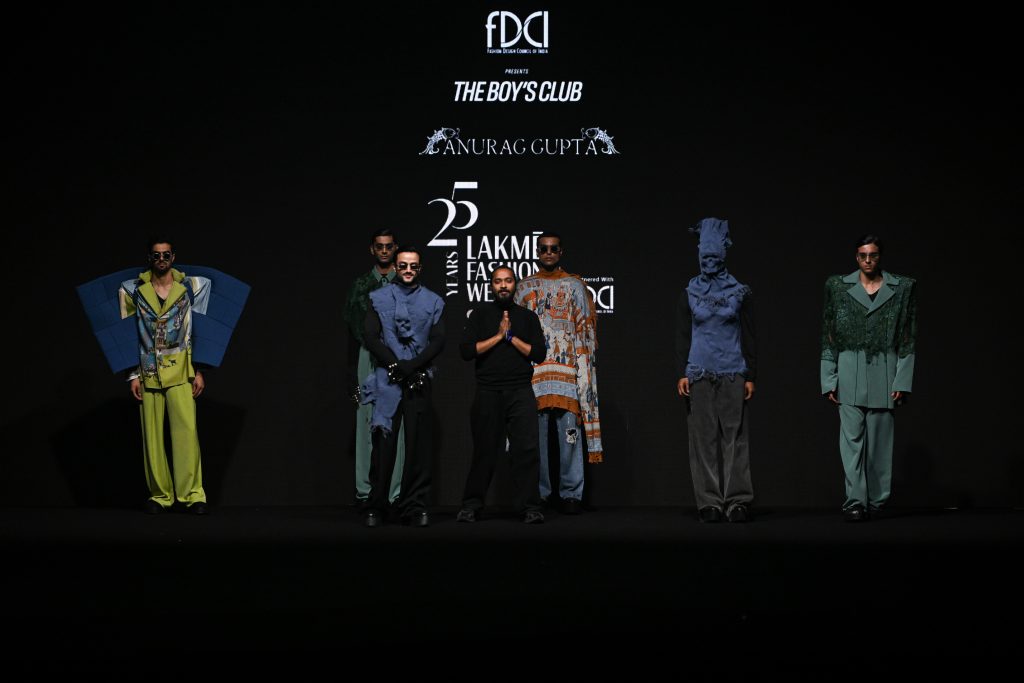
Anurag Gupta’s 3D, jacquard knits and intense screen prints tell us you can do a lot with menswear sans sequins. By Asmitaa Aggarwal Imagine growing up in a village, Biskohar, (Itwa) not so far from Ayodhya, the city of Lord Ram, in a home where forget conversations about fashion, there were not even “pucca” roads, what catapulted him was sheer grit. Anurag Gupta has a lot to be proud of, when he walks the ramp after the FDCI Boys Club menswear show this season at the Lakme Fashion Week 2025. NIIFT (Northern India Institute of Fashion Technology) kind of changed his life, along with a teacher who came to his nondescript school, (near the Nepal border) from Allahabad and taught him not just English but gave him the wings to fly away to the Metro city-Delhi. “I knew I had to leave, the place was too mind constricting, I had big dreams, but no exposure, I didn’t know one word of English so had to learn and unlearn everything as I wasn’t born in privilege,” he says. In 2018, he launched his label, in a glitzy world of fashion knowing that survival here is a challenge- but he did hone his skills- under Varun Bahl and Manish Arora for five years to grasp the business and marketing ethos maybe quirkiness too. “Biskohar had no internet, while I was growing up, but what did help me was that I was curious—even though the only channel was DD and scraps of newspapers from which I got information. My parents ran a medical store, so income was just barely enough,” says Anurag. Fashion for him was an escape, he admired Hrithik Roshan’s dance steps to his sunshine yellow tees, denim jackets in Kaho Na Pyaar Hai, so any hopes of his father to make him an IAS or engineer were incompatible. “I never had that kind of education,” he admits. Anurag admits unlike the swish set he is not inspired by Maldives or Seychelles, rather things he observes around him—sports shoes knitting process, which he converted into necklines, or his intricate screen prints which are laborious but the results are stupendous. “I have developed jacquard knits, deconstructed garments—used from door handles to medical equipment, tyres, tubes to make a line that is also paying homage to 3-D printing,” he admits. Fashion can be daunting-so in 2023, when he read Ambedkar’s book and was inspired to do a collection on “The Failed Promises” (1943) on the exploitation in manual scavenging, how it should be abolished, due to the ignominy, he says many were not interested to write about him. “I am the outsider, and will remain so,” he confesses. Maybe that’s why his line “Metamorphosis” is personal as it encapsulates his story, of how from his “cocoon” he emerged victorious-flew away. Though along the way he has included artists who have inspired him– MC Escher to movements like the Industrial Revolution. “The Dutch artist Maurits C. Escher (1898-1972) had a profound effect on me-specially his ‘mental imagery,’ which gave birth to puzzling architectural mazes and bizarre optical effects,” he concludes.
Khadi adopts new ‘vibe’
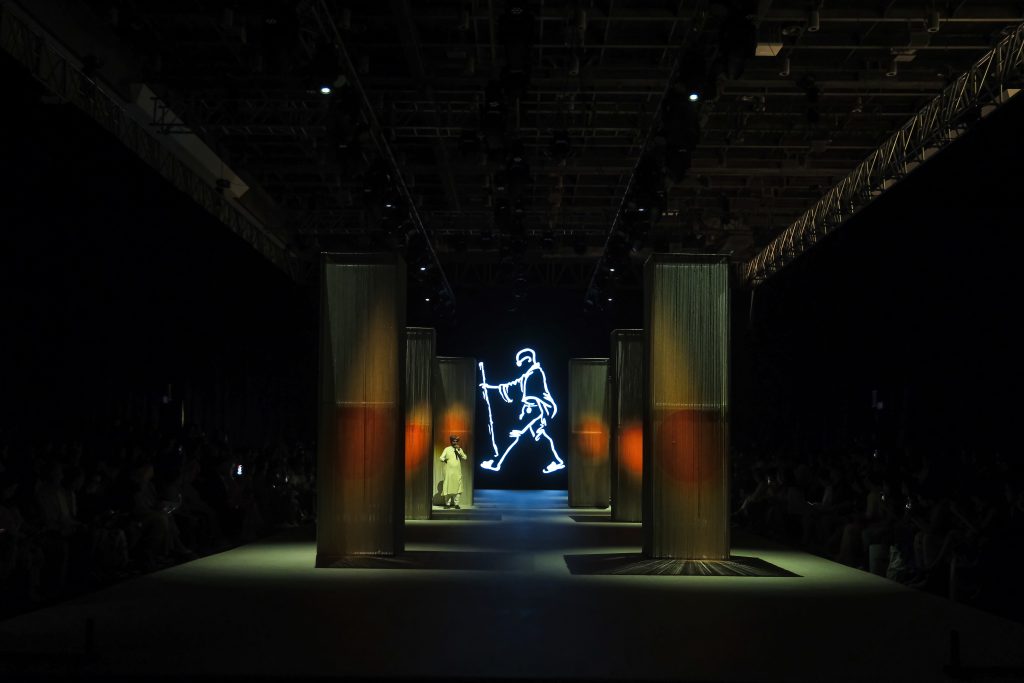
Hoping to wean away GenZ from fast fashion, Co-Ek has launched khadi resort wear-think wrap skirts and summer dresses. By Asmitaa Aggarwal It is always invigorating to observe seismic changes in the way Khadi has been perceived and elevated— leaving its traditional starchiness, adopting a modern nomenclature. This year Co-Ek (Centre for Excellence for Khadi), powered by Khadi and Village Industries Commission (KVIC), crafts dresses instead of saris. It was a concerted move, to serenade GenZ, maybe learning from Moscow Fashion Week, where Nargis Zaidi, head of apparel Co-Ek met khadi lovers, who told her “My grandmother was a Gandhian, I love its imperfections.” The shapes of khadi are now global, jackets skirts, pants, layered magic, inner wear, relaxed fits, also in the process Co-Ek recycles and upcycled katrans, channels circularity while creating statement pieces. “When we sort out fabrics, we do it colour wise, indigos stitched together for example, to offer a discerning palette,” says Nargis. Khadi is a versatile fabric, it may be Swadeshi, but it has international appeal, as she had gone ahead and crafted blazers with it. Since 2021 her efforts have been to start a new narrative, break mindsets and barriers, introduce new colourways (yellow and reds, or charcoals and reds). “We were trying to tell a story—paying homage to little things that often go unnoticed, but impact sustainability, that’s why you see tiny embroidered beetles on resort wear; our line of gamchas, we had the yardage increased while weaving to create wrap skirts,” she adds, hoping this will be an effective alternative to GenZ shopping at Zara and H & M. For the FDCI khadi show, at LFW 2025 she took her experience working with FabIndia and Avaram, forward, by weaving it in Bengal, Gujarat, Punjab to down South, each region bringing along its uniqueness. “We have students from fashion colleges coming to do final projects on khadi which is heartening. A Japanese fashion lover from Tokyo wrote to me on how she was doing her thesis on khadi. Unfortunately, in India, we take it for granted, globally they love the natural textures,” she adds. Hand spun, keeps you cool in summer and warm in winter, organic, a politically powerful fabric, no fabric has this much history!
Clothes with feelings
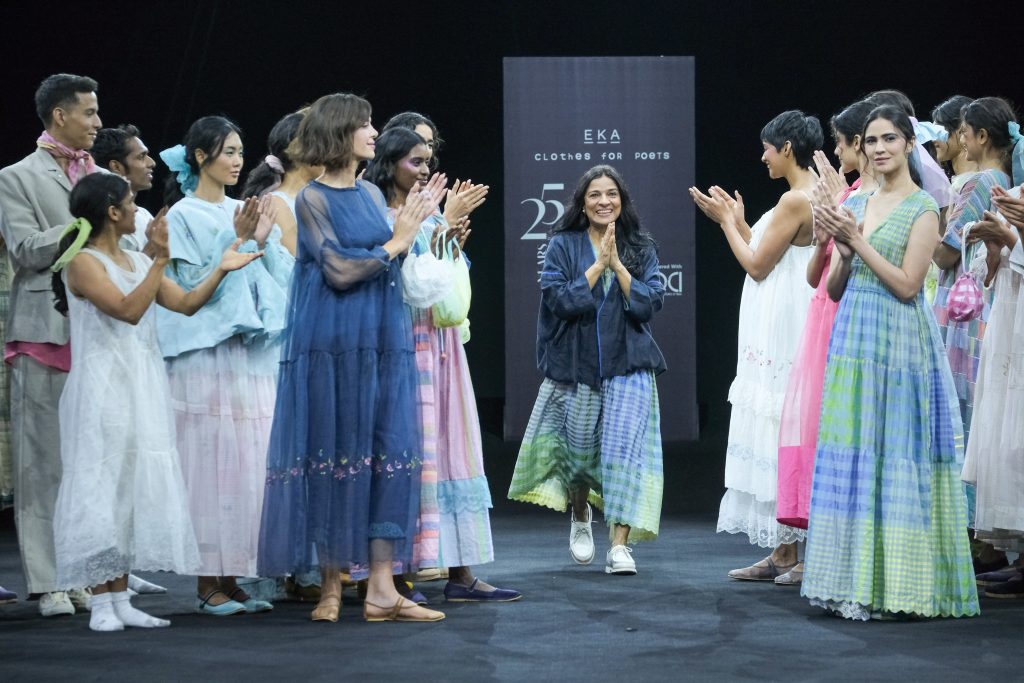
From serenading poets to artists, Rina Singh’s Eka is a case study of craft upliftment. By Asmita Aggarwal If clothes could have feelings Eka would be a right fit! Rina Singh, who built a brand, brick by brick, over 13 years believes it took years of developing product knowledge and working closely with clusters and weavers that helped her finally launch a brand. Unlike Gen Z who know marketing, but learn about product excellence along the way, their skills are so polished that business turns out to be good! “They do it right out of college, I took several years to have the courage and wherewithal to launch my label,” says Rina, adding, “the world of design has changed unequivocally.” Eka and Eka Core are two different ethos—but same mothership, the latter is ready-to-wear, younger, less moody, uses archival textiles and repurposes, so circular in ethos. Rina overdyes it, uses quilting, makes it trans-seasonal as most are leftover fabrics. Eka is known for its love for hand spun and slow, thus the making process is not instant and takes a year of planning. She took a concerted decision to be on the ramp, after a hiatus, to offer woven wonders from Bhagalpur, Banaras, Kota to Bengal, telling a story in Muslin, lace, inspired by Amer, Jaipur with its imposing mirror mosaics, for LFW this year, but she has interpreted it differently—appliqué to tiny embroidered motifs. The idea was to have movement in clothing, like choreography, how clothes adapt to the body and its wearer; as the DNA of the label remains the same every year, but the inspirations are rooted in craft upliftment. You may have boxy trousers, laces only show shifts in moods, things you can wear from Kutch to Tokyo, as it remains feminine, layered, and translucent—this time it’s silks, gossamer and diaphanous. “Sandeep my husband, is a pillar of support—he manages operations, so I am free to design, it takes a huge load off me, in the last decade, he has been a backbone. But I have learnt marketing needs to be loud, brands must have their own voice, and over the years I have learnt not to be rigid about my product,” she adds. Kurukshetra where she was born to agriculturalists, made a deep impact on her psyche growing up, she valued crafts and the “thinking before doing” process of clothing, where you deliberate rather than buy –it is laborious, time consuming, and expensive, but it is also timeless and hand spun, the beauty is unmatched. “I come from a Rajput family where traditionally women invest in weaves, pearls and Kashida, as well as vintage shawls, they understand aesthetics,” she says. Working with the European markets, especially Japan, Rina believes the real jewel in the crown in India is ready to wear, yet we are focussed on weddings, a money churner. “I know the Indian woman likes to be comfortable, yet classy, so why not give her craft-soaked offerings with hints of colour?” she concludes.
Tribute to Shakti
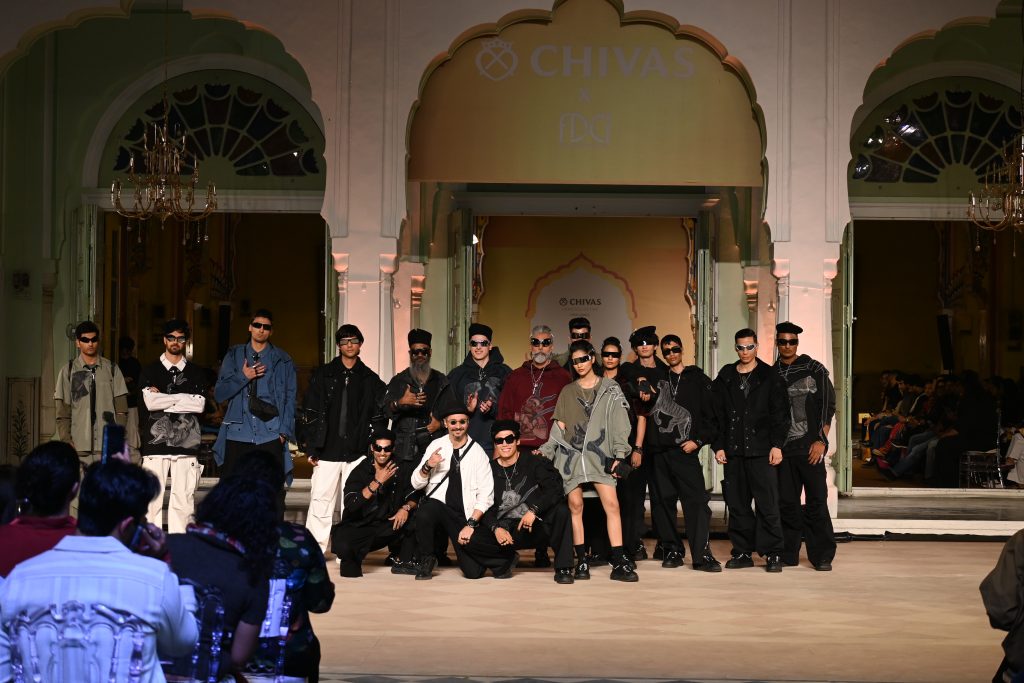
Hindu texts are replete with engaging tales of the goddess and demons, for Nitin Bal Chauhan, the 17th C Devi Kothi became a metaphor, for his streetwear line inspired by Chamunda, and the demons to be slayed — both external and internal in his menswear line titled ‘A Tale of Chamba’. By Asmita Aggarwal You will often see him in black, like the rest of us lovers of this hue, that blends in rather than stands out, I wonder if it has anything to do with how we think or how we want others to think about us? Nitin Bal Chauhan, is in charcoal just like me, when I meet him on a sun-drenched afternoon, bougainvillea blooming in Jaipur, we decided to sit on wrought iron heavy chairs made in the 1850, at Diggi Palace, accompanying heavy duty marble table tops. He had just shown his line at the Chivas Luxe Collective Perfumes presents FDCI India Men’s Weekend 2025 in Jaipur, a line inspired by the temple of Devi Kothi in Chamba. Built by Raja Umed Singh in 1754, dedicated to Goddess Chamunda, it is the northwestern frontier of the kingdom. Chamunda, another form of Durga, is from the text ‘Devi Mahatmya’, warrior goddess, who slayed demons Chanda and Munda. Vijay Sharma, a Padma Shree awardee artist and former curator of the Chamba Museum, and renowned art historian and scholar Dr Vishwa Chander Ohri revived the Chamba miniature painting tradition, Pahari school of art. “Devi Kothi temple’s architecture has an embellished wooden ceiling, and pillars which caught my eye,” says Chauhan, who was raised in Himachal, adding it is remotely placed, and the paintings are almost 300 years old in Tissa, 4-hour drive from Chamba. Bal decided to pay homage to the Chamunda, with hand painting, brush, and Air Ink, (ink made from collecting vehicular carbon emissions in Delhi and NCR. Founded by Anirudh Sharma, a graduate of Massachusetts Institute of Technology in Boston (USA), Graviky produces it) channelling sustainability. “How I’ve dressed myself in the last 20 years is very liberating yet simple,” he smiles. Using cotton twill, detailing like armored core used, a bit like Medieval armour in street wear. To match the Chamunda spirit, he had tracks from the American band GodSmack (had three of their hits– “Woo doo” and “Serenity”) to elevate the pagan elements associated with Chamba, the band connected to that vibe. Bal courted riveting, external elements inspired by armour, he added godets to enhance the shape of armour, straps have a defining factor of street wear, along with broad fringes. “The fighting spirit in clothing comes from Japan, but has entered India only now,” says Chauhan. He adds Hiroshi Fujiwara, is the father of street wear, way back in 1992, and Chauhan added his unique spin on it. Born in Shimla, specifically Mandi, studying at NIFT changed his life, he would come back home, climb walls, get into orchards, jump around, and live carefree. He decided not to get a job, started an NGO titled Sewa Himalayas, revived almost ten crafts – Chamba rumal (detailed patterns), metal carvings, carpet and blanket weaving, Pattu weaving (woollen fabric woven in the Kullu Valley) to woodworking, setting up 73 clusters. “Looked at marketing solutions. Himachal festivals Kullu Dussehra are big draw for tourists and Devis are honoured by carrying them on ornate palki, almost 200 carriages are taken out, it is like the Hornbill of the Himachal, (Shivaratri is huge here),” he says talking about the rich cultural tapestry. “I see a boom in street wear culture, sneakers have boosted it, Gen Z has purchasing power. They know they buy it for Rs 6,000 but can sell it for Rs 12,000. The fastest moving product now is hoodie, the market is in a good place,” he signs off.
From the earth for the Universe
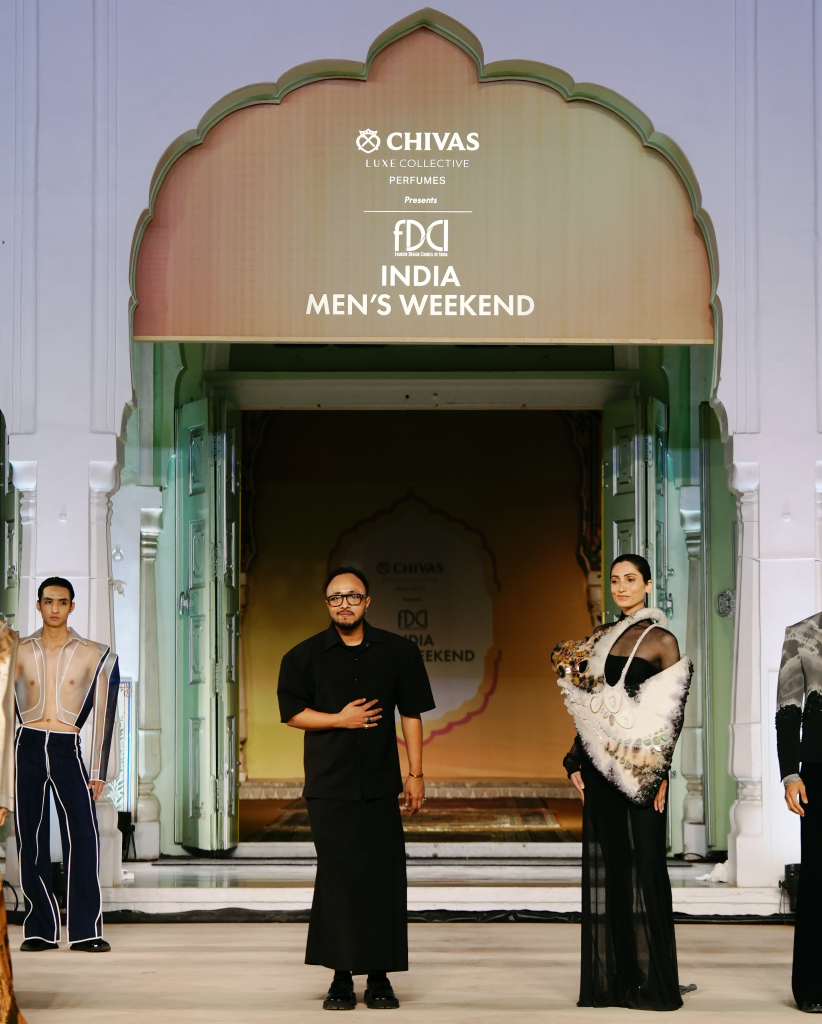
From healing crystals, to dressing body types and not genders, raw wool to unconventional shapes, Akshat Bansal is thinking out-of-the-box! By Asmita Aggarwal Small town boys have this innate desire to succeed, quite different from Metro cities, maybe it has to do with fewer opportunities, and exposure back home. Akshat Bansal of the label Bloni is interesting, from Hisar, went to Central Saint Martins, decided not to do bridal lehengas, but took the rather tough path of understanding science in fashion. Think reflective materials, colour sensitive fabrics, hemp, econyl regenerated, nylon flooring, industrial waste, and fabric scraps to craft ensembles. In 2022, he made his Paris Fashion Week debut, engagingly mixing rubber with tie and dye to crochet, hues which change along with body heat. In his line, the jacket can sometimes become a leotard, then a jumpsuit too, but here the dichotomy is lines like ‘Seher’ beautifully shot capturing small-town aesthetics and its austere life. He attempts to build a bridge between the past and future, and his experiments with felt are ingenious, so is his usage of 100 percent wool, raw in its form (heavily non-processed). ‘Passages’ his line for the Chivas X FDCI is where different dimensions align, fully couture, in its appeal. He uses gemstones, crystals, deconstruction of what earth holds, digging for that era gone by. “From the earth for the universe”, where you have no mechanisms, natural dyes used, mostly tie and dye, vegan rubber, futuristic in its look. “Crystals when they are not polished, but left as they were found, is what we use, it’s a different perception of beauty that many may find ‘dirty’. Just like hemp, it has in-built anti-bacterial properties, found in abundance,” says Akshat. This co-exists with manmade stainless steel, he believes it is impossible to go zero plastic, as there will always be silicon, plus Woolmark does merge Merino wool with polyester for elasticity. His denims are hand woven, by artisans, “I’m wearing CK jeans but I’m missing the comfort of my own creations,” he smiles. His fervent desire to take the road less travelled got him an invitation from Nature Morte gallery, where Peter Nagy termed his creations more “art than fashion”—you can buy it, wear it, or simply display it. A bit like what Natasha Poonawalla wore—a teardrop, it can be a lamp or just a pot too. 3D modelling, traditional hand hammering was employed from Moradabad artisans, to add to this chrome electroplating finish! Another such is a piece Sudha Murthy wore ‘Breathing Cocoon’ biomorphic wearable piece made of metal, wool, agate, and gemstones, which Akshat thinks could also be an artefact placed in a drawing room, breaking rules of what is traditionally considered art. “Why do we always talk of preserving art, but it is living, you can evolve it, isn’t it?” he asks. Crystals, he believes have healing powers, calming effects, remembering amethyst trees back home, protection from negative energy! “I did a Ted talk where I spoke about innovation over decoration, why did we wear jewellery? In history if you see silver releases electromagnetic waves, it isn’t about beauty but energy,” he explains. Cotton is the same wavelength as humans, linen more spiritual he believes, there is a hidden meaning to everything, he calls himself future friendly, not futuristic, but the quest is to find true purpose. His Paris experience was interesting, as looking at his offerings he was often asked, “where did you grow up”? Instead it should be where were you born? His lines are always fluid, and gender for him is nothing but ‘body’. “So many clients who do not fit into womenswear prefer the pieces I make for men. I think it is a body type not a gender we dress. I wonder who set those boundaries? Named these pieces? Why this segregation?” The search is to make a classic, which is named by him-as he asks why can’t pants have a train channelising a non-conformist approach to what is conventionally considered silhouettes, as he completes seven years in business, turned a wise 34 years!