
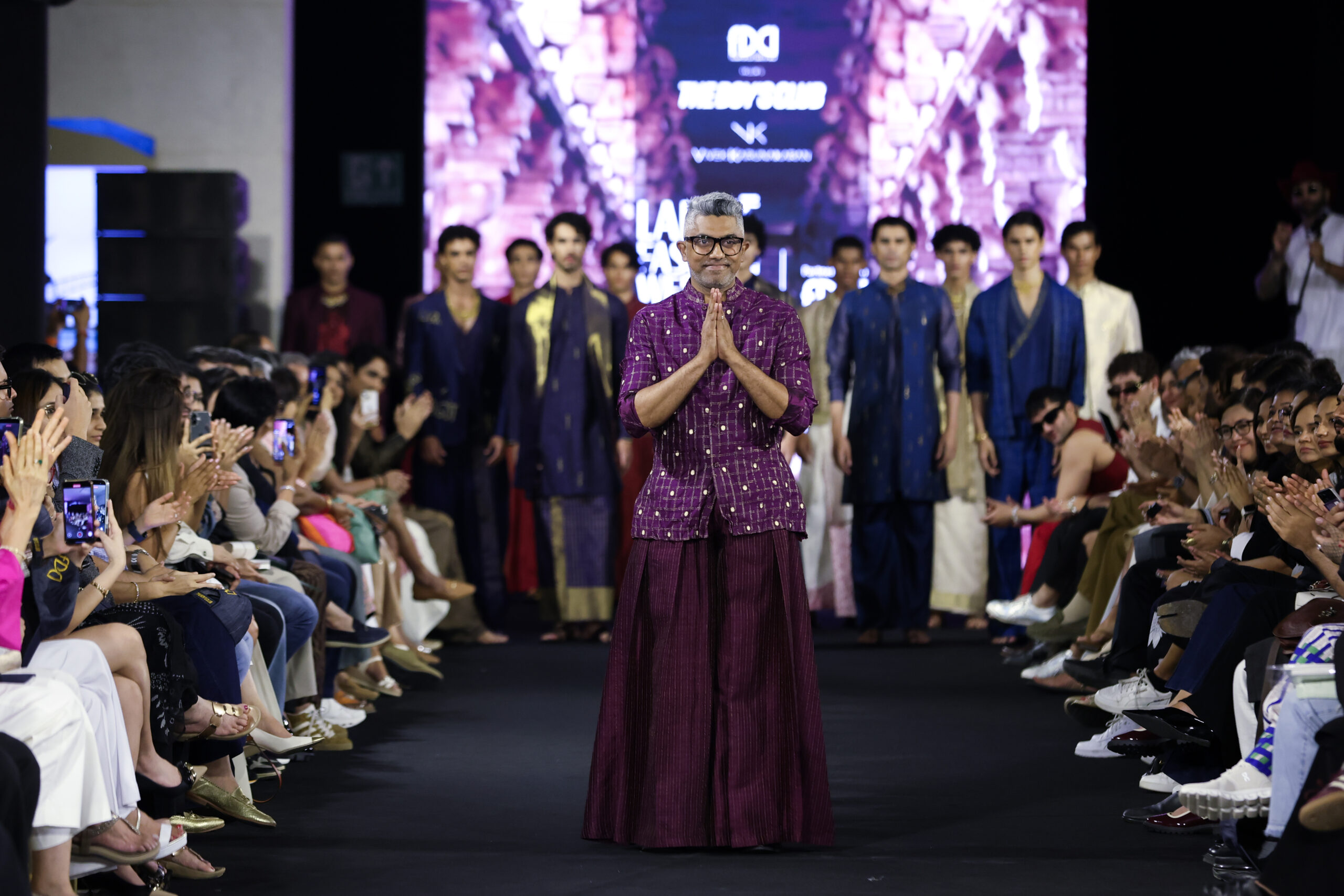
The veshti has found unadulterated love—now it can be worn with silk kurtas, bandhgala et al, Vivek Karunakaran shows us at FDCI Boys Club show at LFW!
By Asmita Aggarwal
Veshti is in and how! This culturally rooted piece of attire has found a new life with Gen Z adopting it, Vivek Karunakaran believes he has been a catalyst of sorts. “Whether it is lungi, dhoti or veshti, it has been reimagined, North Indian wear it uniquely, down South, or Sri Lanka has its own versions in sarongs. This rectangular piece of fabric is now a red-carpet staple too,” he adds.
Vivek is a designer who celebrates his heritage and the Chendamangalam sari, hand woven cotton sari from Ernakulam, Kerala with its puliyilakara (tamarind leaf border), a thin black line that runs with sari’s selvedge, extra-weft chuttikara and stripes-checks of varying width. Vivek works with many such woven wonders in fact reveals that Ram Raj, a South Indian brand has been promoting Veshtis, extremely popular, in Bollywood, Kollywood and even Mollywood. Abhishek and Amitabh Bachchan wear lungis which has again brought the spotlight on it.
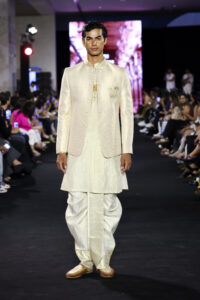
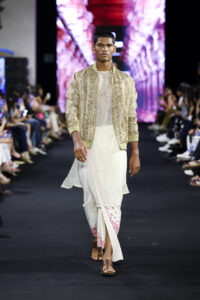
In Chennai Veshtis are worn in silk, Kerala in fine muslin (Mund), border is in zari (kasavu). “In Chennai it is in Kanjeevaram, tissue, silk and thin pinstripes. We have checkered ones with zari inserts. In fact, in Kolkata we did a pop up, veshti we teamed up with a tuxedo, did very well,” he smiles.
This drape evokes a sense of nostalgia, there is an emotion associated with it, veshti also comes with co-ords or a silk kurta, or shirt, a bandhgala and a kamarband, sounds crazy but it’s beautiful, he chuckles. “If you notice how Rashmika Mandana and Vijay Devakonda wore their heritage–veshti, gold and temple motifs, elegant yet luxe,” he adds.
The 40-50 age group has it in their wardrobe, but Gen Z maybe needs to go for the stitched ones, like the pre-stitched sari. “Hyderabad is really the Delhi of the South, less is more doesn’t work here, they have a strong visual aesthetic: love zari plus texturing. Having said that South Indian bling comes with an in-built grace, Delhi’s a bit loud,” he laughs.
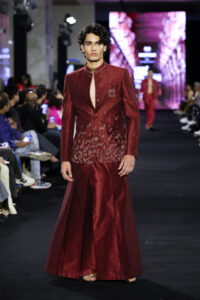
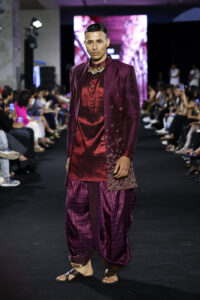
His latest line for Lakme Fashion Week X FDCI “Thangam”, or “gold”, channels the feeling that he is the cultural ambassador of the South. “My grandma saved something in gold for my mom, it is vintage, she told my mom to pass it on to me. Gold is not jewellery, it represents permanence, reminds you of precious moments,” he says.
His love for Tamil script has only grown over the years, it is one of the oldest in the world, starting with his line “Idam”, wearing it on your sleeve, literally and metaphorically. “When you see Tamil script on the back of a bomber or jacket, it makes you curious, conversation starter, everything has a deeper meaning,” he adds. Fascinated by “Thirukurral”, by 18th century Tamil poet Thiruvalluvar, his 1339 passages on how we should live our lives spoke to Vivek. His jackets come with words of wisdom “There is a space to grow with humility” or “Choose your work carefully as it’s going to be the biggest passion of your life”.
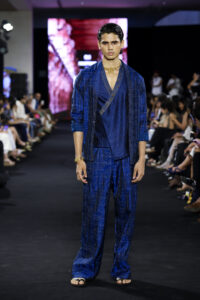

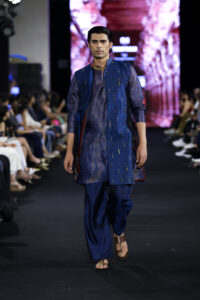
Though his ingenious innovation on Madras checks is engaging, he created hand blocks and converted them to checks, printed them, even though many American brands have used it as “exotic India” trope; traditionally they are used on cotton lungis. “This draped fabric is frankly unisex, if you notice carefully, it has the jasmine placement embroidery on the elbow reminding you of the time when you go a temple and the flower seller outside measures the garland for the Gods inside, by elongating it till his elbow, and then cutting it. It is not a logo on the chest, it is a story we are narrating,” he explains.
For women his veshtis came in silk with applique and translucent borders. “We dressed a bride in Sri Lanka with a red organza veshti and jasmine embroidery,” he concludes.