
Bengali Babus
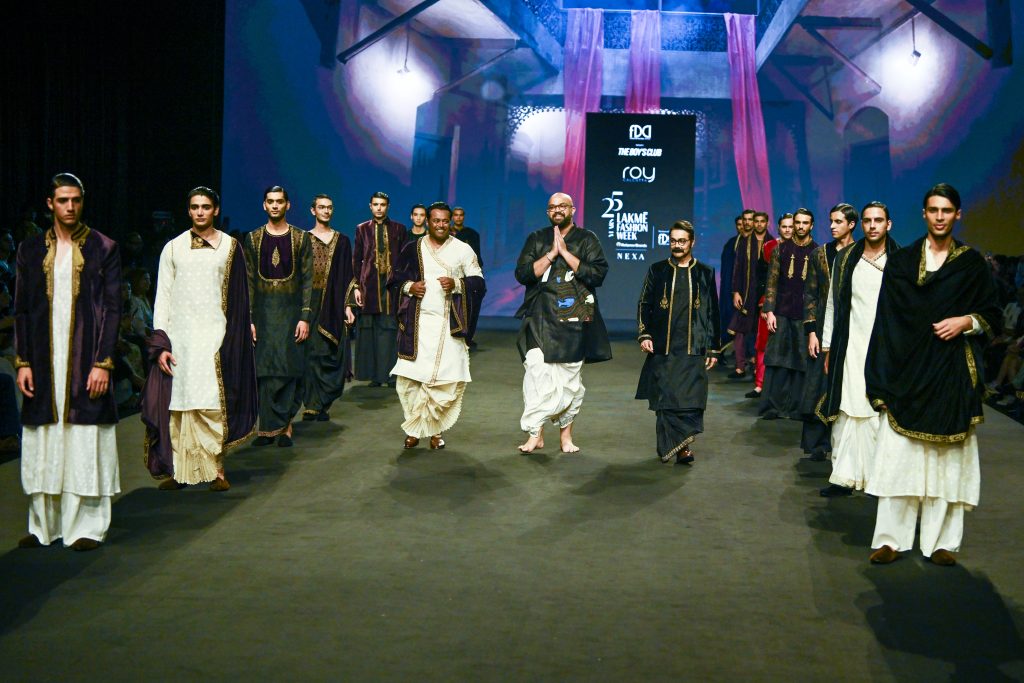
18 century “babu” culture of Bengal dandies gets a fashionable makeover by Abhishek Roy through his smooth velvets and zardozi. By Asmitaa Aggarwal What happens when you grow up in a fulfilling environment away from the craziness of city life in Santiniketan? Well, you have an alternate world view just like Abhishek Roy from Kolkata. Showcasing at the FDCI Menswear show Boys Club, he admits his bachelors and post grad from the historic place, sharpened his mind. Since 2014 he has done costumes for Bangla films like “Bonkesh”, and 2015 launched his label with an inclination towards textiles. For years he has upcycled weaves, specially kanthas, along with Jamdanis, but what’s interesting is his love affair with zardozi. Though he effortlessly amalgamates velvet with Jamdani in his line “Nawabs of Bengal” paying a tribute to Bengal’s rich culture, babus of the 18th century smattered with crafts like “alpona Naksha”. “Santiniketan has multi-cultural diversity, what we learn is not from a syllabus but the sustainable environment. Plus, my grandfather was a professor here and first muralist of India, Shuken Ganguly along with the iconic Nandlal Bose,” he says. What is reflected in his line is what he observed and soaked in as a child growing up in Santiniketan, there was no entertainment, so he began designing outfits for theatre, using paper cutting and moulding techniques to flower ornaments– he loved creating characters through costumes, it interested him. “It was an adrenaline rush doing movies,” he laughs. His FDCI line has shawls, kalidar and side slit kurtas, Sherwanis, bandhgalas, to dhotis something he wears which got him the attention of the Nawab of Pataudi Saif Ali Khan. He loved the pleated pure muslin ones, and soon a relationship developed. “Saif is in touch with his Bengali roots due to his mom Sharmila Tagore. I visited the Musheerabad Museum to understand the zardozi influence on Bengali culture,” says Abhishek. His next is uplifting Kesh weave, where you mix old saris with khadi, adding applique to elevate the look!
Boy from Biskohar
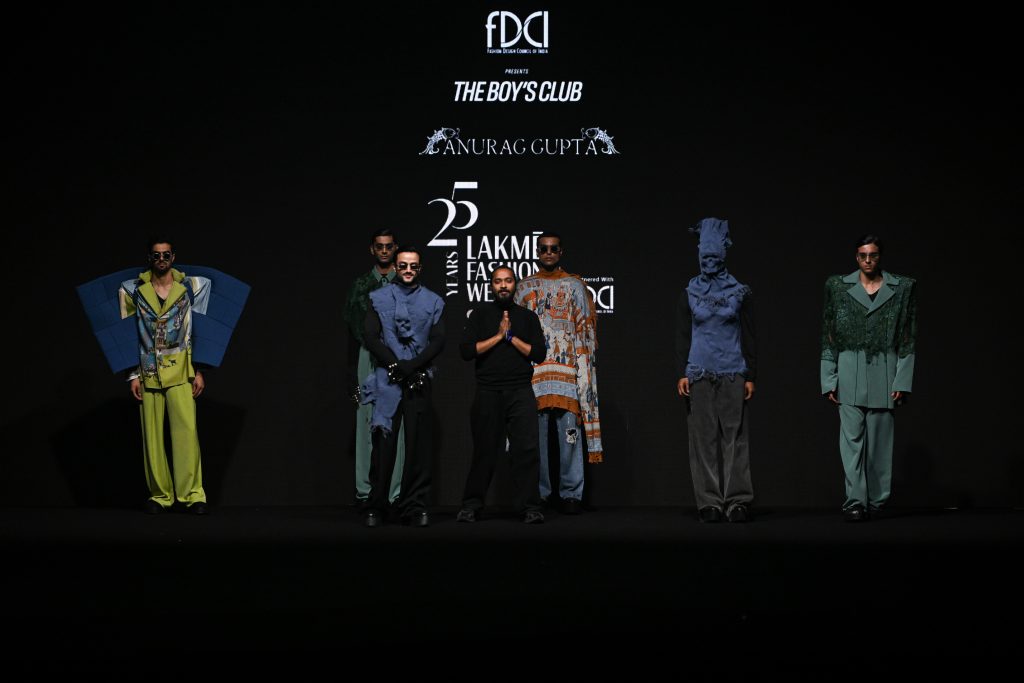
Anurag Gupta’s 3D, jacquard knits and intense screen prints tell us you can do a lot with menswear sans sequins. By Asmitaa Aggarwal Imagine growing up in a village, Biskohar, (Itwa) not so far from Ayodhya, the city of Lord Ram, in a home where forget conversations about fashion, there were not even “pucca” roads, what catapulted him was sheer grit. Anurag Gupta has a lot to be proud of, when he walks the ramp after the FDCI Boys Club menswear show this season at the Lakme Fashion Week 2025. NIIFT (Northern India Institute of Fashion Technology) kind of changed his life, along with a teacher who came to his nondescript school, (near the Nepal border) from Allahabad and taught him not just English but gave him the wings to fly away to the Metro city-Delhi. “I knew I had to leave, the place was too mind constricting, I had big dreams, but no exposure, I didn’t know one word of English so had to learn and unlearn everything as I wasn’t born in privilege,” he says. In 2018, he launched his label, in a glitzy world of fashion knowing that survival here is a challenge- but he did hone his skills- under Varun Bahl and Manish Arora for five years to grasp the business and marketing ethos maybe quirkiness too. “Biskohar had no internet, while I was growing up, but what did help me was that I was curious—even though the only channel was DD and scraps of newspapers from which I got information. My parents ran a medical store, so income was just barely enough,” says Anurag. Fashion for him was an escape, he admired Hrithik Roshan’s dance steps to his sunshine yellow tees, denim jackets in Kaho Na Pyaar Hai, so any hopes of his father to make him an IAS or engineer were incompatible. “I never had that kind of education,” he admits. Anurag admits unlike the swish set he is not inspired by Maldives or Seychelles, rather things he observes around him—sports shoes knitting process, which he converted into necklines, or his intricate screen prints which are laborious but the results are stupendous. “I have developed jacquard knits, deconstructed garments—used from door handles to medical equipment, tyres, tubes to make a line that is also paying homage to 3-D printing,” he admits. Fashion can be daunting-so in 2023, when he read Ambedkar’s book and was inspired to do a collection on “The Failed Promises” (1943) on the exploitation in manual scavenging, how it should be abolished, due to the ignominy, he says many were not interested to write about him. “I am the outsider, and will remain so,” he confesses. Maybe that’s why his line “Metamorphosis” is personal as it encapsulates his story, of how from his “cocoon” he emerged victorious-flew away. Though along the way he has included artists who have inspired him– MC Escher to movements like the Industrial Revolution. “The Dutch artist Maurits C. Escher (1898-1972) had a profound effect on me-specially his ‘mental imagery,’ which gave birth to puzzling architectural mazes and bizarre optical effects,” he concludes.
Khadi adopts new ‘vibe’
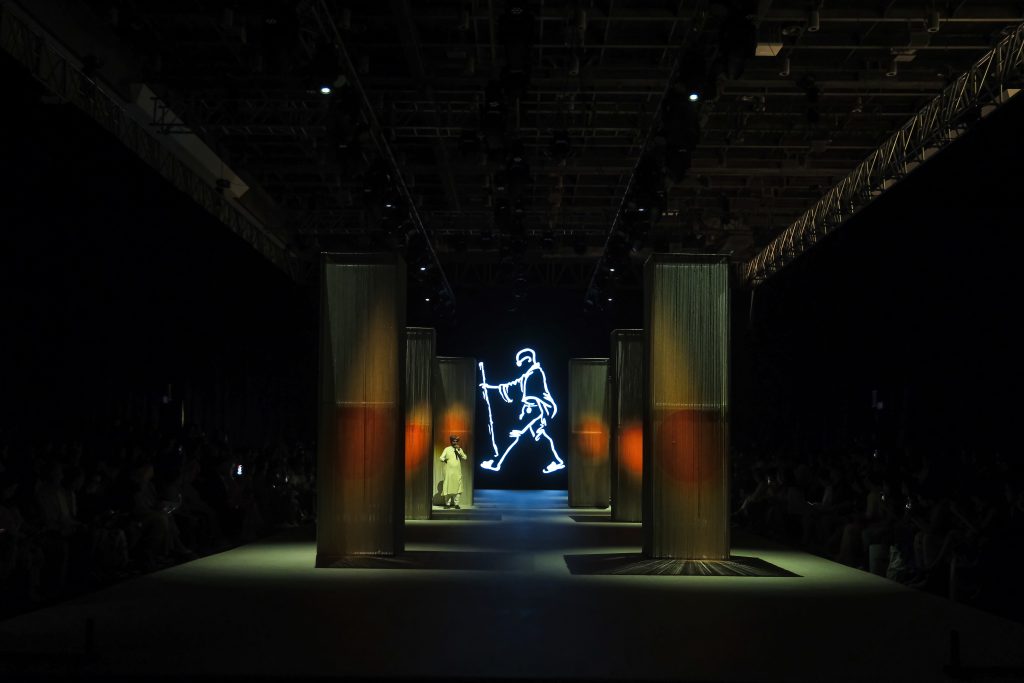
Hoping to wean away GenZ from fast fashion, Co-Ek has launched khadi resort wear-think wrap skirts and summer dresses. By Asmitaa Aggarwal It is always invigorating to observe seismic changes in the way Khadi has been perceived and elevated— leaving its traditional starchiness, adopting a modern nomenclature. This year Co-Ek (Centre for Excellence for Khadi), powered by Khadi and Village Industries Commission (KVIC), crafts dresses instead of saris. It was a concerted move, to serenade GenZ, maybe learning from Moscow Fashion Week, where Nargis Zaidi, head of apparel Co-Ek met khadi lovers, who told her “My grandmother was a Gandhian, I love its imperfections.” The shapes of khadi are now global, jackets skirts, pants, layered magic, inner wear, relaxed fits, also in the process Co-Ek recycles and upcycled katrans, channels circularity while creating statement pieces. “When we sort out fabrics, we do it colour wise, indigos stitched together for example, to offer a discerning palette,” says Nargis. Khadi is a versatile fabric, it may be Swadeshi, but it has international appeal, as she had gone ahead and crafted blazers with it. Since 2021 her efforts have been to start a new narrative, break mindsets and barriers, introduce new colourways (yellow and reds, or charcoals and reds). “We were trying to tell a story—paying homage to little things that often go unnoticed, but impact sustainability, that’s why you see tiny embroidered beetles on resort wear; our line of gamchas, we had the yardage increased while weaving to create wrap skirts,” she adds, hoping this will be an effective alternative to GenZ shopping at Zara and H & M. For the FDCI khadi show, at LFW 2025 she took her experience working with FabIndia and Avaram, forward, by weaving it in Bengal, Gujarat, Punjab to down South, each region bringing along its uniqueness. “We have students from fashion colleges coming to do final projects on khadi which is heartening. A Japanese fashion lover from Tokyo wrote to me on how she was doing her thesis on khadi. Unfortunately, in India, we take it for granted, globally they love the natural textures,” she adds. Hand spun, keeps you cool in summer and warm in winter, organic, a politically powerful fabric, no fabric has this much history!
Nikki’s Khadi Resort wear
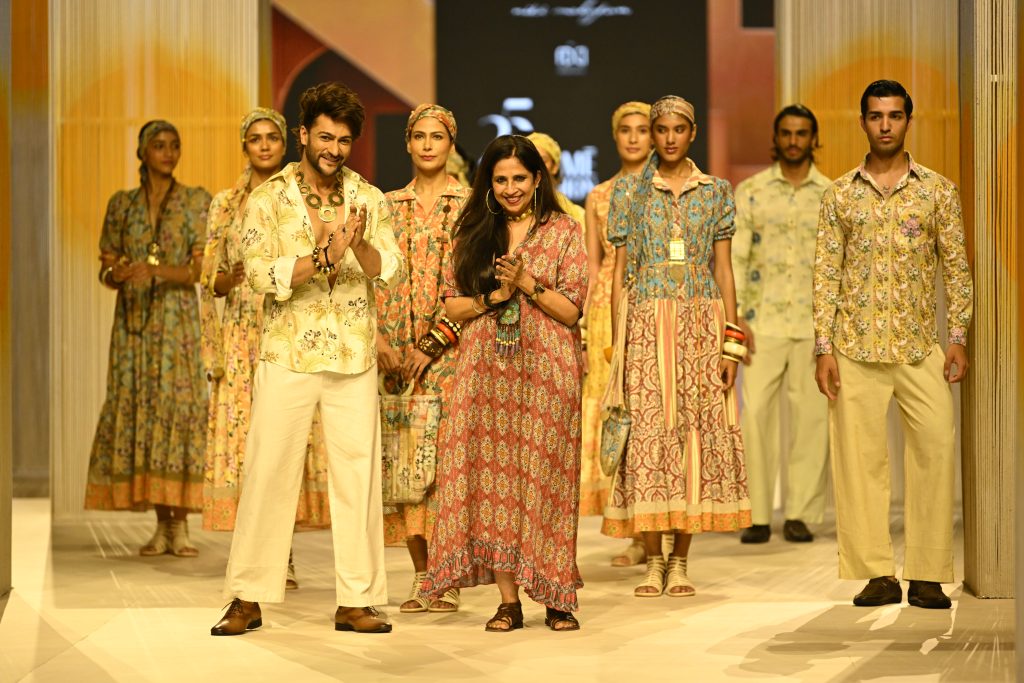
After 42 years in fashion, perfecting block printing, Nikki Mahajan pays tribute to khadi not through predictable kurtas, but dresses with baroque elements and French prints. By Asmitaa Aggarwal She began almost 42 years ago, in the 80s when she was newly married, at 20, studying in Lady Shri Ram college of Commerce, English literature, had no clue even about the word fashion, she would call herself a “tailor”. But Nikki Mahajan knew when she was taught needle work and smocking in Loreto Convent school, Delhi, she started making clothes and embroidered it herself for her friends’ moms — this would be her calling! Ten years ago, the business dynamic altered, she moved to working with Japan, Middle East and US markets, special collections, about after 42 years in the business. Self-taught, the 62-year-old knows the challenges of running a brand, “In the late 80s, there wasn’t any fashion school, only polytechnics, which were not considered great, but I found my way around,” she says. She used to take her two kids to play tennis in DLTA, Delhi where she saw the exodus of Kashmiri women, in the early 90s, sitting opposite, looking for work, she decided to help, hired them as embroiderers utilizing their skill and providing employment. “Bindiya Judge’s store Signature in Hauz Khas Village, was the first one that sold luxury designer wear, but unlike today’s generation, we had to find our own niche,” she explains. For the FDCI khadi show at the LFW, Nikki has done what she does best-block printing, which even her Japanese clients love (she made a 3000-piece line for Anthropologie too). She found a way to make the uneven blocks as they are hand done into some form of evenness by digitizing it for her buyers abroad who wanted “sameness”. “I digitize the fragments I get while visiting various museums all over the word-Egypt to Uzbekistan, Amsterdam to France, and this line is an amalgamation of all those shared experiences,” she confirms. She takes pics and then makes a collage and starts work on the storyboard. To this she added Baroque elements and French prints, dexterously executed on Khadi, even though she works with mostly cotton and silk, she loved the textiles and unevenness khadi offered. “When you wear linen it crushes easily, khadi doesn’t and that’s its beauty–I discovered and admire its slubbiness,” says Nikki. Fashion is now easier. It has Pinterest, Instagram, the new breed of designers are intrepid, they aren’t insecure, it’s the same masala box, but they are cooking up a storm with it. She is back on the runway after 10 years, but decided not to make the usual kurta with khadi rather went opposite-resort wear, carefree and fluid!
No white collar, it’s silver for Anamika
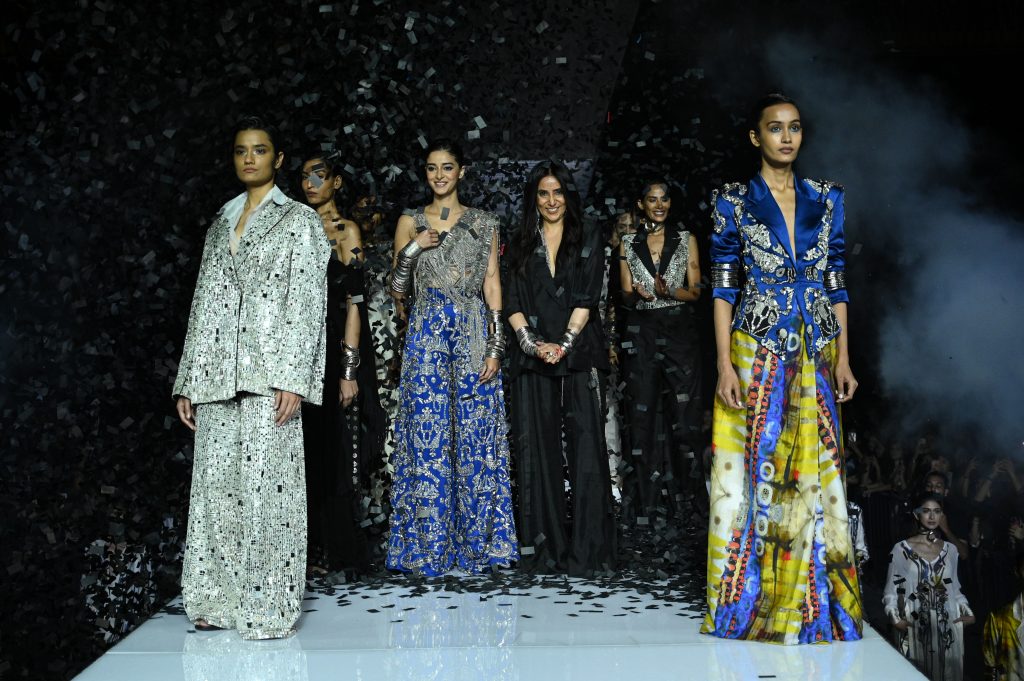
After almost 25 years, Anamika Khanna is hoping women in lucrative careers want something that is not just suits and blazers –maybe a silver tie, suspenders, daddy briefcase and some pearl encrusted denims from AK-OK! By Asmita Aggarwal India is all over the world, and it isn’t just “in India”, anymore maybe that’s why Anamika Khanna’s AK-OK for working women, is timed right, the market is ready for this, especially as professions are now unconventional. One could see nostalgia—daddy suitcases cleverly revived, splashes of colour, even though monochromes are her thing, denim is now slowly moving to her favourite list. Above all, no one can beat her in texturing—how she combines various techniques—patchwork, applique to mirror work at her show for LFW X FDCI. The ignition of the idea came from Rabari tribe who are movers never static—Gujarat, Rajasthan and have some Afghan influences too, she began researching, and found their silver stacking jewellery was phenomenal. She took those—and modernized it with suspenders, ties, chain loop belts, “you don’t need to wear silver only as a jhumka, if it can be a silver collar too”. She had that too—literally, workwear equals—”silver collar”, also the name of her line—like you have blue collar and white collar. “Let me tell you what I think is my biggest strength—I don’t think of the garment but the woman,” says Anamika, understanding the changing needs of modern women, their intimate relationship with clothing, and how it changes their mood. After 25 years in business, every time she does a line, she wants to incorporate something “forgotten or lost”, last season she also paid tribute to the Bonda tribe from Odisha. “Women bring not just power to the boardroom but also emotions and compassion onto work, I wanted each of the 50 pieces to reflect that,” she adds. If you look closely, the styling, it has a churidar, with a dhoti and collared skirt, each reference was out of India, but how to make it fashion Anamika knows. The show was about 9 to 5, and how workwear rules are being broken, in between this mix she revived her dhoti pants of the year 2000, churidars which she loves, as well as tattered holes and cut outs. “Designing as a profession is challenging, lot of people tell me take it easy, take a break, and while I am talking you, I’m sticking applique on a dress, this is my life, I live for fashion,” she smiles,
Clothes with feelings
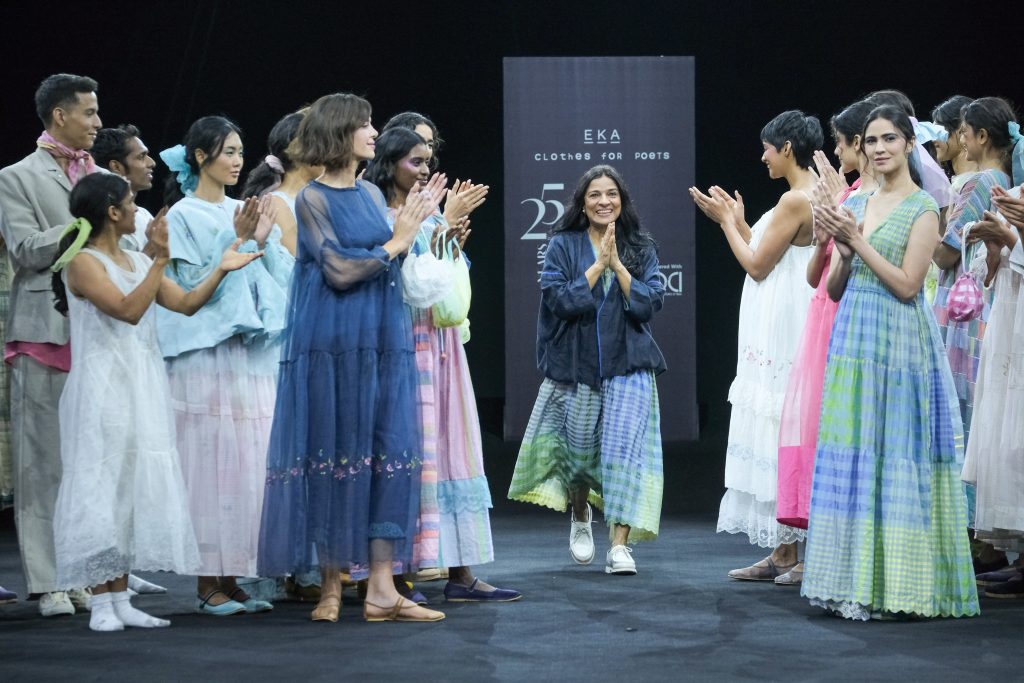
From serenading poets to artists, Rina Singh’s Eka is a case study of craft upliftment. By Asmita Aggarwal If clothes could have feelings Eka would be a right fit! Rina Singh, who built a brand, brick by brick, over 13 years believes it took years of developing product knowledge and working closely with clusters and weavers that helped her finally launch a brand. Unlike Gen Z who know marketing, but learn about product excellence along the way, their skills are so polished that business turns out to be good! “They do it right out of college, I took several years to have the courage and wherewithal to launch my label,” says Rina, adding, “the world of design has changed unequivocally.” Eka and Eka Core are two different ethos—but same mothership, the latter is ready-to-wear, younger, less moody, uses archival textiles and repurposes, so circular in ethos. Rina overdyes it, uses quilting, makes it trans-seasonal as most are leftover fabrics. Eka is known for its love for hand spun and slow, thus the making process is not instant and takes a year of planning. She took a concerted decision to be on the ramp, after a hiatus, to offer woven wonders from Bhagalpur, Banaras, Kota to Bengal, telling a story in Muslin, lace, inspired by Amer, Jaipur with its imposing mirror mosaics, for LFW this year, but she has interpreted it differently—appliqué to tiny embroidered motifs. The idea was to have movement in clothing, like choreography, how clothes adapt to the body and its wearer; as the DNA of the label remains the same every year, but the inspirations are rooted in craft upliftment. You may have boxy trousers, laces only show shifts in moods, things you can wear from Kutch to Tokyo, as it remains feminine, layered, and translucent—this time it’s silks, gossamer and diaphanous. “Sandeep my husband, is a pillar of support—he manages operations, so I am free to design, it takes a huge load off me, in the last decade, he has been a backbone. But I have learnt marketing needs to be loud, brands must have their own voice, and over the years I have learnt not to be rigid about my product,” she adds. Kurukshetra where she was born to agriculturalists, made a deep impact on her psyche growing up, she valued crafts and the “thinking before doing” process of clothing, where you deliberate rather than buy –it is laborious, time consuming, and expensive, but it is also timeless and hand spun, the beauty is unmatched. “I come from a Rajput family where traditionally women invest in weaves, pearls and Kashida, as well as vintage shawls, they understand aesthetics,” she says. Working with the European markets, especially Japan, Rina believes the real jewel in the crown in India is ready to wear, yet we are focussed on weddings, a money churner. “I know the Indian woman likes to be comfortable, yet classy, so why not give her craft-soaked offerings with hints of colour?” she concludes.
Colour me anything — say men
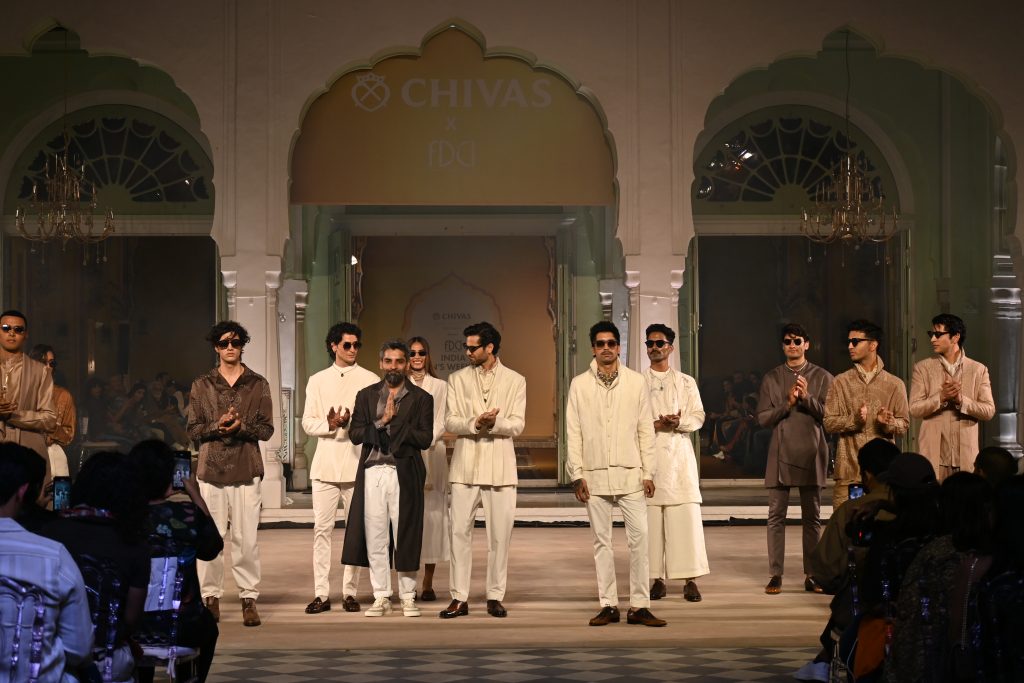
From canary yellow shoes, to men in corsets, sequinned flowers on power shoulders, slogan tees that told you to ‘Grow’, the Chivas Luxe Collective Perfumes presents FDCI India Men’s Weekend 2025 was an eye opener for the intrepid new man-unafraid of embroidery and red. By Asmita Aggarwal When you get trained by the best in the business, you have an undeniable edge, Rohit Gandhi and Rahul Khanna was his first job. After Central Saint Martins, Sahil Aneja didn’t want to get into his family business which was anyway fledging-printing press for local newspapers. Though what he did learn from there was colour theory, and of course, participating in painting competitions in school, which was the propeller for him to try design. After a master’s in business management from Auckland, he knew fashion and specifically menswear was his calling. “I have seen men take a lot more chances, quirky hues to fun factors are now part of their wardrobes. That’s what we have done in ‘Play’ our collection for India Men’s Weekend—graphics to denims,” he says. To this he added slouchy, oversized, and layering rather than structured shapes. Though he credits social media, celebs, and influencers with the innate desire to look different. ‘Play’ comes armed with power shoulders, olive green hoodies, checks with flying threads hanging from mildly embroidered jackets. As slogans are now everywhere, Sahil is not far behind, from ‘Grow’ with mushroom prints, to baby elephants riding a bicycle, done in polyblends, crushed cottons, and linens discovering his niche after ten years. “I wasn’t sure if my clothes would sell, but I realised you have to keep adapting, moving forward, best to go with your instincts,” he smiles. Pawan Sachdeva’s C’est Chic Influencer Ms Coco Queen Sukhneet Wadhwa opened the show in a tee which announced what was to come- C’est chic. ‘Lights camera and fashion’, ‘Transform criticism into creativity’, it said on men’s blue shirts, along with bottle green co-ord sets. Magenta is now officially a man’s hue, they have adopted it religiously, and tie ups are deliberately left untied. Faded prints are everywhere along with paint splatter, Zig zag threadwork running all over monochrome dresses which told us in bold, ‘Creatives are new athletes’ and ‘Your comfort zone will kill you’. Ah yes, how can we forget TV actor Shalin Bhanot and his antics on the runway! Varun Bahl’s sequinned florals What happens when red and black shimmer from atop a fort that is almost 200 years old? Magic! Can it get better? Floral placement embroidery, sheer kurtas, harem pants, in gossamer white and delicate watercolour florals. When you keep it white like Varun, with splashes of colour, add little shimmer in the flowers, as if a child has coloured inside them, pop of sequins, you know style is all about less not more. Varun’s models decided to abandon briefcases and clutch shimmering unabashed crimson handbags. Dhotis sparkled with red dots, hoping you can share them with your wife too! Japanese style Obi belts, but broader, were thunderous; his constant companions in 20 years have been florals, maybe it’s his trips as a child to Kashmir that subconsciously spills on to his collections. Rohit and Rahul’s placement embroidery The newest thing in menswear is how you play with embroidery, the duo known for their clean cuts in a golden palette, and fabric belts gave us a heavy dose of beadwork jackets, in the form of droplets on well-toned shoulders. Pearls are now making sure they replace zardozi, as cowl necks edge out traditional collars. Though if you are intrepid enough you can try a fully sequinned pants suit or their engineered kurtas with unexpected cuts that accompanied Peshawari juttis, as 20s flapper tassels swung on jackets. Mandira Wirk’s pastel prints What happens when you begin a show with a bare-chested Sahil Salathia, and a saxophone player? Well, you get everyone’s attention. Icy blue prints, bodysuits, interesting abstracts, trench coats, basically a lot of Sex and the City appeal. Think sarongs, the line was young and fun just like the designer, and her first outing with menswear. Mahima Mahajan If you like big, bold flowers and velour, in shades of navy blue as well as oversized coats, with crystal butterflies with wings spread over sherwanis, she is your girl! Nikita M’s men in corsets Listen men can wear cappuccino prints and the tiger is really enjoying his day in the spotlight, sometimes inverted on dresses. Nikita got men in high waisted denims, sequinned vests placed under natty bomber jackets. The new place to place embroidery is the shoulders and back, just putting it out there. Lastly, men are now in corsets, denim ones, no longer a reserve for lithe women. Ashish Soni’s icy blue check suits Sailors are now making it to runways (metaphorically), that is their caps and pure whites, only this time, with checks on suits. Men are unafraid to wear super roomy shorts, lace ties, and check jackets with happy little embroidered flowers. Denim has really changed colours—decided to go white, as blush pink check suits, and lemon-yellow jackets make sure, men are embracing colour like never before. Those with a certain rocker attitude can try the denims which caress the bottom of your sneakers and you get those turned in hems, by sheer wear and tear! Well, that’s now fashion! Shantanu and Nikhil’s poet Nikhil’s young son Vivhan opened the show with a book, tulips and a poem, of course wearing a cropped jacket. There is something about men in skirts, which requires courage; the brothers had their signature draped pleated kurtas in ivories and sometimes just bunched up which looked natty. The ode to a Bengali poet, literature lovers, bespectacled men took you to the baitaks of old Calcutta only this time the ensembles were British pants reminding you of colonial era, complete with broad waistbands. Men have made space in their wardrobes for roomy chiffon palazzos. Really! Not kidding. Manoviraj Khosla’s funky shoes If there is anyone who can put men in all kinds of colours of
Is your Antar Agni alive?
Does where you grow up shape you? The answer is in the affirmative…Ujjwal Dubey is a living idiom of his small-town roots, Gorakhpur which you can observe in his botanical prints this season. By Asmita Aggarwal When you call a line “BRB” (in Gen Z terms, be right back) you know the hidden meaning is always that you play hide and seek with your screens. Born in Gorakhpur, studied at the National Institute of Fashion Technology in Kolkata, Ujjwal Dubey’s minimalistic approach won him the Regional Round of the Woolmark Prize in Asia category. 12 years in the business now, one always notices his detailing — hand-embroidered motifs, and an ultra-dramatic entry in buttery soft whites teamed with necklaces, chokers, slimmer pants. He loves Pink Floyd (Fearless) and once called his collection ‘Two faced’ maybe a hint at what the fashion world really is? Sporty jackets, tone-on-tone, draped kurtas, very Japanese in thought with hints of mocha. The spirit of Rajasthan omnipresent in polo pants, touches of thread work on dhotis. Men’s shirts come with sashes, in a world that is going roomy he offered a tapered look, free from the oft repeated oversized looks, serenaded the finer nuances of pattern cutting. There was neither embellishment, nor shine, just good tailoring. Trousers are enjoying a moment in the sunshine — slouched, harem, dhoti to palazzos. “Bottoms make or break your personality; if you have the right one on-a simple tee is enough,” he confesses. The hoodie in Bemberg fabric was super cool in dusty caramels, and rose. Sometimes he admits he just doesn’t want to talk, “just do”. “I always work with just two or three colours, this time, it is almost five which is a new curve of learning for me,” smiles Ujjwal adding too many bothers him. His botanical prints are done in vegetable dyes, a printer he found in Kolkata, this ingenious mix found fervour with Banarasi fabrics, an interesting zari stripe fabric. Then, there was appliqué with lace. “I want to do the smallest and most common thing, but do it differently—my way,” he says. Last time he did pintucks and pleats, really allowed them to run free, giving it a new persona. Always wanting to go in the alternate direction he played with “root prints” this year maybe an ode to his austere upbringing or a plea to never forget where you came from? Kurtas remain his bestsellers, and they serve as an engaging canvas to play, though he believes fashion has unsaid importance. “Have you noticed that your spine straightens when you wear something new? When I see kids buying Rs 200 green pants, in small towns, talking about what they will wear for a night out, what we call ‘adda’ talks, with a 50 Cents style locket bought from the street markets, you know what clothes can do to their confidence,” says Ujjwal. The collection was an attempt to ‘kill standardisation’ in fashion, and the ideology of ‘formats’. That’s why his kurtas are broken, asymmetric and layered, something he enjoyed doing since 2014. Add to this a snake-scale monogram, rose taupe without forgetting waistcoats, now a necessity.
Tribute to Shakti
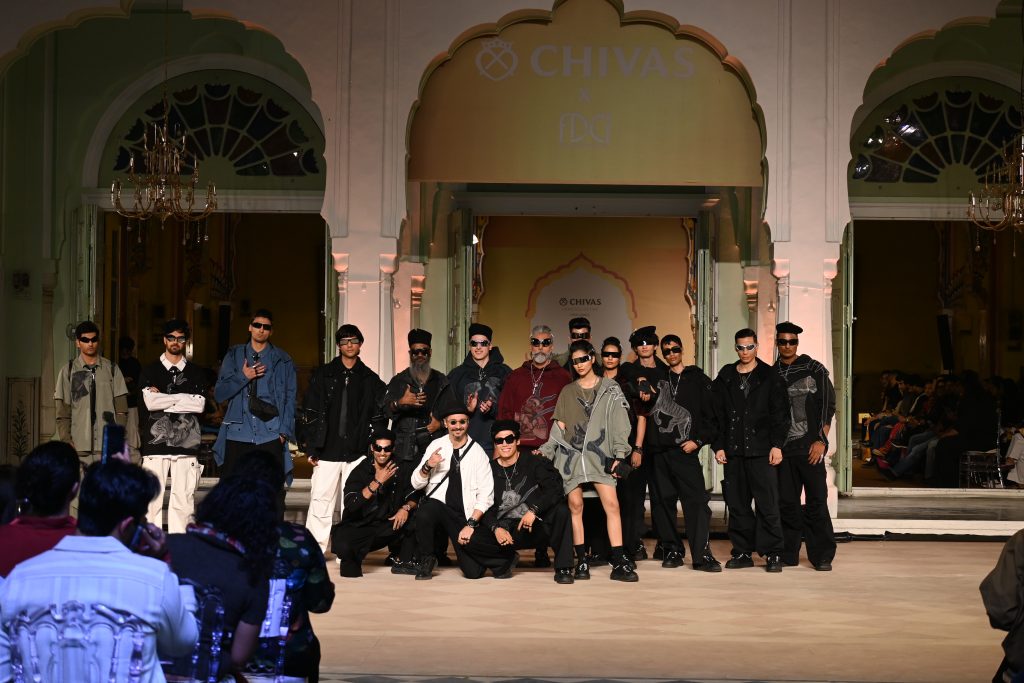
Hindu texts are replete with engaging tales of the goddess and demons, for Nitin Bal Chauhan, the 17th C Devi Kothi became a metaphor, for his streetwear line inspired by Chamunda, and the demons to be slayed — both external and internal in his menswear line titled ‘A Tale of Chamba’. By Asmita Aggarwal You will often see him in black, like the rest of us lovers of this hue, that blends in rather than stands out, I wonder if it has anything to do with how we think or how we want others to think about us? Nitin Bal Chauhan, is in charcoal just like me, when I meet him on a sun-drenched afternoon, bougainvillea blooming in Jaipur, we decided to sit on wrought iron heavy chairs made in the 1850, at Diggi Palace, accompanying heavy duty marble table tops. He had just shown his line at the Chivas Luxe Collective Perfumes presents FDCI India Men’s Weekend 2025 in Jaipur, a line inspired by the temple of Devi Kothi in Chamba. Built by Raja Umed Singh in 1754, dedicated to Goddess Chamunda, it is the northwestern frontier of the kingdom. Chamunda, another form of Durga, is from the text ‘Devi Mahatmya’, warrior goddess, who slayed demons Chanda and Munda. Vijay Sharma, a Padma Shree awardee artist and former curator of the Chamba Museum, and renowned art historian and scholar Dr Vishwa Chander Ohri revived the Chamba miniature painting tradition, Pahari school of art. “Devi Kothi temple’s architecture has an embellished wooden ceiling, and pillars which caught my eye,” says Chauhan, who was raised in Himachal, adding it is remotely placed, and the paintings are almost 300 years old in Tissa, 4-hour drive from Chamba. Bal decided to pay homage to the Chamunda, with hand painting, brush, and Air Ink, (ink made from collecting vehicular carbon emissions in Delhi and NCR. Founded by Anirudh Sharma, a graduate of Massachusetts Institute of Technology in Boston (USA), Graviky produces it) channelling sustainability. “How I’ve dressed myself in the last 20 years is very liberating yet simple,” he smiles. Using cotton twill, detailing like armored core used, a bit like Medieval armour in street wear. To match the Chamunda spirit, he had tracks from the American band GodSmack (had three of their hits– “Woo doo” and “Serenity”) to elevate the pagan elements associated with Chamba, the band connected to that vibe. Bal courted riveting, external elements inspired by armour, he added godets to enhance the shape of armour, straps have a defining factor of street wear, along with broad fringes. “The fighting spirit in clothing comes from Japan, but has entered India only now,” says Chauhan. He adds Hiroshi Fujiwara, is the father of street wear, way back in 1992, and Chauhan added his unique spin on it. Born in Shimla, specifically Mandi, studying at NIFT changed his life, he would come back home, climb walls, get into orchards, jump around, and live carefree. He decided not to get a job, started an NGO titled Sewa Himalayas, revived almost ten crafts – Chamba rumal (detailed patterns), metal carvings, carpet and blanket weaving, Pattu weaving (woollen fabric woven in the Kullu Valley) to woodworking, setting up 73 clusters. “Looked at marketing solutions. Himachal festivals Kullu Dussehra are big draw for tourists and Devis are honoured by carrying them on ornate palki, almost 200 carriages are taken out, it is like the Hornbill of the Himachal, (Shivaratri is huge here),” he says talking about the rich cultural tapestry. “I see a boom in street wear culture, sneakers have boosted it, Gen Z has purchasing power. They know they buy it for Rs 6,000 but can sell it for Rs 12,000. The fastest moving product now is hoodie, the market is in a good place,” he signs off.
Residual Memories
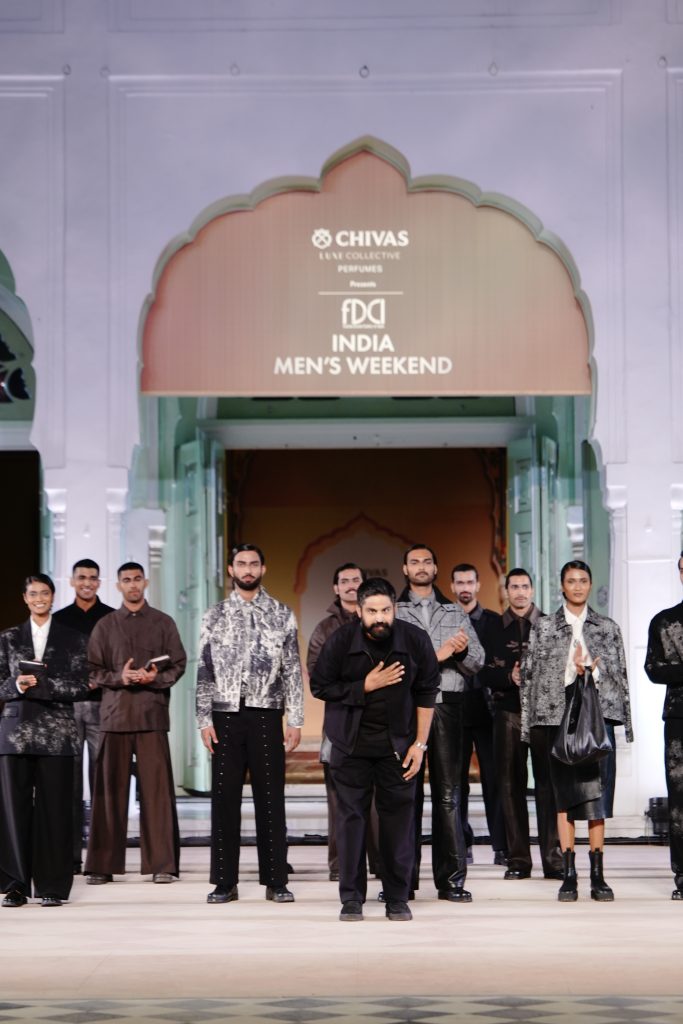
Sushant Abrol, inspired by the ideology of “what is left behind” pays homage to his late brother Samir, through molten metallics, abstract kantha and silver coated denim. Asmita Aggarwal Five years ago, when Sushant Abrol’s brother Squadron Leader Samir Abrol’s brother, died in a crash, he went to the crash site, and noticed boundaries were put in place. It was an emotional time, with his mother, who had lost a young son, the tarmac had ripped, he saw shiny metal pieces strewn across, and one such was right next to his shoes. He quietly picked it up, put it in his pocket, it had a screw left in it, a molten piece of burnt aircraft. He thought to himself this is what gets left behind of a once mighty plane, thus the name of his men’s wear line for Chivas X FDCI “Residual”. “When I looked closely, I saw how deformed metal has become, almost charred,” says Sushant of the label Countrymade. Only three hues – black, silver and grey form the basis of his line, the patterns come from them — cotton, leather coated, metallics, along with hand tucking to add a third dimension mirroring the look of how metal burns and kind of turns inwards or folds. He has added many effects— burnt, tears and charred look, as well as denim and frays, as well as hand done applique. Such is the attention to detail, if you look closely the buttons resemble broken plane parts. Out of fabric scraps, he has created a camouflage pattern, like residual pieces, to make a ‘whole’. The speciality of the collection is a unique coating on denim — silver, then enzyme wash treatment to erode it – giving a washed out look. Images of metal textures, fuselage look of an aircraft is done with rivets. “We have coated cotton, wet-looking, almost slippery, like leather, even though kantha is our USP we incorporate it every year, we have ‘residual stitches’ which have a different interpretation. No motifs were used, allowed kantha to flow, abstract shapes, in any direction it wanted—unpredictable,” says Sushant. Molten lines which have been moved or disturbed, sunset images reflecting faded memories, embroidered denims give us a sneak peek into how he wanted to recreate a scene that has been stuck in the recesses of his memory. The consumer must know what he is wearing, where is it coming from, what’s the story behind it? Not too loud, or restrained but commercially viable clothing, after all, he runs a business. “I do seasonal lines, and just returned from a Paris trade show, where I discovered they like cuts to be away from the body, but in India we still like a fitter appeal-diametrically opposite,” he concludes.