
Shibori, leheriya gets “imperfect”
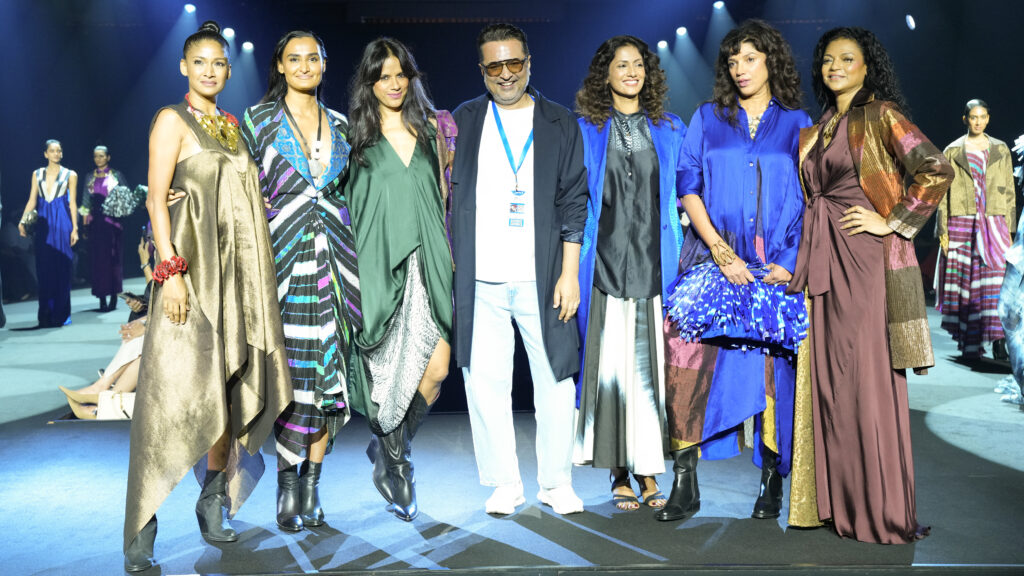
PR exercise is not always fruitful, as brands are not built on celeb dressing, but unique ideology, says Amit Hansraj of Inca. By Asmita Aggarwal “If Sonam Kapoor wears your label doesn’t mean you have arrived”, his point of view is refreshing, maybe because after 20 years in the business of fashion, he realized what really holds value. Amit Hansraj launched Inca, knowing the struggles of young brands, they get trapped in PR exercises, “make this celeb wear our outfit, send free clothes to this TV star” but this is not how brands are built according to him. In 2000 he started supplying to stores like Ogaan and Ensemble, though he had worked with Ritu Beri for six years, Amit Aggarwal too, decided he didn’t want to be an “Instagram genius”. “People who consume fashion are not scrolling Insta, influencers who ask you for clothes will never come and buy your outfits. You are basically not gaining anything by listening to PR demands. Rather relationship building works, a woman who is running a business will not be wasting time on social media. She will need clothes, and will come if you offer her quality,” he adds. Interestingly, he admits, Inca his brand is an exercise in “self-indulgence”, he does one size clothing, this time he added a bit of structure. “I love reversible things, like my jackets, traditional Leheriya got new colours, broke the lines, added vintage textiles, mixed it up. Then we added animal prints with hand blocks, which added depth. I do not like flat clothing,” he adds. His show had 90s supermodels—Carol, Indrani, Nyonika, Sheetal, all the beautiful women he wanted to dress when he began his career, today he got that opportunity. He is clear he does not want to put craft on a pedestal, but make it a day-to-day outfit, not something like your mom’s Banarasi sari lying buried in her cupboard. “Let me tell you something, craft clusters have been monopolized by big designers, they don’t entertain smaller designers. They want to work exclusively with them, all year round, there are many hidden challenges for young brands,” he confesses. Amit decided to do Kantha and Shibori his own way, with untrained women. “I love imperfection. I know many who digitally print Shibori, which I feel is reprehensible,” he adds. He does not want his clothes to look “crafty” this year, to accentuate his look, he began experiments with brass jewellery, made an exaggerated version with doris which he tie-dyed. “Used raffia, it is sturdy, as I didn’t want to use feathers, we revved up our jackets, it was the third element,” he adds. A big believer in “authenticity always works”, even though his Shibori is “made my own way, it looks real to me,” he explains. Dots, cutting in semi circles, is what fascinates him, especially what Carol Gracis wore. It is not size specific, cut on a bias, and takes the shape of the wearer’s body. “I am a textile addict, so Chanderi, linen and silk, organza is what works for me,” he says. After 40 years he admits, he knew his aesthetics even though it is an evolutionary process, “I followed what came naturally to me. Who knows maybe I will do bridal one day, like I dabbled in home and accessories,” he concludes.
Let’s welcome Akaaro pink!
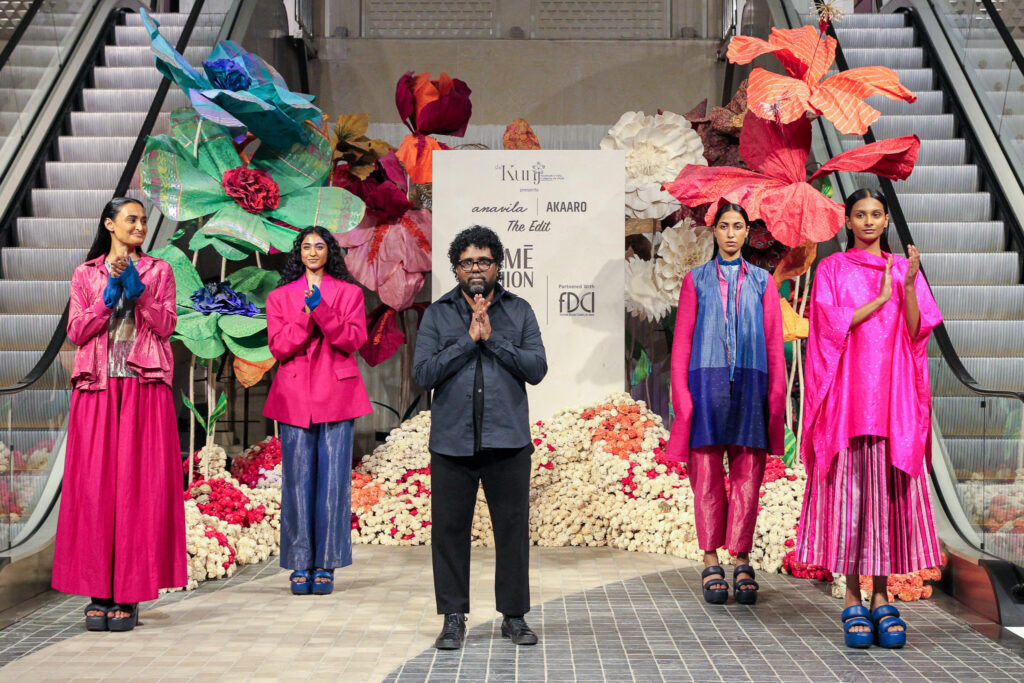
Valentino could have done forgettable pinks, but what Gaurav Jai Gupta has introduced in craft brings with it lightness, subtlety, and grace as Jamdanis take centrestage. By Asmita Aggarwal If you thought pink is only for Valentino, think again as Gaurav Jai Gupta of Akaaro has introduced his stunning version of a handwoven Jamdani sari, knotted to perfection, worn by model Roselyn telling us that you can wear it without any “borders”. His collection showcased at LFW X FDCI opening show at The Kunj, had shoes designed by him, with the help of stylist Nikhil Dudani. “Pinks made a bigger impact as it was on a quintessential Indian complexion. Textiles increase the scale of colour, it also depends on how well you can use the tonality of hues in your favour,” says Gaurav, honoured to be showcasing at the mecca of crafts, The Kunj. Just like his blues that still sell well, he decided to keep it minimal and clean, no layering playing with circle-dots patterns. Khadi silks, Jamdanis formed the fulcrum, and the one and only upcycled coat he made from the entire collection’s waste was a showstopper with dexterously executed patchwork. Metallics were omnipresent, and his signature Kinji sooti saris, played with oversized blazers. “Our outerwear is popular, mostly utility pieces, as we introduced almost 50 separates, wearability is of prime importance for us,” he adds. Engagingly, the sari has now been seen as a dress, or even a drape, he never serenaded the palla or pleats, for him it was more about the form. Ashish Karmali, stylist from Jharkhand helped him undertake many challenging drapes to add a third dimension. “Starlight” his LFW X FDCI line is in continuation of what he started with—”Skies Mine” and then “Moonrise”, from the sky to the moon, and now the pink horizon. “With wars and politically disturbing times, everything impacts me. We had to do a show in the US that got cancelled,” he admits, and showing at The Kunj was appropriate as it channels the “right energy”. Golden platforms, taking us back to 60s, balloon skirts largely roomy, you could easily spot the metallic sheen, with just hints of shimmer, no fuss even in the ponchos as the sleeves are longer, narrower, and exaggerated. “I don’t think people from South Delhi and West Delhi understand crafts, maybe they know about Bandhani and Khadi, but that’s all,” he laughs. What he does want to work with in the future, is printing and embroideries, or what he calls “surface texturing” in his design language. Madina, from Israel played the violin to let in the Jamdanis, which gave us a peek into their visual beauty ushering in lightness and subtlety.
Sari dress anyone?
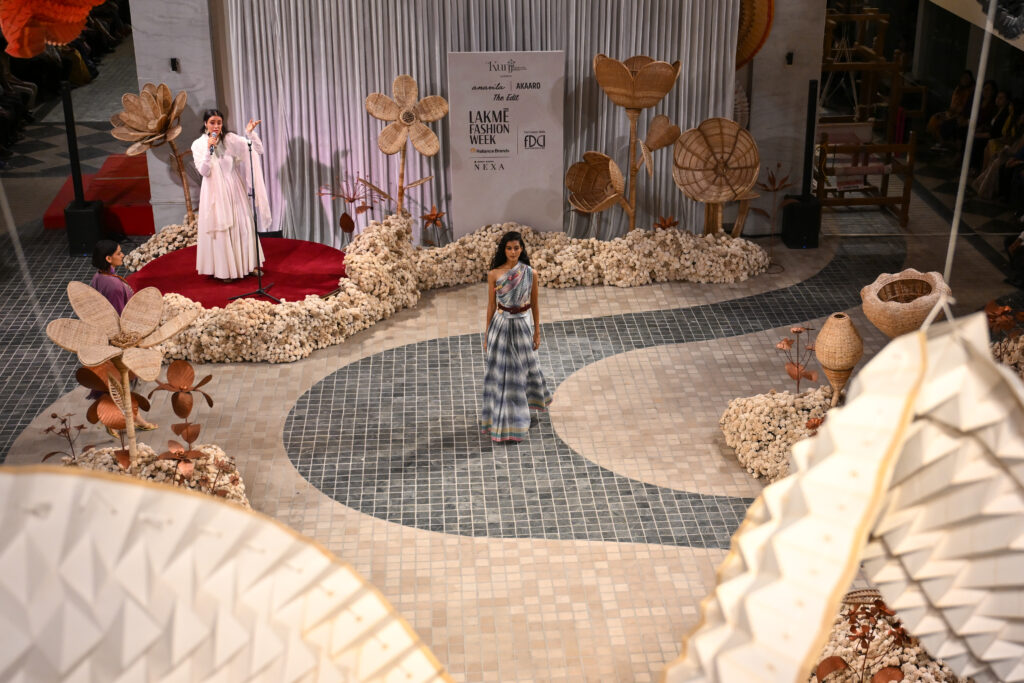
The opening show of the LFW X FDCI by Anavila Mishra and Gaurav Jai Gupta along with in house designers from The Kunj displayed the prowess of the sari, which is now not restricted by pleats and palla but has found a new disposition—jackets, Obi belts and knots. By Asmita Aggarwal Imagine being surrounded by art, culture and heritage, at the first glance at the roof of The Kunj, by the Ministry of Textiles, you are smitten by saris Ikkat, Pathani, Kota Dorias, Mekhla Chaddars, Narayan Peths, Sambalpuri to Maheshwaris, draped in Origami, by the inimitable Ankon Mitra, as you glance up. The waft of mogras on your wrist, and the cobbled ramp complete with wicker flowers, could there be a more befitting opening for the FDCI X LFW? After all, India is a nation known for its hand work, intricacy, and design thinking. The carved wooden pillars Chettinad style strike you, with their austerity on all three floors. Though everyone’s favourite undoubtedly was Suhail Bhan a Kashmiri Pandit, who has been perfecting the art of Bharatnatyam, setting the flow with his dexterous presentation. “I started learning dance when I was 12, learning from Justin, an American! I practise two hours daily, and teach also. Some are surprised to see men dancing, but they look so beautiful, it is an altogether different energy. Today there was more improvisation, as we danced for 20 minutes. Dance is about grace, control, and expressions, as well as how you involve the audience in your journey. I sing also, learnt for a year, it helps in dance,” says Suhail. Live music by classical singer Deveshi Sahgal began the opening show by Anavila Mishra, muslins and her unabashed love for whites. But what’s new is the sari is no longer being worn with palla and pleats, but jackets. “Sarmast”, references the Deccan, from the state of Wajd, thus the ode to handwoven linen, but it was a joy to see the Kerala Kasavu sari rubbed shoulders with pant suits on the notes of Aaoge Jab Tum by the inimitable Ustad Rashid Khan, an eternal fav. Saris came with Obi belts, trench coats, roomy Japanese jackets, telling us there are many ways to wear them. Blush pink looks fab in handloom cotton, as Kimono-style jackets revved up saris, lace bows in the hair completed the look. The show had “The Edit” by seven in-house designers of The Kunj curated by DC Handlooms Amrit Raj. “The look that we presented was entirely woven from waste like all our products, we showed styles on a male model, but all four garments are unisex. The kurta is a kurta dress, then a two-way top, jacket was reversible. The Kunj has been a great place for us to meet customers, and design for them accordingly, generating this level of work with artisans. We upcycle other people’s waste, this is my first experiment with B 2 C, it’ll help develop a deeper relationship with the customer,” says Bhavya Goenka of the label Iro Iro. Pedal looms we have used, natural dyes, extra weft technique to weave waste, Rohingya refugees have embroidered on linen. Interestingly, the belt has arrived and so has the long jacket, the broader the better, the Kutchi mirror work jackets, Ikkats in maroons, traditional saris draped almost sinuously around the body, pleats misplaced and palla disappearing, gave a peek into how innovatively the sari has metamorphosed.
I am greedy for crafts: Valaya
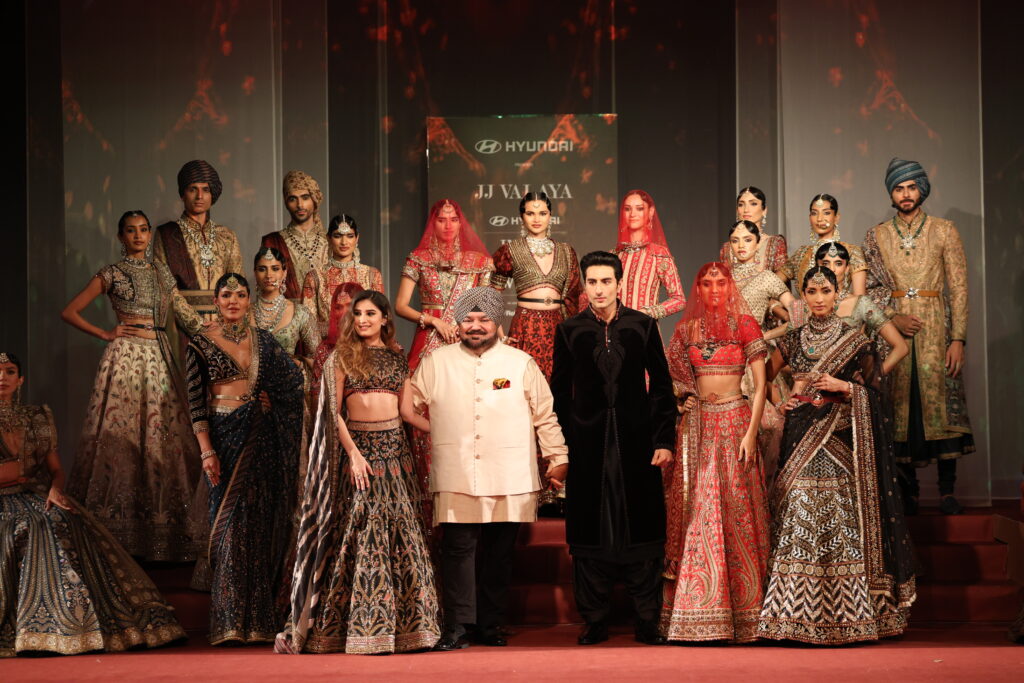
Army mom, Rajasthani crafts, travel and love for the East, forms the basis of Valaya’s ICW line replete with motifs of the Balkans to his ideology –a “royal nomad”. By Asmitaa Aggaarwal J J Valaya was born in Rajasthan, Jodhpur, a fauji kid who travelled all over the country Lucknow, Chandigarh, Pune, to Delhi and from here comes the spirit of travel, as well as exposure to multitude of cultures, living in different parts of country understanding artisanal forms that exists there. “My mom was an army wife, used to handle ladies’ welfare at the army cantonment where they teach embroideries-cross stitch, shadow work to smocking, which I imbibed along the way. All that seeps in, I believe in the power of creativity, it paves the way, defines the path of your life,” says Valaya. It has been 33 years, 35 if you count his education in NIFT, this is why he asserts, fashion is a fab career option, only if you have passion for it, as you are put on test every six months. “You must put blinkers on like a race horse, keep moving. Focus on what you are good at and focus on that, you can’t rest on your laurels. Be aware of what is going on in the world, don’t lose focus, don’t waste too much time on networking. Put in a lot of effort, work hard to hone your skill, make it the best,” he advises young designers. This is no hard and fast rule, he believes in “less is more” or “more is less”. Every designer can support both and believe in either ideology, maximalism vs minimalism both have advantages. India is a land of maximalism, foods are complex, we are a continent not a country, everything changes in our country from our festivals to our dresses. “No simplicity in Diwali or holi we are extravagant – architecture, carvings on rocks and stones, making masterpieces. Indians are not averse to embellishments, it is our greatest treasure—some use it to flourish with just a beautiful garment, some would create an entirely embellished masterpiece to go into a museum-highly subjective our love for shine, he believes. “It all depends on our design language. We love to celebrate—weddings are grand, we consume couture with fervour,” he adds. People should believe in their country more, focus on quality, Valaya doesn’t have gora hangover, feeding to the whims of the West, nor do we try to appease them. “Unless we get accepted in the West we don’t arrive, we feed on that ideology. We can’t be farther from the truth, India will be the prime market for everything in the next ten years,” he explains. His philosophy is to simply believe in my country, make indigenous fashion statements as brides are consuming couture, like they rush to buy bags and jewellery. Why not buy beautiful clothes? “Couture in India is linked to weddings, some women buy embroidered jackets, to feel happy,” he says. Any good brand in the world will be evolutionary in nature—is true benchmark of a brand which believes in its ethos and grows within that. It means you are aware of trends, you don’t blindly follow them, because luxury, to be called luxe, needs a high degree of timelessness. It is an investment, buying masterpieces, not clothes, you want them to last, pass them down to generations, that’s what couture is, he adds. The collection for ICW 2025 “East” and it’s his journey into this hemisphere….he is going back in time, 18th century when the West used to look at East with wonder. “It was a mysterious land full of stories —amazing cultures, artisans, crafts. So we wandered from the Balkans into the far East and finally settled in India,” says Valaya. When it comes to crafts, he is greedy, doesn’t cultivate favourites, he believes there is so much to explore in this country, it will take a lifetime. Any Indian designer must rediscover hidden crafts, and reinterpret for the current generation. Exactly what I am doing, innovate every year, push limits of excellence when it comes to workmanship, detailing and prints we sneak in. We don’t believe in extreme change every year. It has to be evolution. There is a distinct DNA of the brand that’s why customers come to us,” he adds. The bride is well travelled, the internet has brought everything close to us, she is intelligent, aware of what’s going on, all these factors make her better informed than brides of the past. “Being a classist, I want to create masterpieces she can truly enjoy, cherish, make her feel good, look good, give her pieces she knows can be worn again. I do not like gimmickry, I do not want to shock, I want to awe, but with a degree of craftsmanship, and artisanal quality in the garment. All the initial sketches are always done by Valaya himself; every sketch that’s made is fine-tuned by me. “Couture demands that attention, I really enjoy what I do. Gen Z and Gen Alpha are in another mind space, we are mere observers, from a distance see what’s happening and adapt to what’s going on. Tradition plays such a large part of Indian couture, there won’t be any radical changes happening, but mindset is changing-GenZ wants things to be experimental,” he adds. It is a very intelligent generation, they know exactly what they want. They realise, anything good has value and they are willing to pay for it, “so I think after 35 years I have learnt how to adapt to this generation,” he explains. Being a stylist, photographer, designer, a multifaceted person, “the royal nomad with a panache for art deco”, is an apt tagline. “It applies to me, as I love what I do, 33 years down the line I am still as excited about every show, every collection, every brand campaign that we do, photography is my alter ego at play, great leveler. We also do home interiors-carpets, love designing furniture, very fortunate to
I was a rebel, out to prove a point: Rimzim
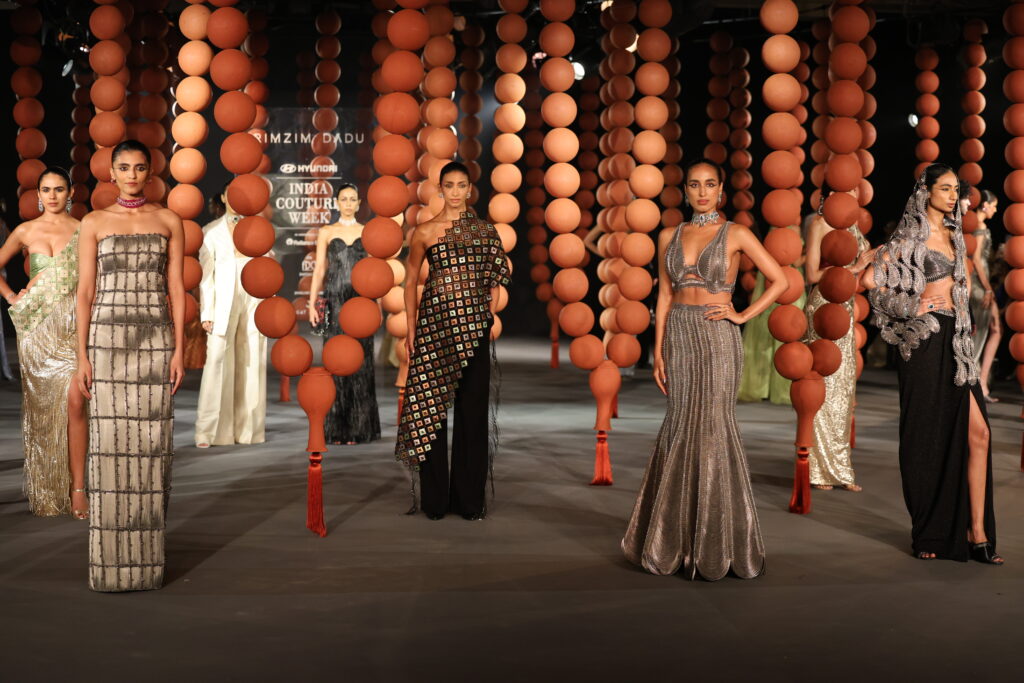
Age and time have taught Rimzim Dadu the importance of merging commerce with fantasy, this year her Banjara tribal jewellery inspired chainmail dress took one month to execute, just like her rejigged sari not swathed in metres of fabric-happily crisp. By Asmitaa Aggaarwal Once upon a time Rimzim Dadu’s steel saris were looked upon as an anomaly, but that was almost 18 years ago, when lehengas were red, zardozi weighed them down. As fashion and the audience has evolved, Dadu calls herself a “rebel, out to prove a point”. At 21, she didn’t care about commerce, though today she realises it takes a lot of maturity to finally run a business. “I think I have found a sweet spot to do what I want to, discovering my own voice, and an audience that accepts my aesthetic,” she adds. Instagram, she feels, has really evolved the public perception of style, though the intelligentsia may despise it, it isn’t frivolous. If anyone follows me they know exactly what’s new, what I am thinking, it is now a democratic process nondependent on traditional media,” she adds. Indian fashion is now looked upon with respect, also curiosity, we are no longer a manufacturing hub, crafts and artisans are the showstoppers, but there is room for many India stories. “There is India traditional, modern, and futuristic. Our traditional weave had been heavily dependent on motifs and embellishment, so what’s wrong with shine? I don’t find it repulsive. Even if you look at Jamdani it is white, but the motifs on it give it that unique character,” she admits. Dadu is experimental, develops new textiles, drawing boards, and karigars envision how to upcycle what is traditionally looked at as waste. “Sometimes it takes ten failed attempts to get things right,” she says, adding, “We start again if we feel it is not going how we planned.” The language of bridal couture has altered enormously; steel saris earlier brides would ask if they could check with their mom-in-law, before buying, now they are the decision makers. Cliché is out; everyone wants to look bolder. “Couture now has elevated craftsmanship, it is a vision, our metallic jewel tones, and a whole new section of gunmetal grey this season is a big risk I have taken. Even though I don’t like to work on set themes,” she says. Her inspiration this year has been Banjara tribes and their vivacious jewellery, Dadu has done Patola in the past, this year she has fallen in love with Bandhani, the knots, used as an embellishment rather than in whole. “For me fashion is art, so the skirt that we made with metal and steel interlinked inspired by tribal jewellery, a chainmail structure, took one month to make after several failures, just one piece,” she smiles. Though Dadu is a woman of finer tastes—she wants to do things other than clothing—maybe lights, textiles, sculpture. “Though what helps is switching off and living in my bubble,” she grins. That’s why her new “streamlined” lehenga (not using 20 but 2 metres of fabric) or playing with a new way of draping “palla”, after detailed R & D is what ICW 2025 saw. Cording, steel wires, in sherwanis, bandhgalas, bomber jackets, it has been a journey of following her passion, even as the new mother Dadu finds “solace” when she works relentlessly to create stand out pieces.
Upcycled Shimmer
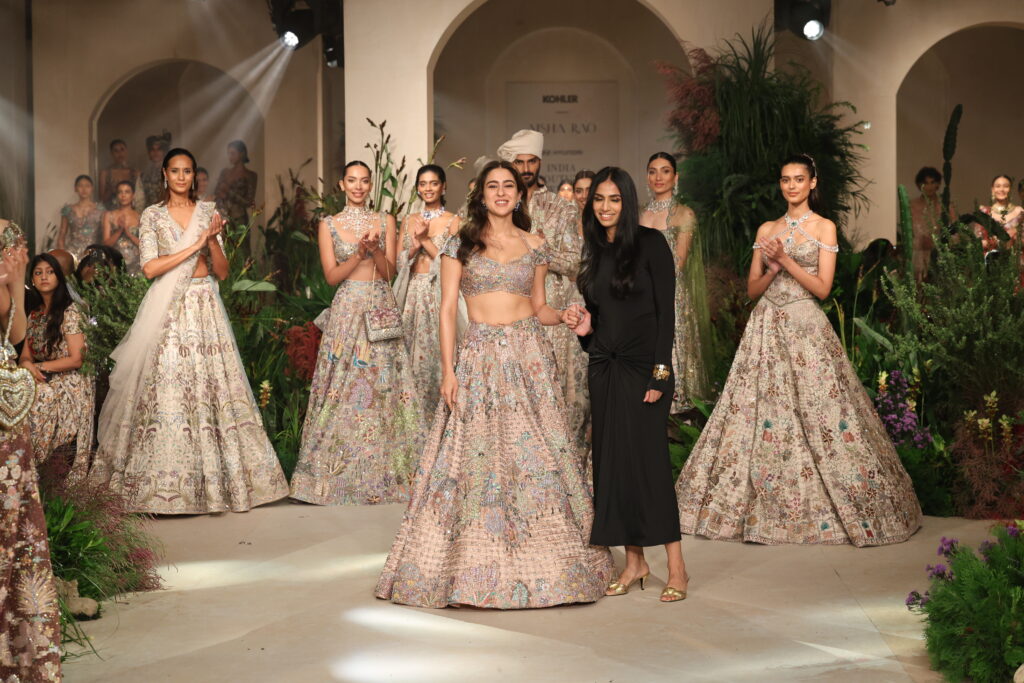
Hyderabad has emerged as a competition to Delhi-Mumbai for couture, even though the lawyer turned designer believes going green can be possible in couture! By Asmitaa Aggaarwal She is a lawyer, who always had an interest in environmental law, and decided to mix her two passions –legal eye with fashion. Upcycling, applique to molten metallics, Aisha Rao, from NUJS (law) to studying in Barcelona Istituto Europeo di Design, IED and then garment construction at Parsons New York, she knew her heart was in making clothes that bring out the vibrancy of India, its unabashed celebrations. Showcasing her line “Wild at heart” at the ICW for the first time, she has said ‘no’ to plastics for a long time, and was in fact debating whether she really wants to work in fashion, known to be the most polluting industry in the world. “Whenever you cut a bias skirt, there was a lot of waste generated, along with this was when we used sequins, bugle beads, bullions on the ‘khaat’. We wanted to find a way to use both these and we did, by upcycling them. I wanted to make a viable business, but reduce carbon footprints,” says Aisha. And of course, a degree in law always helps—specially when recently Bloomingdales sent her a contract she was able to maneuver dexterously. “Brides don’t understand the concept of waste, all they want is to look pristine,” she laughs. Mother of two kids, Aisha often finds inspiration in their stories, like Roald Dahl’s Matilda to Paper dolls, though Indian couture is enjoying the spotlight, with China slowing down–Ambani wedding, Prada introduced Italian version of Kolhapuris, LV embroidered bags. Sabyasachi Mukherjee has stated, he would like his jewellery to not be locked up but worn on linens and skirts. Plus, couture is now functional, not just about heavy lehenga cholis. “We are doing dresses you can wear at your friend’s wedding, the crystal one-piece blouse can be teamed up with palazzos, traditional peacock motifs top this is now your companion to a date night draped skirt,” she says. Couture was earlier reserved for the OGs, very tough for young people to break in, it is also manpower heavy and super expensive, till now Delhi, Mumbai and Kolkata were hubs the South largely ignored. Two designers have broken the glass ceiling and given Hyderabad, a great representation—Jayanti Reddy and Aisha Rao. “I have always loved the Banarasi weave, this year also it finds a representation, in my collections, pure gold zari saris in Kanchipuram. Girls have a mind of their own, they will wear a tiny beach blouse, but mom-in-law still prefers classic woven sari,” she laughs. Her kasavu tissue saree, zari with satins, have done well, for cocktails, to white weddings. “We did sequins overload in the Barcelona line, as an ode to Antoni Gaudi, the acclaimed Spanish architect, I’ve always wanted to tell a story,” she affirms. This season Aisha offers jackets with bustiers inside, a sweater shape you can add over your lehenga, with a smattering of aari work and zardozi. “I’m sitting in Hyderabad, so Bollywood is tough to crack for me, though what celebs wear is aspirational, gets instant results, when a lehenga sells in volumes, it is good for business,” she says. From palms, peacock colours, chintz, maximal flora, lush teak berry, there is a little bit of Aisha in each piece she crafts, “of coursen o lehenga comes within a pocket as that was my pain point at my own celebrations,” she concludes.
Bihar to custodian of Bal’s legacy
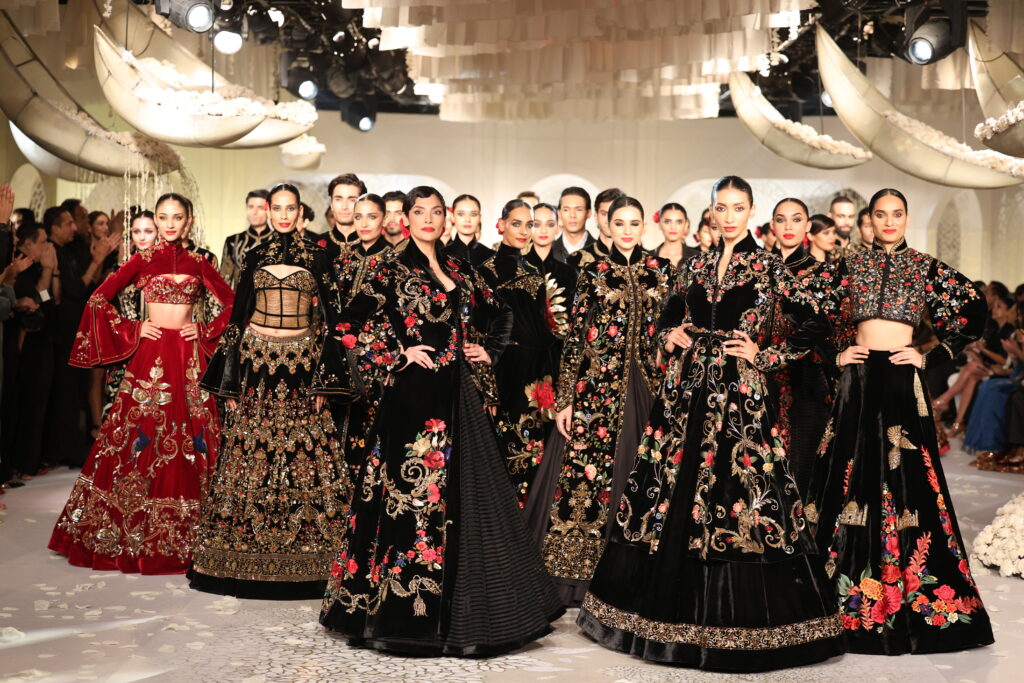
Tasnim Fraze, creative director Rohit Bal, brings garden of flowers from Kashmir in Matka silks and poetic khadi for ICW 2025. By Asmitaa Aggarwal It is quite a larger-than-life legacy of the iconic Rohit Bal to carry on his nimble shoulders but Tasnim Fraze, believes, “It’s an honour and a deeply personal responsibility. Everything he created came from a place of love — for Indian craft, the beauty of Kashmir, and the people who bring that beauty to life. I had the privilege of learning and growing under his guidance for over a decade. As Creative Director, my role now is to protect what he built and let it grow, with the hope that everything we create reflects the integrity and grace he always stood for.” His journey with Rohit Bal began in 2013, just after he graduated from design school Symbiosis International University, he began as a young designer in his team and over time, got the chance to be involved in more — from design to the business side of things. “Rohit Bal always valued growth and believed in continuous learning. He encouraged me to pursue further education, which led me to do my MBA at IIM Ahmedabad. That experience helped me understand how to balance creativity with business decisions. But the real learning came from working with him — being in the atelier, working with artisans, and watching how an idea would turn into something special in his hands,” he adds. The FDCI ICW collection called Kash-gul, draws inspiration from the landscape and poetry of Kashmir — especially from Gulistan, which means the “garden of flowers”. This collection connects with shared memory, craft, and tradition. “We’ve worked closely with artisans to preserve techniques that have been passed down over generations. We’ve used fabrics like Matka silk and velvet, with thread work and gold zardozi that add richness and depth. The motifs — peacock, lotus, and rose — were signature elements in Rohit Bal’s work, and they continue in this collection. What I have tried to retain is his sense of elegance and the quiet drama that made his work timeless,” he explains. Tasnim grew up in Bihar, grew up surrounded by culture, stories, and art. Bihar is also the land of hand-woven matka silk, and khadi was a part of daily life. “Being around these kinds of fabrics from a young age naturally drew me toward textiles and eventually, into fashion. Fashion became more serious for me during design school. And everything truly came together when I started working with Rohit Bal,” he confirms. Couture today is about meaning, he believes. Brides are looking for pieces that reflect who they are — not just garments that are heavy or ornate. “There’s a clear shift toward personal connection, craftsmanship, and quiet elegance,” he adds. For the festive season, what always works is a garment that feels intentional — something with clean construction, beautiful fabric, and quiet presence. When it’s made with care and worn with confidence, it never fails to leave an impression!
Choli out, sharara-peplum blouse in: Jayanti Reddy
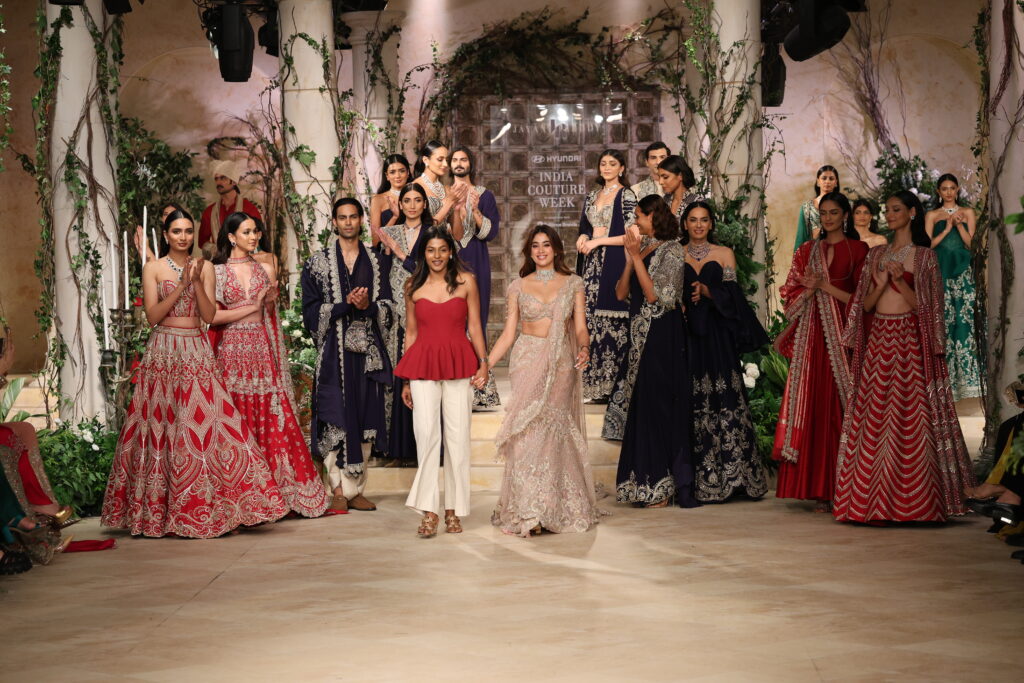
Banarasi weave interpretation is loved by South brides, for Jayanti Reddy Hyderabad has become a nerve center for couture. By Asmitaa Aggaarwal She comes from the city of pearls, and Hyderabadi elegance, known for her love for Birdi craft that she resuscitated, but in the last 13 years in fashion Jayanti Reddy, may have studied business in US, but at heart she knows couture is her first love. “I was doing one off pieces, heavily embellished for a select clientele, we mixed interesting shapes with comfort. Though the focus has been jewel tones and pastels, with a smattering of gold,” says Reddy. In these years there have been many inspirations—travel to textile art, even using leftover scraps patching them together to create new fabrics. Or woven panels with zardosi threadwork, made into slimmer skirts; new interpretation of Banaras with lighter more gossamer touches. “The lehenga choli is obsolete, it is now the Sharara and peplum with two sheer duppattas, and trail,” she explains. The South has become a hub for brides, the market is booming, it offers originality, variety as well as fantasy, for her Banarasi weaves are best sellers. “Capes, jackets to corsets offer a third dimension, and weddings are a mix of cultures. There is no set template of what will work, we need to keep evolving as brides do and frankly Bollywood wearing a Jayanti Reddy creates enormous awareness,” she concludes.
Insta helps boost revenue, says Nikhil Mehra
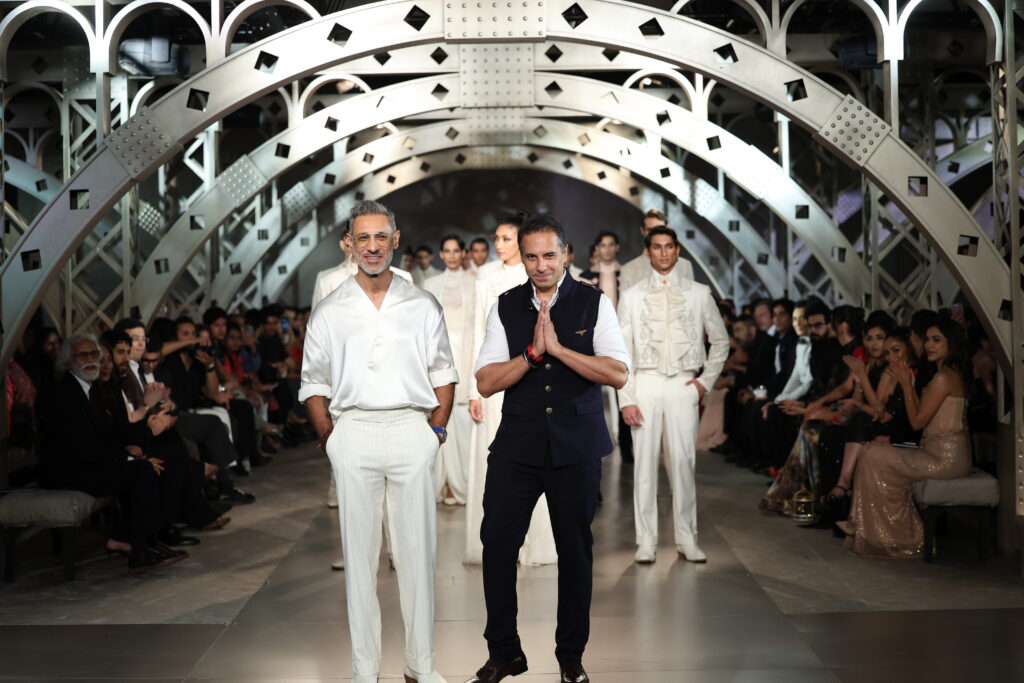
Gender fluid Shiva-Shakti has been a leitmotif for Nikhil Mehra as the younger brother in the duo Shantanu-Nikhil confirms menswear is where the real game is now! By Asmitaa Aggaarwal For 25 years now Nikhil Mehra, the younger sibling of the duo Shantnu and Nikhil has been on a trek, in the world of fashion, he calls it a journey of “self-exploration”. The focus has been on transforming men’s silhouettes, moving away from the idea that a man is simply a “caretaker’. “There is a sense of poetic femininity, where drapes are the mainstay. Women in S and N couture are portrayed as strong independent brides, rather than coy, not romantic so in some ways it has been a role reversal of sorts. “If you look at the history of couture it was considered the holy grail, unapproachable. Now for the last few years it is moving away from ostentation, display of wealth, with a lot more focus on experimentation,” says Nikhil. Maybe that’s why the obsession with red has dimmed, societal norms have been broken, brands are looking at watered down versions of couture—Anamika with AK-Ok and Tarun Tahiliani with OTT. “Less is more for us, we try to tell a story through minimalism, like our hand-crafted brooches, there may be a lack of abundance, but there is a definitive respect for crafts,” says Mehra. Though he questions, “just because it is $4000, should we say we have put 4,000-man hours making it? We don’t think like that? He works with sporty elements, as games is what keeps him going personally too, here too there is innovation—yarns are developed, mostly breathable knitted fabrics, wool blends. “Accessorizing has been a fun thing, so we channel military regalia, kamarband on shirts/sherwanis, merging two different worlds,” he adds. Nikhil admits post-colonization, we embraced colours vibrantly, as well as prints and refused to be cowed down by a Western aesthetic of black and greys. “Fantasy in fashion is before you are 22 years old, after running a business, you grow up really fast. The theme of Shiva Shakti, gender fluid has been constant in our lines, even as our brides have abandoned dupatta and decided to wear a lehenga with structured jackets, that she can wear with drainpipe pants later for a girl’s night out,” he smiles. Men have been neglected in fashion, he believes, so the brand took cognizance of it, “men are no longer a mere plus one, they have an identity of their own”. Pre-covid couture was only wedding wear, now it is about celebrating every moment, not just a D-day, anniversary, a personal milestone et al. “Paris Fashion week, celebs walked for Balenciaga, among others, so the showstopper is an important aspect, good for business. FB and insta generate revenue for us. People want to see what their icons are wearing,” he adds. His fav hues—dark navy and cherry, mix in this is deep emerald, slate greys and rubies. That’s why his line for ICW 2025 titled “Metropolis” serenades a global man, who takes his cultural identity with him. “We went to Moscow, St Petersburg, and Pitti Uomo, to Sardinia, a man now is unapologetically well dressed, he enjoys the process. That’s why menswear is more potent now than ever before,” he says. Vivan Mehra, his son, is now gearing up for Emerson college Boston, in filmmaking and acting, so like all doting fathers, Nikhil believes he gets this talent from his mom, Vidushi, a theatre actress. “I knew he was not going to study accounting or engineering, rather performing arts was calling. It was a toss up between football and acting, the latter won. In fact Karan Johar told him to watch a lot of Japanese films, watch finer nuances like lighting to understand 70 MM world,” he concludes.
Barefoot doc of craft: Ritu Kumar
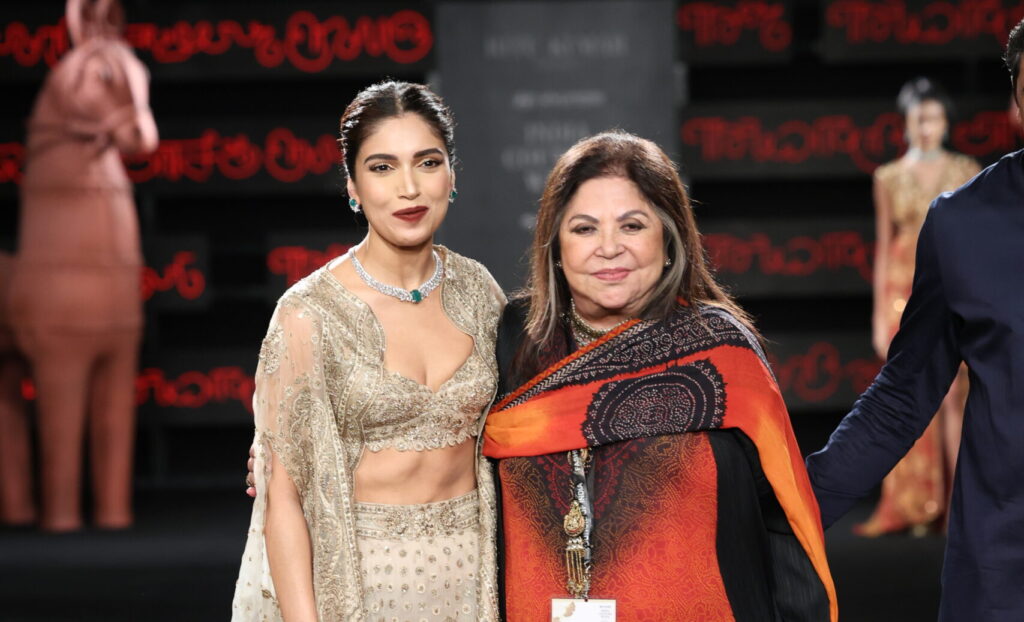
No one can tell one bridal outfit from another. No one has time and dedication in this computer age for crafts, laments Ritu Kumar. By Asmitaa Aggaarwal In the 60s she was the first to do the classic ready-to-wear bridal, as traditional woven saris were the norm, now Ritu Kumar sees a huge change, due to the number of options available in couture. “The palette is not structured anymore, Bengal they still wear red Banarasi, but D-Day hues have a new handwriting of pastels, shapes remain conventional, as Gen Z innovates. There is an introduction of beads, sequins, and pearls, we are doing Europe with a mix of India in couture renditions,” says Ritu. When she began in Serampore (Calcutta), there were no books on crafts available, no one knew about the beauty of Machilipatnam to Ajrakh, but zardozi always found glory. “Not a page was written about Indian textiles, now there is huge awareness about crafts; we are one of the few countries who have retained our luxe heritage. I have worked with some outstanding people in this field-textile art historian Jasmeen Dhamija to Laila Tyabji, enriching my journey,” she adds, saying Martand Singh and people like him were the “barefoot doctors of craft—truly academic nourishers.” In the 70s no one knew about India as for 200 years we were ruled by the British, colonised, they took the paisley and machine printed it on fabrics, sold it back to us, she explains. But true to her craft Ritu took the hand block print to the prestigious Pret-a-porter show in the 70s France, filling the vacuum which she has detailed in her book Costumes and Textiles of Royal India. She is ready for her new book, just finished editing, on contemporary India her journey from the 60s to now. “Our hand block print saris did so well that soon Surat and Banaras started abandoning polka dots and doing hand block prints,” she smiles, adding sequins never permeated into her aesthetic. Interestingly she says, everything in bridal looks the same, can’t tell from the other, made in Farrukhabad or Bengal no one knows, which needs to change. Fashion, she says, must make a social impact, as we have an ingenious handwriting, it is alive on the ramp not in museums like other countries, it is being worn from Lajpat Nagar to Dilli Haat as well as couture week catwalks. “India is an engaging phenomenon, but what I would love to do most is revive the Kani shawl which no one has been able to as it is such a complex weave, like Chintz, my perennial favourite,” she admits. It is so special that it can never be copied! In this computer world, she says no one has the patience for crafts, to understand its nuances, sit and learn. “I am a painter but I don’t know the vegetable dyes used to make paintings—I am just a catalyst, artisans are the showstoppers,” she says. Rinku aka Sharmila Tagore whom Ritu knows since her Calcutta days wore the Begum of Bhopal’s joda, for her wedding to Pataudi wanted Kareena to do the same. Ritu took on the task, 5 months, contacting Mughal emperor Wajid Ali Shah’s old karigars, from Metiabruz (Calcutta) to repair the 300-year-old gold sequins one by one, and get the gold zari woven again that had got torn off. “It was worth the time, and dedication,” she signs off.