
Valaya’s Flying Carpets
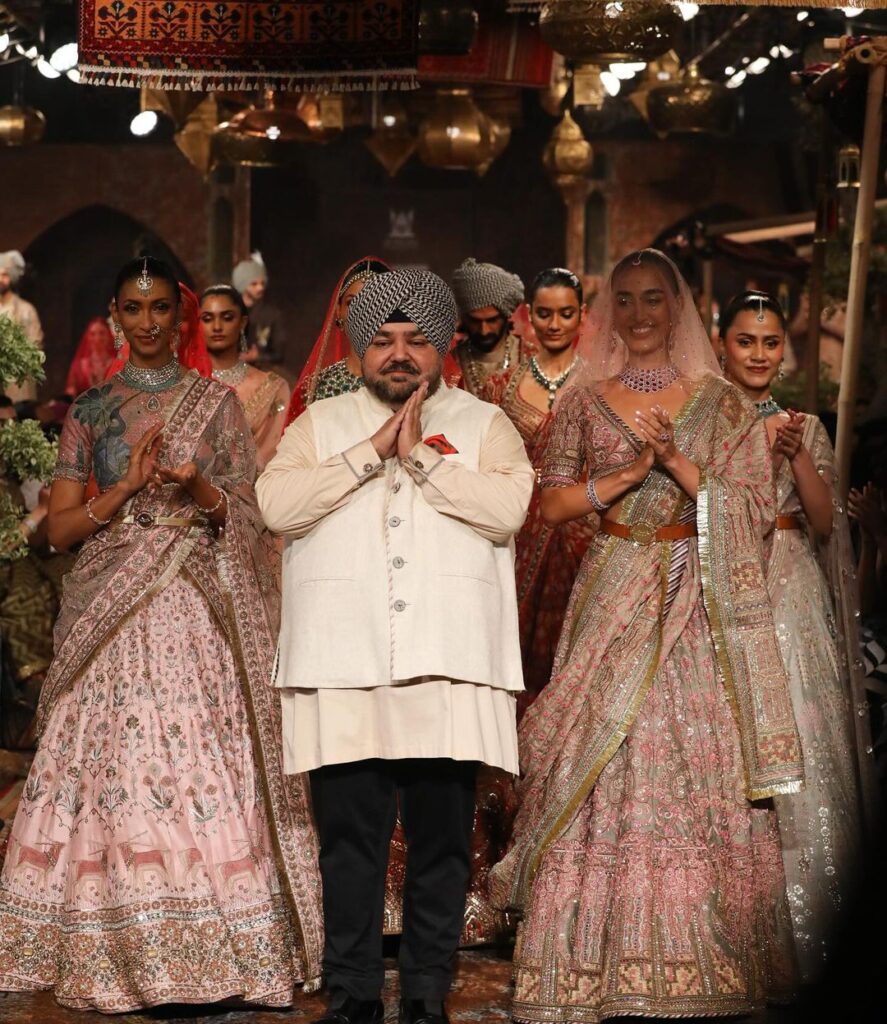
From embroideries inspired by Mughal miniature paintings, big, broad embroidered belts cinching Sherwanis to reinventing the humble shalwar, cherry red lehengas to lighter chevron palazzos, J J Valaya redefined bridal wear. By Asmita Aggarwal It was the music directed, produced by Sahil Vasudeva, at the J J Valaya ICW 2024 show that accentuated the embellished capes and chevrons. Music can make or break a show, this one featuring Mahima Dayal (vocals), Kartikeya Vashist (flute), Tariq Vasudeva (spoken word), Suhel Saeed Khan (sitar), and Makrand Sanon (percussion) revved up the line titled, Muraqqa, an Arabic word for meditation. We sat in a pitched tent, surrounded by vintage carpets, with the sound of the desert instrument Oud playing, couture is really a mood. Sahil, played the piano live, even though he studied maths and economics like a good Indian kid, in Ohio, music was his calling and the show was a tribute to his father who passed away a few months ago —a person who always supported his dreams, got him private tuitions in classical piano, sent him to Delhi School of Music. You could see the prints on JJs lehengas inspired by Persian carpets, that spread like paintings on the runway, looking like you have entered a Turkish market, on a rainy Delhi evening. The aged metal embroideries seemed to be in tune with the desert theme, a Bedouin tribe, though Valaya, also gave us options of lighter printed palazzos with cholis. Saris came with capes shimmering with zardozi, on Rumis verses. Supermodel and model trainer, Laxmi Rana opened in a nose ring, and Valayas signature– a leather belted sari. The chevron safas, Mughal motifs, didnt channel softness, rather everything was extravagant. Valaya heralded the return of the salwar— updated, printed and narrower. The idea was to take us on a journeyPersia, Turkey to India; thus, the tribal music. Sahil used an African song and wrote Khusrows lyrics on it. The show was punctuated with a waterfall, thunder, and desert storm, they created a Devdas style character, who is pontificating on life, high on spirituality. He leads you to India, thus the show ends with Chaap, Tilak says Sahil. The Oud is a string instrument, the mothership is from where the sitar originated, Sahil did the composition in just five days, and improvised six minutes of a show to time it with the catwalk. In a live show you have to sometimes play catch up, and make up music on the spot, he says. Valayas big, broad fabric, embroidered belts cinched sherwanis, lehengas interestingly came with capes. Deer danced on lehengas, the entire forest frolicked on them too, the embroidery looked as if it walked out of a miniature painting. Handkerchief-shaped sherwanis were engaging, there were Patiala salwars for men and of course, the ceremonial red lehenga.
Dolly J’s Midas Touch
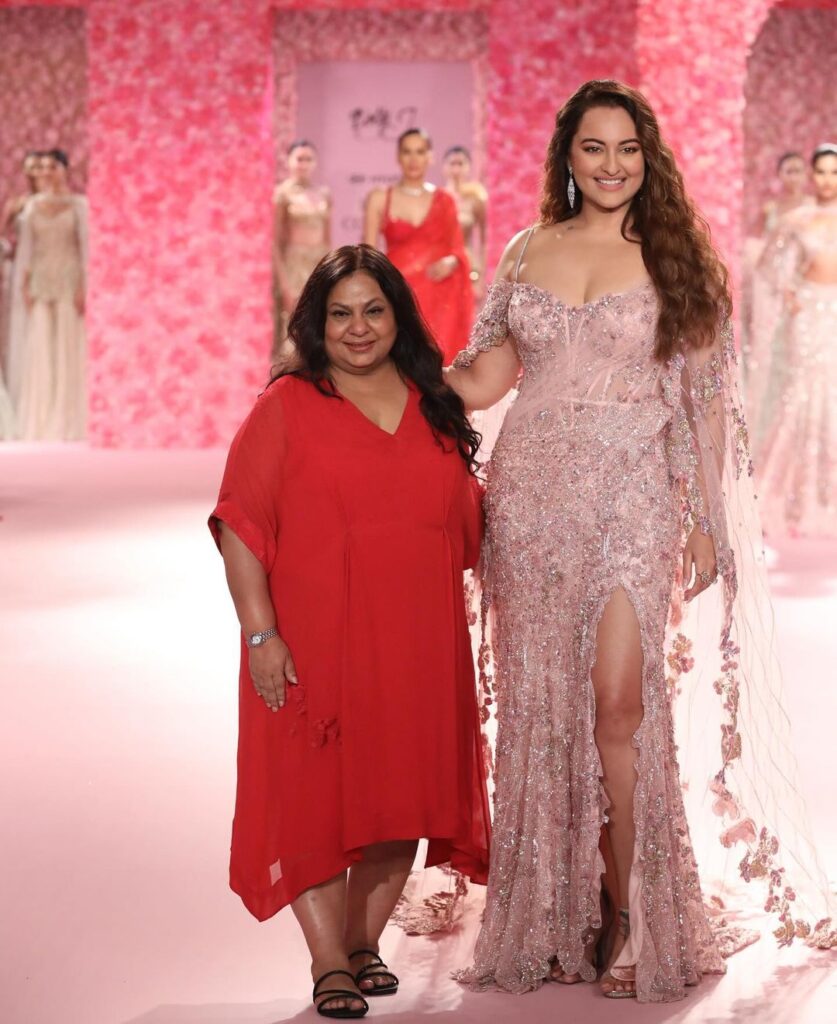
Body positivity, 3D motifs and inventing a new fabric, which rustles like paper but is organza, made Dolly Js ICW 2024 show, feel like a bouquet of roses. By Asmita Aggarwal Actor-turned-politician Shatrughan Sinhas wife Poonam, came to support her newly married daughter Sonakshi, in a woven sari. The set was a set brimming with roses —arches lined like a maze. Body positivity has always been important for me, and this collection is for young brides like Sonakshi, she is my muse. For me, it was a happy collection, says designer Dolly Jhunjhunwala, who introduced teals, mauves, and lavender in keeping with the mood of easier hues, at the ICW 2024 in a show titled La Vie En Rose or life in happy hues. The just married Sonakshi exclaimed, Any girl would love this — it is feminine, divine, and glam. The live music by singer Rachel, I was groovin to her beats. Im not a pink person, but it takes vision to put me in something like this. Today, it is my colour. Though I love red, white, pastels, yellows, and my all-time classic is cream. Sonakshi, dressed in a curvaceous pink gown, is not one to mince words, and admitted at her wedding, trendy is what I wore— a red woven sari, simplicity will never be out of fashion. What Dolly gave me is comfy, I can breathe, move around. It took me exactly five minutes to choose my wedding outfits. I wore my mothers sari and wedding jewellery for the court signing. Me and Zaheer are not fussy people, she laughed. She adds, she would like to wear something that makes her feel good from the inside. Flowy and feminine. Though for my bachelorette party, with the Sona Mandi theme I wore an Anarkali, the outfit spoke for itself, she added. Lilac gowns with leg show, burnt maroons with embroidered bodices, Sonakshi sang Love me by Justin Bieber, along with the live crooner Rachel, next to the piano, on stage, and said, Today, I am pretty in pink. Everything had a Midas touch -gold, boas, cutwork blouses, Dolly admits her signature remains gold/silver, plus, the love for colours, has been quite vividthis year the theme looks like Cinderella reloaded, more like once upon a time, whimsical for the India Couture Week 2024. Florals remain a constant, easy light shimmer makes movement less restrictive, India is incomplete without bling, she admits with a smile. This season, the innovations range from developing a fabric, which has the feel of paper, but is organza blended. Clothes I design are not very Indian in their shapes, says the self-taught designer. The motifs are 3 D just as she likes them, only bigger and bolder, with peacock feathers, incorporated in the iconography. Mostly, cholis have gone risqué, but this time, Dolly has wooed the ones, who like to keep it traditional, fish cuts work well as well, as gowns and fitted skirts. Brides have stopped hoarding clothes they want to wear and use, but the buying is timed, according to the occasion and season. There are fitter bodies, so they desire sculpted clothes, she adds. Her repertoire has faux feathers for glamour, bustiers knotted at the back, sheer as well as gowns with pockets, not forgetting functionality. Pink has been a bestseller and this time, Dolly tried a bit of teal, even though that was not her design vocabulary, though she hasnt bid adieu to hot red! Dolly Jhunjhunwala, has earlier paid a tribute to pearls in her line Basra, won over Sachin Tendulkars daughter Sara with an embellished draped sari, emboldened with thread work in gold as well as sequins.
Kunal pursues Patolas
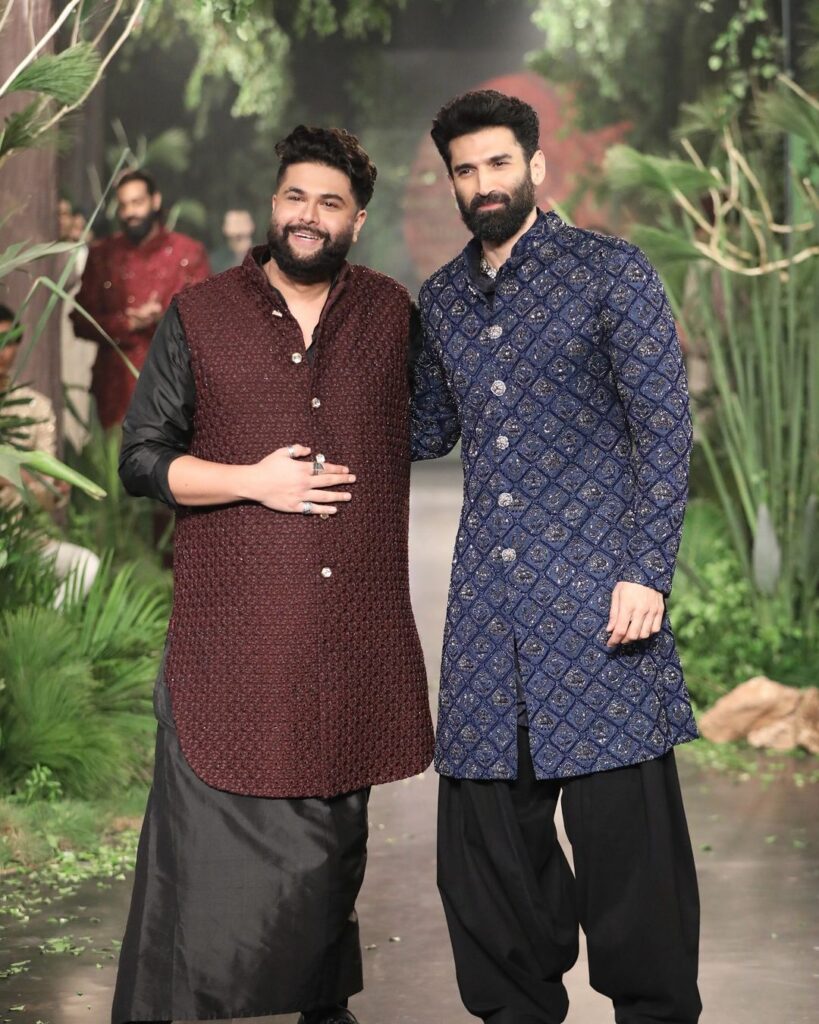
Kunal Rawal introduces Patola-inspired weave for grooms, turning tables on traditionality; he serenades us with denim dhotis, and comfort, to make sure reusability, and functionality co-exist at ICW 2024. By Asmita Aggarwal Remember Ranbir Kapoors hybrid dhoti, well, Kunal Rawal is the one to take risks. Even though he is young in couture, he believes he has found his feet, and often says, India is 14 countries in one the craft is diverse, and so is the market. We are a country of celebrations where marriages are auspicious, and grand, so why shouldnt couture be personalized, to suit the psyche more than the body type? Star Arjun Kapoor may not have the abs like the rest of the Bollywood toned gang, but he does have a winning attitude, whether it was giving up his seat for a lady during the show, or posing freely with his fans, he has no starry airs. Well, Aditya Roy Kapoor, is a different ball game he is suave, unshackled and seems to have fun in whatever he does, he was the ideal showstopper for Rawal. Kunal gave us mogras, the sweet smell wafted through the hall, and cushions to sit on, creating an oasis, with birds chirping and greenery. In his unique style, the show began with Gurmukhi, and then it was raining men —bearded, wearing earrings, kundals, ponytails, turbans to delicious curls. As Kala Doria played with IP Singh and Akshay Raheja, women walked in sherwanis armed with silver-edged swords. The turning of tables wasnt restricted to just shapes, Kunal convinced Aparna Bahl, the choreographer to take the cue and walk the ramp. Kunal got older, bulkier models in dhotis, he does know how to add drama, music played a big role in the presentation which had everyone foot-tapping. Culturally couture is the richest, and GenZ demand a hand-crafted product, which has a fresh thought, can be reused, has real value, comfort, of course, is king, says Kunal, adding, couture is mostly looked at for women, men were never in the game, only for the last few years, there has been a shift. Menswear, he believes, is a specialists job, thats why he admires Rick Owens for his ingenious concepts, and what Alessandro Michele did for Gucci, almost giving it a new identity. Men have clarity, are strong minded, they are loyalists, now unlike earlier, they take a keen interest in what they want to wear, he admits. For ICW 2024, the overall theme revolves around union of two minds thus, the title Sehera, the science behind auspicious dates intrigued Kunal. You want to make sure, a marriage has positivity, good energy, and favorable omen, he says. Thus, his motifs are inspired from this sentiment — betel leaves, evil eye, coconuts, wedding are soaked in a robust layer of culture, they have a distinct spiritual side. To fructify his thinking, he has come armed with a treasure trove of textileshis most potent armour is the Patola-inspired, hand woven, weave, traditionally women have loved. He has delved into Chikankari for the first time, brocades, and Bandhini are all time favourites, he created unique block prints, used silks and Ajraks to craft safas to stoles. For me, a line is successful only if it is comfortable, he adds. You can see how effortlessly his deconstructed sherwani works, or Patiala, breeches, pants are done in stretch, linings are sweat absorbent, fabrics weights are lighter, and come with an exquisite fall. The paneling in the bandhgala, is cut closer to the body, making way for exciting shapes. There is no cookie cutter method we follow, it is all about pattern play, he admits. He works on technicalities, jersey sleeves add ease in movement, he urges grooms not to go in for a mannequin look, but customize it. Taking it a step further, there is personalized lining on offer, cusping used to join pieces together, ensuring smoothness in wear. When I started, I felt there was a uniformity in menswear for weddings, the product was boring, men were dictated how they need to look. Now there has been an evolution, he explains. Personally, he admires drapes, but has only attempted a few, this time he has dhotis, even though flares are in trend, Kunal has not worked with them. He introduced nifty dropped crotches, six types of Aligarh shalwars, in modern iterations. Everything comes with lots of pockets, he reiterates. After design, music is his love, this year for the ICW 2024 show, he created five new tracks, he believes storytelling in the format of weddings excites him tremendously. Aesthetically groom wear is altering; hand crafted products are being appreciated. As a designer, I feel fortunate to be able to access varied textiles, seeped in history, he concludes.
Tytler’s Echoes of Roman Grandeur
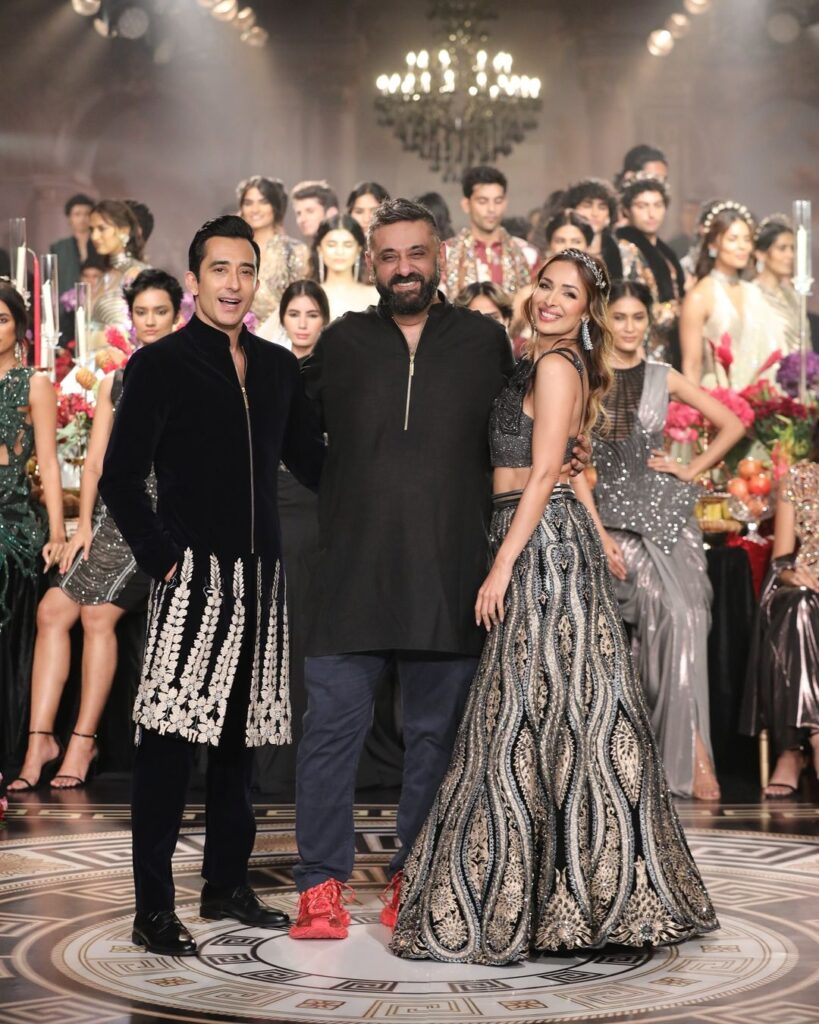
Taking us back in time, to the Roman empire, replete with its imposing iconography, Siddartha Tytlers dark, grand line played with asymmetry, sheer and glimmering rhinestones at the ICW 2024. By Asmita Aggarwal He is the quintessential Mr Handsome Rahul Khanna, it has a lot to do with his genetics, being the son of Bollywood dreamboat Vinod Khanna, but unlike his father, he is doing fewer films, and is mostly setting Instagram on fire. At 50, if he can sizzle like that it is more to do with just looks! Mr Khanna was the showstopper at Siddartha Tytler ICW 2024 showcasing, where he told us through his line, Caligulas Feast, how decadence can be translated through extravagant ensembles, bursting with shimmer. Giving us a lesson in history — Gaius Caesar Augustus Germanicus, a Roman emperor, was assassination in 41 AD, but till he lived he courted pageantry like none other. Tytler exclaimed, He lived life large; a bit like me. The ramp was converted into a debauched feast, with a revolving stage, and a Roman bust at the centre, overflowing with flowers and lit candles, it had all the theatrics of 70 MM entertainment, and in this glamorous mix was also Malaika Arora, dressed as Tytler said, as if she is going to war donning an armour. What I am wearing is stunning, I felt like a fierce goddess, exclaimed Malaika. For the Roman emperor, known for his debauchery, and ostentation, the show paid homage to how he was also the most amazing host —thus the huge spread. On a lighter note, preparing for a show can be daunting, but Mr Khanna seemed unfazed, he laughed, I only thing I check to see is if my zip is fastened, of course I always take a few deep breaths. Khanna, who is a star amongst his fans, wore a velvet sherwani, with placement embroidery, though Aroras cutwork gown accentuated all the curves, she so diligently worked out without fail! My shoes should fit right; I should feel comfortable. I always say a prayer every single time before I hit the runway. And this garment is in addition to the many blacks I proudly own, she said, adding, I get FOMO if I dont walk the ramp. Tytlers draped gowns, complemented the imposing sets, exaggerated sleeves, charcoals, velvet as his sherwanis came with mythical golden birds flying on jackets with their beaks glistening with rhinestones. He thoroughly enjoyed adding asymmetry, played with layering and gave Malaika corsetry in gunmetal embroidery, depicting the strength he admires within her. Interestingly, the kurtas had metamorphosed, got many cousinshigh low hems, draped, pleated et al. He included faux fur, introduced cropped jackets with pants, asymmetrical dhotis, liquid fabrics that hugged the waists, and created the mood with Roman leaf-shaped emperor headbands. The dupatta draping aped the extravagance of the erstwhile kings. White and gold remains a winning combination, fabric manipulated into high-waisted skirts, more than lehengas there were options you could choose from. Kaftans as well as abundance of sheer teared through in body hugging gowns, skirts, exaggerated sleeves, exposing washboard abs and endless legs. Heavily jewel-toned jackets, large floral printed pant suits— bold was the mood. As flowers were everywhere, it was if you entered the garden of five senses, Tytler balanced louder pieces with frothier prints, rather than zardosi. Grand, dark are themes which interest me, concludes Tytler.
Suneet Varma’s ode to shine
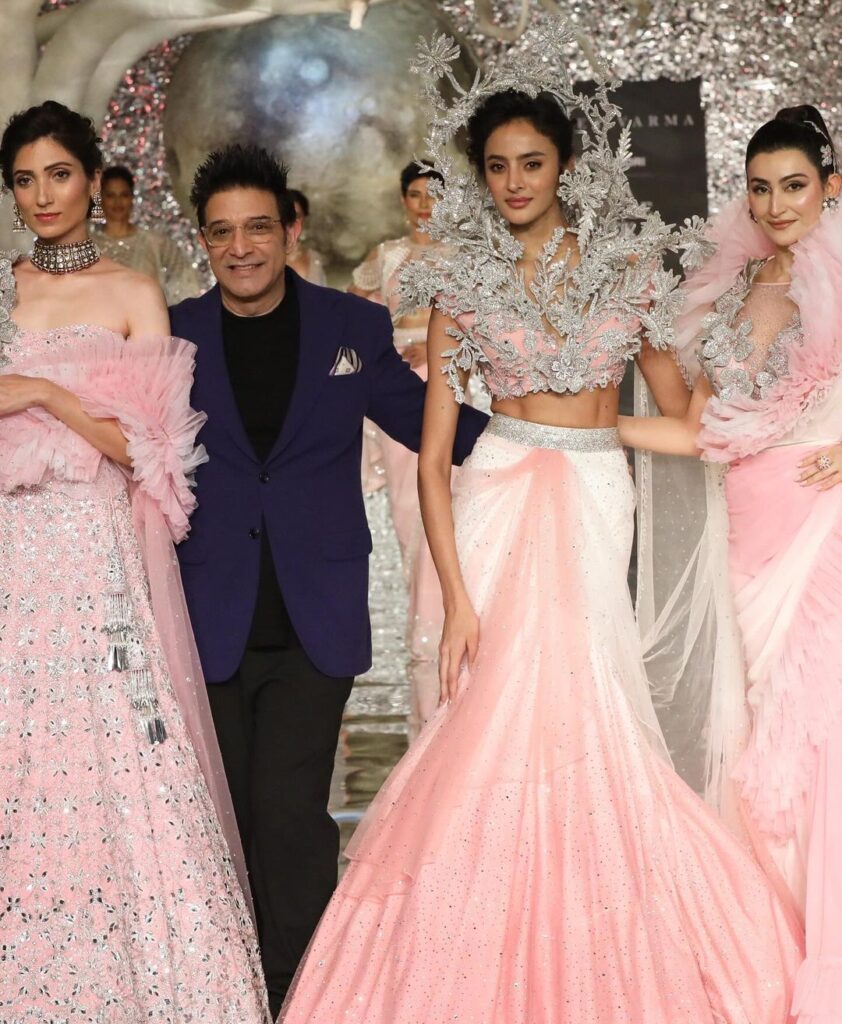
Mirror work, to mokaish, shimmer has always been the highlight of Suneet Varma’s oeuvre, even as the designer, who was trained by Yves Saint Laurent announces, there is nothing better than being in the spotlight on your D-Day at ICW 2024! By Asmita Aggarwal What I really look forward to in a Suneet Varma show is his jig at the end of the showcasing—and let me tell you he has the moves! Suneet likes constantssexy, shine, glamour, and decade-old friendships. When we talk of shimmer, there is no one who can light up like Suneet—a tree stood in the middle of the runway, and the show began with Urdu poetry, thus the title Nazm for the Hyundai ICW 2024. Few know that Suneets mom, Indira is an avid lover of Urdu shayari, and they both bond over classic Hindi numbers. Over the years she has offered him unflinching support! From the 60s Ghar Ghar Ki Kahani, and a song by Kishore Kumar….Sama hai Suhana Suneet gave us a taste of vintage Bollywood with a dash of gold through his pre-stitched sari-gowns. Pearls were strung together to form blouses, cutwork flowers, rested on nimble shoulders, he used various techniques in the library of sparklemokaish to mirror work. Now that old is really gold— and Zeenat Aman is everyones It girl it was only apt to pay a tribute to her hipster pants era and strumming a guitar, in Chura liya hain tumne jo dil ko in the inimitable voice of Asha Bhonsle and Rafi saheb. There is undoubtedly no one as fashion-forward as Zeenat, thus models came armed with pixelated sequinned saris in white. Interestingly, he had socialite Shalini Passi almost dressed as a Barbie, only ruffled, in a sari. Bollywood chart-toppers kept the rhythm divine, from Aao na gale lago na, conjuring up images of Helen moving like a dream with heartthrob Rajesh Khanna, serendipitously also dressed in pink and gold! Faux feathers, bare backs channelled sexy, as the ramp was overtaken by mirror work, gotta borders, as if we had entered a house of illusionthrough tiny mirrors. The veil is enjoying its moment in the spotlight, and the Suneets fully beaded bustiers, and draped saris, reminding you of the ones that yesteryear actress Mumtaz wore, made vintage appealing. Palazzos offered ease, with tunics cut away from the body, as draped dhotis in ash grey, were worn with flared sleeve blouses. Sequinned sheaths, asymmetrical tunics teamed up with shararas, even if you switched off the lights, the garments will shine unabashedly. Surface ornamentation was Suneets way of welcoming a bride, who wanted to make sure she was the highlight of her D-Day!
Roses with lace for Isha Jajodia
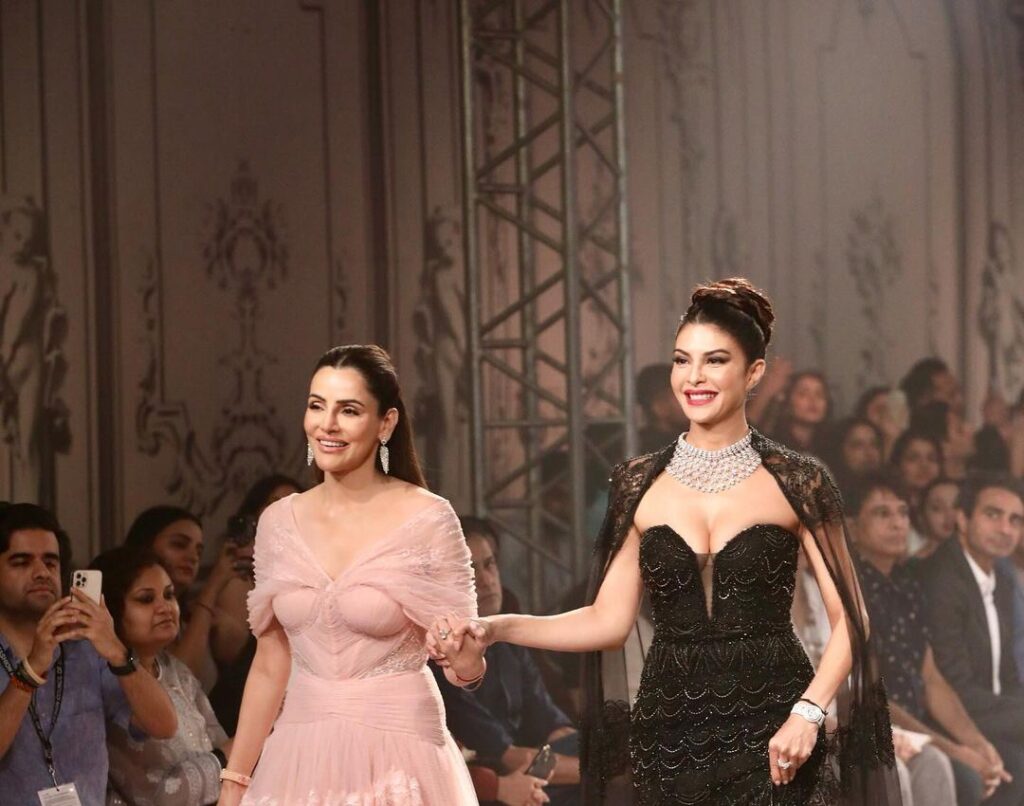
Lace and Chikankari make a heady combo, as Isha of Rose Room woos brides with a softer, lighter full skirt, with just charming hints of shimmer for ICW 2024. By Asmita Aggarwal Black, lace and Jackie! There seems to be nothing better than this, add a top bun to this mix, and you get a show that tells brides —- you don’t need to be weighed down by zari, and zardozi, try lace. “I love her work,” said Bollywood actress Jacqueline Fernandes, adding, “I’ve been a fan of Rose Room, Isha has dressed me for many special occasions. The romance and femininity she offers, is a match made in heaven. There is superlative Indian craftsmanship making each piece graceful, and chic, almost timeless,” says Fernandes. Charcoal was not in the vocabulary of wedding wear, but Isha admits, she wanted to pay homage to its potency. “We don’t see this particular hue in Indian couture, Jackie was my muse, she manages to bring out the inner goddess. While I dressed Riddhima Kapoor Sahni in Chikankari with pearls,” says Isha. “I was confident what Isha would make me wear would be perfect, and it was,” says the sister of the Bollywood star Ranbir Kapoor, Riddhima. Rose Room had ornate tassels, off white, buttery hues were intermingled with faux feathers, and the body huggers came with trails. She added lace stockings under gowns, and bodysuits. Corsets were everywhere– fish tail gowns serenaded fitter bodies, though pants suits were worn with corsets and sheer shirts tucked, adding flirty layers. Isha prefers subtle glamour –mocha to peach. Saris with capes, and fabric manipulated into roses on gowns, elegant was the overall mood. Cinched waists, long net trials, beaded bustiers, emerald green shararas with racer back tunics, dropped shoulders cholis more ruffled than risqué, often came bunched up. Isha doesn’t like to mix hues, she keeps it solid—like the flaming reds. Gold Romanesque breast plates were tied at the back, calling only petite women, as the embroidery was tone-on-tone. Isha believes brides today are taking the unconventional route for their D-Day—the lehenga, choli and dupatta is outdated. Now it is the advent of corsets, full skirts, and maybe a short jacket. That’s why her ICW 2024 line, “Art of Eternity” is wooing new-age women with laces, specially developed, much more intricate than last year when she has the statuesque Vani Kapoor, in flaming red. Bridal hues too have taken a tumble with new, fresh, light colours reigning, mostly pastels, and add a certain “frothiness” to the ensemble, she adds. “I have introduced a softer palette, with dashes of red, which you could say is my signature. This year, architectural motifs forge a bond with laces to offer delicateness,” says Isha. In a wedding market dominated by heavy zari, zardozi, dabka to aari, gotta patti, there is a client, who wants to feel free, and easy and above all, not weighed down by threadwork. Isha’s recent trip to Rome, served as an inspiration in March this year, where the imposing churches, where the catacombs and frescos, some built in 440 AD, replete with mosaics, columns, arches and sculptures remain etched in her memory. “The detailing is what stayed with me, frankly being a creative person, it can come from anywhere even a Michelin star winning restaurant, or a cruise, I have so many moments in the treasure trove of my imagination,” she adds. Isha’s clients love the cinched waists, slender structured shapes, but elegant, she has not lost touch with what she began with “Chikankari. ” My line is paying an ode to love, in a poetic way, through the medium of couture, it is various forms of love “mostly importantly self-love,” she concludes.
Abu-Sandeep’s triumph of love
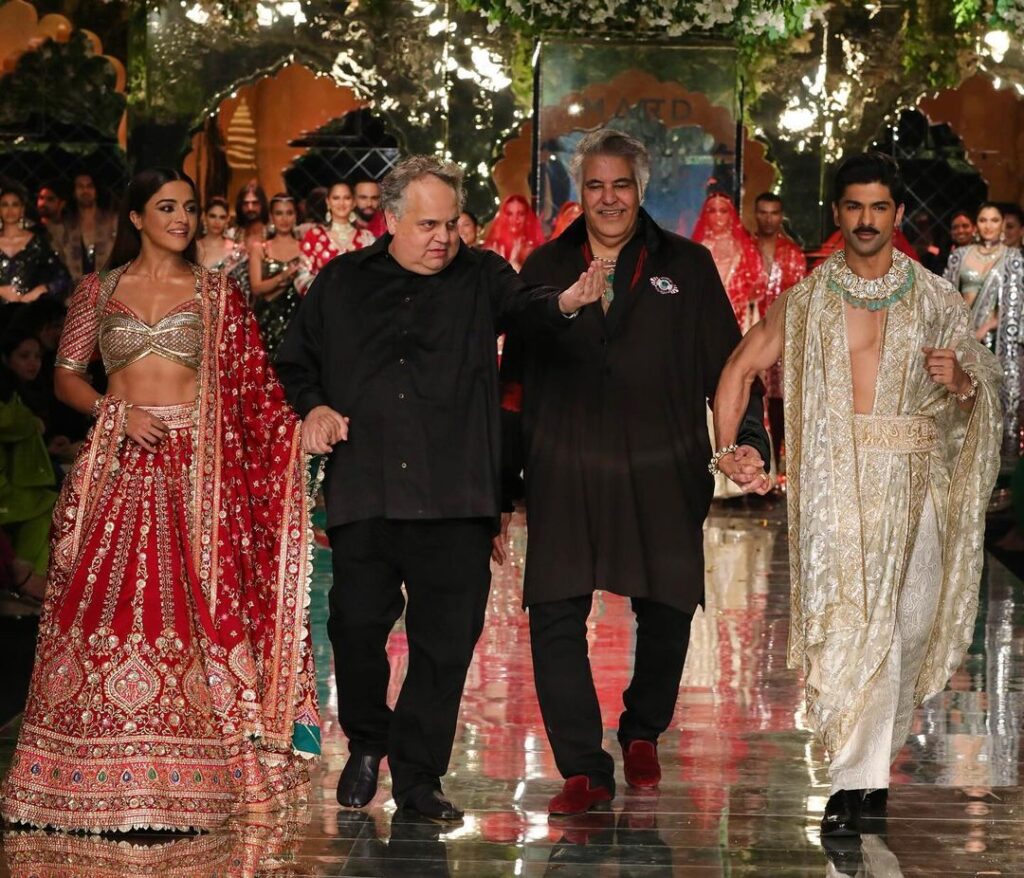
Their mission is to elevate craft to art, like they did with Chikankari, or mirror work, added white to couture; for 38 years Abu-Sandeep have been the undisputed frontrunners of luxury. They brought ASAL and MARD to Delhi for the first time at Hyundai ICW 2024. By Asmita Aggarwal It was a concept as old as time Rani meets Rajkumar, and frankly there were many firsts, the whites with the Kolhapuris for men were refreshing, flaming cherry red and bottle greens were dancing together, inclusive model Sakshi Sindwani made her presence felt. What I loved about Abu Jani and Sandeep Khosla who opened the Hyundai India Couture Week 2024, is that they did not forget their roots—yesteryears models Carol Gracias to Noyonika Chatterjee were back on the runway. The old merged with the new! The crowd cheered for Heeramandi star Taha Shah dressed in brocade pants, and a tunic with imposing flowers on his toned shoulders along with actress Wamiqa Gabbi. The lehenga blouse is modern now, its certainly not a risqué choli, it is ruffled/layered/sheer/pussy bow, you can pair it with your jeans later. Similarly, the embroidered kaftan, or their signature chikankari each of the 80 pieces, were an ode to the past making its way into the present. Crystallised bustiers, saris with capes, beaded tassels, to the maximalist gotta-patti the show had no dearth of shine. Their models came with white beards and in skirts, sheer and angrakhas; the ASAL brides in pussy bow blouses with lehengas. Minty fresh lehengas, and dhotis complemented their mastery over mirror work and the dupatta was replaced with the veil, sometimes just a pearl headdress. Abu and Sandeep have a distinct hold on their clientswhether it is the entire Bachchan family or the Ambanis, it has nothing to do with the fact that they have almost been around for four decades, but more to do with how they have remained relevant in a world of fleeting loyalties. Their lehenga for the recent Ambani bahu Radhika, was emboldened with hand painted artworks by Jayshri Burman, which the duo crafted into glamour. They also designed the younger brother Anil Ambanis wife Tina Munims lehenga; their interest in art, and artifacts is legendary. Plus, Abu collects vintage postcards to “almost” extinct textiles, plus understands the curvature of interiors, which he has dabbled in. Abu sketches, is quieter, while Sandeep is the gregarious one, with an in-built sense of humour, the grandeur comes from Abu working for various epic productions Devdas to Umrao Jaan. Though it is quite different from his first job—distributing leaflets at a gas station, Khosla is from Kapurthala (Punjab), they launched in 1986, when Indian fashion was fledgling. They have traversed a gigantic journey, from their first store Mata Hari (inspired by a spy) to acquiring Dimple Kapadia as their client. We are completing our 38th year in design. We began as maximalists, we have remained devoted to maximalism. Our design expression celebrates hand- craftsmanship at its most complex, and detailed level. We have reinvented embroideries to an impossibly high standard. We revel in layering, and fabulous finishing, and embellishments. Our work is unique, and an ode to living large, and celebrating beauty, and reinvention of the classical to create ultimate couture that is both contemporary, as well as destined to remain timeless, says Khosla, who like Abu is self-taught designer. For the first time in India Couture Week 2024, in Delhi they have introduced their label Asal, affordable bridal wear, and Mard for men. They admit they were the first to introduce the colour white, as a hue for couture, 35 years ago when it was considered for widows. We did an exhibition of white khadi with white embroidered jackets and kurtas, Jaya Bachchan was the queen of white. We did Kerala cotton kurtas in Chikankari, and other techniques when it was unheard of. Today everyone and his brother and sister lay claim to Chikankari, and the change and reinvention all started in our office and with us, says Sandeep. They celebrate the sheer growth of the bridal sector, and the profusion of new and expanded creative expression aided by an entire PR machinery, and social media presence. We are saddened by the rampant rise of plagiarism, there needs to be stringent measures to ensure it is strictly called out, says Abu. The two learnt the ropes from the best, Xerxes Bhathena, fashion designer at Burlingtons Fashion House, of the 70s, who later designed for Namak Halal as Praveen Babis designer. Asal by Abu Sandeep, was born out of our own desire to create clothes for a much wider audience, at a more affordable price point than their couture. We witnessed many designers ripping off AJSK, we decided it was time to create our own label, which boasted similar aesthetic sensibilities, but at a different price point. Asals product is beautifully detailed, glamorous, and reminiscent of our couture. It opens our creative expression to a whole new demographic, and expands the AJSK Universe. Mard is our young menswear label catering to the new-age man, who is unafraid to own his swag, says Khosla. Stand-up comedian Sumukhi Suresh began the show on a humorous note, and if anyone has seen Sandeep Khoslas Instagram, they will vouch for his laughs. They collaborated with musician duo Akshay and IP to include an album Cake with five original songs that were composed especially for the show. Akshay Raheja and IP Singh made their Bollywood debut as a composer duo in the film Crew, and earlier collaborated with Kunal Rawal for his couture week showcasing. Our work is instantly recognisable. And stands far apart from the rest. We work relentlessly to constantly hone and reinvent our expression so that every collection is better and more refined than our last. We put Chikankari on the couture map. We have made bridal wear and we continue to remain the leaders. We have reinvented zardozi, mirror work, thread as well as the block prints of Bandhani. Five years ago, we put Ajrak on the
Voluminous Sculpting
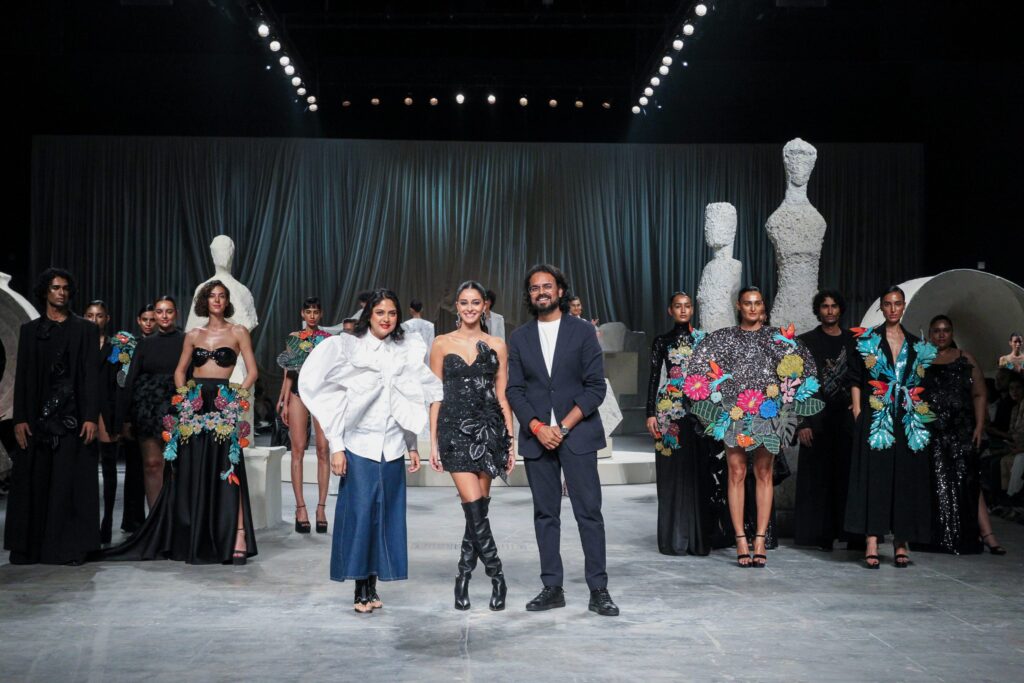
Giant moths on chests, cutwork forests on body huggers and you throw in a little of Henri Rousseau and a children book, The Fox and the Star, you get Rahul Mishras inspiration behind his LFW X FDCI 2024 AFEW line. By Asmita Aggarwal Would you ever wear the wing of a moth on your chest? If you believe in the philosophy of Rahul Mishra, you would as he would tell you that wing came from a combination of his two inspirations this season for the LFW X FDCI 2024 grand finale show in Mumbai. The first one is —– an illustrated childrens book The Fox and the Star by Coralie Bickford-Smith, a story about love, loss and learning to accept change and the second French painter Henri Rousseau better known for his jungle fantasy pictures, this largely made up the sense and sensibility of his pret line AFEW launched by RBL. Maybe you can call sculpting his third passion, guessing by the sculptures placed on the runway in white, just like most of his collection this season! Animals, leaves and even branches, of course the moth that transformed into a rather Surrealist one and placed on blouses, and unless you are an intrepid dresser you would choose something less fantastical, as this is after all a pret line, so it didnt need so many theatrics. Though one must give Mishra the boy, from humble beginning in Kanpur, A-grade for the way he manipulated aari embroidery, hand sculpting, cutwork, and patchwork in the line titled The Sculpt. Few know that the real reigns of the label are with Divya, his wife, who may not be the public face of the brand, but the entire backend is run smoothly by her in a sprawling NOIDA space. The duo first met at National Institute of Design, Ahmedabad, both were studying apparel design, and she is the one who coerced Rahul not to leave the course midway. On another note, Rahul has had amazing good fortune too, he got the seed money to invest in his label which many cant even dream of by winning the International Woolmark Prize in 2014, with the prize money of $100,000. But it is Rahuls not settling personality, and maybe a high degree of fearlessness that in 2020 he was the first Indian brand to showcase at the Paris Haute Couture Week run by the super snobby Chambre Syndicale de la Haute Couture. You could see glimpses of his PFW line in AFEW, watered down yes, subdued for sure, but his love for larger-than-life cut outs trees, flowers, branches were all was there in its glory, sometimes colourful most of the times monochromatic. The designer who grew up in Malhausi, studied in a school without a roof, is now from a star gazer, has turned into a red carpet favourite, and his love for shimmer this year was evident, sequins a mini avalanche of them were placed below his roomy pants, covered up with net, at other times as tapered pants and turtle necks, a testimony to this obsession. Draped skirts were another favourite, fabric manipulations seemed to be making a strong presence just like his exaggerated shoulders, an ode to the women heading boardrooms in the 80s. Checkerboard skirts that gave women an hour glass figure, he also serenaded the viral Instagram trend where you can now wear your skirts over your pants, however uncomfortable that might be! He used Hindi iconography on his sheer tees for men, something that current Insta star Orry would certainly pick up from him, or maybe will receive as a gift. The collection from ivories and charcoals moved to a brighter space, with exaggerated flowers, almost 3 D, as he went a little gimmicky too, with a revolving stage and models playing dress up! But the crux of the matter is that the ubiquitous pant-suit bigger and better is not going anywhere soon, it is still loved, and so are pleated midis, though Rahul decided to add some glamour to his denim too! Hems of his pants now shimmered and sparkled, as dirty pinks took centerstage. To end the spectacle of a mixed line where you could time travel to the Amazon jungle with his cut work pieces, or select a more studied but restraint approach to dressing with his well-crafted white shirts, Bollywood sweet heart Ananya Pandey sure went for a skinny, body con dress to show off her washboard abs. But with the entire forest on your sleeve or hem or chest, Rahul Mishra told us he is really in love with his daughter as he is imagining it come alive on his clothes, like Aarna does in her imagination!
No Gender Coding
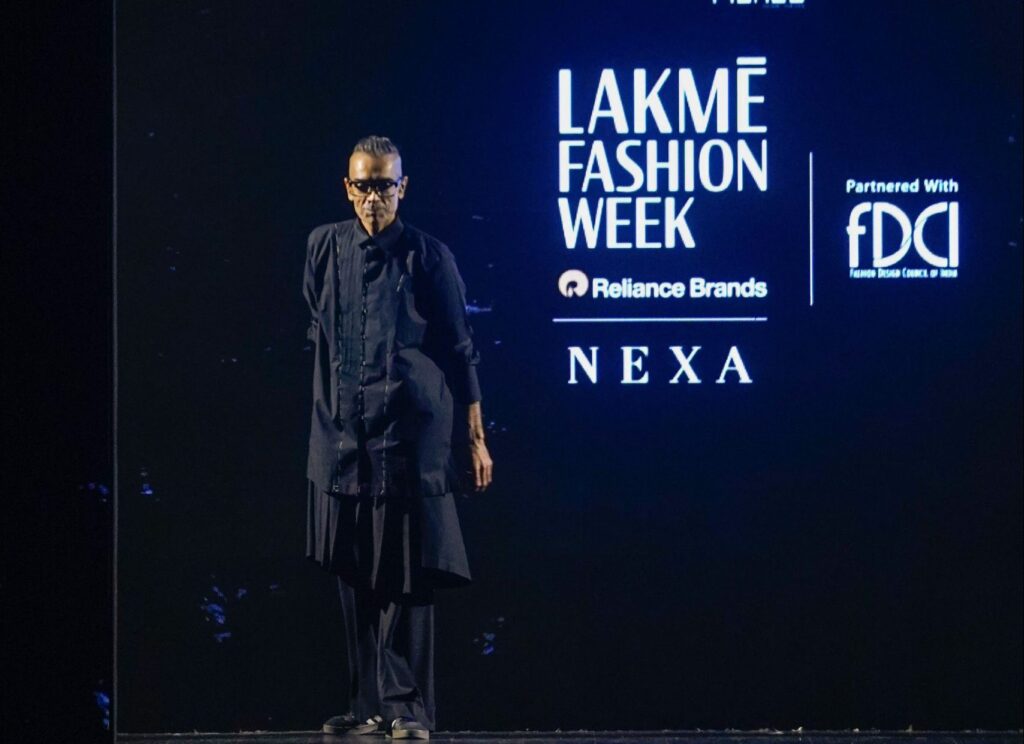
There is a fragility in masculinity and Arjun Saluja finds this conundrum a collection-worthy theme. After six years he is back at the FDCI showcase at LFW with his gender bender clothing hoping to solve the puzzle of conditioning or at least question it! By Asmita Aggarwal Frankly, in fashion there are two types of designers—- one who are intellectual and dont play to the gallery and then there are the sequin lovers, who thrive to be in the news. Arjun Saluja forms the first half of these quiet warriors, better-known for his gender bender clothing, a knowledge center, he gained after working with the legendary Patricia Fields and graduating from the Philadelphia College of Textiles and Design. Bonus: He also knows how to make dyes out of onions! After a hiatus of six years, Arjun is back with his A game, and 17 years in the business of making menswear interesting, but calling it that would be unfair as women like his menswear more! Though the reclusive Arjun, will tell you making a mark in India is an uphill task as translating the language of global diversity requires time and patience. Arjun wanted to search for a new way of dressing, find a rhythm where you can express more fluidity, and he believes even though there is talk about androgyny, one should weigh in on how much has really changed on retail floors. India still lacks concept stores, there are of course, several multi-designer stores, says Arjun. After almost two decades, the designer considers his biggest achievement to be unwavering in his focus and the direction he wants to take his brand—- pushing novel ideas. Design doesnt have any end, it is all about improving your craft, he admits. Versatility is important in a price sensitive market, especially as Indians only like to spend on bridal ensembles, almost a cultural phenomenon. I wanted to break that mold, deconstruct existing patterns, says Arjun. Occasion wear is a winning game, but structural clothing is still finding its feet, for that many consumers shop internationally, they are apprehensive about cuts and shapes in India. They believe we do not understand tailoring, but look at how beautifully we construct bandhgalas, sherwanis and Aligarhi pyjamas. If you look closely at Yohji Yamamoto the Japanese maverick in every silhouette he has a fleeting touch of the kimono and his clothes are universally worn all over the world—local can be global it is finally about starting a conversation, he exclaims. His quest has been, how do you manipulate body types, cut ingeniously and drape effortlessly? How can bigger women wear your clothes and feel liberated, in conceptual clothing, he adds. His textiles of choice are chosen to support his vision, you need a fabric that can take two extremes structure and drape, making an interesting contradiction. Arjun has always attempted to push his customer, he cuts on a bias, cuts asymmetrically, circular, squares, serenades interesting shapes; silks, cottons, gaberdine to blends help achieve this vision in natural fabrics. Thus, 2024, his line finds fragility in masculinity, as he feels men are in a very confused state in our country today—there is overwhelming patriarchy, cultural dilemmas, egos, and above all conditioning that they have been trying to break for generations, feeling stuck in that space. Fashion can be political, it doesnt have to be like the BBC, it can deconstruct what we see and observe in an artisanal way, he explains. Arjun chose black to express himself this year, most of what we wear is ego based, and no one has answers to what we are trying to create in society through fashion. His admiration for Comme Des Garcons, Sacai, Issey Miyake is palpable, as he admits these gurus put emotions and feelings in their clothes, technically they made the body look different. Their kinks, beliefs, fetishes to suppression, is woven into a narrative that excites me, says Arjun adding that Balenciaga to Margiela were all architects of modern fashion. Designers who question the existing stereotypes have an angst about it, almost not settling for status quo, and that makes their oeuvre exciting, he says. His problem with fashion today is that it is all about marketing, it has less soul, somewhere you lose your identity, where is your unique language, it’s drowning in the sea of Instagram. I do embroidery only if it works for the narrative, I am deeply rooted in texture and surfacing, he admits. Women, unlike men, are clear about what they want, and even as he dresses strong women occupations have changed in the last 20 years. Women today have grown into their own, they are courageous and resilient, a great facet of a woman I admire. She is not looking for approval and she owns herself and is a whole individual, he concludes saying this is his target customer.
Revisiting roots
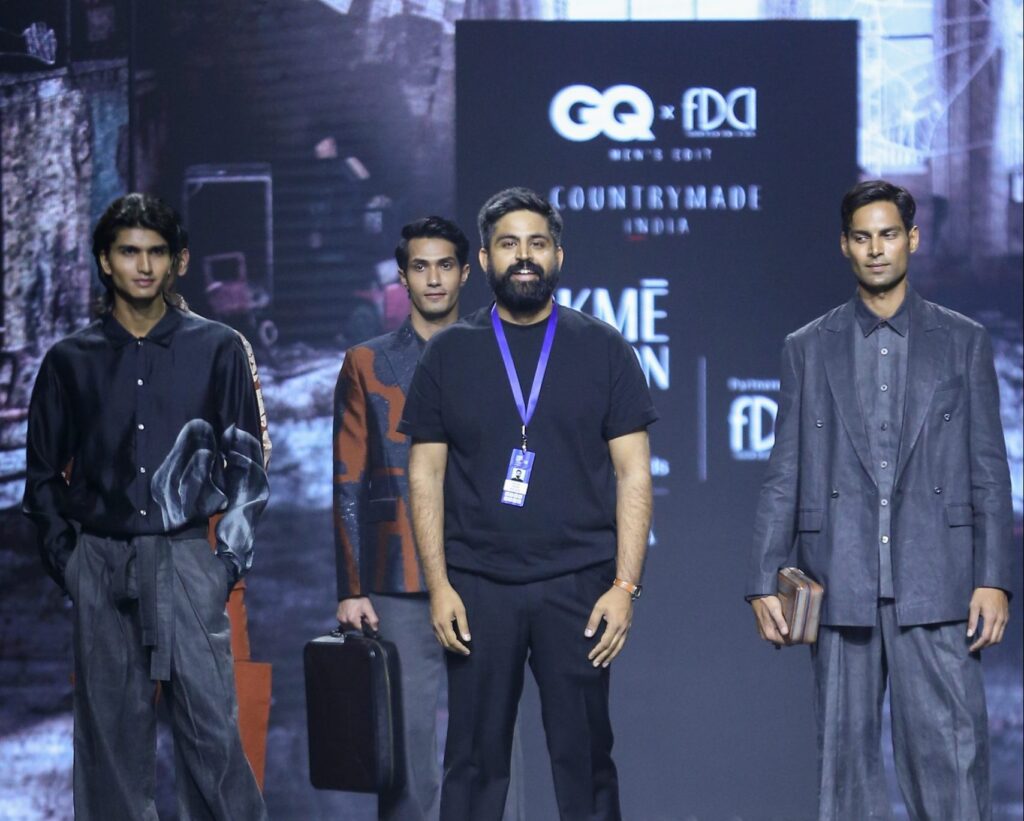
Whether it is Gaza, Kashmir, Syria or Ukraine, human exodus is captured poignantly through embroideries and embellishments as well as abstract outlines by the maverick Sushant Abrol of the menswear label Countrymade. By Asmita Aggarwal He had a child-like excitement every time he begins work on a new collection and thats what makes his ensembles a work of emotion. This time it is a song an ode to 1950s rock that he wrote and recorded with the help of a Mexican artist which will give his LFW x FDCI 2024 line a third dimension. But this year he has scored a first, his chipped paint walls have made it to WGSN forecasting site as a trend to look out for, so Countrymade by Sushant Abrol is now setting the benchmark internationally too! This is his fifth year of inception, for a newcomer the hustle can be overwhelming, as it is a high-octane industry, but Sushant has learnt to be a sponge, and approach things with the right attitude. The slow and steady approach had paid off dividends, and he believes consistency and showing every six months helps him stay on track, as routine gives seasonality and structure. His LFW X FDCI 2024 line Road Back as the word in itself says, is a journey backwards. Whether it is Kashmiri Pandits going back to their hometown, or people like his grandfather wanting to visit their ancestral homes in Pakistan, or Syrians going to Europe, or even Palestinians leaving the Gaza strip and hoping to return home soon, human exodus has been a cultural phenomenon part of human strife. The line is an ode to returning to your roots, and he says, it is not depressing at all, rather it is a bitter sweet symphony. The challenge has always been to think differently, thus these modern ruins are a testament to the undying human spirit, says Sushant. The small aspects of those who left their home and return to it, years later maybe even decades, is captured aesthetically through the storytelling with help from embroideries and embellishments that Sushant has used to translate these thoughts. Shattered glass on shirts prints when he sees his home has lost its windows, or the two broken chairs he used to sit on with his brother is now an abstract outline on a jacket. The old ceramics or modern fossils have been converted into buttons to resemble plates Sushant made at a pottery studio, with stoneware clay. The miniature perfume bottles of the mother who lived in this house once upon a time, are the motifs on his easy trousers. Walls paints are now chipped; thus, the colours are a strong amalgamation of rust orange and concrete. The denim that was wax coated in the last collection, this time around has been given a cement and concrete coating, which shows the cracks of time. We used rust granules in a powder form and coated the denim with it to make our trench coats, he explains. The line has denim over jackets as well as double-breasted blazers, relaxed but not like streetwear they have a definitive stricture, without using tapering. The problem with every menswear designer is the inability to sell daily wear as most men shop big for occasions, but undoubtedly Sushant is a storyteller and he understands the medium of fit and drape quite effortlessly. My dream is to save enough and open an experiential store soon, he concludes.