
Charvet style shirts anyone?
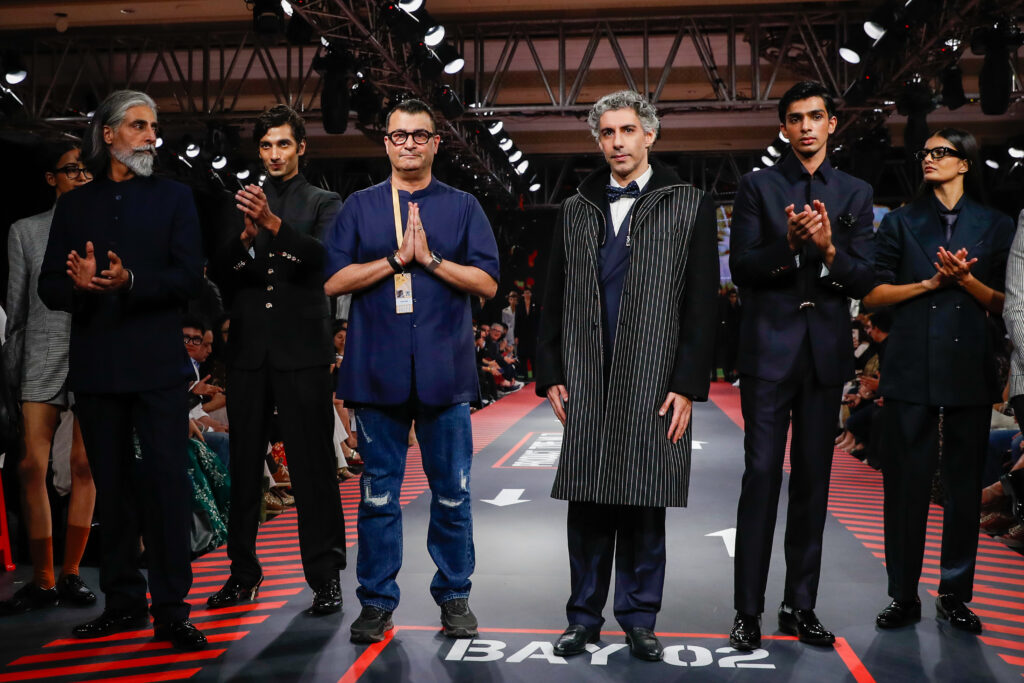
From styling SRK in Mayur suiting, showing in NY in 2005, Ashish Soni has taken the road less traveled-fit, tailoring over dabka and zardozi. Next move- Arvind Mills and Soni style! By Asmita Aggarwal He is the OG of fashion, started in 1991, 2000 launched couture in a country obsessed with embellishments and embroidery, but he stayed true to fit and tailoring. He was one of the first to participate at the Olympus Fashion Week in 2005, when no one in India cared about the artistry of a perfect sleeve, he had kind of mastered it. Ashish Soni has been using Arvind Mill fabrics for the last 30 years, though they are primarily known to be leaders in making denim, they have a vast range—linen, wool blends. Their Egyptian cottons are so superior that it ignited a desire to use them innovatively. The collection Ashish showcased at LFW X FDCI will go live in 16 stores all over the country, they will handle production, knowledge transfer will be Soni’s responsibility. “I am a tailor if your raw material is good, magic ensues,” he adds. Ashish has been interested in the quality of linens they offer, the count matters, spinning strength, “earlier it was 50-60 now it is 120 counts, finest linen, there are many technological advancements,” he explains, even their 100 percent bamboo fabric, feels like wearing silk. Arvind Mills shirting material is the finest which Charvet uses, (French shirt makers, 1838 in Paris, France, by Joseph-Christophe Charvet, now owned by Chanel) that royalty and celebs can’t get enough of is now being offered to a discerning Indian consumer. Wool blends, super 200 are the best in the world, it is twisted 120 times, per roll, to get that fine-ness, now it is 150 to 200, which is being used by Loro Piana and Brioni, is being offered to Ashish to work with, it is the first for him. Is the Indian customer ready for this kind of ultra luxe minus the dabka, does he understand it? “We are educating people, even tier 2 and 3 cities, like Indore and Raipur, they have crazy spending power like Chandigarh. If they don’t know how they will buy what is real luxury in terms of materials? Thus, I am also crafting a style book on how you can wear a suit ingeniously, this will hopefully tempt them to buy,” he smiles. A tier 3 customer may not have the time to come and buy, so Ashish is taking the product to them. In a Metro competition is high, so many brands, already heightened awareness exists. “There are no DLF Emporio in Pune or Raipur,” he says, adding, “If you look at menswear in organized retail, the numbers are much higher, but it is vastly ignored.” Interestingly Ashish began styling in the 90s when no one knew what it meant, as he never did lehengas, saris or sherwanis, it was commercially difficult to survive. “No one wanted to buy a Rs 5000 shirt, with no embroidery in the 90s. Old, affluent families used to purchase Raymond fabric and get a suit tailored, it was tough to survive, I began styling,” he confirms. His first job was styling SRK for Mayur suiting, in 1993 before “Dilwale” was released. Saif Ali Khan and hundred others in Bollywood followed for almost 30 years. He says, “A second opinion when you put up a collection works best, as a stylist has 3 D vision. He has a clearer view than a designer, as he is not emotionally involved in the line. Plus, new social media audience is more visual and has less patience,” he concludes.
Fashion must be socially, politically conscious
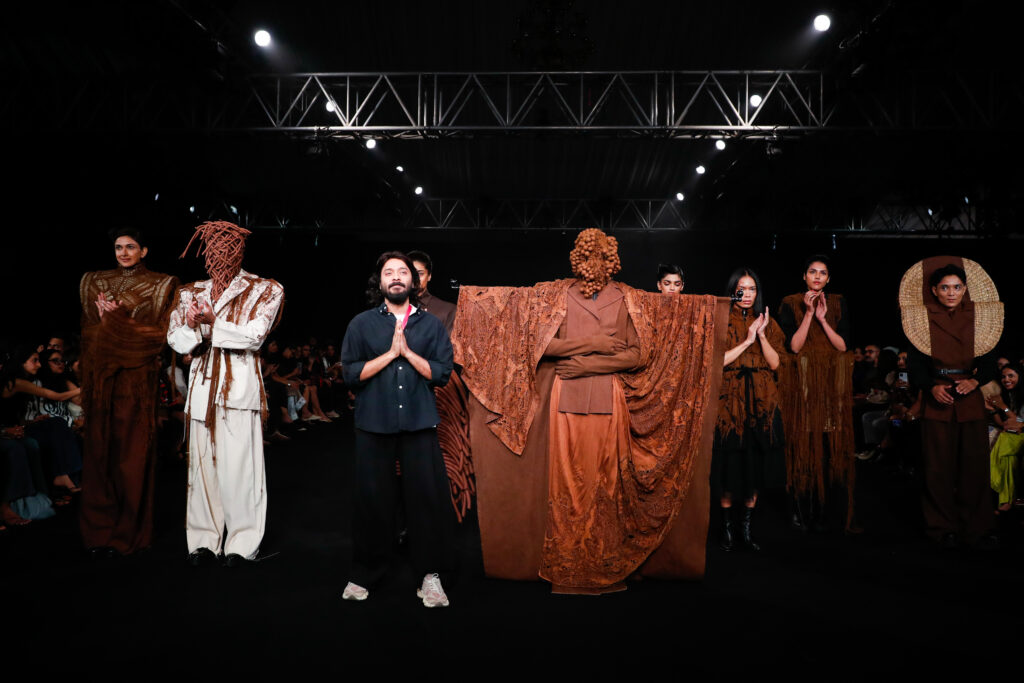
Water hyacinth gets converted into nifty baskets for gifting and packaging, as Anurag Gupta gives sex workers a dignified life training them in weaving water grass, Pacchu Tola, Biskohar. By Asmita Aggarwal It was a bright, sunny day, Anurag Gupta decided to visit Bharat Tex, his gaze fell on a stall from Bihar, and saw how beautifully the bags were crafted. “On a closer look it was water hyacinth, (Jalkumbhi) or water grass, mostly seen as a waste material,” he says. Locals have found a way to put it to good use by making mats, baskets, bags, as it is a much better and stronger alternative than jute. The NGO Anurag visited rescued sex workers more than 1300, trained them in this craft, “what I liked is that they ‘made’ artisans in Hajipur, on the border of Bihar-Jharkhand, didn’t work with existing ones. The idea was to offer them a dignified life which resonated with me,” he says. Anurag grew up in Biskohar, Uttar Pradesh, he realized there is raw material available there too, he wanted to highlight the marginalized, often not spoken or written about, especially women who work in red light districts. “My village is divided into two parts; Pacchu Tola, is a red light area, even though Biskohar survives on agricultural produce these patches face extreme poverty and helplessness. Women lack employment; I wanted to speak about their daily struggles, politicians come during elections, promise things, situations remain the same,” he says. Anurag will pay them to learn how to weave water hyacinth, start training 30 women, they can work from home, he has aptly titled it “Jal se Jivika”. “This can turn to custom packaging, boxes for corporate gifting, and the product is fully sustainable,” he remarks. For LFW x FDCI Anurag has worked with knitted textures, stepped out of his fantasy world, is making a “commercial” line, minus the avant-garde drama. Shapes remain experimental, knitwear is woven, combined with jacquards, and interesting textures. “We must talk about protests, as a community, it affects everyone. It is important for fashion to be politically conscious. Why should it be dominated by only Bollywood, stars, glamour?” he asks. His efforts have been to take the industry to the village, not other way round “we need to provide alternatives to people living on the fringes”. Social causes, putting a spotlight on what he internally and strongly believes in, Anurag felt he started with manual scavengers, but fashion media is partisan. “They look only at shiny people, privileged, don’t entertain me, maybe I’m not a people pleaser,” he confirms. Diet Sabya tried to police, and has fallen too in the trap of Elle, Vogue and Harper’s Bazaar, “big designers overshadow smaller ones who never get spoken about, just the top five are praised by magazines. How much will we talk about Sabyasachi. We know his contributions. We need to move on,” he concludes.
No Gucci or Balenciaga only Russia, says Sergey
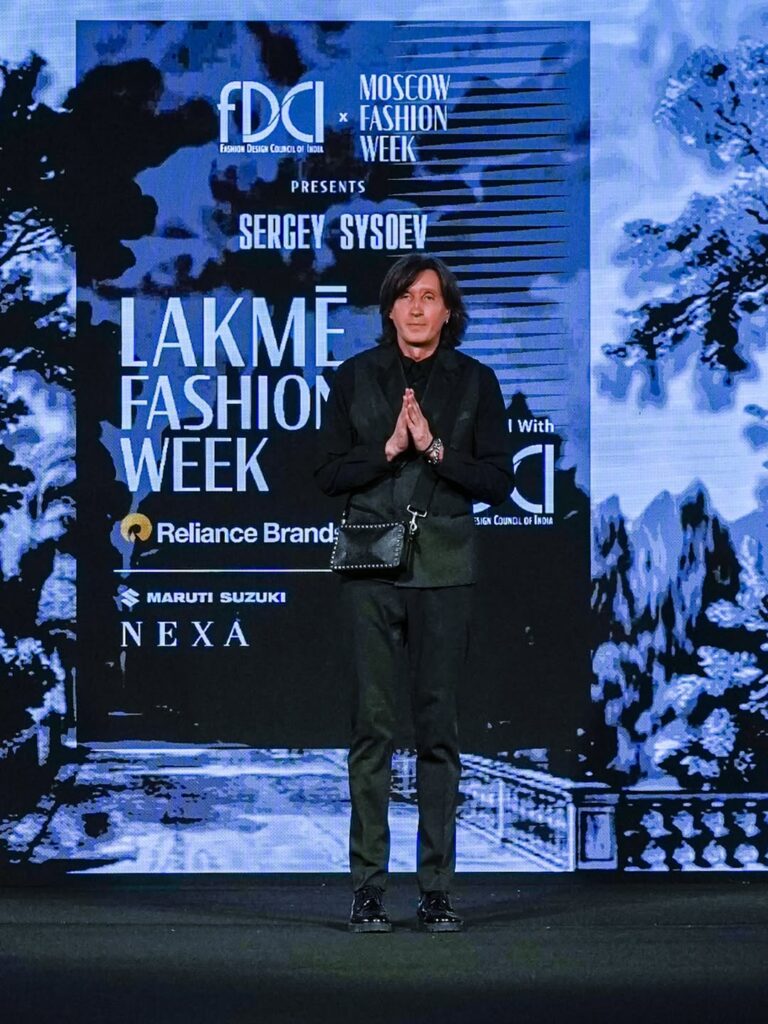
Even though Russians have made a mark on global fashion, Demna Gvasalia, Guram, Lotta Vokova, post the collapse of the Soviet Union, Sergey Sysoev believes he wants to revive traditional folk arts-Gzhel ceramics, Vologda lace, this LFW he pays homage to the fragrant flowers of Ivanovo. By Asmita Aggarwal On 26 December 1991, the Soviet Union was formally dissolved, due to many factors, primarily economic stagnation. Till then they never knew what Coca Cola tasted or how well Nikes glided. There was a time in Russia when there was no exposure to brands, today they are huge consumers with a market of $2.59–$2.6 billion. That’s not all. Russians are creatively heading global brands—-think Balenciaga by Georgian Demna Gvasalia, now Gucci, and his brother Guram both launched Vetements, to stylist Lotta Volkova, born in Vladivostok, Russia, now styles Miu Miu. Sergey Sysoev showcased at LFW XFDCI, a label he launched in 1996, teaches art history in Kosygin State University, Moscow. He says, the former USSR is more than just Matryoshka dolls, Vologda lace, Gzhel ceramics as old as 14 th century, and silk shawls. “I have never been to India, it is my first time, but I know about the intense and deep love for colours here, as well as age-old textiles. I may not be able to name any, but I remain fascinated by weaving heritage,” he says. After 30 years of working in the industry Sergey loves folk art and craft, like porcelain painting, which is often used in tableware. “In my last collection I paid homage to Russian native ornaments,” he confirms, like Slavic, Byzantine, and folk-art traditions. Gzhel lace has been his favourite, eight years ago he reinvented decorations, into a modern language so that younger customers are serenaded. “I’m happy Demna and Lotta are doing well globally, very proud. I never set out to pursue recognition outside my multicolored country, I want to dress women in Russia,” he smiles. He is hoping to collaborate and understand Indian cultural and embroidery techniques, expand his craft, without losing focus on Russia’s cultural identity. The government is supporting Moscow Fashion Week, earlier they only had Mercedes and Volvo Fashion Weeks, but Putin is making an effort to grow domestically. “We wanted to break free from systems set up by European countries, hoping to nurture ‘Made in Russia’, which looks at what our people want, not what Western brands dictate,” he adds. “The Sarafan traditional Russian dress is also being contemporized in linen with hand embroidery,” he explains, adding there is silk which also elevates the ensemble. He combined knitted fabrics and the flowers of the city of Ivanovo, as homage to his mentor, designer Slava Zaitsev, who was born there. Inspired by the beauty of the region, known as “City of Brides”, “Russian Manchester” as it has a burgeoning textile industry. At the LFW show on the sounds of church bells ringing, and birds chirping, he showed his mastery over crushing techniques, metallics in three colours, predominantly tangerine, exaggerated bows, Jacquards and sheer. “I like stripes, my embellishment is restricted to yokes, so that it doesn’t overpower the outfit,” he says. Though the crushed gold, bunched up waists offer comfort, along with pleated dresses. His effort was to be restrained, thus mixing different diverse patterns often clashing to drive home the idea that fashion doesn’t need to be linear. “I grew up listening to Bollywood songs, actors, many movies were re-watched in Russia, saw one on my flight here too, can’t recall the name. The story was about love, washed with music and colours. I’ve seen Russians wait outside hotels for hours hoping to catch a glimpse of their favourite movie stars,” he smiles. He admires the way Belgian great Dries Van Noten is inspired by India, how he uses the iconography, culture and its myriad aspects, dating back to his first trip to here in 1987. “His use of Ikat in 2022, Kalamkari, hand-painted and block-printed cotton as well as Kantha is spectacular,” he concludes.
Hey Barbie! looking swish in Mashru stripes
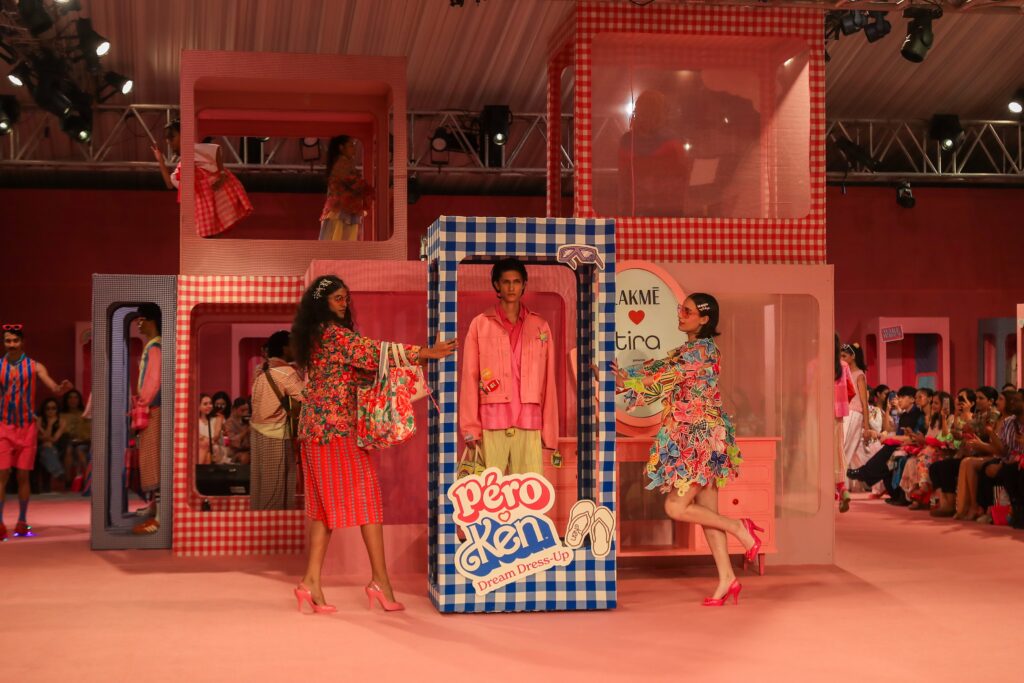
Aneeth Arora’s Barbie comes armed with the most crucial accessory, intellect, she dresses like Arundhati Roy and Meera Nair in Banarasi brocades and hand spun cotton, not in bodycon and her signature monochromatic swimsuit! Get ready for Barbie 2, Pero style. By Asmita Aggarwal You would never imagine Barbie and Aneeth Arora, two ends of the spectrum, one likes pink, the other banks on intellectual prowess! Interestingly, Arora is a risk taker, like collaborating with Hello Kitty and making it her own, Barbie for her is a versatile brand with unique storytelling. “Constraints help me think I feel challenged,” laughs Aneeth, showcasing at LFW X FDCI Barbie was created by Ruth Handler, debuted on March 9, 1959, at the American International Toy Fair, New York City, she was inspired during a European trip, 1956 when she saw the German Bild Lilli doll. Though Barbie’s body has been controversial since a 1958 Mattel-sponsored market study before the doll’s release, moms weren’t happy about having it “too much of a figure.” This 11-inch Barbie for Aneeth is not a doll, it is a journey, earlier children would play with paper dolls, but you had Barbies of all body types, colours, and professions when it started way back in 1959. You could dress her up any way you want. “Barbie loves dolling up, that’s where Pero comes in,” says Aneeth. She undertook deep R and D and believes Barbie can’t be put in a box; she had a pretty sporty and sexy wardrobe-vintage one dressed up in lace. Doll’s history is engaging, it started with Cabbage dolls created in the 70s, for girls to play. “My first Barbie was bought when I secured a good rank in school, so was the second, third one gifted. I am looking at Barbie not in the same way the world views her,” she says. Greta Gerwig’s Barbie movie starring Margot Robbie and Ryan Gosling, grossed over $1.4 billion globally. This theme fits in with Aneeth’s larger love for nostalgia, with a child-like, innocent approach to fashion; fantasy world that kids create while playing is what she has serenaded her. “Whether it is author Arundhati Roy or Meera Nair Pero fans, they will find their pieces from the Barbie collection,” she smiles. The theme is “dream dress up”, even though Pero for a buyer has always been a combo of textiles and intellect, for a thinking woman who knows her mind, is comfortable with her body. Like artist Mithu Sen or her long time friend Himashu Shani. She this time too offers “classics” as she calls them, along with fun, and playful clothing, breaking the stereotype that Barbie has to be a certain “blonde” only. Pink and Barbie are synonymous, Aneeth will do the “girlie hue” but in her own way, as it can have million tones. “I did have reservations because I wasn’t sure if the brand expected me to do their version of pink,” she laughs, adding, “There won’t be any pencil skirts or bodycon. The first swimsuit Barbie wore which was black and white has been given an interesting new avatar with Chevron stripes woven in Mashru,” she explains. “Barbie loves stripes,” says Aneeth. Few know that Japan has been one of the biggest markets for her, along with the US, Europe. For the girl who came from small-town Udaipur, is now retailing from 300 stores all over the world. “Japan respects handmade, funnily it has two extreme sides, one is textile the Zen side, other is crazy Harajuku, both co-exist peacefully,” she says. A bit like Aneeth, sometimes “more is less” for her, the underlined emotion remains nostalgia, childhoods are not very different whether they are in India or abroad as innocence remains a common thread. “So is curiosity, isn’t it?” she says. With economic downturn, wars and political uncertainty, does Aneeth look at fashion differently? “I am just trying to bring happiness to everyone’s lives despite the dark era. When you wake up and wear something that gives you joy, that matters,” she adds. On a serious note, 300 artisan families are associated with the brand and 3,000 others rely on her, “clothes can’t solve any problems, but at least they make you feel lighter on a dull day,” she says. Her staples Chanderi, Mashru from West Bengal, vibrant stripes, pink on pink done in Banaras, Kadwa, to jacquard introduces us to Barbie who loves Indian crafts. “We have also dressed her in hand spun cotton, as well as Banarasi Brocades,” she smiles. This time she has done jersey, hand knitted, flat bed, as a plastic doll she isn’t that flexible, this is new and expected for her, crochet added for an extra edge. She has channelled her famous song, “Life in plastic is so fantastic,” chorus from the 1997 hit “Barbie Girl” by the Danish-Norwegian dance-pop group Aqua with recycled plastic, with “Found Pero”. She is inspired by tiffin baskets called “Koodai”. It is a traditional, hand-woven South Indian basket, crafted using Chettinad plastic wire techniques in Tamil Nadu. “We have recycled plastic and made mini-Barbie bags,” she admits. Craft doesn’t need to be serious, even when she did Kullu intense textiles for Woolmark, many years ago, she felt the end consumer understood it better when you can add a bit of fun. “In a 20-minute show what can you really show, so I decided I want mine to be experimental. It is an experience we offer, you travel to a different world,” she says. The travesty is when Ralph Lauren uses Madras checks everyone writes about it, but here, they take crafts for granted. In a time when everything is AI and online frenzy, Aneeth opened a retail store. “I like doing things my way, when I am ready. When Barbie came to us there was this message, ‘you can be anything’ but I want to say, ‘you are already everything’,” she concludes.
Farmer’s son from coal mines wins Circular Design Challenge
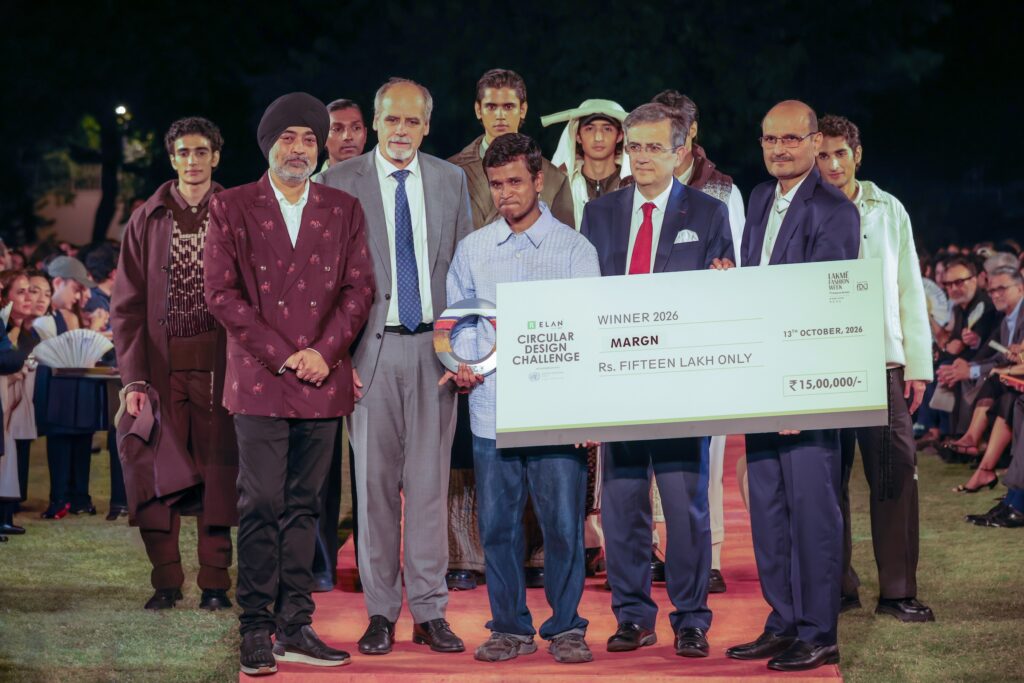
He saw how his father repaired an old umbrella, or sewed mom’s old saris into a mattress for 9 kids, Saurabh Maurya from Singrauli understands substantiality as he has lived it! By Asmita Aggarwal Saurabh Maurya is from a non-descript town of Singrauli, Madhya Pradesh, better known for the NTPC power plant, coal reserves, and mining, where most locals are employed. Like most impoverished children growing up in rural India who aspire for government jobs, Saurabh did too. He was encouraged at home to try for engineering and medicine, to give stability to his siblings, but it was a senior studying at NIFT who changed the course of a young, impressionable boy’s life forever. Saurabh decided to follow his heart, study fashion design in Bangalore-in hindsight it was the right move. He launched his label post graduating in 2019 believing that Margin or his brand Margn, will channel sustainability. “Isn’t that what margin means you have space to alter? I must confess where I came from no one even knows the word fashion,” he smiles. Quite apt! Eight years he has been working with the Lahaul, Darcha, Jhanjeli, and Spiti (Himalayan region) intermixing indigenous handcrafts with eponymous knits, creating a pool of 62 artisans, though he started with just three. “We added hand crochet and knits to this brewing cauldron along with my co-founder Rohit Yadav. This was part of our college project which made our hearts sing, so we continued,” he says. Rohit and he are vastly unique, the former loves finance and maths, Saurabh is free spirited, more creative. “I realised while living in Lahaul, tourism generates enormous waste-specially paragliding, he put that to good use along with recycled cotton. Parachutes were transformed into wind sheeters, trousers and work wear essentials like puffer jackets using mostly layering and appliques. “We mix knits with insulated material, but we haven’t forgotten Lahauli motifs, geometric, vibrant, multi-coloured nomadic patterns, which have won a GI tag too. As well as fruits, plants and flowers,” he explains. Most artisans don’t work in summer, they grow crops to sustain through the harsh winter, so Saurabh gave them more work when they are at home-warm, knitted caps, to covers. This wisdom came from watching his father crafting new things and repairing by age-old hand techniques. “He had no choice. I came from an impoverished family of 9 siblings. He taught us how to make things last as buying new or discarding broken things wasn’t an option,” he adds. His father resisted his attempts to work in fashion, he still doesn’t understand what he does, but after NIFT and much convincing he came around. “I had to tell them I could do it, give me a chance even though I had no angel investor or bank balance. When you are a farmer’s son, you are busy saving resources, you learn to live on little. I saw my father repair an umbrella with recycled plastic cover, make mattresses using my mom’s old torn saris,” he affirms. His CDC line is an homage to his indomitable spirit–titled “Origins”, how staying with him in the fields, sowing crops, he learnt life lessons, “how he would sell his crops, his strong ideals, perspective everything helped me reach where I am today,” he concludes.
Farming in Hajipur village to LFW with wool indigo denim
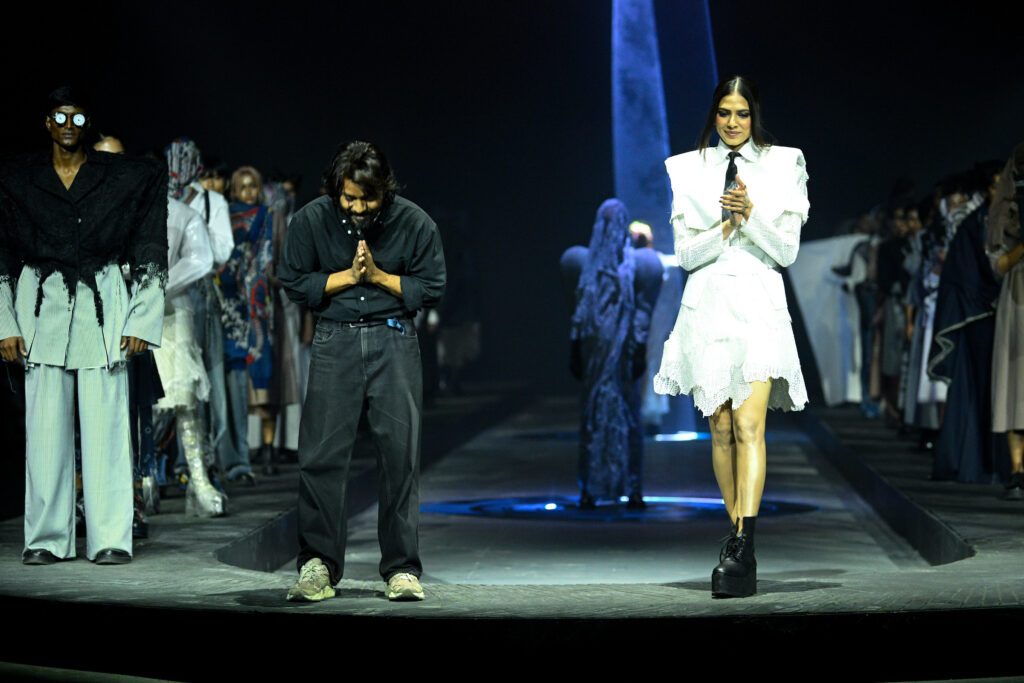
Farmer’s son Satendra Singh and Dilip Singh meet Anurag Gupta to showcase their experiments with indigo dyed wool in IIT Delhi paving way for jeans you can wear in winter, keep warm! By Asmita Aggarwal He is from a non-descript village, Hajipur, tehsil Saipau, Dholpur, on the MP-UP border, in Rajasthan, born to a farmer, his dreams were beyond the fields everyday he grew up watching. Satendra Singh’s school bag was hand sewn at home out of leftover Urea bags that came for crops nourishment, mom used to cut and stitch two handles on them, which went with his blue faded pants and rubber chappals. He decided to work on textiles, graduated from the Indian Institute of Handloom Technology, Jodhpur, and then from Bhilwara did his B Tech in textile chemistry. Cleared the entrance for IIT Delhi, to do his M Tech in textile engineering, little did he know his thesis would take him to LFW X FDCI runway. Can we make denim in wool for colder climates? You can’t wear denim in winter, is there an alternative for it? These were the questions that were swirling in his mind, when he began working with Prof B S Butola, Department of Textile and Fibre engineering, who told him to try indigo dyeing wool, it took two years to perfect this project! “The fabulous part about IIT is it gives you money for research, the challenge was to make denim in wool, machine washable at home,” he says. The product was handloom, wool Merino from Australia, so he decided to show the prototype to Levi’s. They loved it, and saw potential. Indigotex Private Limited, his company, is an IIT Delhi–originated startup, focused on R&D in innovative, sustainable textiles, protective textiles, and waterless technologies to reduce water consumption in textile industry. The company’s first product, IndiWool™️ Denim, is a wool-based, all-weather denim fabric that is machine washable. “Indigotex is developing ECOTEX wool and wool-blended machine-washable fabrics and indigenous lightweight breathable extreme-cold textile solutions (up to −30 °C) for the Indian Army which till now is wearing imported fabrics, in Siachen,” he says. They are funded by FITT-IIT Delhi, SIDBI and Ministry of Textiles. His trip to Bharat Tex he recalls a funny incident, with just his bag, after office, carrying samples, he knew nobody, “any foreigner going into a denim stall I followed and showed them my work, came back to IIT as I had no money.” Indian wool is underutilized as it’s too coarse, almost 70 per cent goes waste, farmers burn it, he says. In his village farming is only 4-5 months, rest of the time no work, in Dholpur, there’s no industry, unemployment, poverty, his idea was to start wool indigo industry there-with his company Indigotex. Designer Anurag Gupta decided to work with new materials like wool denim, for LFW, though his journey began from a village Biskohar, Ayodhya, in 2018, he knew it was going to be experimental. “Covid changed me. I decided I won’t work with craft but do something out-of-the-box,” he adds. In fashion they shy away from innovation, want to play safe as long as it is lucrative, he feels. He started working with knits, when most knitting units were shutting down, no work for them, exports affected due to high tariffs. “Knits are not considered a craft, but I decided to make knits in jacquards—overturned bird eye, ribbed, tuck, which no one wanted to do in small quantities, somehow I convinced them,” says Anurag. His signature though has been deconstruction, adding textures, subverting the template, cutting, slashing, which he says, “wasn’t accepted by clients, it was tough to survive for me. My themes too were unique-manual scavengers which no fashion journalist wanted to write about.” The wool experiment with Satender Singh, makes it softer and the roughness goes out, less water consumption, in more ways than one it is sustainable, also this wool after washing doesn’t shrink. “The surface is smooth and wearable and doesn’t feel itchy! Satendra Singh and Dilip Singh’s collaboration was a eureka moment for me,” he adds. Inspired by 18th century Japanese painter Utagawa Kuniyoshi, Anurag liked his landscapes, women, Kabuki actors, cats, and mythical animals, especially Samurais, seaside islands to dragons. “Fashion magazines make me feel like an outsider, also I’m not a people pleaser, rich privileged kids get more easy coverage as they are in the party gang, we know jugaad, started from scratch,” he laughs. He signs of by saying he wanted to show a film he made on pollution, a video as a brand, how it is affecting human life.
After 25 years “waste is gold”
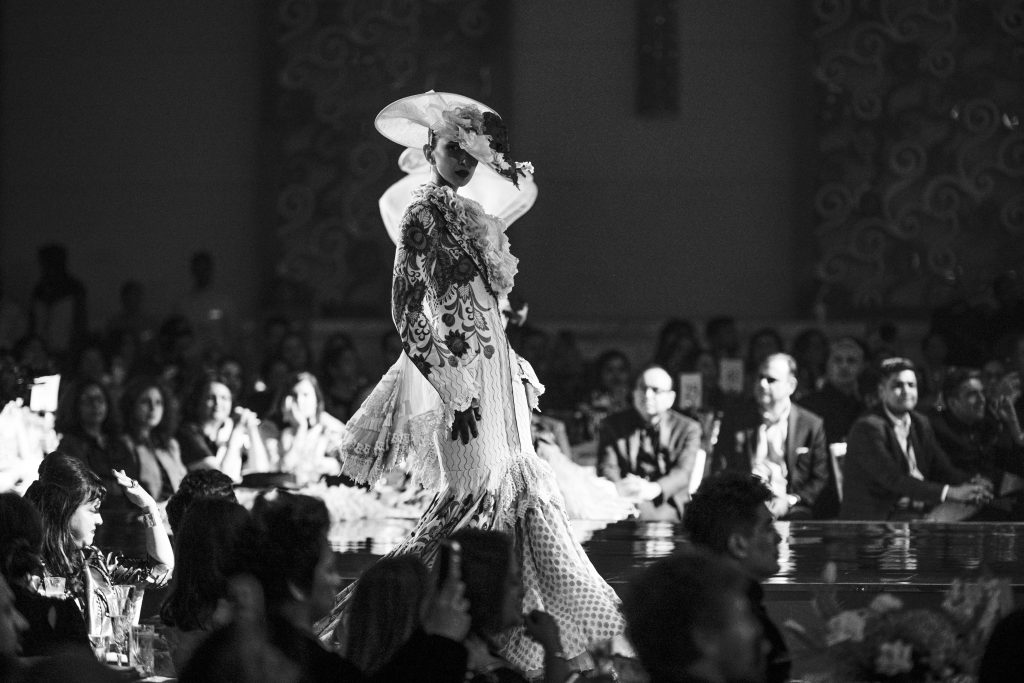
As fashion celebrates its silver jubilee, what is clear now is —sustainability is the only way to go forward, and designers have already taken the lead! By Asmitaa Aggarwal It was a reunion of sorts, designers came in droves, some who had not been seen for over 20 years—Anshu Arora of The Small Shop to Raghavendra Rathore, Ritu Beri, Monisha Jaising, Nikki Mahajan, once doyens of their field, today reticent. FDCI X LFW got them together—after all it was the time of celebrations—25 years of the fashion world! The Jio Convention Centre, Mumbai was where almost 300 people congregated—the most known faces, who have uplifted the barometer of design, innovation, and ingenuity—made a heady blueprint to go forward. Almost 33 designers recreated archival ensembles from 2000 onwards, with 60 models (Lisa Hayden to Lisa Ray), the biggest pool, with Indian-American actor Kal Penn as the host (Van Wilder, The Namesake, TV series House), who not only laughed at himself, but also asked an interesting question to Bollywood dreamboat Kareena Kapoor. “What do you think of fashion critics?” She candidly replied, “They are as important as film critics—they should keep designers on their toes.” Manish Malhotra when asked about his jewels glimmering on his sherwani admitted it was a “hard sell” and someone rightly said, “All this madness is therapeutic I would have it any other way.” Kareena confessed, “make and hair stylists the real stars as they make us look amazing. My darling brother Manish is here. Maybe I will come again on the catwalk not as size zero but owning my body completely”. For 25 seasons she walked as show stopper, once pregnant with her son Taimur, “most emotional moment for me, though my only hope is I don’t fall on the ramp, even if I do, I can get up with dignity. I also suck my tummy in a little,” she laughs. The show had Ritu Beri (2006), Tarun Tahiliani (2000), Monisha Jaising (2002), Rajesh Pratap Singh (2012), Raw Mango, Anshu Arora (2004), Anamika Khanna (2004), Manish Malhotra (2001) outfits recreated, among others. “As I reflect on the 25th year of Lakmé Fashion Week, I am reminded of the incredible journey fashion has taken in India. I had the privilege of opening the very first Lakmé Fashion Week in Delhi in 2000. Looking back, it’s nostalgic to see how far fashion has come—from a time when we could barely fill a room to today, where we are overflowing with a passionate audience. Creativity now permeates everything—the way people dress, the way they express themselves, and the way fashion is embraced in everyday life. It is a testament to how the industry has evolved, pushing boundaries and shaping a more vibrant, dynamic fashion landscape,” says Ritu Beri who started in 1990. She was the first one to do a show in Paris, headed a French fashion house Jean Louis Scherrer, and in 2010 won the Chevaliere des arts et des Lettres award. Though after 25 years one thing was clear—waste was gold now. Nagpur-based Shruti Sancheti, made hair bands, bags, scrunchies out of katrans, and has managed to get orders for it. There is undoubtedly a stream of attempts to be sustainable –the value of the ensembles made from it was Rs 30,000, says Urvashi Kaur. “We create textiles out of fabric, trying to be zero waste, but the beauty is that we are able to craft one-of-a-kind pieces, the key is to be able to shift consumer behaviour,” says Urvashi. On this it’s kantha, and her undying love for tussars, all hand-woven wonders she works with as the market is showing renewed interest, buyers want to know about their garment and how it is made. There seems to be a good churn happening, fashion weeks are a great platform for designers to express themselves visually. “We lost great design somewhere in the greed to keep selling, opulence and money wanting to show status. But the question is how do you contribute to a community. If your work does not hold meaning that money is not happy money. Young people are facing climate change, we have capitalist exploitative businesses, but we must find a way to keep our beautiful traditions alive,” she adds. Bangalore-based Mani Shankar, believes the customer has also changed, each city has its own nomenclature– “Delhi loves bling, so I make it, I must survive also. But the Rs 30000 fabric manipulation linen kurta sells well too, it is our USP,” he adds. “The last 25 years have been momentous in shaping what we now call the Indian fashion industry. Specifically, the last 10 have seen accelerated growth for many brands due to the various initiatives of the FDCI and the influx of corporatisation. I’m truly hoping the next decade is all about true growth, appreciative of all categories of fashion not limited only to bridal couture. I look forward to this next chapter,” says Ashish Soni. For 17 years he has been in the business of fashion, and Nachiket Barve, believes fashion is evolving with more awareness. He has launched a new line of enzyme washed denims for Rs16000, admits he has understood the market better. “I adapted. Design is a dialogue between the customer and you, you can’t be stuck in time or resist change. I look within. We are going to do more business and growth. India’s biggest strength is craftsmanship and willingness to change which will hold us in good stead,” he adds. Akshat Bansal of the experimental label Bloni, showed how he managed to do bio mimicry of a crocodile skin with Shibori, plus his additions of stainless-steel architectural materials on a tailored jacket. Some places you can also see ghungroos, as he sells the silk organza Japanese weave, with reflective properties for Rs 2,50000 lakhs. It comes with Savile Row tailoring, and a mix of various engaging techniques, custom designed. He is one of the bold, new designers who are taking fashion to the next level—see his silk felt raw fabric, it was waste that weavers
No white collar, it’s silver for Anamika
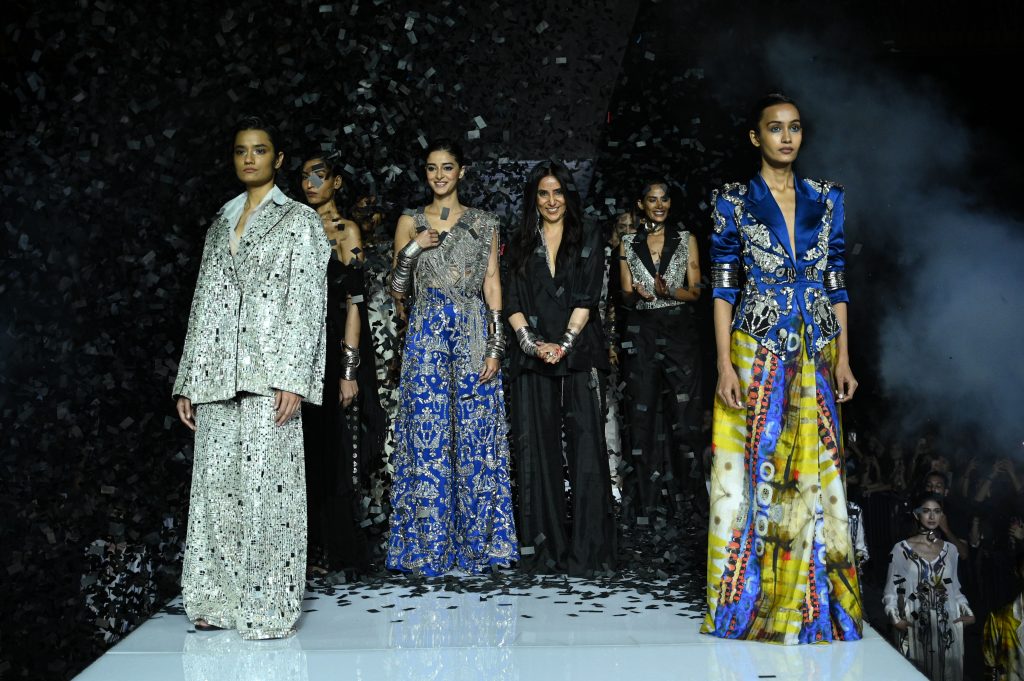
After almost 25 years, Anamika Khanna is hoping women in lucrative careers want something that is not just suits and blazers –maybe a silver tie, suspenders, daddy briefcase and some pearl encrusted denims from AK-OK! By Asmita Aggarwal India is all over the world, and it isn’t just “in India”, anymore maybe that’s why Anamika Khanna’s AK-OK for working women, is timed right, the market is ready for this, especially as professions are now unconventional. One could see nostalgia—daddy suitcases cleverly revived, splashes of colour, even though monochromes are her thing, denim is now slowly moving to her favourite list. Above all, no one can beat her in texturing—how she combines various techniques—patchwork, applique to mirror work at her show for LFW X FDCI. The ignition of the idea came from Rabari tribe who are movers never static—Gujarat, Rajasthan and have some Afghan influences too, she began researching, and found their silver stacking jewellery was phenomenal. She took those—and modernized it with suspenders, ties, chain loop belts, “you don’t need to wear silver only as a jhumka, if it can be a silver collar too”. She had that too—literally, workwear equals—”silver collar”, also the name of her line—like you have blue collar and white collar. “Let me tell you what I think is my biggest strength—I don’t think of the garment but the woman,” says Anamika, understanding the changing needs of modern women, their intimate relationship with clothing, and how it changes their mood. After 25 years in business, every time she does a line, she wants to incorporate something “forgotten or lost”, last season she also paid tribute to the Bonda tribe from Odisha. “Women bring not just power to the boardroom but also emotions and compassion onto work, I wanted each of the 50 pieces to reflect that,” she adds. If you look closely, the styling, it has a churidar, with a dhoti and collared skirt, each reference was out of India, but how to make it fashion Anamika knows. The show was about 9 to 5, and how workwear rules are being broken, in between this mix she revived her dhoti pants of the year 2000, churidars which she loves, as well as tattered holes and cut outs. “Designing as a profession is challenging, lot of people tell me take it easy, take a break, and while I am talking you, I’m sticking applique on a dress, this is my life, I live for fashion,” she smiles,